Reagan’s Farewell, 1989: We the People need no government

As we move along through Reagan’s final speech from the Oval Office in January 1989 in our series on his farewell address, we come to his reinterpretation of the Constitution and the purpose of the American people.

When you’ve got to the point when you can celebrate the anniversaries of your 39th birthday, you can sit back sometimes, review your life, and see it flowing before you. For me there was a fork in the river, and it was right in the middle of my life. I never meant to go into politics. It wasn’t my intention when I was young. But I was raised to believe you had to pay your way for the blessings bestowed on you. I was happy with my career in the entertainment world, but I ultimately went into politics because I wanted to protect something precious.

—The bit of folksy humor that begins this paragraph quickly transitions into something far darker. Reagan is a happy entertainer who is forced by a great danger to change careers and enter politics. What danger? Well, it is set up by this seemingly innocuous description of himself: “I never meant to go into politics. It wasn’t my intention when I was young. I was raised to believe you had to pay your way for the blessings bestowed on you.”

What does this mean? It’s a bold non-sequitor: why would going into politics contradict a belief in “paying your way”? Why is an intention to go into politics the opposite of pulling your own weight? For Reagan, and for the American people who had listened to him and lived with his economic and political policies for eight years, however, the meaning is very clear. Politics is government, and government is bad. The president who introduced the concept of the evil “welfare mother” (or “welfare queen”), who decimated unions and worked hard to convince the nation that anyone on unemployment or welfare or Medicaid (but not Medicare) was a dishonest, un-American liar and cheater would of course see those people as not “paying their way”, as asking for blessings to be bestowed upon them from the government for no good reason. And the government who bestows those undeserved blessings is bad; it is a threat to democracy itself. So entering that government was a tough move for Reagan that he only took out of dire necessity.

Ours was the first revolution in the history of mankind that truly reversed the course of government, and with three little words: “We the People.” “We the People” tell the government what to do; it doesn’t tell us. “We the People” are the driver; the government is the car, and we decide where it should go, and by what route, and how fast. Almost all the world’s constitutions are documents in which governments tell the people what their privileges are. Our Constitution is a document in which “We the People” tell the government what it is allowed to do. “We the People” are free. This belief has been the underlying basis for everything I’ve tried to do these past 8 years.

But back in the 1960’s, when I began, it seemed to me that we’d begun reversing the order of things — that through more and more rules and regulations and confiscatory taxes, the government was taking more of our money, more of our options, and more of our freedom. I went into politics in part to put up my hand and say, “Stop.” I was a citizen politician, and it seemed the right thing for a citizen to do.

I think we have stopped a lot of what needed stopping. And I hope we have once again reminded people that man is not free unless government is limited. There’s a clear cause and effect here that is as neat and predictable as a law of physics: “As government expands, liberty contracts.”

—First paragraph? Fine. The comment about all the other constitutions in the world is incorrect, but we can go with the general flow of this statement about our own form of government. (Although the original wording was “We the States”, which kind of ruins it for Reagan, because originally the framers wanted a political unit, the governments of the states, to dictate terms. “The People” is more folksy for Reagan but was actually a very hard sell at the Constitutional Convention in 1787, where most framers were intent on building up the power of state governments.)

Now for the second paragraph. What can those “rules and regulations” in the 1960s that were so threatening to our democracy be? Yes, it was the Great Society legislation of the Johnson presidency, including civil rights legislation. Reagan was closer to those 1787 delegates who wanted to speak in the name of the state governments than he was to “the People” in that he was not a fan of the federal government telling states what to do. He was not a fan of affirmative action or the Equal Rights Amendment or any of the social legislation passed by Congress under Johnson to guarantee equal protection under the law because that legislation was federal. Reagan found unlikely bedfellows in the South on this topic. Reagan believed that the federal government—and the state governments, too—should not pass any social legislation to help groups that faced entrenched racial, sexual, or ethnic discrimination. Those people needed to get with the American way and help themselves—to pay their own way, like white people did. Like he did.

The dangerous social legislation quickly morphs into dangerous taxation, because many of the social programs Johnson started (like Head Start) were federally funded. Taking money from some Americans to help other Americans was “taking more of our money, more of our options, more of our freedom.” Who “our” or “we” is is unspoken, but it’s clearly referring to hardworking white America.

Reagan is not kidding when he says “I stopped a lot of what needed stopping.” Taxes were cut (and then raised, but only to pay for defense spending), welfare was crucified in an intense attack campaign, Medicaid spending, education spending were all cut in an attempt to give hardworking white America back its money. Then Reagan says “man is not free unless government is limited… as government expands, liberty contracts.”

This is an echo of his First Inaugural speech in 1981, in which he said:

The economic ills we suffer have come upon us over several decades. They will not go away in days, weeks, or months, but they will go away. They will go away because we, as Americans, have the capacity now, as we have had in the past, to do whatever needs to be done to preserve this last and greatest bastion of freedom.

In this present crisis, government is not the solution to our problem; government is the problem.

From time to time, we have been tempted to believe that society has become too complex to be managed by self-rule, that government by an elite group is superior to government for, by, and of the people. But if no one among us is capable of governing himself, then who among us has the capacity to govern someone else? All of us together, in and out of government, must bear the burden. The solutions we seek must be equitable, with no one group singled out to pay a higher price.

We hear much of special interest groups. Our concern must be for a special interest group that has been too long neglected. It knows no sectional boundaries or ethnic and racial divisions, and it crosses political party lines. It is made up of men and women who raise our food, patrol our streets, man our mines and our factories, teach our children, keep our homes, and heal us when we are sick—professionals, industrialists, shopkeepers, clerks, cabbies, and truckdrivers. They are, in short, “We the people,” this breed called Americans.

The “economic ills” are social programs to help the poor and discriminated against, and “they will go away” because we must do “whatever needs to be done to preserve this last and greatest bastion of freedom”. Like our ancestors, we will fight tyranny; the tyranny of democracy, apparently. The “elite” government that created social programs that take money from good hardworking white people and give them to “special interest groups” will be destroyed, and balance and democracy will be restored when the neglected, oppressed white American is safe from having to help those insidious special interest groups. By 1989, Reagan was satisfied that our democracy was safe from helping people.

It’s ironic that later in this speech Reagan will reference John Winthrop’s City on a Hill address. He clearly did not read the part where Winthrop said

…we must be knit together in this work as one man, we must entertain each other in brotherly affection, we must be willing to abridge our selves of our superfluities, for the supply of others’ necessities, we must uphold a familiar commerce together in all meekness, gentleness, patience and liberallity, we must delight in each other, make other’s conditions our own—rejoice together, mourn together, labor, and suffer together, always having before our eyes our Commission and Community in the work, our Community as members of the same body, so shall we keep the unity of the spirit in the bond of peace, the Lord will be our God and delight to dwell among us, as his own people and will command a blessing upon us in all our ways, so that we shall see much more of his wisdom, power, goodness and truth than formerly we have been acquainted with…

—“We must be willing to abridge ourselves of our superfluities, for the supply of others’ necessities”: in other words, people who have money must give some of it to those who don’t. That’s the democratic ideal our nation would be founded on 157 years later. Reagan claims that the “breed” he is describing has no ethnic or racial divisions, but his eight years of demonizing black and Latino Americans as “welfare queens” and criminals proved that to be untrue.

Nothing is less free than pure communism—and yet we have, the past few years, forged a satisfying new closeness with the Soviet Union. I’ve been asked if this isn’t a gamble, and my answer is no because we’re basing our actions not on words but deeds. The detente of this 1970’s was based not on actions but promises. They’d promise to treat their own people and the people of the world better. But the gulag was still the gulag, and the state was still expansionist, and they still waged proxy wars in Africa, Asia, and Latin America. Well, this time, so far, it’s different. President Gorbachev has brought about some internal democratic reforms and begun the withdrawal from Afghanistan. He has also freed prisoners whose names I’ve given him every time we’ve met.

—We segue with Reagan to the outside world again, and to the Soviet Union, the epitome of the unfree state that America will become if we don’t stop giving money to the poor. We will pass over the fact that the U.S. was also fighting proxy wars in Africa, Asia, and Latin America to say that this first mention of Gorbachev is very interesting in hindsight, as this speech was given in January 1989; by that time, Moscow had already begun to lose control of some of its republics, and in just a few months the Soviet people would vote for delegates to the new Congress of the People’s Deputies. The Soviet Union was on the brink of collapse. The Revolutions of 1989 that would dissolve the Eastern bloc were just months away. Gorbachev would allow all of this to happen, and would facilitate the dissolution of the Soviet Union and the creation of a democratic Russia.

Yet to hear Reagan tell it, it is Reagan alone who is pushing democracy, lecturing Gorbachev on what freedom is, and giving him the names of political prisoners to release. “President Gorbachev has brought about some internal democratic reforms” is the understatement of the century.

But life has a way of reminding you of big things through small incidents. Once, during the heady days of the Moscow summit, Nancy and I decided to break off from the entourage one afternoon to visit the shops on Arbat Street — that’s a little street just off Moscow’s main shopping area. Even though our visit was a surprise, every Russian there immediately recognized us and called out our names and reached for our hands. We were just about swept away by the warmth. You could almost feel the possibilities in all that joy. But within seconds, a KGB detail pushed their way toward us and began pushing and shoving the people in the crowd. It was an interesting moment. It reminded me that while the man on the street in the Soviet Union yearns for peace, the government is Communist. And those who run it are Communists, and that means we and they view such issues as freedom and human rights very differently.

We must keep up our guard, but we must also continue to work together to lessen and eliminate tension and mistrust. My view is that President Gorbachev is different from previous Soviet leaders. I think he knows some of the things wrong with his society and is trying to fix them. We wish him well. And we’ll continue to work to make sure that the Soviet Union that eventually emerges from this process is a less threatening one. What it all boils down to is this: I want the new closeness to continue. And it will, as long as we make it clear that we will continue to act in a certain way as long as they continue to act in a helpful manner. If and when they don’t, at first pull your punches. If they persist, pull the plug. It’s still trust but verify. It’s still play, but cut the cards. It’s still watch closely. And don’t be afraid to see what you see.

—For Reagan, the KGB still run the Soviet Union and “while the man on the street years for peace, the government is Communist”, and will never allow freedom and human rights. One gets the feeling that Reagan would be genuinely astounded by what happened in the Soviet government just a few months after this speech. Yes, Gorbachev was very “different from previous Soviet leaders”. The folksily boxing and poker metaphors at the end would all be made obsolete by the open and unimpeded dismantling of the Soviet government led by Gorbachev.

Next time: Closing thoughts on what it means to be an American in the looming 1990s

Reagan’s Farewell Address, 1989: or, Common Sense

Welcome to part 2 of our close reading of President Ronald Reagan’s Farewell Address of January 11, 1989. Here we pick up from where we left off in part 1 with Reagan explaining the “American miracle” that won him the respect, at last, of all those aristocrats at the G7 meeting in Ottawa.

Well, back in 1980, when I was running for President, it was all so different. Some pundits said our programs would result in catastrophe. Our views on foreign affairs would cause war. Our plans for the economy would cause inflation to soar and bring about economic collapse. I even remember one highly respected economist saying, back in 1982, that “The engines of economic growth have shut down here, and they’re likely to stay that way for years to come.” Well, he and the other opinion leaders were wrong. The fact is, what they called “radical” was really “right.” What they called “dangerous” was just “desperately needed.”

—That “highly respected economist” was Lester Thurow, and his complaint was with Reagan’s “trickle-down economics” theory which said that if you cut income taxes and suspend all federal regulation of business, you will get business owners with plenty of cash on hand to expand by any means necessary and voila, you will have more jobs and more output and a booming economy. This enticing idea won many people over to Reagan in 1980 and 81. He advertised it during a 1981 speech with this graph:

reagan

With “their bill” the average family’s taxes would skyrocket between 1982 and 1986, while with “our bill” they would drop then flatline. What proof do we have today that unregulated business and banking combined with massive tax cuts for business and banking and the rich did not work? Notice at the top of Reagan’s chart: the average family income is $20,000. Three things come to mind: even in 1980, average family income was much higher than this, at about $48,000; next, no family today could live on $20K a year; and last, it is precisely the poorest families that are paying the highest taxes today. “Our bill” has achieved what “their bill” could only dream of.

But in 1989, Reagan could boldly state that “what they called ‘radical’ was really ‘right’. What they called ‘dangerous’ was just ‘desperately needed.'” Luckily, presidents give their farewell speeches long before the effects of their economic programs have fully played out.

And in all of that time I won a nickname, “The Great Communicator.” But I never thought it was my style or the words I used that made a difference: it was the content. I wasn’t a great communicator, but I communicated great things, and they didn’t spring full bloom from my brow, they came from the heart of a great nation—from our experience, our wisdom, and our belief in the principles that have guided us for two centuries. They called it the Reagan revolution. Well, I’ll accept that, but for me it always seemed more like the great rediscovery, a rediscovery of our values and our common sense.

Common sense told us that when you put a big tax on something, the people will produce less of it. So, we cut the people’s tax rates, and the people produced more than ever before. The economy bloomed like a plant that had been cut back and could now grow quicker and stronger. Our economic program brought about the longest peacetime expansion in our history: real family income up, the poverty rate down, entrepreneurship booming, and an explosion in research and new technology. We’re exporting more than ever because American industry became more competitive and at the same time, we summoned the national will to knock down protectionist walls abroad instead of erecting them at home.

—Reagan is correct in saying that his economic program was not new; Harding and Coolidge both slashed the taxes paid by the wealthy. Harding cut them from 73% to 25% in just two years. Both  men also slashed federal regulation of business and banking. And the 1920s ended in the Stock Market Crash and the Great Depression. Reaganomics, as the plan came to be known, was indeed a “rediscovery” of a certain human value—the desire for wealth—over the founding principles of this nation.

Where to start with the second paragraph; “the people” didn’t really have their tax rates cut—that was mostly for the wealthy, and even Reagan actually had to raise taxes in 1982 and 1984 to offset spiraling defense spending. That long “peacetime expansion” was fueled by an enormous increase in Cold War military spending. Family incomes were up but did not keep par with inflation, and we “summoned the national will to knock down protectionist walls abroad” mostly through exploitive (and unregulated) business practices.

Common sense also told us that to preserve the peace, we’d have to become strong again after years of weakness and confusion. So, we rebuilt our defenses, and this New Year we toasted the new peacefulness around the globe. Not only have the superpowers actually begun to reduce their stockpiles of nuclear weapons—and hope for even more progress is bright—but the regional conflicts that rack the globe are also beginning to cease. The Persian Gulf is no longer a war zone. The Soviets are leaving Afghanistan. The Vietnamese are preparing to pull out of Cambodia, and an American-mediated accord will soon send 50,000 Cuban troops home from Angola.

The lesson of all this was, of course, that because we’re a great nation, our challenges seem complex. It will always be this way. But as long as we remember our first principles and believe in ourselves, the future will always be ours. And something else we learned: Once you begin a great movement, there’s no telling where it will end. We meant to change a nation, and instead, we changed a world.

Countries across the globe are turning to free markets and free speech and turning away from the ideologies of the past. For them, the great rediscovery of the 1980’s has been that, lo and behold, the moral way of government is the practical way of government: Democracy, the profoundly good, is also the profoundly productive.

—There is nothing more wryly ironic than celebrating a “new peacefulness around the globe” that you brought about by arming yourself to the hilt. It is absolutely true that under Reagan the U.S. did have its first nuclear arms reductions treaties with the Soviet union. No argument there. But that’s why under Reagan we a) boosted our conventional weapons and armed presence around the world and b) started looking toward unconventional nuclear weapons (like the Strategic Defense Initiative dubbed “Star Wars”) that weren’t covered by the SALT agreements.

What the “great movement” is that we began, or what “believing in ourselves” means to Reagan we don’t know. When Americans really believe in themselves, they believe in their founding principles, and realize that bringing peace to the world can and should be achieved by setting an example for real democracy and supporting democracy wherever it is found. To Reagan, in this speech believing in ourselves sounds a lot like believing we have the right to take our status as a military superpower to the next level.

If his statements about countries around the world embracing democracy and capitalism and rejecting “the ideologies of the past” (read socialism and communism) were true, then under Reagan the U.S. would not have been fighting dozens of covert wars against communists and socialists in Asian and Latin American nations throughout his two terms. Many Americans in the 1980s protested U.S. coups and civil wars in foreign nations as the opposite of “the moral way of government” and the opposite of democracy and profound good.

Next time: American history a la Reagan

Reagan’s Farewell Address, 1989

We feel the need of a close read here at the HP, and circumstance has led us to choose Ronald Reagan’s last speech from the Oval Office in January 1989. It’s an interesting way-back machine for us in 2015, in that the 1980s are not that long in the past, yet the constant references to Reagan by conservatives and others, especially during election years, make it seem as if that administration was at once recent enough for these people to remember and have opinions about, but also part of a long-ago past we are light years away from now. Yet it’s clear that we are living every day with the impact of Reagan-era economic policy. The deregulation of industry, tax cutting ideology (if not always practice), anti-government (“government is the problem”) and pro-military stances are all certainly the mantra of most conservatives today, to the point where one might be forgiven for believing this is a long-standing mantra, deeply part of the American soul and history, when really it was thrust into being not quite 30 years ago.

Well, let’s get to the speech:

My fellow Americans:

This is the 34th time I’ll speak to you from the Oval Office and the last. We’ve been together 8 years now, and soon it’ll be time for me to go. But before I do, I wanted to share some thoughts, some of which I’ve been saving for a long time.

It’s been the honor of my life to be your President. So many of you have written the past few weeks to say thanks, but I could say as much to you. Nancy and I are grateful for the opportunity you gave us to serve.

One of the things about the Presidency is that you’re always somewhat apart. You spend a lot of time going by too fast in a car someone else is driving, and seeing the people through tinted glass—the parents holding up a child, and the wave you saw too late and couldn’t return. And so many times I wanted to stop and reach out from behind the glass, and connect. Well, maybe I can do a little of that tonight.

People ask how I feel about leaving. And the fact is, “parting is such sweet sorrow.” The sweet part is California and the ranch and freedom. The sorrow—the goodbyes, of course, and leaving this beautiful place.

—It’s rare that a presidential speech so clearly betrays its writer. It’s very hard to believe that Reagan would ever have found these words, simple and straightforward and yet eloquent—nay poignant—on his own. The writer (whom we assume to be Ken Khachigian, but correct us if we’re wrong) found precisely the words Reagan would want to say, to express his folksy, aw-shucks—yet poetic—persona. It’s almost as if Reagan is parroting his own Reaganness.

You know, down the hall and up the stairs from this office is the part of the White House where the President and his family live. There are a few favorite windows I have up there that I like to stand and look out of early in the morning. The view is over the grounds here to the Washington Monument, and then the Mall and the Jefferson Memorial. But on mornings when the humidity is low, you can see past the Jefferson to the river, the Potomac, and the Virginia shore. Someone said that’s the view Lincoln had when he saw the smoke rising from the Battle of Bull Run. I see more prosaic things: the grass on the banks, the morning traffic as people make their way to work, now and then a sailboat on the river.

—This is an astounding paragraph. It’s short and has no complex terms, but it manages to a) personalize the president, whom we can picture looking out the window in the morning; b) compare Reagan to Lincoln by saying both men share great and terrible burdens of leadership; c) favor Reagan over Lincoln, because Reagan can look out over a prosperous nation made so by his own policies, whereas Lincoln presided over the disaster of Bull Run. How things have improved since then! —and all thanks to Reagan.

I’ve been thinking a bit at that window. I’ve been reflecting on what the past 8 years have meant and mean. And the image that comes to mind like a refrain is a nautical one—a small story about a big ship, and a refugee, and a sailor. It was back in the early eighties, at the height of the boat people. And the sailor was hard at work on the carrier Midway, which was patrolling the South China Sea. The sailor, like most American servicemen, was young, smart, and fiercely observant. The crew spied on the horizon a leaky little boat. And crammed inside were refugees from Indochina hoping to get to America. The Midway sent a small launch to bring them to the ship and safety. As the refugees made their way through the choppy seas, one spied the sailor on deck, and stood up, and called out to him. He yelled, “Hello, American sailor. Hello, freedom man.”

A small moment with a big meaning, a moment the sailor, who wrote it in a letter, couldn’t get out of his mind. And, when I saw it, neither could I. Because that’s what it was to be an American in the 1980’s. We stood, again, for freedom. I know we always have, but in the past few years the world again—and in a way, we ourselves—rediscovered it.

It’s been quite a journey this decade, and we held together through some stormy seas. And at the end, together, we are reaching our destination.

—The sentence “It was back in the early eighties, at the height of the boat people” is unwittingly laughable. “Way” back seven years ago is odd, and then for the president to refer to Vietnamese refugees not just as “boat people” (a colloquialism acceptable in private speech but not from the Oval Office), but as “the boat people” is unsettling. It’s too much along the lines of “the Jews”, “the feminists”, “the gays”—a little dehumanizing. And, just for the record, the real height of renewed refugeeism from Vietnam began in 1986, just two years before his January 1989 speech.

Next, the folksiness merges indistinguishably into a corny type of patriotism: of course the American sailor was “hard at work”, and “young, smart, and fiercely observant.” And then suddenly we are all that sailor; we are all beacons of freedom, emblems of liberty, people who stand for something. Now, we at the HP agree that this is what Americans are when we live up to our founding principles. But Reagan makes it clear that his presidency, not those principles, is responsible for this American identity, or really more for the recognition of that leadership role by non-Americans. “In the past few years”—i.e., during his two terms—America has re-established its good standing in the world and Americans have come to believe in their own virtue and purpose again, after… well, after what? What has been preventing us from feeling this way?

The fact is, from Grenada to the Washington and Moscow summits, from the recession of ’81 to ’82, to the expansion that began in late ’82 and continues to this day, we’ve made a difference. The way I see it, there were two great triumphs, two things that I’m proudest of. One is the economic recovery, in which the people of America created—and filled—19 million new jobs. The other is the recovery of our morale. America is respected again in the world and looked to for leadership.

—Okay, the two things that have been keeping us from having pride and a sense of purpose in the world were a bad economy and a loss of morale. The bad economy started in 1981, the year Reagan took office, but the implication of recovery beginning early in his first term is that Reagan inherited the bad economy and quickly fixed it (“we’ve made a difference”). It is startling that he completely elides the Crash of 1987, in which we endured one of the largest and most devastating stock market falls in our history which resulted in $1 trillion in total loss of wealth amongst Americans. It simply did not happen, because “the expansion that began in late ’82 continues to this day”.

Something that happened to me a few years ago reflects some of this. It was back in 1981, and I was attending my first big economic summit, which was held that year in Canada. The meeting place rotates among the member countries. The opening meeting was a formal dinner for the heads of government of the seven industrialized nations. Now, I sat there like the new kid in school and listened, and it was all Francois this and Helmut that. They dropped titles and spoke to one another on a first-name basis. Well, at one point I sort of leaned in and said, “My name’s Ron.” Well, in that same year, we began the actions we felt would ignite an economic comeback—cut taxes and regulation, started to cut spending. And soon the recovery began.

Two years later, another economic summit with pretty much the same cast. At the big opening meeting we all got together, and all of a sudden, just for a moment, I saw that everyone was just sitting there looking at me. And then one of them broke the silence. “Tell us about the American miracle,” he said.

—One’s jaw is left on the floor after this anecdote. Let’s go through it: the president of the United States, a founding nation of the G7, was completely unrecognized at the 1981 G7 meeting in Ottawa. No one spoke to the president of the United States. He had to sit quietly like “the new kid in school” and had no role to play in the summit. Somehow, Reagan (and his speechwriter) believe that we will believe this.

Then Reagan segues to some good old-fashioned American chauvinism: not only are the big bullies at the summit foreigners, but they are French, with wimpy names like Francois, and German, with aggressive yet laughable names like Helmut. The leaders referred to are of course Francois Mitterand and Helmut Kohl. “They dropped titles”—classic foreigners. Snobby representatives of the nobility, and totally contrasted with Reagan, who represented the class-free, all-equal U.S. Somehow, it’s also upsetting that two world leaders who meet often would call each other by their first names; the implication is that Reagan, the president of the U.S., does not know the attendees at the G7 and therefore can’t join in their conversation. But finally, Reagan gets bold and just like the U.S. in the 20th century, asserts himself with the Europeans and becomes their leader. He gives his simple, wholesome, free-of-monarchical-taint, good American name—Ron—and forces his way into the group. His economic plan sparked the massive U.S. recovery and when the world leaders met again, “everyone was just sitting there looking at me”. The Cinderella transformation is complete! Now all those snobby foreigners want to hear about “the American Miracle.”

This is so clearly a bit of fantasy that one wonders, quite seriously, whether Reagan really believed it himself. It’s possible that that is how he perceived it by January 1989, because it fits into his personal mythos so well.

We’ll break here, and come back next time with Reagan’s description of his economic miracle.

Next time: “what they called radical was really right”

Crash Course on the Puritans: so close, John Green!

We decided to watch the Crash Course “When is Thanksgiving? Colonizing America, Crash Course U.S. History #2” because this CC series is so popular with young Americans. It started out so well! Nice explanation of the unequal labor system that developed in Virginia and clear explanations for it. Plus he differentiated between Pilgrims and Puritans, which you know we appreciate.

But he hit the seemingly inevitable rocks of myth as soon as he really got into the Pilgrim/Puritan section, beginning of course with a weird and incorrect reason for the Pilgrims leaving the Netherlands. He said the Dutch were “too corrupt” for the Pilgrims. At least this was a new one we hadn’t ever heard before (the usual reason being that the English didn’t want their children becoming Dutch). The real reason was that the Netherlands was about to resume fighting its religious war with Catholic Spain, and the English did not want to get in the middle of that (especially if Spain won and immediately persecuted all Protestants). The English were also barely tolerated by the Dutch, because Pilgrim religious practice was very radical.

Green also says the Pilgrims were trying to go to Virginia and got blown off course to Massachusetts, which is not true.

He then ridicules the Pilgrims for not bringing enough food and for bringing no farm animals. If you have ever seen the Mayflower replica at Plymouth, you’ll know that there was simply no room in that small ship for farm animals. Later, when animals were brought over, they frequently died on the way over from the terrible conditions—just like the people. And the Pilgrims did bring food, but much of it was spoiled by seawater leaking into the casks. No one leaves for “the wilderness” without bringing food. They just didn’t have the best of containers.

On to the Puritans, and a decent explanation of Congregationalism marred by the following misapplication of the City on a Hill section of the John Winthrop sermon “A Model of Christian Charity”, in which Green conflates the 19th-century Americans’ interpretation of the sermon as saying that America and later the U.S. were “exceptional” and a model for other nations to adopt. See our post clarifying what Winthrop really meant.

So far, it’s not too bad. But then we take an unfortunate left turn into pure myth. (Green says these courses are written by his high school history teacher; what gives?) He says that in Puritan society a small “church elite” held power and that there were separate rights for freemen, women, children, and servants. The church elite idea comes from the fact that one had to be a church member to vote or hold political office in the Massachusetts Bay Colony, and the myth that so few people were members that they formed an elite, and the myth on top of myth that that was the original intent.

You did have to be a church member to become a freeman, but the number of men who became freemen was not fractional. Research is ongoing because the original myth of a tiny fraction of freemen in the colony that was first put about by Thomas Lechford, a disaffected colonist who went back to England in the 1640s, has only recently been addressed by historians, who are finding that Lechford’s complaint that only 1 in 5 colonists was a church member is grossly exaggerated. The real problem is that, like Americans today, many Puritan men did not want to become freemen because they did not want the obligations and duties of a freeman (voting, participating in government) so they went to church all their lives but never became members. (Many did, however, vote illegally and participate in their town governments despite the requirement.)

HP readers know that we go over the rights developed and recorded by the MBC in 1641 in our series on the Body of Liberties, and we address the rights of minority populations in that series. Women, children, and servants were subject to many of the same laws as freeman and other male inhabitants, but also had some special protections to offset their traditionally unequal status in society.

Then Green goes deep into the realm of fantasy to say that Roger Williams was banished for saying everyone should be able to practice whatever religion they wanted. This is like saying Frederick Douglass thought slavery was good for black Americans. It’s beyond untrue. Williams, as we explain in our series devoted to him, was banished for saying the king of England who gave the Puritans their charter in America was an antichrist. This was treason, and could have gotten the whole colony scotched. No one was less interested in religious freedom than RW at the time of his banishment. It was much, much later in what is now Rhode Island that he began to entertain religious tolerance (but not for Catholics or Quakers).

And not for Anne Hutchinson, either, who was not banished for “being a woman preaching unorthodox ideas” but for inciting a civil war in the colony by claiming that God spoke directly to her and told her who was saved and who was not, and that everyone running the colony was not. She was not “banished to New York”; she originally went to Providence but after she began inciting the same civil war there, Roger Williams kicked her out and she went to what is now New York.

So ends Green’s crash course. The underlying problem is not lazy scholarship but something he references at the very end: Americans “like to see ourselves as pioneers of religious freedom”. That is true. It is true because ever since the U.S. was founded, we have striven to offer true religious freedom, and that is a wonderful thing that set us apart from most nations. But the U.S. was founded in 1775—not 1607. It took a long time and a lot of populations mixing in the 13 colonies, and the advent of the Enlightenment in Europe, to get Americans to the point where they could entertain that idea. Religious freedom was not part of the political landscape in the 17th century. The Puritans did not leave England to establish freedom of religion. They left England so they could practice their own religion freely, which is very different. They were committed to protecting their religion and, hopefully, extending it to other lands. Why on earth, then, would they allow competing (and to their minds wrong) religions in their colonies?

Our job is to separate the modern American ideal of religious freedom from the early modern ideals of our 17th-century founders. We can’t blame them for failing to do something we thought of 150 years after they died. And we can’t teach our nation’s history as a series of failures to live up to 21st-century law, mores, and myths. Alas John Green—you need the shock pen after all.

Oklahoma attempts to ban AP U.S. History

Over the past 20 years or so, conservative politicians have added criticizing the way U.S. history is taught to their laundry list of complaints about the liberal takeover of America. You know the criticisms by now, most likely, as they have probably been voiced in your own state: students are taught that American exceptionalism is a lie; that American history is a long, unbroken string of racist crimes and hate; that big government is good; and that the Civil War was fought over slavery (for our take on the last one, see What made the north and south different before the Civil War and Amazing Fact! the Civil War was fought over slavery). In Oklahoma, a state House committee has bowed to state Republican complaints that the new AP exam is “unpatriotic and negative” and approved a bill to remove AP funding and create a new U.S. history exam to replace it. “[State Rep. Dan] Fisher said Monday that the AP U.S. History course emphasizes “what is bad about America” and complained that the framework eliminated the concept of “American exceptionalism,”according to the Tulsa World.”

Where to start.

First, let’s laugh at the complaint about American Exceptionalism. We all take it to mean that because of its founding principles, America has a special mission of democracy and justice to carry out in the world, and that mission, which we have always carried out successfully, has ennobled our nation. But that’s not what the term “American Exceptionalism” really means. it was coined by that tireless chronicler of American ways and means, Alexis de Tocqueville, who said:

The position of the Americans is therefore quite exceptional, and it may be believed that no democratic people will ever be placed in a similar one. Their strictly Puritanical origin, their exclusively commercial habits, even the country they inhabit, which seems to divert their minds from the pursuit of science, literature, and the arts, the proximity of Europe,… have singularly concurred to fix the mind of the American upon purely practical objects.

Andrew Jackson facelift

We were transacting some business yesterday and happened to get an old $20 bill from an ATM. We were comparing the old and new and couldn’t help noticing how Andrew Jackson was airbrushed to look substantially younger and more handsome in the new bill:

IMG_1816

In the new bill, on top, his eyes have been made larger and the deep bags underneath his eyes have been removed. His jaw has also been widened and shortened, changing his face from its familiar long rectangle to more of a heart shape. Jackson looks positively appealing in the new bill. One has to wonder why this was done…

If only we had old $1, $5 and $10 bills to analyze. Maybe Washington, Lincoln, and  Hamilton have had similar makeovers. If anyone out there can send images, please do!

Sons of Liberty on “History” is terrible and stupid and partly accurate

Everyone by now is talking about History.com’s Sons of Liberty and how blazingly inaccurate it is. Everything that can be falsified has been falsified, from the ages of the leading participants to their motives to their actions. The AV Club sums it up better than we can here.

We went to the History.com website to take a look and were intrigued, given the circumstances, to see a box called “Historians’ View” on the landing page. Once clicked, we came to a page that begins with this statement:

“SONS OF LIBERTY is a dramatic interpretation of events that sparked a revolution. It is historical fiction, not a documentary. The goal of our miniseries is to capture the spirit of the time, convey the personalities of the main characters, and focus on real events that have shaped our past. For historical information about the Sons of Liberty and the dawning of the American Revolution, please check out the links below.”

A slew of links out to other resources follow this, and most of them are accurate, which seems baffling at first—if you know the real story, why not tell it?

But that brief statement explains all. Should the “History” channel offer historical fiction rather than fact? No. Should it present historical fiction as a documentary for TV viewers, with this disclaimer buried below the episodes on the website? No. Should it promote 21st-century gun values by claiming that they are part of our hallowed revolutionary history? No.

The latter is most important, because the Revolution was all about our evolution from a tradition of mindless, horrible violence to a focused legal, philosophical, and military fight for liberty and justice. In our post The Boston Tea Party and a Tradition of Violence, we describe the terrible violence and destruction that Americans felt no qualms about using when they were upset, or for no real reason at all. Violent action was sanctioned in the American colonies in ways it never was in Britain. Mobs formed at the drop of a hat, and destroyed people’s homes and businesses—literally tearing them apart brick by brick—to settle personal grudges as well as political arguments. Tarring and feathering, which is somehow presented as a harmless prank today, involved holding people down naked and pouring boiling tar over their bare skin, then covering them with feathers. At the time, it was called “the American torture”. It cost many lives.

It was this kind of violence that the real Sons of Liberty’s leaders began to realize had to go if Americans wanted to claim they were calling for a just war against Britain. The Boston Tea Party was the striking departure from that tradition of violence. It was deliberately carried out without costing a single life—the men who called for the protest and led it in the harbor read the riot act to all participants: no one was to use any violence against any one. The protest had to be completely nonviolent for the same reason Martin Luther King wanted civil rights protests to be nonviolent: to show the injustice of the inevitable hostile reaction when compared with the high ideals of the protestors. And it was successful. The Tea Party was completely nonviolent, and that’s what aroused general public sympathy throughout the American colonies when the British cracked down so hard on Massachusetts in retaliation.

So making “Sons of Liberty” violent is indeed to “capture the spirit of the times”, as the disclaimer says, and if early episodes showed the unthinking violence our forefathers used early in the run-up to revolution, it would be completely accurate. But then it has to show the evolution away from violence in late 1773. It has to focus on the efforts of John Hancock, the Adams cousins, and others to swerve the growing energy for revolution away from mindless personal attacks to directed, politically powerful stands for liberty that could serve as building blocks for that liberty.

Instead, this series unsurprisingly focuses on imaginary affairs and other forms of make-believe that just confirm our judgment that the series’ producers and the “History” channel either a) did not know the real story or b) did not believe the facts were interesting enough to present, or both. It’s baffling how many shows about historical events believe those events were so incredibly boring they’re not worth making a show about, and fill in with guns and sex and made-up speeches and events instead. If you think the facts are boring, just write your fictional show and be done with it. Why call it Sons of Liberty when it’s not about them?

Perhaps one day, 100 years from now, someone will write a miniseries about the producers and management at the History Channel that shows them all as ex-cons who commit terrorist activities on the weekends. They could hardly complain, could they, from beyond the grave?

Raising the Flag on Iwo Jima was NOT a fake!

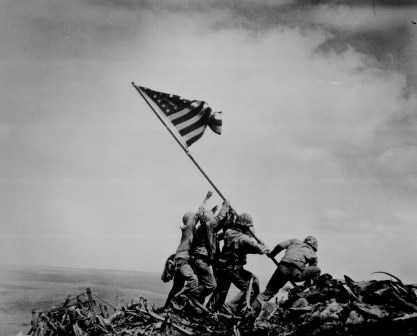
In our third and last installment of reading famous American photographs, we cover Raising the Flag on Iwo Jima, the February 23, 1945 photo by Joe Rosenthal showing five U.S. Marines and a Navy corpsman raising the flag on Mount Suribachi, the highest point of the Japanese island of Iwo Jima:

WW2_Iwo_Jima_flag_raising

Rarely does a photograph convey urgency and movement as fully as this. The effort of the man on the right to physically plant the flag pole into what looks like difficult, hard ground is clear. His head is turned down, looking at the ground, focused on his work. The next man to the left is also focused on training the pole into the ground. The man behind him pushes the pole upward, and the last man has just lost his grip on the pole as it raises. His arms still strain upward with the force of his effort. The wind is just about to unfurl the flag, signifying victory. Yet for all the movement, the men also seem made of marble—it looks very much like a sculpture. The perfect triangle composition that takes your eye from the flag down the pole to the man planting it, across to the men holding the pole, and back up to the flag is classic. There is nothing in the sky to distract from the lone symbol of the flag—no airplanes, no shells exploding.

The first question might be, why are there only four men? Unfortunately, one man is almost completely blocked from view behind the second man from the right because their bodies were lined up as they both worked to plant the flagpole. Here’s a helpful diagram:

624px-Raising_the_Flag_outline

This outline also gives us the men’s names. Franklin Sousey, Michael Strank, and Harlon Block would all be killed in the Battle of Iwo Jima: Stank and Block on March 1, within hours of each other, and Sousley on March 21, just days before the official end of the Battle on March 26, 1945.

The Battle of Iwo Jima was critical to the U.S. war effort in the Pacific. It was the first Japanese home island to be invaded by the U.S. in its “island-hopping” strategy of taking the small but strategic Pacific islands the Japanese relied on to refuel planes on their way to bigger targets. Often these islands were so small that they were uninhabited. But each island the U.S. landed on was defended to the death by the Japanese, who knew that a) they needed these islands as stopping points to faraway destinations and b) that the Americans were slowly but surely working their way to invading Japan itself. When U.S. forces invaded Iwo Jima on February 19, 1945, they were met with even fiercer resistance than before.

The Americans wanted to capture Mount Suribachi as soon as possible so the Japanese could not use it as a lookout and a place from which to shell incoming U.S. forces. It was taken relatively quickly, on February 23, just four days into the battle. But the fighting was far from over, as the Japanese barricaded themselves into pillboxes dug into the hillsides and fired on U.S. forces for another unbelievably fatal month.

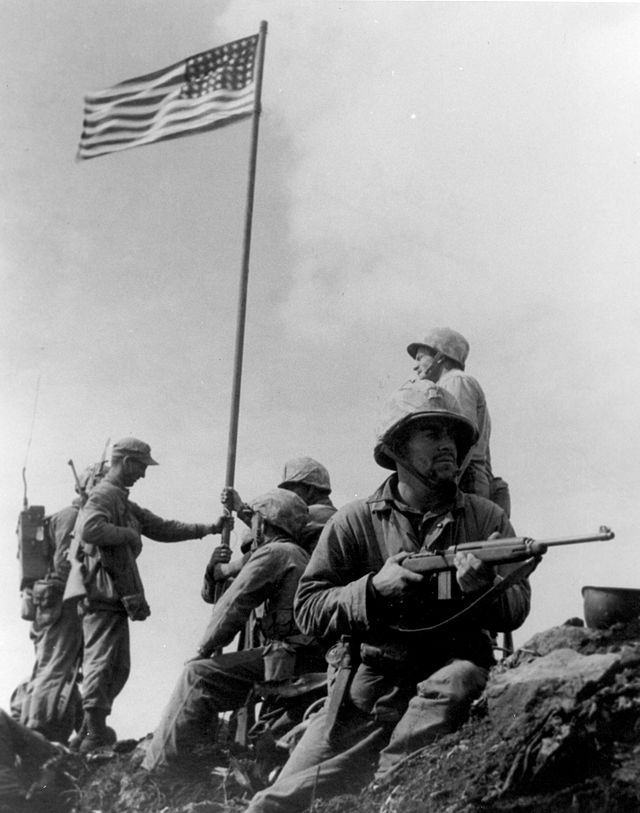
There were actually two different flag-raisings on Mount Suribachi. The first was ordered by Lt. Col. Chandler Johnson and sent Harold Schrier, Earnest Thomas, and Henry Hansen up the mountain with a 40-man combat patrol. Johnson is said to have given Schrier a flag and said “If you get to the top put it up.” Schrier did, and received a Navy Cross for volunteering for the mission. A photographer named Louis Lowry who joined the patrol took photos of this first flag-raising.

The sight of the flag so inspired the Secretary of the Navy, James Forrestal, who was at Iwo Jima, to say “the raising of that flag on Suribachi means a Marine Corps for the next five hundred years.” According to legend, he asked General Holland Smith if he could have it as a souvenir. This reportedly enraged Lt. Col. Johnson, who felt the flag belonged to his battalion. To keep it away from Forrestal, Johnson ordered another group up the mountain to replace it. This was not the only reason, of course; Johnson wouldn’t endanger his men in such a petty mission. They needed to put up a bigger flag that could be seen better by men on the landing beaches. And so the second, famous group went up about two hours after the first group. They had been laying telephone wire on Mount Suribachi during the first flag raising. Joe Rosenthal took his photo and history was made. But he almost missed it; while he was setting up for a good shot, the men began raising the flag, and Rosenthal had to grab his camera to get a shot before it was over. As Rosenthal took photos, Sgt. Bill Genaust shot newsreel footage of the event. (Genaust was killed on March 4.)

When Rosenthal sent his film to Guam to be developed, the AP photograph editor immediately spotted the shot and sent it to New York. The photo was printed in hundreds of newspapers in less than 24 hours. It spoke to the bravery of the U.S. armed forces, the pride of the U.S. victory at Iwo Jima, and the danger Americans were facing in the Pacific theater.

But then trouble began. Rosenthal asked the men to pose for a group photo after the flag-raising. When he was asked a few days later if his photo was posed, he said yes—not knowing the questioner was referring to the already-famous flag-raising photo and not the group shot. Word spread that the photo was a fake. The popular New York radio program Time Views the News claimed that “Rosenthal climbed Suribachi after the flag had already been planted… Like most photographers he could not resist reposing his characters in historic fashion.” The Pulitzer Prize the photo had already won was threatened with revocation. When he realized the error, Rosenthal went to his grave defending the photo. Genaust’s newsreel film proved that Rosenthal’s shot was really from the flag-raising as it happened, and most people realized it was not fake, but for decades the conspiracy theory persisted in the shadows—growing up in the 1970s, one of us at the HP remembers hearing it was faked, and accepting this claim without much ado, as children do. Hopefully by now, that rumor is finally dead.

In honor of the other U.S. servicemen who risked their lives to plant the flag, we give you a photo of the first flag-raising on Mount Suribachi:

640px-First_Iwo_Jima_Flag_Raising

There’s not the same immediate energy as the more famous photo, but this image does capture the grim resolution of the men. As the flag is steadied in its plant, one man in the center sits down, seemingly exhausted, eyes on the horizon. One man stands looking in the same direction, perhaps at the U.S. forces continuing to land on the beaches below, for whom the flag is a signal that Japanese shells will no longer rain down on them from the peak. The mountain is captured, the flag is raised, but the battle is not over, and even as the photographer faces the men, the soldier closest to him keeps a lookout inland for Japanese fire. The moment is not as technicolor as the more famous photo, but the bravery and commitment are just as real.

“Migrant Mother” and the real story of Dorothea Lange’s masterpiece

Part 2 in our series on Reading Famous American photos brings us to one of the most famous photographs in world history: Dorothea Lange’s Migrant Mother: Lange-MigrantMother02 It was taken in 1936. The Library of Congress has annotated it thus: “Destitute pea pickers in California. Mother of seven children. Age thirty-two. Nipomo, California”. The woman stares into the distance, her brow lined with worry, trying to perceive a glimmer of hope in her desperate situation. Her two daughters hide their faces from the camera, but the mother does not even seem to see it. Her mind is working to find some way forward, some way to feed her children, including the baby almost hidden in her lap. Their clothes are worn and dirty. Never did the future for Americans facing the Depression seem so bleak; there is no guarantee that this family will come through intact. The photo is beautifully framed in a classic triangle: you look at the mother’s face, then travel down her arm to the baby, then back up to the girl on the right, and across to the girl on the left—and then back again to that expressive, strong, but desperate face.

That Migrant Mother was Florence Owens Thompson, a migrant worker originally from Oklahoma. She married Cleo Owens and moved with him and their three children to California in the late 1920s, where he had relatives, and they worked in saw mills and farms in the Sacramento Valley. Owens died in 1931, leaving Florence pregnant and with five children to support at the height of the Depression. Florence met Jim Hill and had three more children with him, supporting her family by picking cotton, doing manual labor in hospitals, working as a cook—anything to bring in money. The family was on the road in March 1936, looking for work in the fields after finishing a hitch picking beets. Their car broke down on the highway, near a pea-pickers’ camp. That was bad news; worse was to come. There were around 3,000 migrant workers at the camp, all unemployed after a freezing rain had destroyed the crop. There would be no work for anyone. As Hill and two of the boys walked into town to get parts for the car, Florence waited in the camp with the younger children.

At this point, Dorothea Lange appeared with her camera. Lange was a photographer working for the Farm Security Administration to document the human toll of the Depression. She took six photos of Florence and her three youngest children, and wrote these notes: “Seven hungry children. Father is native Californian. Destitute in pea pickers’ camp … because of failure of the early pea crop. These people had just sold their tires to buy food.” Later, Lange described her encounter with Florence:

I saw and approached the hungry and desperate mother, as if drawn by a magnet. I do not remember how I explained my presence or my camera to her, but I do remember she asked me no questions. I made five exposures, working closer and closer from the same direction. I did not ask her name or her history. She told me her age, that she was thirty-two. She said that they had been living on frozen vegetables from the surrounding fields, and birds that the children killed. She had just sold the tires from her car to buy food. There she sat in that lean-to tent with her children huddled around her, and seemed to know that my pictures might help her, and so she helped me. There was a sort of equality about it.

Lange sent her photos to the San Francisco News and to Washington, DC. When this photo ran in the newspaper, people were so moved and appalled by the conditions at the camp that the federal government sent 20,000 pounds of food to the camp. By the time it arrived just a few days later, Florence and her family had moved on to work at another farm.

So much is history, and legend. Florence Owens Thompson (she remarried in 1945), however, told a different story. She claimed that Lange never spoke to her at all, and just started taking pictures. She also ridiculed the idea that they had sold their tires for food—how would they drive the car if they sold the tires? “I don’t believe Dorothea Lange was lying,” Thompson said, “I just think she had one story mixed up with another. Or she was borrowing to fill in what she didn’t have.” Thompson also claimed that Lange had promised not to publish the photos. Thompson was humiliated by her family’s poverty and didn’t want it broadcast around the nation.

Luckily for her, the family’s name was never published, and the identity of the family and the Migrant Mother remained unknown until 1978, when a California reporter saw Florence in her mobile home and recognized her. The newspaper published his article that quoted Florence as saying “I wish she hadn’t taken my picture. I can’t get a penny out of it. She didn’t ask my name. She said she wouldn’t sell the pictures. She said she’d send me a copy. She never did.” There was no way for Florence to know that, as a government employee, Lange gave up all rights to her work and never received any money from the photo herself.

The photo became more and more famous as the single best illustration of the nightmare of the Depression. In 1998, it was put on a U.S. stamp—the first time that living people (the daughter on the left and the baby in Florence’s arms) were featured on a stamp. According to her children, Florence was humiliated all over again by the celebration of the photo, but when she became ill in August 1983, her children appealed to the public for help, and over $25,000 in donations for the Migrant Mother’s medical bills came in. For the first time, Florence felt like she was more than a symbol of failure and shame.

Florence Owens Thompson died the next month. Her gravestone reads “Florence Leona Thompson, Migrant Mother—A Legend of the Strength of American Motherhood.” Migrant Mother is rightly famous, but for Florence’s sake, this photo should have its due, too:

MigrantMotherandDaughters1979

This is a re-enactment of the photo taken in 1979. Katherine and Ruby stand on either side of their mother, and Norma, the baby in Florence’s arms, kneels beside her mother. Florence managed to provide for her family and get them through the Depression, despite all odds. Katherine’s tribute to her mother is fitting: “We never had a lot, but she always made sure we had something. She didn’t eat sometimes, but she made sure us children ate. That’s one thing she did do.” Next time: Raising the Flag at Iwo Jima

Reading famous American photos: Migrant Mother, Flag-Raising at Iwo Jima, and The Soiling of Old Glory

We all know certain iconic photos from American history—a Migrant Mother staring down starvation during the Great Depression:

Lange-MigrantMother02

U.S. Marines and Navy soldiers raising the U.S. flag at Iwo Jima during WWII:

WW2_Iwo_Jima_flag_raising

and this photo of a black American seemingly about to be stabbed with an American flag during a civil rights protest:

flag stabbing

Each of these photos has been misinterpreted in some way. In this short series, we’ll start with the last one. It was taken by Stanley Forman on April 5, 1976, in Boston, Massachusetts during a protest over court-ordered school desegregation—busing. It seems to show a white man about to stab a black man who is helplessly pinned and prevented from escaping by another white man. The attacker is Joseph Rakes, the black victim Ted Landsmark, the man pinning him back is Jim Kelly.

What they were really doing is this: Rakes, holding the flag, was swinging it at Landsmark in an attempt to threaten him, but was not running toward him to kill. You can see that Rakes’ feet are planted—he’s not moving. He was just at a point in his flag-swinging where the flag was horizontal. Rakes was against busing, but he was not trying to kill anyone.

The man holding Landsmark, Jim Kelly, was a Boston city councillor who was notoriously against desegregation of any kind—in schools, housing, anywhere. He was there to protest busing. Yet it is Kelly who is trying to get Landsmark out of the way of this man waving the flag because he was afraid Landsmark would be attacked. You can see that Kelly’s feet are moving. Ted Landsmark was a lawyer—you can see he is the only one wearing a suit—who had already been attacked by anti-busing rioters and had his nose broken. He seems to be resisting Kelly, perhaps thinking he is yet another white about to attack him.

Rakes later said that he first saw this photo on the bus as he rode to work the next day. It was on the cover of the newspaper someone else was reading.  “I saw the image and thought, ‘Who is that lunatic with the flag?’ Then I realized it was me.”

Even if Rakes wasn’t about to stab Landsmark with the flag, it’s a chilling image. Using the flag as a threat in any way is a cruel and sickening perversion of that national symbol. You don’t have to stab someone with it to soil Old Glory; just using it to protest democracy is soiling enough.

But taking the time to learn the truth about this image is more instructive than just being repulsed by what it seems to show. That Jim Kelly would protect a black man who was promoting busing tells an uplifting story about humanity and decency trumping racism, even if for a moment. And Rakes’ immediate reaction to the photo, in which he saw a “lunatic”, also cuts through the ideology of racism and reveals the basic indecency of any racial attack.

For each photo that we deconstruct here, we’ll offer one that is not so famous but should be. Here is the first:

Valerie Banks

On September 12, 1974, when the school year began in Boston with court-ordered busing despite the protests, white students at South Boston High School boycotted classes. Some refused to sit with black students. Others were afraid of the inevitable violence that would take place in and around the school. Black students also boycotted, for fear of being attacked. Only this young woman, Valerie Banks, bravely showed up to her geography class that day. This lone American, waiting with determination, patience, and courage for a better day, should be remembered.

Next time: Migrant Mother myth-busting