
The myth of the North being “more racist” than the South

Welcome to part 3 of our short series of excerpts from the high school textbook American History: A Survey which deals with with one last reading from AH.

It’s a bitter irony that under the subheading “Black Abolitionists”, American History promotes the sickening myth that free black Americans living in the free states of the north before the Civil War were subject to more racism and worse living conditions than black Americans enslaved in the south:

Abolitionism had a particular appeal to the free blacks of the North, who in 1850 numbered about 250,000, mostly concentrated in cities. They lived in conditions of poverty and oppression often worse than those of their slave counterparts in the South.

—…if free black Americans were worse off than enslaved black Americans, why would abolitionism appeal to them? This logical fallacy begins a section that only gets worse.

We are getting this message for the second time; you’ll recall in part 1 of this series AH pushed the idea that immigrant factory workers were worse-off than enslaved black Americans. Again, we shudder at the comfort AH has with referring to human beings as “slaves” rather than “enslaved people” or “enslaved Americans”. Calling people “slaves” changes them from people to things, which is why the word exists. It allows you to go on to say things like this:

An English traveler who had visited both sections of the country wrote in 1854 that he was “utterly at a loss to imagine the source of that prejudice which subsists against [African Americans] in the Northern states, a prejudice unknown in the South, where the relations between the Africans and the European [white American] are so much more intimate.”

—Let’s unpack. The English traveler is Marshall Hall, an abolitionist who visited the U.S. and Canada and wrote The Two-Fold Slavery of the United States with the hope of appealing to slaveholders in the U.S. to end slavery. Hall’s purpose was to use positive energy to end slavery: rather than attack slaveholders as the inhuman monsters they were, he hoped to reach out to them as good people who would, by nature of their goodness, come to see that enslaving people was wrong. As he put it to them, “I take the liberty of addressing [myself] to you, because from you, I believe, all good to the poor African people in the United States must originate. …from your kindness and generosity, and sense of justice, any peaceful, beneficent, and momentous change in their condition must flow.”

Hall’s tactic is not in itself a bad one; you catch more flies with honey than vinegar, and people you attack are not likely to come around to your way of thinking. But in his efforts to portray slaveholders as basically good people, Hall goes much too far.

Notice his title is the “two-fold” slavery of the U.S. Hall was taken aback by the difficult condition free black Americans lived in in the north. He had expected to see terrors and suffering in the slave south, and happy bliss in the free north. What he saw instead, he says, was “a [virtual] slavery to which too little attention has hitherto been paid.” Free black Americans in the north, says Hall, have it worse than enslaved black Americans in the south.

We immediately suspect that Hall was the guest of slaveholders who made sure that the people they held as livestock put on their best face for the visitor. “Happy” enslaved servants were given new clothes and good food for the duration of Hall’s visit, and were instructed to do all in their power to give him a good impression of slavery—or else. This suspicion is reinforced by Hall’s observation that

…the African in the slavery of the United States is usually so well cared for, that he is for the most part, according to the expression of Henry Clay, “fat and sleek”, and his numbers increase in a higher ratio than those of the European [i.e., whites]; whilst the African said to be free is so crushed by state legislation and popular prejudice as to provide for himself and family through extreme difficulties, and is at once wretched individually and scarcely increases his numbers as a race…

Much, therefore, as has been said of Abolition, I can scarcely regard it, under existing circumstances, as a boon to the poor African in the United States.

Quoting Henry Clay, the “great compromiser” who did so much to expand slavery in the U.S., in an antislavery book is pretty dicey. Clay had a vested interest in telling Americans that enslaved people were “fat and happy”.  Hall notes that freedom in the north is but technical, and therefore abolition as it exists in the U.S. is worthless. It is slavery by another name. Even worse, Hall’s statement that enslaved black Americans have more children than white Americans (“his numbers increase in a higher ratio than those of the European”) is meant to prove how happy the enslaved black people are–they have big, happy families! When in reality, their “increase” is due to their being forced to have children so the number of people to enslave is always growing. This is the definition of slavery: breeding human beings for sale. We know too much about the rape and forced sexual intercourse enslaved black Americans were subjected to to do anything but feel enraged at this ridiculously stupid statement by Hall–and, even more, at AH‘s inability to perceive it. This is what American students are taught in the 21st century.

Hall goes on to elaborate his point that actual slavery is not bad at all in his very short chapter on “Slavery: Its Cruelties and Indignities”–a meager three pages that begin on page 118 in a book of over 200 pages. As Hall notes, “This has usually been the first topic with anti-slavery writers.” But Hall has little time for the physical cruelty of slavery because his entire labor is to show that physical slavery is nothing compared with spiritual bondage. As he puts it, “The cruelties of slavery are, at the most, physical. I have told you of moral and intellectual inflictions; of hearts rent asunder and of minds crushed.”

Yes, we may grant him his case that mental and emotional torture are equally bad, and sometimes worse, than physical torture. But they are both torture. Hall’s subsequent descriptions of physical cruelty against enslaved people turn the stomach. Clearly Hall was shown “happy” enslaved people but also allowed to see the “necessary discipline” that was sometimes “required” to keep enslaved people down. We will only quote one ad from North Carolina for a runaway that Hall includes:

Run away, a negro woman and two children. A few days before she went off, I burnt her with a hot iron, on the left side of her face. I tried to make the letter M.

M. RICKS, July 18, 1838

“I tried to make the letter M” is a statement, an image, that is forever implanted in your mind once you read it. “Trying” to brand your initial with a hot iron onto a person’s face is a kind of barbarism that is hard to even take in. It is only possible if you don’t think of that person as a human being but as a piece of livestock that belongs to you. We realize the slaveholder likely failed to make the M because of the woman’s struggles and screams. Is this really better than “moral and intellectual inflictions”? Is this really incapable of “rending a heart asunder” and crushing a mind? Is being branded better than being denied a good job in the north? Hall seems to see people like Ricks as the exception that proves the rule that actual slavery is reliably better than the wage slavery faced by black Americans in the north.

And this is the man American History chooses to quote to American students today, in 2017, as a reliable, objective observer whose words are, apparently, proof that free black Americans would have been better off enslaved.

Somehow, we go on, back to AH:

This [quote from Hall] confirmed an earlier observation by Tocqueville that “the prejudice which repels the Negroes seems to increase in proportion as they are emancipated.”

—But the famous French traveller through the United States was not supporting the idea that abolition was a lie; de Tocqueville was observing that in a nation where race-based slavery is legal, any black person who gains freedom will present a problem. The free black person is a rebuke and a challenge to the slave law; the free black person, by living a human life, shows that slavery is not part of God’s benevolent plan but an artificial human invention designed to turn people into livestock. And a slave nation does not want to see that.

Northern blacks were often victimized by mob violence; they had virtually no access to education; they could vote in only  a few states; and they were barred from all but the most menial of occupations.

—All of the statements about black Americans made here were also true of American women of all colors. Women were virtually enslaved in this way, and that enslavement was encoded in laws that did not let women vote, inherit money or property, or claim custody of their children. Yet we don’t find AH saying women would have been better off enslaved. (We hope not; we didn’t read their chapter on women’s suffrage…)

…For all their problems, however, northern blacks were aware of, and fiercely proud of, their freedom. And they remained acutely sensitive to the plight of those members of their race who remained in bondage, aware that their own position in society would remain precarious as long as slavery existed.

—We’re not sure what the first sentence means: black Americans were “aware of” their freedom? All of the language fails here, perhaps because of its shameful duplicity. Black American were sensitive to the “plight” of “those members of their race” who remained in “bondage”? A more honest sentence might read “they remained acutely aware of the horrors suffered by other black Americans who were enslaved and forced them to breed as livestock”. 

But the worst is at the end, where apparently free black Americans were only aware of enslaved black Americans as a threat to their own freedom. AH makes it sound like free black people resented and feared enslaved blacks for making their own lives in the north harder.

We’ll end for now with a reiteration of the fact that living with institutional racism and oppression is not, in fact, worse than being bred for sale. And while there was institutional racism and oppression in the free states before the Civil War, it is impossible to say that people who voted to end black slavery were “just as racist” as people who refused to do so.

Next time: we conclude with an example of the damage textbooks like this do.
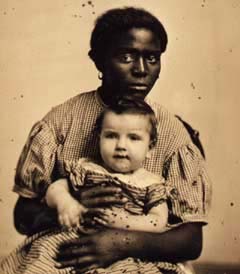
Louisa, unenthusiastically enslaved

Part 2 of our short series of excerpts from the high school textbook American History: A Survey focuses on this photo:

Louisa

The photo is easily found online—we found it on the PBS site Africans in America. It is a photo of a black American named Louisa who was enslaved by the Hayward family in  Missouri. Here’s how PBS describes this photo:

Under the institution of slavery, African Americans and the white people who owned them lived in close proximity and developed relationships with each other. These were defined by the power imbalance between the people involved. They could be relationships of mutual compassion or mutual hatred, but they were an inherent part of daily life.

One of the most complex relationships was the one that existed between white children and their African American caretakers. White children were often in the unnatural position of standing to inherit the people who raised them, and enslaved nannies were in the similarly unnatural position of caring for the children who would grow up to be their masters. This picture, of slave nurse Louisa and her charge, H. E. Hayward, suggests the inherent tension of these relationships.

We’ve already quarreled in part one with the idea that “compassion” between enslaved people and the people claiming to own them as livestock could ever be genuine. Here we want to focus on the second paragraph, which to us is an accurate description of the image. The baby is happy. The young woman holding him looks sorrowful at best, wary and emotionally beaten down at worst. Her eyes, like the baby’s, are on the face of the Hayward parent or parents who wanted the photo. The baby smiles, while Louisa seems to feel all of the stress of being responsible for a white child. If anything happens to that child, Louisa will bear the blame and be punished accordingly. Her life and welfare hang on his. That baby is already her “master.” Any love she might feel for a baby in her care is marred by the fact that she is forced to care for him and not her own children, who may have been sold away from her, and by the fact that any love he might feel for her as his closest caregiver will be systematically and deliberately destroyed as he grows up, so that he will be able to sell her as livestock when that becomes necessary for his own personal enrichment. The photo is a haunting representation of the perversion of all natural human emotion that slavery depends upon, and that’s why it’s famous.

American History, however, has a different take:

NURSING THE MASTER’S CHILD Louisa, a slave on a Missouri plantation owned by the Hayward family in the 1850s, is photographed here holding the master’s infant son. Black women typically cared for white children on plantations, sometimes with great affection and sometimes—as this photograph may suggest—dutifully and without enthusiasm.

Again, AH‘s level of comfort with the terms “master” and “slave” is jarring. But then, perhaps that is what enables AH to criticize Louisa as unenthusiastic in her “duty”. That the editors of AH could look at this photo and approve a caption that belittles her fear and subjection by saying she has no “enthusiasm” for babysitting an adorable child is astounding. How they could critique her for just being “dutiful” instead of “enthusiastic” is completely inexplicable. It comes perilously close to the old “lazy negro” caricature wherein black Americans were depicted as lazy and sullen and unwilling to work hard.

We go on next time to AH’s thoughts on black abolitionists.

What do you think was the worst thing about a slave auction?

That was the question on a 10th-grade American history homework handout we were shown this week, from a public school in the Northeast. Needless to say, it was from the Civil War section of the curriculum. It was followed by this puzzler: “How do you think slaves felt at a slave auction, and why?”

The mind boggles at these questions. A slave auction is the place where the purpose of slavery is fulfilled: to breed human beings for sale. Is there any facet of a slave auction that is not repellent? Can the horrors of a slave auction be hierarchized? What were students supposed to say to answer this question? It implies that there were some aspects of slave auctions that were less awful than others, which is simply untrue.

We asked what textbook the class was using, and were given a copy: American History: A Survey, with Alan Brinkley listed as main author on the cover (McGraw-Hill, 2003 edition). While the handout in question did not come from this textbook, its habit of qualifying slavery as only partly bad is shared and propounded by American History.

First, we’d like to remind our readers that We don’t talk about black slavery in America:

I don’t like to use the word “slave”. To me, it validates the concept that people can be changed from people to slaves, things, property. Many people have been and still are enslaved around the world. But no human being is a slave.

Like most Americans, however, American History uses the word slave without qualm. The damage this does is quickly apparent. Let’s parse a few quotes from the book.

From a section on black codes:

These and dozens of other restrictions might seem to suggest that slaves lived under a uniformly harsh and dismal regime. Had the laws been rigidly enforced, that might have been the case. In fact, however, enforcement was spotty and uneven. Some slaves did acquire property, did learn to read and write, and assemble with other slaves, in spite of laws to the contrary. Although the major slave offenses generally fell under the jurisdiction of the courts (and thus of the Slave Codes), white owners handled most transgressions and inflicted widely varying punishments. In other words, despite the rigid provisions of the law, there was in reality considerable variety within the slave system. Some blacks lived in almost prison-like conditions, rigidly and harshly controlled by their masters. Many (probably most) others enjoyed some flexibility and (at least in comparison with the regimen prescribed by law) a striking degree of autonomy.

—Using the word “slave” here does exactly what racists in the 19th century wanted it to do: it dehumanizes. “Slaves” do this and that, “slaves” experience different treatment by “owners”, “slaves” enjoy flexibility. How can we still be referring to some human beings as “owners” of other human beings in 2017?? It is inexcusable. And we’re not sure what proofs the authors have that “probably most” enslaved Americans were able to escape the harshness of black codes.

A quick note: history textbooks from big K-12 publishers are produced by freelance writers, and edited by freelance editors. The historian’s name on the cover means little. Usually that historian has been brought in to write a new chapter, a new section or two, and to help come up with supplementary material. The main text is mostly static. Freelance writers are given existing copy and asked to revise it in some way (usually to shorten it). HP authors have worked as freelance writers and editors for history textbooks, so we could take a page out of American History and say that “many, probably most,” freelance writers working on textbooks have no idea whether the content they are given is accurate/factual or not. They are not asked to vet the copy for accuracy. If, as some HP writers have done, they point out errors to their editor, the editor is usually at a complete loss about what to do—there is no contingency plan for changing what the copy says, just for shortening or moving it around or putting it into bullet points or multiple choice questions. We had nothing to do with the writing of American History, and do not make any claims to know exactly how it was produced; we work under our own assumption that it followed this standard procedure. And so when we wonder what proofs are given that “most” enslaved Americans were not subject to the full force of the black codes, we feel sure that that question, if it was ever asked by a freelancer, was never answered.

Back to the text:

White farmers with few slaves generally supervised their workers directly and often worked closely alongside them. On such farms, black and whites developed a form of intimacy unknown on larger plantations. The paternal relationship between such masters and their slaves could, like relationships between fathers and children, be warm and affectionate. It could also be tyrannical and cruel. In either case, it was a relationship based on the relative powerlessness of the slaves and the nearly absolute authority of their masters. In general, African Americans themselves preferred to live on larger plantations, where they had more privacy and a chance to build a cultural and social world of their own.

—It is hard to believe one’s eyes: the 19th century idea of paternalism is being endorsed by a 21st-century textbook. The relationship between “masters” and “slaves” was like that between fathers and children? The idea that slavery could be a “positive good”, helping poor ignorant black people to learn how to live in society and follow Christian teaching, was relentlessly shopped by proslavery Americans in the 1800s. And here it is again in the 2000s, as students are told that “intimacy,” and “warm and affectionate” feelings could grow between people who were being bred for sale and those breeding them for sale.

Of course, we should back up to the first line, in which enslaved people are described as “workers.” Another textbook came under fire for doing this in 2015; people who are enslaved and by law treated as livestock are not “workers”. We’ll revisit this below.

Finally, to describe large plantations as having safe spaces for people suddenly referred to as “African Americans” to have private lives and create their own culture, without giving any kind of proof of this claim, is pretty alarming. Why is this the one place where “slaves” are suddenly “African Americans”? The suggestion is that on large plantations–which were large because the forced breeding was ramped up–were in part havens in which black Americans began to create African-American culture.

Even so, according to some scholars, the actual material conditions of slavery may, in fact, have been better than those of many northern factory workers and considerably better than those of both peasants and industrial workers in 19th-century Europe.

—…we’d say “some (not most) scholars” on this one. Here enslavement is presented once again as just another kind of hard “work.” But it’s also yet another argument proslavery Americans made in the 1800s, before and after the Civil War, to promote and protect slavery. Yes, factory workers lived in abysmal poverty, and their bosses had total control over them at work. But they weren’t bred for sale, their families weren’t broken up and sold to different people who considered themselves their “owners”, and you could quit factory work if you wanted to. You could work your way up the ladder to be a boss. You got paid. You could vote. You could get married if you wanted to, to whoever you wanted to. You could move away. You were a citizen of this country, with the rights of a citizen. This is, to put it mildly, better than slavery.

Most free blacks [in the south], however, lived in abject poverty, under conditions worse than those of blacks in the north. Law or custom closed many occupations to them, forbade them to assemble without white supervision, and placed numerous other restraints on them. They were only quasi-free, and yet they had all the burdens of freedom: the necessity to support themselves, to find housing, to pay taxes. Yet great as were the hardships of freedom, blacks usually preferred them to slavery.”

—The “burdens of freedom” is an expression, a concept, that we have not encountered before. Again, echoes of the old proslavery arguments are heard: slaveholders give slaves food, shelter, clothes, religion; they care for them when they’re sick; they support them when they’re too old to work. Why, slaves had it pretty good! If it weren’t so breathtakingly awful to say blacks usually preferred freedom to slavery, we would laugh. Yes, black Americans usually preferred freedom to slavery. Like people usually prefer not being tortured to being tortured.

This last line is the most sickening, perhaps, of the echoes of proslavery arguments: that the enslaved liked slavery. That they knew they were not intelligent enough, not civilized enough, to be free, and they were grateful for their white masters’ help and care. The recently revived myth that “many” enslaved black men fought willingly for the Confederacy is a sign of the undying appeal of this idea to a small number of Americans (see more on this myth here).

Next time: more, if you can bear it, from American History: A Survey

The Obama farewell address: advice from another world?

At long last we wrap up the close reading of President Obama’s farewell address that we began on January 13! We, like most of the nation, have been waylaid and distracted many times since then by the almost daily, certainly weekly news bulletins from Washington alerting us to almost every conceivable type of crisis or question or misstep arising from the Trump administration.

Five months into that administration, we begin to wonder if it serves any purpose to follow all those bulletins. What good does listening to accounts of our Constitution being violated, our national commitment to making liberty and justice for all a reality being ridiculed and undermined, or our president acting like a king do? What action can we take? Do marches work in the long term? Petitions? Shouting matches at town hall meetings? Jokes on late-night talk shows?

One of those things does work, and it’s nice that it’s the town hall meetings. On this site that so often discusses the Puritans, creators of the American town hall  and town hall meeting, it’s good to be able to join with our last president in his optimistic view of the future by recommending a return to something the Puritans valued deeply: taking right action.

In this case, it’s political action. As those Americans who believe our system of government—that any system, almost any kind of government—is the problem and not the solution, a hindrance at best and a trap at worst, attempt to dismantle it, we have to step up to keep it alive. Participate in local government. Vote, attend town hall meetings, go to candidate information sessions, learn how your government is supposed to work. Keep track of your state government. Write or call the people you elect to get information on how they plan to vote on upcoming legislation. Vote. Get referenda or other popular, grass-roots legislative change engines running if you need to. Do the same for your federal government.

This can be exhausting. Many Puritan men who were full church members and thus entitled to vote and run for political office chose never to become freemen and do so. (Freeman was their term for a full [male] citizen.) They knew how much time it took. Going to meetings after work is tiring. People with families may struggle to do it. Taking time out of the weekend is challenging.

But we were never so desperately in need of our democracy as we are now. So answer the call to right action. Be represented in our representative democracy. Choose the optimism Obama sent as his final message, the message that says if we remain inside our government, if we are its engine, we keep it alive and we keep it honest. Don’t let those Americans who break the government and then say we should throw it out because it’s broken achieve that self-fulfilling prophecy. Don’t wait for Democrats to retake the House and Senate; this is just an aggravation of the partisanship that’s killing us. We need to find ways to unite. Cross as many bridges as you can to create unity behind the real American identity, which is ever-expanding justice, liberty, and the common good.

We’ll finish with a quote from John Adams to motivate us:

There is nothing which I dread so much as a division of the republic into two great parties, each arranged under its leader, and concerting measures in opposition to each other. This, in my humble apprehension, is to be dreaded as the greatest political evil under our Constitution.

Go unite our states.

Positive change v. negative: closing Obama’s Farewell address

On we go at last with our close reading of the Obama farewell speech, despite our temptation to address the president’s poignant question “why was there a Civil War?”, since Yoni Appelbaum over at the The Atlantic does a fine job addressing that for us.

Our transcript source is now The New York Times, since the Trump Administration removing the transcript from its location at whitehouse.gov/farewell. Along with pages on LGBT rights, climate change, health care, and civil rights.

We left off with President Obama’s comments on attacks on the Enlightenment order that is the foundation of the American way, with him saying there had not been a successful attack by foreign terrorists in the United States in the last eight years.

And although Boston and Orlando and San Bernardino and Fort Hood remind us of how dangerous radicalization can be, our law enforcement agencies are more effective and vigilant than ever. We have taken out tens of thousands of terrorists, including Bin Laden.

The global coalition we’re leading against ISIL has taken out their leaders and taken away about half their territory. ISIL will be destroyed. And no one who threatens America will ever be safe.

And all who serve or have served — it has been the honor of my lifetime to be your commander-in-chief. And we all owe you a deep debt of gratitude.

But, protecting our way of life, that’s not just the job of our military. Democracy can buckle when it gives into fear. So just as we as citizens must remain vigilant against external aggression, we must guard against a weakening of the values that make us who we are.

And that’s why for the past eight years I’ve worked to put the fight against terrorism on a firmer legal footing. That’s why we’ve ended torture, worked to close Gitmo, reformed our laws governing surveillance to protect privacy and civil liberties.

—This section starts out as the usual tough-on-crime/terrorism/”threats” section that is in most 21st-century farewell addresses, but then morphs into an attempt by the president to say that military action is not the only patriotic action, and that military action without constitutional underpinnings is as dangerous as any crime/terrorism/threats. But this section falls strangely flat. The quick half-sentence “we must guard against a weakening of the values that make us who we are” is vague and could be used to support more militarization. It’s not clearly stating that military action alone has no moral value; it is judged good or evil by the cause it supports. And the Obama administration did not leave a great legacy when it comes to prisoners at Guantanamo, stopping surveillance of the public, and protecting privacy.

That’s why I reject discrimination against Muslim Americans who are just as patriotic as we are.

That’s why we cannot withdraw from big global fights to expand democracy and human rights and women’s rights and LGBT rights.

No matter how imperfect our efforts, no matter how expedient ignoring such values may seem, that’s part of defending America. For the fight against extremism and intolerance and sectarianism and chauvinism are of a piece with the fight against authoritarianism and nationalist aggression. If the scope of freedom and respect for the rule of law shrinks around the world, the likelihood of war within and between nations increases, and our own freedoms will eventually be threatened.

So let’s be vigilant, but not afraid. ISIL will try to kill innocent people. But they cannot defeat America unless we betray our Constitution and our principles in the fight.

Rivals like Russia or China cannot match our influence around the world — unless we give up what we stand for, and turn ourselves into just another big country that bullies smaller neighbors.

Which brings me to my final point — our democracy is threatened whenever we take it for granted.

—Here things pick up as the president says that fighting for human rights is “part of defending America.” That’s true. So long as Americans are willing to recognize extremism and intolerance and sectarianism and chauvinism within the U.S., and not always just in other nations, and to fight it as hard here at home as they do abroad, we are on solid ground. The scope of freedom and respect for the rule of law will shrink if the U.S. only enforces rule of law outside its own borders. That’s what it means to say that no one can defeat America but ourselves—if we betray our Constitution and our principles in the fight against injustice in other nations, our credibility is dissolved along with our democracy.

All of us, regardless of party, should be throwing ourselves into the task of rebuilding our democratic institutions.

When voting rates in America are some of the lowest among advanced democracies, we should be making it easier, not harder, to vote.

When trust in our institutions is low, we should reduce the corrosive influence of money in our politics, and insist on the principles of transparency and ethics in public service. When Congress is dysfunctional, we should draw our districts to encourage politicians to cater to common sense and not rigid extremes.

But remember, none of this happens on its own. All of this depends on our participation; on each of us accepting the responsibility of citizenship, regardless of which way the pendulum of power happens to be swinging.

Our Constitution is a remarkable, beautiful gift. But it’s really just a piece of parchment. It has no power on its own. We, the people, give it power. We, the people, give it meaning — with our participation, and with the choices that we make and the alliances that we forge.

Whether or not we stand up for our freedoms. Whether or not we respect and enforce the rule of law, that’s up to us. America is no fragile thing. But the gains of our long journey to freedom are not assured.

—We heartily second all of the statements made here! When people lose faith in our political system, they stop participating, and begin to elect people they hope will either destroy that system as impossibly corrupt, or reform it through strong-man tactics—bypassing Congress via executive orders and/or pushing oppressive and unconstitutional laws through Congress. But we, the people, have to bring meaning to our government or it will cease to exist. That is the substance of Obama’s next section:

In his own farewell address, George Washington wrote that self-government is the underpinning of our safety, prosperity, and liberty, but “from different causes and from different quarters much pains will be taken… to weaken in your minds the conviction of this truth.”

Read Washington’s great address here.

And so we have to preserve this truth with “jealous anxiety;” that we should reject “the first dawning of every attempt to alienate any portion of our country from the rest or to enfeeble the sacred ties” that make us one.

America, we weaken those ties when we allow our political dialogue to become so corrosive that people of good character aren’t even willing to enter into public service. So coarse with rancor that Americans with whom we disagree are seen, not just as misguided, but as malevolent. We weaken those ties when we define some of us as more American than others.

When we write off the whole system as inevitably corrupt. And when we sit back and blame the leaders we elect without examining our own role in electing them.

It falls to each of us to be those anxious, jealous guardians of our democracy. Embrace the joyous task we have been given to continually try to improve this great nation of ours because, for all our outward differences, we in fact all share the same proud type, the most important office in a democracy, citizen.

—It’s this kind of optimism that is so desperately essential to democracy. If, over 275 years later we still have to work to improve our democracy, we can see that as a clear sign that it’s hopelessly flawed and we should give up, or we can see it as a clear sign that our democracy has been greatly improved over those 275 years, and can just keep getting better and better. You have to choose the latter—choose optimism—to keep democracy alive.

Citizen. So, you see, that’s what our democracy demands. It needs you. Not just when there’s an election, not just when your own narrow interest is at stake, but over the full span of a lifetime. If you’re tired of arguing with strangers on the Internet, try talking with one of them in real life.

If something needs fixing, then lace up your shoes and do some organizing.

If you’re disappointed by your elected officials, grab a clip board, get some signatures, and run for office yourself.

Show up, dive in, stay at it. Sometimes you’ll win, sometimes you’ll lose. Presuming a reservoir in goodness, that can be a risk. And there will be times when the process will disappoint you. But for those of us fortunate enough to have been part of this one and to see it up close, let me tell you, it can energize and inspire. And more often than not, your faith in America and in Americans will be confirmed. Mine sure has been.

—This is a call to energy and real life that more Americans need to answer.

Over the course of these eight years, I’ve seen the hopeful faces of young graduates and our newest military officers. I have mourned with grieving families searching for answers, and found grace in a Charleston church. I’ve seen our scientists help a paralyzed man regain his sense of touch. I’ve seen Wounded Warriors who at points were given up for dead walk again.

I’ve seen our doctors and volunteers rebuild after earthquakes and stop pandemics in their tracks. I’ve seen the youngest of children remind us through their actions and through their generosity of our obligations to care for refugees or work for peace and, above all, to look out for each other. So that faith that I placed all those years ago, not far from here, in the power of ordinary Americans to bring about change, that faith has been rewarded in ways I could not have possibly imagined.

And I hope your faith has too. Some of you here tonight or watching at home, you were there with us in 2004 and 2008, 2012.

—This list of the good and bad moments ends with an emphasis on the good, and subtly reminds us of the historic step that was electing our first black president.

The rest of the speech is shout-out to the First Lady, the Obama daughters, vice-president Joe Biden, the White House staff, and the vast network of volunteers who worked on his campaigns. And then this:

And that’s why I leave this stage tonight even more optimistic about this country than when we started. Because I know our work has not only helped so many Americans; it has inspired so many Americans — especially so many young people out there — to believe that you can make a difference; to hitch your wagon to something bigger than yourselves.

Let me tell you, this generation coming up — unselfish, altruistic, creative, patriotic — I’ve seen you in every corner of the country. You believe in a fair, and just, and inclusive America; you know that constant change has been America’s hallmark, that it’s not something to fear but something to embrace, you are willing to carry this hard work of democracy forward. You’ll soon outnumber any of us, and I believe as a result the future is in good hands.

—These are defiantly positive statements to make as Donald Trump prepared to take office. Obama wants to counter the idea that there will no longer be a place in the country for those who did not support Trump, and encourage them to continue to push for the positive change that is the work of improving our democracy by extending and strengthening it, even as proponents of the negative change that is the work of narrowing and destroying our democracy look forward to having the upper hand.

My fellow Americans, it has been the honor of my life to serve you. I won’t stop; in fact, I will be right there with you, as a citizen, for all my remaining days. But for now, whether you are young or whether you’re young at heart, I do have one final ask of you as your president — the same thing I asked when you took a chance on me eight years ago.

I am asking you to believe. Not in my ability to bring about change — but in yours.

I am asking you to hold fast to that faith written into our founding documents; that idea whispered by slaves and abolitionists; that spirit sung by immigrants and homesteaders and those who marched for justice; that creed reaffirmed by those who planted flags from foreign battlefields to the surface of the moon; a creed at the core of every American whose story is not yet written:

Yes, we can.

Yes, we did.

Yes, we can.

Thank you. God bless you. And may God continue to bless the United States of America. Thank you.

Next time: thoughts on how to live Obama’s optimism.

Obama’s Farewell Speech: If only Washington hadn’t been so right

On we go at last with our close reading of the Obama farewell speech, despite our temptation to address the latest violation of our Constitution re moves to end the right of judicial filibuster.

Our transcript source is now The New York Times, since the Trump Administration removing the transcript from its location at whitehouse.gov/farewell. Along with pages on LGBT rights, climate change, health care, and civil rights.

We left off with this statement: “And increasingly we become so secure in our bubbles that we start accepting only information, whether it’s true or not, that fits our opinions, instead of basing our opinions on the evidence that is out there.” We pick up from there:

And this trend represents a third threat to our democracy. Look, politics is a battle of ideas. That’s how our democracy was designed. In the course of a healthy debate, we prioritize different goals, and the different means of reaching them. But without some common baseline of facts, without a willingness to admit new information and concede that your opponent might be making a fair point, and that science and reason matter, then we’re going to keep talking past each other.

(CROWD CHEERS)

And we’ll make common ground and compromise impossible. And isn’t that part of what so often makes politics dispiriting? How can elected officials rage about deficits when we propose to spend money on pre-school for kids, but not when we’re cutting taxes for corporations?

How do we excuse ethical lapses in our own party, but pounce when the other party does the same thing? It’s not just dishonest, it’s selective sorting of the facts. It’s self-defeating because, as my mom used to tell me, reality has a way of catching up with you.

—“A common baseline of facts”; we find that even in the short time since Obama’s farewell we have experienced many people lobbying harder than we could have believed possible to deny, denigrate, and destroy that foundation of rational society. “Fake news” has become the most used phrase in America, to our detriment, because it just doesn’t make sense. If something is untrue/a lie, it’s not news at all. There aren’t two kinds of news, the real and the fake. There is news of real events and lies/rumors of fake events. But we have been worked on so diligently by anti-democratic people that we seem now to accept that news itself is somehow suspect, and those anti-democratic people slander the truth as “fake news”, which is such a big leap into some dystopia from a YA novel that we can’t quite believe it’s happening, but it is.

Take the challenge of climate change. In just eight years we’ve halved our dependence on foreign oil, we’ve doubled our renewable energy, we’ve led the world to an agreement that (at) the promise to save this planet.

(APPLAUSE)

But without bolder action, our children won’t have time to debate the existence of climate change. They’ll be busy dealing with its effects. More environmental disasters, more economic disruptions, waves of climate refugees seeking sanctuary. Now we can and should argue about the best approach to solve the problem. But to simply deny the problem not only betrays future generations, it betrays the essential spirit of this country, the essential spirit of innovation and practical problem-solving that guided our founders.

—It’s amazing what ancient history this seems like just a few months later, as the Trump Administration has begun the process of undoing all of the climate change prevention measures the Obama Administration put in place, and has actually forbidden government agencies to use the term “climate change” in any written or oral communication. This is such a big leap into dystopia that it moves beyond YA to 1984, but it’s also happening. We will indeed be “busy dealing with its effects” even if we don’t say the words “climate change.”

It is that spirit — it is that spirit born of the enlightenment that made us an economic powerhouse. The spirit that took flight at Kitty Hawk and Cape Canaveral, the spirit that cures disease and put a computer in every pocket, it’s that spirit. A faith in reason and enterprise, and the primacy of right over might, that allowed us to resist the lure of fascism and tyranny during the Great Depression, that allowed us to build a post-World War II order with other democracies.

An order based not just on military power or national affiliations, but built on principles, the rule of law, human rights, freedom of religion and speech and assembly and an independent press.

—The “spirit” is that of “innovation and practical problem-solving” and it is indeed beholden to the Enlightenment; faith in reason and primacy of right over might, rule of law, human rights, and an independent press are what made the United States a great nation. Those are the principles enshrined in the Constitution.

(APPLAUSE)

That order is now being challenged. First by violent fanatics who claim to speak for Islam. More recently by autocrats in foreign capitals who seek free markets in open democracies and civil society itself as a threat to their power.

The peril each poses to our democracy is more far reaching than a car bomb or a missile. They represent the fear of change. The fear of people who look or speak or pray differently. A contempt for the rule of law that holds leaders accountable. An intolerance of dissent and free thought. A belief that the sword or the gun or the bomb or the propaganda machine is the ultimate arbiter of what’s true and what’s right.

Because of the extraordinary courage of our men and women in uniform. Because of our intelligence officers and law enforcement and diplomats who support our troops…

(APPLAUSE)

… no foreign terrorist organization has successfully planned and executed an attack on our homeland these past eight years.

—Sadly, that Enlightenment order we call the American Way is being challenged by Americans who are not Muslim or immigrants or “suspicious” in any other way. Freedom is being attacked by mainstream Americans who see it as standing in the way of their power. Our federal government is being dismantled, and what is left is being honed to serve individual profit. We are being turned against each other in the interest of people who will gain by our division.

We are, in short, seeing what George Washington warned us about most passionately and directly in his 1796 Farewell Address: treachery from within. Let’s turn to the first Farewell Address in American history, which seems as if it was written expressly for us in 2017 (we did the bolding):

The unity of government which constitutes you one people is also now dear to you. It is justly so, for it is a main pillar in the edifice of your real independence, the support of your tranquility at home, your peace abroad; of your safety; of your prosperity; of that very liberty which you so highly prize. But as it is easy to foresee that, from different causes and from different quarters, much pains will be taken, many artifices employed to weaken in your minds the conviction of this truth; as this is the point in your political fortress against which the batteries of internal and external enemies will be most constantly and actively (though often covertly and insidiously) directed, it is of infinite moment that you should properly estimate the immense value of your national union to your collective and individual happiness; that you should cherish a cordial, habitual, and immovable attachment to it; accustoming yourselves to think and speak of it as of the palladium of your political safety and prosperity; watching for its preservation with jealous anxiety; discountenancing whatever may suggest even a suspicion that it can in any event be abandoned; and indignantly frowning upon the first dawning of every attempt to alienate any portion of our country from the rest, or to enfeeble the sacred ties which now link together the various parts.

—That is, you love your democracy and your democratic government, and you should. But remember that it is a painfully new idea, and there are going to be many people—outside the U.S. and even within it, your fellow citizens—who don’t believe it will really work. They will try to tear it down, and tell you you’re crazy, and get you to go back to the old ways. You’ve got to remember that being united under your unique government is your greatest treasure. Forget the things that make you different, like religion or customs and focus on what you have in common, what you share that no other people on earth share: a democratic government of the people, for the people, and by the people.

That was Washington’s message. We’ll continue on with Obama’s next time.

Obstruction or democracy?

We keep hearing TV broadcasters asking Democratic members of Congress whether their attempts to rebut the Trump Administration’s platform isn’t just the same sort of obstructionism that Republicans were accused of during the Obama Administration.

In a discussion about whether Supreme Court nominee Neil Gorsuch’s confirmation would be blocked by Democrats who a) were skeptical of his record and b) were protesting the Republicans’ refusal to give President Obama’s candidate Merrick Garland a hearing, a Democratic member of Congress was asked, “Isn’t that the same sort of obstruction of justice Democrats accused the Republicans of when they wouldn’t allow Merrick Garland a hearing?”

In interviews about blocking the Republican alternative to the American Health Care Act, Democrats are repeatedly asked whether their efforts aren’t just like the Republicans voting over and over to repeal the Affordable Health Care Act.

And discussions of the travel ban on seven Muslim nations have gone the same way: “aren’t you just obstructing anything the new president wants to do?”

The list goes on. We want to just step in to say no, it’s not obstructionist to stand up for democracy, liberty, and justice for all. Those Republicans who wanted to block expanded health care, a Democratic president’s Supreme Court Justice, and our Constitution’s ban on creating religious tests were all engaged in anti-American, anti-democratic harm. Those Democrats who are now trying to block reduced health care, the fantasy that the Constitution says a President can’t nominate a new Justice in an election year, and religious discrimination are engaged in pro-American, pro-democratic good.

It’s not just member of Congress of course; college students protesting the invitation of speakers to their campuses who promote discrimination and practice hate speech have also been accused of violating the First Amendment by denying those speakers their freedom of speech. But not all speech is protected, and hate speech is certainly not. Refusing to treat someone who promotes discrimination differently than someone who does not is not protecting fairness and equality, it’s protecting hate speech, and saying it’s no different than other speech in the guise of protecting, somehow, “diversity”.

As Kate Knibbs says, “The phrase ‘ideological diversity’ is a Trojan horse designed to help bring disparaged thought onto campuses, to the media, and into vogue. It is code for granting fringe right-wing thought more credence in communities that typically reject it, and nothing more.”

Let’s not let those who would violate our Constitution tell us that by standing up for it we are being obstructionist.

Next time: back–yes, back after all–to Obama’s farewell address.

The Constitution does not protect freedom of religion

Congress shall make no law respecting an establishment of religion, or prohibiting the free exercise thereof; or abridging the freedom of speech, or of the press; or the right of the people peaceably to assemble, and to petition the Government for a redress of grievances.

We all recognize this as the text of the First Amendment of the Constitution. Most of us put it into our own words as “the First Amendment protects freedom of religion.” But it does not. It protects freedom of worship, which is very different.

What the First Amendment does regarding religion is: first, it forbids our federal legislature from making any laws creating an official state religion; second, it forbids our federal legislature from preventing people from worshipping as they see fit. That’s what “free exercise” means—how you worship. Whether you go to a church, synagogue, mosque, or have a prayer room in your home, you are protected. If you wear a head covering like a yarmulke or turban as a form of worship, you are protected.

The First Amendment is all about physical forms of religious worship. It comes from a time when people would burn Catholic churches or refuse to let Jewish Americans build synagogues. It stops this, and stops schools from forbidding students to wear religious clothing.

It does not protect religion itself, or as we usually put it, religious belief. It does not protect anyone’s right to believe certain things. If one’s religion prohibits homosexuality or birth control, that is a belief, not a form of worship. Belief is not protected because belief is so amorphous. One could claim any crazy notion as a religious belief and demand that it be protected. We could say that our religion says women shouldn’t ride public transportation, or men should not be allowed to use public showers, or cats can’t be kept as pets, and we would have to be accommodated.

The Founders were wise enough not to get into religious belief. They just made a safe space for public and private physical worship.

We were glad to hear someone get this in a radio interview last week. The article starts badly, with the author saying

The question under current debate is what it means to “exercise” one’s religion.

If a football coach is not allowed to lead his team in a public prayer, or a high school valedictorian is not given permission to read a Bible passage for her graduation speech, or the owner of a private chapel is told he cannot refuse to accommodate a same-sex wedding, they might claim their religious freedom has been infringed.

The first two examples are clearly not worship. They are expressions of religious belief. Only the latter is worship, concerning what happens in a house of worship. The article continues:

One of the thorniest cases involves Catholic Charities, whose agencies long have provided adoption and foster care services to children in need, including orphans. Under Catholic doctrine, the sacrament of marriage is defined as the union of a man and a woman, and Catholic adoption agencies therefore have declined to place children with same-sex couples.

Again, doctrine is belief, not worship. Marriage being between a man and woman only is a belief, not a form of worship. Doctrine cannot be protected by our federal government. The article talks many times about “freedom of religion” clashing with “freedom from discrimination”, and that’s why: when you enforce belief, you enforce discrimination because belief can reach out beyond a religion to impact others while worship can’t. Put it this way: there’s no form of Catholic worship that impacts non-Catholics because non-Catholics aren’t in Catholic churches trying to worship. But there are forms of Catholic belief that impact non-Catholics, because non-Catholics will be impacted by them without ever setting foot in a church. Gay non-Catholics will be discriminated against by anti-gay Catholics if being anti-gay (a belief) is enshrined as a form of worship, and thus given protection by the First Amendment.

“Exercising” one’s religion means worship, plain and simple, and exclusively. It’s a literal word: you exercise (move)  yourself physically to do something to worship God.

So Charles Haynes, director of the Religious Freedom Center at the Newseum Institute in Washington, is completely wrong to say “We may not like the claim of conscience, but you know, we don’t judge claims of conscience on whether we like the content of the claim. We are trying to protect the right of people to do what they feel they must do according to their God. That is a very high value.”

Americans may have a “right” to do “what they feel they must do according to their God”, but only when it comes to forms of worship. One political charter, like the Constitution, could not possibly protect all “values” and all “feelings” about what is right, because they will naturally conflict. And the Constitution does not deal in feelings, but in political rights.

Now here’s where the article gets good:

…Bishop Michael Curry, leader of the Episcopal Church in the United States, said he has witnessed the persecution of Christians in other parts of the world and doesn’t see anything comparable in the United States.

“I’m not worried about my religious freedom,” Curry said. “I get up and go to church on Sunday morning, ain’t nobody stopping me. My freedom to worship is protected in this country, and that’s not going to get taken away. I have been in places where that’s been infringed. That’s not what we’re talking about.”

Curry’s reference only to “freedom to worship,” however, missed the point, according to some religious freedom advocates. They say they want the freedom to exercise their faith every day of the week, wherever they are — even if it means occasionally challenging the principle of absolute equality for all.

“We can’t use equality to just wipe out one of the [First Amendment] rights,” Carlson-Thies says, “or say you can have the right, as long as you just exercise it in church, but not out in life.”

Bishop Curry gets it! He realizes that “worship”—getting up and going to church and not being stopped—is what is protected. “My freedom to worship is protected in this country”; that is correct. We were really gratified to hear him say this.

Then to have his opponents say that having “only” freedom of worship isn’t good enough is very telling, because they come right out and say they want freedom of belief—if only for themselves. They want to “exercise their faith every day of the week”? They have that right in the Constitution. What they really want is to “challenge the principle of absolute equality for all”; that is, they only want freedom of belief for themselves. Anyone whose beliefs clash with theirs should be shut down.

To say as Carlson-Thies does, that “equality wipes out rights” would be laughable if it weren’t so dire an example of double-speak destroying our democracy. Equality is “rights”. They are one thing. Our guaranteed equal rights give us… well, equality. How can guaranteeing everyone’s equal rights destroy equality?

His final statement tells us the truth: he wants to get rid of freedom of worship (“in church”) and put in freedom of belief (“in life”). But only for himself, and his beliefs. All others that clash with his would have to be discriminated against.

We need more Currys in this country, who understand that no democratic government committed to equality of opportunity can protect freedom of belief because that is the opposite of democracy. It is anarchy. Beliefs will always clash. The federal government cannot uphold any one set of beliefs over another. If equality feels like oppression to some people, we need to help them resolve that struggle. That’s the American way.

George Washington didn’t show his tax returns

…yes, this statement was made on national television last week, in an interview that Bill Maher conducted with Trump supporter and virtual spokesman Jeffrey Lord, who answered Maher’s demand that the current president show his tax returns “as all presidents have done in my lifetime” in this way:

I totally disagree with this. I don’t think he should ever show his tax returns. We’ve had presidents in the United States from George Washington all the way through to Lyndon Johnson who never released a single tax return.

There was scattered laughter in Maher’s audience as people realized the enormity of Lord’s seeming ignorance. Income tax was not instituted in U.S. law until 1913. While an income tax was levied during the Civil War to help the U.S. pay for the war (the Revenue Act of 1862), that was an emergency measure that did not last beyond the war. The 1894 Tariff Act imposed an income tax, but Congress was still debating its constitutionality, and it was not until 1913 that the Sixteenth Amendment was passed, legalizing and instituting a national income tax.

But Lord isn’t ignorant. No, he doesn’t know about the Revenue Act of 1862 or the 1894 Tariff Act, but few Americans do, or need to. Most Americans do, however, know that the U.S. income tax does not stretch back to Washington. There are no cherished stories of Washington traveling to New York City or the new capital, Washington, DC to turn in his 1040-EZ. For Lord to bring up Washington is more than ignorant, and worse than ignorant: it’s dangerous.

Lord is dangerous because he believes the American people are stupid. He’s dangerous because he wants to drape the flag over a breach of trust with the American people. He invokes George Washington to shut people up. We’re not sure whether Lord knows there hasn’t always been income tax in the U.S., but we get the feeling he does, and said what he said to sound a) knowledgeable and b) patriotic. People who peddle you patriotism to cover lies or crimes are un-American, and the opposite of patriotic.

Is the current president hiding criminal activity by refusing to share his tax returns? We have no idea. We will not say that he is, because we don’t know, and that’s not something one should assume. But we do agree with critics that his refusal invites speculation on criminal activity—the worst-case scenario for why he won’t share them.

Those who would defend Lord’s Washington line will say that only pedantic nitpickers would focus on his “little mistake” in the timeline instead of his grand point about individual freedom. They are wrong. Because Lord used Washington in a deliberate attempt to propagandize Trump’s refusal to share his returns as patriotic. That’s the grand point.

Race and the “hardworking middle class”: Obama’s Farewell Address

Hello and welcome to post four in our close reading of President Obama’s farewell speech, now available at The New York Times since it has been ousted from whitehouse.gov. We left off in our last post promising to get to President Obama’s frank address of race, so let’s begin.

There’s a second threat to our democracy. And this one is as old as our nation itself.

After my election there was talk of a post-racial America. And such a vision, however well intended, was never realistic. Race remains a potent…

(APPLAUSE)

… and often divisive force in our society.

Now I’ve lived long enough to know that race relations are better than they were 10 or 20 or 30 years ago, no matter what some folks say.

(APPLAUSE)

You can see it not just in statistics. You see it in the attitudes of young Americans across the political spectrum. But we’re not where we need to be. And all of us have more work to do.

—The last comment is important. Older members of the HP who describe their childhoods in the 1970s to teenager today may as well be talking about another planet. While it’s true that hidden racism is no better than outright racism, it’s easy to forget what outright racism represents: a consensus that there’s nothing wrong with it. Overt racism is a sign that people feel comfortable expressing racism; they don’t expect anyone to challenge or reproach them. In America 50 years ago, it was okay to be openly, outrageously racist. In America today, it isn’t, because those 50 years were spent stripping away the social justifications of and legal supports for racism. The biological arguments for racism, the “oh come on, it’s just a joke” arguments for racism, the “this is the way it’s always been” arguments, the “this is how God intended” arguments—all were at last relentlessly, righteously assaulted as the nation pushed to live up to its mandate of liberty and justice for all.

But, as the president says, that doesn’t mean racism ended. Racism will never end. It’s part of human nature. And that means the fight against racism must never end. We have to rise above our nature. All of us will always have more work to do, but if we do it, we will get closer to being free of racism, as close as it is possible to come. We cannot afford to have the work of the last 50 years undone by anti-Americans who want to go back to the old days. Their mythical view of an all-white America that was happy and strong and rich would be laughable if it weren’t so dangerous to this nation.

If every economic issue is framed as a struggle between a hardworking white middle class and an undeserving minority, then workers of all shades are going to be left fighting for scraps while the wealthy withdraw further into their private enclaves.

—This single sentence says so much. Here the president is frank about how neo-conservatives and white supremacist/fascists do indeed frame every economic issue. This began with Reagan. His 1984 “Morning again in America” ad (you can find it easily on YouTube) was 90 seconds of showing only white Americans while a voiceover talked about hardworking people buying houses and getting married and thriving. (Yes, for exactly two seconds a black and a Latino child are shown watching an American flag being raised. But apparently when they grow up these non-white children will not contribute to America’s wealth, strength, and happiness.) Since then, “hardworking” and “middle-class” have come to be code words for “white” and “native-born”. Anyone who isn’t hardworking and middle-class is a non-white criminal. In the last presidential campaign, these ceased to be unspoken codes, as neo-conservatives and fascists and other Trump supporters applauded his description of Mexicans, Muslims, and other non-white immigrants as criminals, and stood by Trump’s refusal to call the KKK a hate/terrorist/white supremacist group.

If we’re unwilling to invest in the children of immigrants, just because they don’t look like us, we will diminish the prospects of our own children — because those brown kids will represent a larger and larger share of America’s workforce.

(APPLAUSE)

And we have shown that our economy doesn’t have to be a zero-sum game. Last year, incomes rose for all races, all age groups, for men and for women.

So if we’re going to be serious about race going forward, we need to uphold laws against discrimination — in hiring, and in housing, and in education, and in the criminal justice system.

That is what our Constitution and highest ideals require.

—A loud minority of Americans want a zero-sum game. They feel that any and every advance by people unlike them (non-white, immigrant) comes only at their expense. If anyone else wins, it’s because they lose. That’s why they want to repeal laws against discrimination, ironically by claiming those laws discriminate against whites/white men/native-born white Americans. These people are Americans in name only, as they would violate our Constitution to enrich and (so they think) protect themselves.

But laws alone won’t be enough. Hearts must change. It won’t change overnight. Social attitudes oftentimes take generations to change. But if our democracy is to work the way it should in this increasingly diverse nation, then each one of us need to try to heed the advice of a great character in American fiction, Atticus Finch, who said “You never really understand a person until you consider things from his point of view, until you climb into his skin and walk around in it.”

For blacks and other minority groups, that means tying our own very real struggles for justice to the challenges that a lot of people in this country face. Not only the refugee or the immigrant or the rural poor or the transgender American, but also the middle-aged white guy who from the outside may seem like he’s got all the advantages, but has seen his world upended by economic, and cultural, and technological change.

We have to pay attention and listen.

—It’s hard to feel a lot of compassion for white men in western society. They still have every advantage when it comes to being educated, hired, well-paid, catered to politically, and identified as the “average person”. White men do still have all the advantages, even after 50 years of economic, cultural, and technological change. Again, it’s the zero-sum mentality at work: any change for white men is seen as an alarm bell that the God-ordained proper world order is being destroyed. Not all white men feel this way. But the ones who do should only be paid attention and listened to as part of an effort to re-educate them to be Americans.

For white Americans, it means acknowledging that the effects of slavery and Jim Crow didn’t suddenly vanish in the ’60s; that when minority groups voice discontent, they’re not just engaging in reverse racism or practicing political correctness; when they wage peaceful protest, they’re not demanding special treatment, but the equal treatment that our founders promised.

(APPLAUSE)

For native-born Americans, it means reminding ourselves that the stereotypes about immigrants today were said, almost word for word, about the Irish, and Italians, and Poles, who it was said were going to destroy the fundamental character of America. And as it turned out, America wasn’t weakened by the presence of these newcomers; these newcomers embraced this nation’s creed, and this nation was strengthened.

(APPLAUSE)

So regardless of the station we occupy; we all have to try harder; we all have to start with the premise that each of our fellow citizens loves this country just as much as we do; that they value hard work and family just like we do; that their children are just as curious and hopeful and worthy of love as our own.

(APPLAUSE) (CHEERING)

And that’s not easy to do. For too many of us it’s become safer to retreat into our own bubbles, whether in our neighborhoods, or on college campuses, or places of worship, or especially our social media feeds, surrounded by people who look like us and share the same political outlook and never challenge our assumptions. In the rise of naked partisanship and increasing economic and regional stratification, the splintering of our media into a channel for every taste, all this makes this great sorting seem natural, even inevitable.

And increasingly we become so secure in our bubbles that we start accepting only information, whether it’s true or not, that fits our opinions, instead of basing our opinions on the evidence that is out there.

—Bubbles have always existed. They’re not the product of social media. Newspapers in the 19th and early 20th centuries in America were always firmly ideological—Republican or Democrat, nativist or pro-immigrant, for blacks or for whites or for Jewish people, etc. But the harm of bubbles is intensified by social media. Now we don’t even have to know that we are buying “our” paper for “our” people; we can go online to a site that pretends to be objective while it peddles ridiculous and harmful, divisive and undemocratic opinions, or, more and more often, lies. People become used to arguing with other people only when they leave those social media bubbles, not within them, and the right to argue a point is confused with the right to win an argument. It’s enough to make one wonder whether the “information wants to be free” movement that destroyed paid journalism was an anti-democratic plot after all…

Next time: the third threat to American democracy