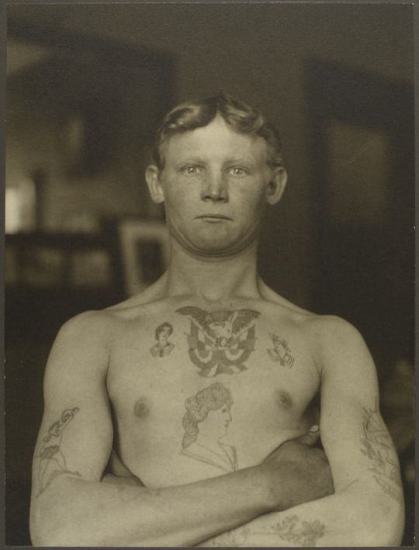
Immigrants have always been scary-looking, but that’s never stopped us before

A while back we showed some photos from the wonderful Washington Post feature “What America’s immigrants looked like when they arrived on Ellis Island”. It’s a collection of  photos taken by Augustus Sherman at Ellis from 1892-1925. Sherman was the chief registry clerk at the immigration station.

Here’s what we said at the time:

His photos are wonderful because most of them show people dressed in their very best clothing, usually traditional clothes. While immigrants at that time traveled in their regular clothes because they knew the trip in steerage was dirty, they brought their best clothes to put on once they arrived at Ellis Island so that they would seem like presentable people who were a) not poor and b) good citizen material. They dressed to impress, and they had plenty of time to change during the long waiting periods between landing at the dock and being processed.

Adults and children alike were decked out in elaborate clothes. Women must have been sewing for months to create these wonderful ensembles. As the site points out, seeing these people reminds us that America has long been a place where a multitude of cultures mix on the streets, in schools, at work and at play. While immigrants did not wear these magnificent dress pieces every day, they did leave Ellis and make their way in America with them on, and brought them out on special occasions, making America a bottomless reservoir of cultural identity and expression.

It would be great if someone would create a similar archive of 21st-century immigrants.

And then we showed some of the photos. At the time, we were just enjoying the window onto the past they provided. But with all the (usual) scaremongering talk about immigrants that was generated by the Syrian refugees, we suddenly thought of them in a new way.

Look at this woman from “Ruthenia” (today’s Belarus and Ukraine):

Ruthenian-woman

Would this woman pass the very, very difficult screening process we have in place for refugees and be allowed into the U.S. today? It doesn’t seem likely. Headscarf, ethnic clothing… looks like a terrorist.

In fact, all the women wore headscarves:
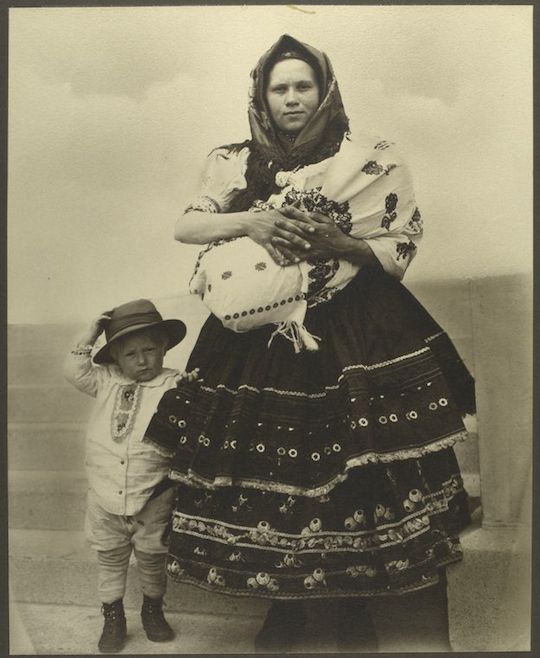
Slovak-woman-and-child


Three-Dutch-women

If headscarves are a red flag, these Slovakian and Dutch women would be held up for quite a while if they were screened today.

And what about these women?

They wear headscarves and have strange looks in their eyes; the one on the left seems pretty angry. Both of them were likely deeply committed to a religion that most native-born white Americans rejected as foreign and dangerous to the U.S. government and American Way. Yes, they were Italian Catholics who whisked into this country without anyone checking to see if they were terrorists. This at a time when the U.S. government was actually suspicious of Catholics as agents of the Pope. Yes, the Immigration Act of 1924 would limit the number of southeast European Catholics (and Jews) who could enter the country, but they were never banned altogether.

This Algerian man would likely not get into the U.S. today dressed like this. Yet he successfully entered the country a century ago, and likely lived a quiet life. His descendants are probably living quietly in the U.S. today.

Algerian-man

What about this guy?

A-German-stowaway

No way, right? But this German man successfully entered the country, likely with no more screening than the usual six-second physical at Ellis Island.

This Russian soldier seems fairly menacing:

Cossack-man-from-the-steppes-of-Russia

Are those bullets of some kind on his jacket? That seems like a knife in his belt. Whatever he’s holding—club, sword—is also pretty violent-looking. This man came to America loaded for bear. But he got in, and you know that he got his picture taken because of his “colorful outfit”.

We just weren’t scared of people like this a century ago because we assumed that anyone who came to America would see that it was the greatest society on Earth and toe the line. We believed that our society was strong enough to take in disparate peoples and turn them into Americans. We believed our society was appealing enough to win over our immigrants and make them real Americans who would live and die for their new country.

When did we lose that faith in ourselves? When did we decide that every single immigrant, man, woman or child, was a threat powerful enough to bring down our whole system and way of life? Why did we decide it? There have been acts of terrorism in this country before 2001, and they were usually (and usually wrongly) blamed on immigrants (think Haymarket). And we’ve passed stupid laws banning certain “undesirable” immigrants: the Chinese, the Japanese, southeastern Europeans (read Jews and Catholics). But the panicky idea that all immigration is a threat, that no one should be allowed into the country unless they’re white people from Europe, that every immigrant and even every refugee must go through the most rigorous, nay impossible screening process imaginable, is recent.

Here’s a rundown of what war refugees must do if they want to enter the U.S. today, courtesy of John Oliver:

Look, it is difficult to vet people coming out of a war zone, but it’s not like we’re letting just anyone in. We are the United States of America, not Arizona State. Because just for the record here, let me just walk you through what our screening process actually is.

If you’re a refugee, first, you apply through the United Nations’ High Commissioner for Refugees, which collects documents and performs interviews. Incidentally, less than one percent of refugees worldwide end up being recommended for resettlement.

But if you’re one of them, you may then be referred to the State Department to begin the vetting process. At this point, more information is collected, you’ll be put through security screenings by the National Counterterrorism Center, the FBI, and the Department of Homeland Security. And if you’re a Syrian refugee, you’ll get an additional layer of screening called the “Syria enhanced review,” which may include a further check by a special part of Homeland Security, the USCIS Fraud Detection and National Security Directorates.

And don’t relax yet, because we’ve barely even started. Then, you finally get an interview with USCIS officers, and you’ll also be fingerprinted so your prints can be run through the biometric databases of the FBI, the Department of Homeland Security, and the Department of Defense.

And if you make it through all that, you’ll then have health screenings which, let’s face it, may not go too well for you, because you may have given yourself a stroke getting through this process so far. But if everything comes back clear, you’ll be enrolled in cultural orientation classes, all while your information continues to be checked recurrently against terrorist databases to make sure that no new information comes in that wasn’t caught before.

All of that has to happen before you get near a plane.

This process typically takes 18 to 24 months once you’ve been referred by the U.N. to the United States.

This is the most rigorous vetting anyone has to face before entering this country. No terrorist in their right mind would choose this path when the visa process requires far less efforts. But nevertheless, the House still voted on Thursday to add a few more steps.

It doesn’t seem likely that anyone in the photos above would have entered the U.S. under those conditions. And that would have been a terrible injustice. Not every immigrant is an angel. That German guy probably got into a lot of fights. But we can’t be scared of immigration. We can’t put ourselves in a lock box and say “no more immigrants”. We have to believe, as we once did, that America makes Americans, that Americans can be made, not born, and that that is a source of our greatest triumphs as a nation.

Stacy Schiff does not know anything about the Puritans

We’ve complained about this before, and we hate to start the New Year on a bashing note, but it’s been forced upon us by Schiff’s December 18 op-ed in the New York Times.

“Anger: An American History” is an attempt to contextualize the current anti-immigrant, “we are at war” environment Americans find themselves in now. This sort of contextualization is a good idea. But you can’t make up a context, and that is what Schiff does, once again, by demonizing the Puritans.

Let’s do a close-read:

From that earlier set of founding fathers — the men who settled 17th century Massachusetts — came the first dark words about dark powers. No matter that they sailed to these shores in search of religious freedom. Once established, they pulled up the gangplank behind them.

—The Puritans did not come to America “in search of religious freedom.” As we have pointed out, in The Puritans and Freedom of Religion, they came here so they could practice their own religion freely. That is a very different thing than “religious freedom”. They were persecuted in England for criticizing the Anglican church, so they came here specifically to create a new state where their own religion was the state religion. There was no “gangplank” to pull up behind them. No one in the western world that we know of was offering religious freedom at that time. To set the Puritans up as the only ones who didn’t, and as terrible hypocrites who denied others the liberty they sought, is ridiculous.

The city on a hill was an exclusively Puritan sanctuary. The sense of exceptionalism — “we are surely the Lord’s firstborn in this wilderness,” the Massachusetts minister William Stoughton observed in an influential 1668 address — bound itself up from the start with prejudice. If you are the pure, someone else needs to be impure.

—Yes, we’ve established that the Massachusetts Bay Colony was created by Puritans for Puritans. Just like Virginia was created by Anglicans for Anglicans. Schiff’s attempt to peg a start date for the concept of American Exceptionalism by tying it to the Puritans is again misguided. First, the Stoughton quote is (like almost all quotes from Puritan clergy) referring to religion and religion only: Stoughton is saying that because their parents came to America to set up a reformed Anglican state, the people listening to him are the first-born citizens of a state blessed by God with pure religion. This has nothing to do with American exceptionalism, which is a political theory that says America’s political founding as the United States was a unique—and uniquely good—event in human history because it created representative democracy for the first time and led other nations to adopt it.

Schiff does not understand either Puritan theology or American exceptionalism, and so she conflates the two. Then she makes an awkward leap to her next topic, which is:

Quakers fared badly. In Boston, Cotton Mather compared them not only to dogs, but to serpents, dragons and vipers. The great young hope of the New England ministry, he sounds as if he would have started a Quaker database if he could have. Banned, exiled, imprisoned, whipped, Quakers were a “leprous” people, their teachings as wholesome as the “juice of toads.”

Baptists and Anglicans fared little better. In 1689, Boston’s Anglicans discovered the windows of their church smashed, “the doors and walls daubed and defiled with dung, and other filth, in the rudest and basest manner imaginable.” The most moderate of Massachusetts men believed in Papist cabals; priests qualified as the radical Muslim clerics of the day. From the pulpit came regular warnings that boatloads of nefarious Irishmen were set to disembark in Boston harbor, to establish Roman Catholicism in New England.

—As so many people do, Schiff takes things that every other group in Europe did in the 17th century and pretends that only the Puritans did them. Only Puritans persecuted people who did not practice their version of Anglicanism (which evolved into Congregationalism in America). Only Puritans hated and feared Catholics. But anyone who casts even a passing glance over the history of the Reformation knows that hating anyone who did not practice your religion was the rule, not the exception. Catholics hated Protestants, Lutherans hated Calvinists, Calvinists hated Arminians, etc. etc. That’s what religious wars do: they create impermeable boundaries between sects or faiths. The Quakers were no better: they came into Massachusetts hell-bent on stripping away the Puritans’ religion and forcing their own onto the colony.

If she understood Congregational practice, Schiff would know just how much of a threat Baptists posed: they did not believe in infant baptism, which was key to the Puritans, who believed babies should be baptized as quickly as possible to bring them into the fold of believers, in case they died in infancy or childhood.

And if she read any history, Schiff would know that in 1689, the Dominion of New England was in place in all of today’s New England and in New York and today’s New Jersey. This was a government imposed by the new Catholic king of England, James II, and it stripped Massachusetts residents of their lands, their political representation, and their religious majority: everyone was forced to pay taxes to support the unreformed Anglican church at the expense of both Congregational and Baptist churches. The royally imposed governor forced Christmas and other religious celebrations that both Baptist and Congregational citizens rejected, and turned some churches into Anglican churches. This is the background to the desecration of the main Anglican church in Boston, which was part of a popular uprising against the governor that led to the overthrow of the Dominion.

The alerts naturally served an evangelical purpose. The common enemy encouraged cohesion, appealing to a tribal instinct. In the words of Owen Stanwood, a Boston College historian, the trumped-up fears neatly packaged the Massachusetts settlers’ “desire for security, their Protestant heritage, and their nascent sense of racial privilege.”

—Name the group in America at the time that did not seek to build cohesion by creating a common enemy. There isn’t one. Whites organized an identity against blacks in slaveholding regions; whites and sometimes blacks identified against American Indians; English colonists identified against the Catholic French in Canada. The list goes on. Again, something everyone did is presented as something only the Puritans did.

The enemies did not need actually to be in New England’s midst. As an Anglican official snorted from a Boston prison in 1689: “There were not two Roman Catholics betwixt this and New York.” New England was nonetheless sacrificed over and over to its heathen adversaries, according to the ministry, that era’s Department of Homeland Security.

—Schiff of course hates all Congregationalist ministers, and so connects them to the modern-day government organization she hates. In an NPR interview she did about this piece, she claimed that the ministers were the only source of information in Massachusetts because “there was no press.”

The first printing press was up and running in Boston in 1639. Pamphlets and broadsides published in London were always made available in New England. What she means perhaps is that there were no newspapers, but Publick Occurrences hit the presses in 1690. She just doesn’t know what she is talking about. People respected their ministers, but they got news from many sources.

Now Schiff moves to her favorite topic, the 1692 witch mania:

So great was the terror that year that grown men watched neighbors fly through the streets; they kicked at gleaming balls of fire in their beds. They saw hundreds celebrate a satanic Sabbath as clearly as some of us saw thousands of Muslims dancing in the Jersey City streets after 9/11. Stoughton would preside over the witchcraft trials, securing a 100 percent conviction rate. A Baptist minister who objected that the court risked executing innocents found himself charged with sedition. He was offered the choice between a jail sentence and a crushing fine. He was not heard from again. One problem with decency: It can be maddeningly quiet, at least until it explodes and asks if anyone has noticed it has been sitting, squirming, in the room all along.

—That second sentence should give everyone who reads it great pause. How many of “us” saw Muslims celebrate on September 11th? How “clear” was that for “us”? If you find yourself arguing back that very few Americans entertained such a bizarre conspiracy theory in 2001, you have an idea how most people in Massachusetts in 1692 would feel if they heard Schiff saying “they” saw people fly through the streets. Hey, they would respond; some people had witch-mania, but the vast majority of us did not, and did not support the trials, and were glad when they were over.

And it was Giles Corey, a farmer, who was killed by pressing (stones placed on his chest in an attempt to get him to confess). He was not a Baptist minister, and he had actually accused his wife Martha of witchcraft before he decided the trials were wrong, and he recanted his testimony.

The last sentence makes absolutely no sense in the context, but we are indeed squirming and squirming from reading this article.

Having firmly established that all bad things in America come from the Puritans and nowhere else, Schiff moves on to show how later generations used their inherited Puritan evil to create “toxic brush fires” of bigotry. But they only get one short paragraph, and the essay ends with the Puritans once again:

Anxiety produces specters; sensing ourselves lost, disenfranchised, dwarfed, we take reckless aim. “We have to be much smarter, or it’s never, ever going to end,” Donald J. Trump has warned of the war on terror. Amen. At least we can savor the irony that today’s zealots share a playbook with the Puritans, a people who — finding the holiday too pagan — waged the original war on Christmas.

—Christmas was not mentioned anywhere in this, but she just can’t resist adding it in. The Puritans did not think Christmas was “too pagan”. They thought God made all days equally holy, and that humans shouldn’t decide that certain days were better than others. Again, many other Protestant reformers in the 17th century  joined them in this, including Baptists and Quakers.

Creating false history does not help Americans see their way more clearly in the present. Creating a bogeyman to blame all our bigotry on is ridiculous–as if a group of people who held sway for under 60 years in one part of the country in the earliest settlement period, who if not for the Pilgrims and Thanksgiving were about to fade permanently from the public mind in the early/ mid-1800s, created all bigotry and hatred in this country and maybe the world. What does this line of “reasoning” do for the people who pursue it? What does it satisfy in them? How does abhorring a group most Americans, especially Stacy Schiff, know nothing about make present-day America a better place? How does it end hatred?

It doesn’t. Keep this in mind the next time you read about those hateful Puritans.

A Holiday Gift: Religious Tolerance

Here’s a sharp video from Dr. Larry Schweikart, University of Dayton, on the PragerU site that explains the origins of religious tolerance in the English colonies of North America, and the astounding breakthrough that was the First Amendment of the U.S. Constitution. He even gets the Puritans right! Since WordPress won’t let us import the video, we just have to give you the link:

Religious Tolerance: Made in America

Enjoy, and enjoy watching a short video rather than reading reams of text from the HP crew. That’s our gift to you!

Saints and Strangers and history

Welcome to the wrap-up to our short series on Saints and Strangers, the NatGeo series on the Plimoth settlers. We’re keeping it brief, as promised.

We’re all pretty used to the fact that movies and TV shows and series that cover historical events are never fully accurate. It’s a shame that we all accept that, but it happens because most people don’t realize that what they’re seeing is inaccurate. Beyond that, most of the writers on these programs and movies don’t realize themselves that what they’re writing is inaccurate. Myths get passed down through the generations and become the basis of popular history, while facts get bullied into a corner and completely forgotten. This is doubly astounding because almost without fail, the facts are more interesting than the fictions. But because the facts are, sadly, less familiar than the myths, the facts are less appealing, no matter how interesting they are. Writers are also afraid to deviate from the accepted norms, to tell a story that goes against conventional wisdom, because they will be accused of violating the facts. It’s a real crazy-quilt of fiction given the gravitas of fact and fact being denigrated as deviation from the norm.

In the case of the Plimoth settlers, the norms/myths are taught early on, in grade school, in America. Pilgrims, First Thanksgiving, white caps, turkey, religious freedom. One thing we were immensely grateful that S&S abstained from was telling the apocryphal 19th-century “story” of Captain Standish courting Priscilla Mullins via John Alden, and losing her to Alden. (This myth was given a nod by S&S‘ decision to portray Mullins as a sassy, flirty beauty with long flowing hair who comes on pretty strong to the dopey Alden.)

The heart of the problem is that when you begin from a myth, any research you do will be bent to the task of supporting that myth. If you believe the Pilgrims celebrated a single Thanksgiving each November as a holiday, you will read Of Plimoth Plantation‘s description of thanksgiving days as proof of this, rather than proof that days of thanksgiving were as constant as days of fasting and humiliation, and you will completely ignore the fact that one of the reasons why the Separatists left England was that they refused to celebrate any holidays.

Thus were primary resources proudly cited by S&S, but we can’t get excited about it. Ignoring reams of facts while misapplying a few facts to support a general myth is not research.

It’s always dangerous to manipulate facts to promote your own worldview, as we see from multiple political races and the claims candidates make to support their wild variations from U.S. principles of representative democracy and make them seem like tried-and-true Americana. Long story short, if you’re interested in any topic, read objective histories about it, and then bring in as many primary sources as you can to test those histories, and then make a decision about what really happened, what it meant then, and how it reverberates now.

Saints and Strangers: getting it wrong, getting it right

Welcome to part 2 of our brief series on the NatGeo channel’s Thanksgiving offering Saints and Strangers. Here we’ll go over highlights of part 2.

The episode begins with the English party going out to meet the Wampanoags who have kidnapped an English boy as a reprisal for the English raiding the Indians’ corn stores the previous Fall. This is a prime example of the show getting some things wonderfully right and others bafflingly wrong. It is accurate in presenting kidnapping as an Indian tactic, and in showing the kidnapped boy treated very well, and given clothes and gifts by his captors. Most kidnappees, Indian or English, were fully adopted into the groups they were kidnapped by (often to replace young men lost in battle) and treated very well. It is inaccurate in showing William Bradford apologizing for stealing the corn.

Remember how episode 1 showed Bradford refusing to help fix the mast on the Mayflower, even though the ship would sink without the repair, because he wouldn’t work on the Sabbath? This is a complete fabrication, but it was conjured up out of thin air to try to make a point about how devout Bradford and the Pilgrims were (as opposed to the non-Separatists on board). Having him apologize for stealing the corn is another fabrication meant to make us identify with Bradford as a good man. This is  acceptable in the context of reminding modern viewers that the English settlers did not come over with the intent of murdering as many Indians as possible, or with an immovable hostility toward all Indians. But the way in which it’s inaccurate is large and complex.

First, just as he approved fixing the mast on a Sunday, Bradford approved stealing the corn. There were two reasons: first, the settlers knew about the smallpox epidemic that had devastated the Indian population in today’s southeastern New England and actually fully consumed some groups, so when they found the corn caches untouched, they assumed the people the corn belonged to were dead. Therefore, taking their corn was not a problem. Second, even when he found out the corn’s owners were not dead, Bradford maintained the position that the corn had to be taken for the settlers to survive, which is true—they did not have enough food to last the winter.

The show’s determination to make Bradford sorry for stealing is part of its attempt to make a 17th-century person conform to 19th- and 20th-century cultural norms. The show portrays Bradford as apologetic because he recognizes the Indians as his equals, despite their race. That is a 19th/20th-century idea. For early-mid 17th-century Europeans, the only differentiator that really mattered was religion. Indians were not alien to the settlers because of their race; it was their religious difference that mattered most. They were not Christian, but almost more importantly to the Separatists, they were not people who had left the Anglican church to practice more pure Protestant worship. It was that specific for them. As we point out in The Puritans and Freedom of Religion, in Europe at that time, most people saw those who did not practice their exact form of religion as demons, heathens, spiders, monsters, and antichrists. The vitriol showered over Catholics by Protestants—and vice-versa—will turn your stomach if you read it. And within Protestantism, the proliferation of different sects produced just as much hatred. The Thirty Years’ War (1618-1648), fought mostly in the principalities that became Germany, produced war crimes and atrocities that boggle the mind, and justified them on the basis of religion. Whole towns were set on fire and the population kept inside to be burned alive because they were Protestant, or Catholic.

So the Separatists in Plimoth did not hate the Indians for being heathens as much as they hated the Catholics and disdained their unreformed Anglican brethren. At least the Indians, unlike the Catholics, had the excuse of not ever having heard the Gospel. Neither did they hate the Indians for their race. Race was a concept just getting off the ground in the mid-1600s, as African slavery came to the Americas. When Bradford faced the Wampanoags, he faced them as potential allies or potential enemies, and practiced as sophisticated a diplomacy as he could to maintain them as allies. But he wouldn’t have apologized about the corn because he would have maintained that God provided it for his people. He would have told Massasoit this, to impress upon him the supernatural support the little group of settlers enjoyed. That godly support was a bargaining chip, and it was hard for Massasoit to completely dismiss it, after seeing his people and neighboring groups harrowed by disease that the English people seemed immune to.

That’s a long, long digression on a short point, but it seems like an important one.

Here’s something the show gets very right: when Bradford wants to build a separate church building, Stephen Hopkins counters that they need to focus their energy on paying off their investors, which was absolutely true. The colony lived under the threat basically of repossession if it didn’t send valuable raw materials back to England that its investors could sell. Copper and gold were the (vain) hope; fur was the sure thing, but timber was the resource that the settlers were able to send first. Any trees cut down that first year after houses were built had to be prepared for shipment back to England, not for building a church.

Hopkins also claims that the colony is first and foremost a commercial venture, which is exactly how the non-Separatist majority of settlers saw it. The friction between them and the Separatists who saw they colony as first and foremost a religious safe-haven would eventually see the Separatists buying the non-Separatists out so they could go their “separate” ways.

One badly anachronistic moment is when, after joining forces with Hobbamock to attack the Massachusetts, English military leader Miles Standish tells the surviving Massachusetts “if you force us to violence it will reverberate for generations to come”. This foreshadowing is something that would never have occurred to Standish. It wasn’t the kind of threat Europeans made at the time. They would have said “we will kill every single one of you right now so you have no posterity”. There were to be no future generations reverberating with anything for heathens.

Another thing the show does well is to keep us guessing about Squanto’s loyalties. We will never know what his motives or goals were, whether he loved the settlers or hated them or saw them merely as pawns in his own game of power and survival. We will never know if he loved Massasoit or hated him or saw him merely as a pawn in his own game. We just don’t know. All we know is that both settlers and Wampanoags mistrusted him from time to time. So when Squanto does not translate Bradford’s words accurately when Bradford is addressed Canonicus, sachem of the Narragansetts, and turns Bradford’s words into an insult, we are left wondering why, just as everyone at the time was left.

The show goes to great lengths to tell us that Bradford really loved Squanto as a friend, and risks the colony’s survival to protect him when Massasoit demands his head. But Bradford’s own account says that he protected Squanto because “[the attack on Squanto] was conceived not fit to be born; for if [the English] should suffer their freinds and messengers thus to be wronged, they should have none would cleave unto them, or give them any intelligence, or do them service afterwards; but next they would [attack the settlers] themselves.” [160]

Bradford later writes this very direct assessment (he writes in the third person):

…they [the English] began to see that Squanto sought his own ends, and played his own game, by putting the Indians in fear, and drawing gifts from them to enrich himself; making them believe he could stir up war against whom he would, and make peace for whom he would. Yea, he made them believe they [the English] kept the plague buried in the ground, and could send it amongst whom they would, which did much terrify the Indians, and made them depend more on him, and seek more to him than to Massasoit, which procured him envy, and had like to have cost him his life. For after the discovery of his practises, Massasoit sought it both privately and openly; which caused him to stick close to the English, and never durst go from them till he died. They also made good use of the emulation [jealous rivalry] that grew between Hobbamock and him, which made them carry more squarely. And the Governor [Bradford himself] seemed to countenance the one [Squanto], and the Captain the other [Hobbamock], by which they had better intelligence, and made them both more diligent.

This is powerfully different from the show’s presentation of Bradford’s deep friendship with Squanto. Here Bradford says he, and all the settlers, began to see that Squanto would use anyone to get more private power, and that he only stayed with the settlers because he was afraid of being killed if he left Plimoth. When Squanto and Hobbamock became enemies, Bradford prudently pretended to trust Squanto while Standish pretended to trust Hobbamock, so they could get as much information out of both men as possible to protect themselves.

This is just Bradford’s side of the story—we don’t have Hobbamock’s or Squanto’s—but it rings true for the English approach to American Indians. Bradford appreciated the practical help the settlement got from Squanto regarding planting and farming, and believed God provided Squanto to help them in that way. (Bradford would likely have been glad that Squanto had been sold into English slavery so he could learn English and eventually help them.) But he did not trust Squanto, and seems not to have considered him a friend.

Oh criminy, then comes the First Thanksgiving. The biggest problem here is that Wampanoag women are shown at the tables, which did not happen.  As we point out in Truth v. Myth: The First Thanksgiving, only Wampanoag men came (about 90 of them eventually) and the time was spent hunting and holding shooting games. No women. A tiny note is that there a lot of chairs at the tables as well as benches, but chairs were an expensive rarity in Plimoth in 1621.

Mrs. Billington yells “damn them!” twice when the men heading to Wessagusset steal the settlers’ corn, which would have gotten her whipped and/or fined in the real Plimoth, where cursing was not allowed.

When Squanto dies, Edward Winslow and Bradford talk about him, and Winslow says Squanto was a schemer. Bradford grabs him by the shoulders and says “The Lord forgives you for believing you are better than that man,” another example of 19th-century religion being foisted onto 17th-century Plimoth. The Separatists did believe that they were better than Indians—and Catholics and unreformed Anglicans and anyone else who was not an English Separatist.

Right: Winslow goes to help tend Massasoit when he seems to be dying. This was a critical turning point in the difficult relations between the two groups, and the Wampanoags seemed to have believed Winslow’s god helped their sachem.

The show nears its end with a terrible myth, which is Bradford saying we have to prepare for our second Thanksgiving. Thanksgiving was not an annual tradition in Plimoth. Thanksgivings were held when appropriate, to thank God for his beneficence, just as days of humiliation and fasting were held to beg God’s mercy. There was no “second Thanksgiving” at Plimoth, but the show insists on it. At this mythical Thanksgiving, Indian women are again present and dance with English men, which was out of the question at that time.

At the very end, Bradford has a voiceover: “They called us Pilgrims, but what have we become? Saints, strangers, savages. We came for God, to move forward, for ourselves and our children.” His son arrives from Holland that Spring, and the circle is complete. Though no one ever called the Separatists Pilgrims in the 1600s.

We’ll quickly wrap this up next time—we promise it will be brief!


Saints and Strangers, myths and misunderstandings

Yes, we sat through the four hours of Saints and Strangers on the National Geographic channel (“NatGeo”), and entered into it fearing the worst. The series made an effort to be authentic, using primary sources for some of the dialogue, but in the end the show was a queasy mix of fact and fiction.

There are two main problems with this and with almost all shows that address history: the people making the show don’t understand what their historical subjects really believed, and therefore can’t use their firsthand quotes properly; and anachronism creeps in almost unavoidably.

Saints and Strangers has another problem, which is since they announced that they used primary sources, viewers are led to believe that everything they hear the characters saying is authentic, something they actually wrote down at the time. For instance, when William Bradford first lands in America, and he and his party are exploring, he says in a voiceover “there were some things God neglected to mention”—just as Indians begin to attack.

This is not 17th-century language by any stretch; Bradford never said that.  It’s 19th-century language trying to evoke “old-fashioned” talk. But beyond this relatively small problem, a larger problem with the show is revealed here: the settlers are fixated on Indian attack. Yes, the settlers are shown worrying about lack of food, but even that is all about Indian attack: how will we trade for food if the Indians are our enemies and attack us? will our pillaging of food stores bring on an Indian attack?

The English settlers we call Pilgrims (they did not call themselves that, nor did anyone else at that time; it’s really a 19th-century term although the show has Bradford saying “they call us Pilgrims”) were worried about many things, most likely in this order: 1) will the Separatist minority in the colony be able to found and maintain it as a haven of true religion; 2) will the colony make enough money to pay off its investors; 3) will more Separatists really come from Holland to bolster the fledgling colony, or will they abandon us; 4) will we have enough food to survive until the Spring; 5) will the non-Separatist majority overwhelm us and take over the colony’s government, or will they just go back to England in the Spring?

These were the main concerns because they addressed the main reason for founding the colony of Plimoth: to set up a godly commonwealth in America. The non-Separatist settlers, who were not on a righteous mission to reform Protestantism, were concerned that the Separatists were too otherworldly to run a colony and do what had to be done, and they worried that their own chances of survival would be hampered by the religious nuts running things.

Neither group was unfamiliar with American Indians. English sailors had been visiting the Atlantic seaboard (today’s New England) for decades before 1620, fishing and trading with the Indians. That’s how the Indians eventually contracted smallpox, in the 1619 epidemic that decimated the native population so awfully, just before the Pilgrims arrived. That’s how Squanto and Samoset knew English (Squanto having also been kidnapped by sailors and sold into English slavery). So Indians were not an unknown and utterly terrifying quantity. The settlers arrived feeling relatively confident that they could establish trade relations with the Indians just as their predecessors had.

For their part, those Indians remaining were not deathly afraid of the English. The English just weren’t a threat: there were less than 100 of them after a few months, and they had no power, no alliances, no nothing. The Wampanoags, Massachusetts, and Narragansetts saw the English as potential pawns in their ongoing political game of chess and nothing more. There was no reason for them to immediately destroy Plimoth.

The grave-robbing that some settlers carried out was a terrible insult and desecration, and it was taken very seriously by the Indians. The show does not make it clear that when the settlers broke into mounds that they thought were corn caches but found to be graves, they were frightened and repulsed, and usually left them to find corn caches. While the Reformation in England saw some fanatics desecrating traditional Catholic graves, and while it was common in large towns to remove old bodies when a graveyard became full to make room for new bodies, straight up robbing a grave was not “okay” in England. American Indian graves were sometimes opened by Spanish and English settlers to get an understanding of the local people’s spiritual beliefs. But the first time Plimoth settlers began to open what they thought was a corn cache and found it to be a grave, they hastily put everything back in order and left.

But in the show, one of the settlers deliberately breaks into what he knows is a grave and holds up a skull that seems to have long blonde hair—clearly implying that the Indians who lived there killed an English person (woman?) and therefore are criminals who don’t deserve any consideration. This bizarre moment is inexplicable to the Plimoth scholar, who knows that the actual Plimoth men were divided about what this meant: was an English sailor adopted into an Indian community and honored as one of them by being buried in a traditional way? or had he been murdered? They weren’t immediately panicked. And, on a side note, no women are recorded as having joined English fishing parties to America and again, an English woman would have been far more likely to have been adopted into an American Indian tribe than murdered.

To return to breaking into corn caches, Bradford vehemently protests that this is wrong; they can’t steal food, God is testing them by showing them corn that they mustn’t eat. If the makers of the show had opened Of Plimoth Plantation, Bradford’s history of the colony, they would have seen that Bradford had no such qualms. He calmly says they found corn and took it without a second thought and thanked God for it.

The urge to have Bradford reject stealing from Indians is problematic. The show’s makers want him to be a hero, so he can’t be racist. But that is not at all how the issue was framed at the time. We’ll get into this problem in the next post.

For now, the show’s intent to present Indian attack as the only concern, the only possible concern, of the settlers sits ill with the show’s generally positive portrayal of the Wampanoags, especially their leader Massasoit. This portrayal is contested by some Wampanoags, mostly on linguistic and material cultural grounds, but it’s the first time we’ve really seen American Indians presented as actual human beings who have virtues and faults and opinions and worries and axes to grind and suspicions and generosity just like any other people (rather than Noble Savages or George of the Jungle). To present the Indians as real people but the settlers as cartoon characters scared to death of savages is inaccurate and unhelpful.

Other issues: the show seems to claim that Dorothy Bradford, depressed and scared, killed herself by throwing herself overboard in the harbor. This is infuriating, and an example of not understanding the Separatists. Dorothy is shown as a weak, nervous woman (hysterical, in fact) who, when someone on the Mayflower talks about how Indians torture their prisoners screeches out to her husband, “Is such a place safe for settlement?!” She can’t accept the fact that they had to leave their young son behind in Holland, frets when William leaves the ship, and, of course, being so weak of mind, kills herself.

Where to begin. First and foremost, a woman like Dorothy Bradford, who had devoted herself completely to Christ, was extremely unlikely to kill herself. Taking your own life was a sin that damned you inevitably to Hell, and insulted God. As scholars, we posit that no devout Separatist would take her own life after so short a time of trial as the journey to America. And Dorothy Bradford was devout: you didn’t marry a man like William Bradford if you weren’t as iron-hard dedicated to your religion as he was. Second, Dorothy Bradford had already left her home to go to Holland, where life was not easy, and was not a weak, fainting female who couldn’t stand the challenges of America. She slipped overboard on the freezing, sleet-covered deck and drowned. Why is that inevitably a suicide? When the sailor falls overboard on the way over, he’s not labeled a suicide. John Winthrop’s son Henry fell overboard from the Arbella just days after it arrived in what is now Boston Harbor in 1630, but he is never labeled a suicide.

In the show, when Bradford asks what happened, he is told that she slipped on the wet deck, that it was an accident. That makes sense. But the build-up to the accident, where she is crying on deck, then her face goes deadly calm, and then she is falling face-first in a swan dive into the water, all claim suicide.

—Why are all the non-Separatists presented as loud, crude, mean, and lusty characters from Shakespeare? The show’s writers show more snobbery against them than the Separatists ever did.

—Why do the landing parties carry guns and wear full armor, but whenever they are confronted by Indians run away? Why carry guns you’re not going to use?

—When the mast of the Mayflower cracks and the ship is imperiled, Bradford says he and his men can’t help fix it because they don’t work on the Sabbath. This never happened. Separatists were not idiots, and Bradford does not record this protest in OPP. (He does, however, accurately describe the break as the result of deliberate “cunning and deceit” on the part of the ship’s owners who consistently over-laded the ship, weakening the mast, and then pawned it off on the settlers as fixed).

—When a young boy dies on ship, Dorothy Bradford says “He suffered for the sins of others.” This is a religious idea utterly alien to the Separatists that she would never have thought or said. Anything that happened to a person happened because it was God’s plan for that person, end of story. Only Christ suffered and died for the sins of others.

—Why are the houses they show in episode 1 in Plimoth so enormous? The first houses were tiny.

—A man enters his freezing hut in Plimoth in the dead of winter, where there’s a one-foot gap at the top and bottom of the door, and immediately takes his coat off since he’s “indoors” now. Then he washes his hands in a shallow basin of water. Pretty sure no one took their coat off for about 5 months over the New England winter, and water would have frozen solid inside any house. When the man’s wife dies, Bradford says “God doles out hardship to those with faith strong enough to accept it”, which is another anachronism better suited to the 19th century. Trials from God were strictly meant to reveal God’s will, and show a person how to fulfill it.

—When Squanto asks Bradford if he misses home, Bradford says “this is my home now.” Squanto asks, “Is the Lord with you now?” and Bradford stares mournfully into the distance, unable to answer. If you have read even one paragraph of William Bradford you know that his answer to that question was always, ever, and unequivocally yes yes yes. Because he believed it, and because no Protestant at that time (or now, really) ever believed God was not watching them.

—When Edward Winslow marries Susanna White they have a marriage ceremony with everyone gathered; this never happened for any Separatist. Marriage was not a sacrament (which is why divorce was allowed) and was carried out in a very brief civil ceremony with only 2 official witnesses.

—Few of the women wear caps to cover their hair, which is terribly inaccurate, and those who do have their hair flowing out from under the cap. Caps did two things: they kept your hair out of your face and your work, and they modestly covered your head as God willed. The women wore caps and kept their hair completely under them.

Next time,  part two and a wrap up. It has some good things to say about the show, and won’t be as long as this!

Classic Truth v. Myth: The first Thanksgiving

We’re still slogging our way through the unbelievably myth—no, it’s really worse: lie-packed Saints and Strangers series about the Pilgrims on National Geographic, so this week we present once again our TvM post on the first Thanksgiving. Enjoy, and have a good holiday weekend.

The first Thanksgiving: it’s a hallowed phrase that, like “Washington crossing the Delaware“, “Don’t fire until you see the whites of their eyes” or “Damn the torpedoes!”, does not bring up many solid facts. Unfortunately, “the first Thanksgiving” is usually either completely debunked, with people saying no such thing ever happened, or used as a weapon against the Pilgrims—i.e., they had a lovely Thanksgiving with the Indians and then killed them all.

The truth about the first Thanksgiving is that it did happen, in the fall of 1621. The Pilgrims had landed in what is now Massachusetts the previous November—a terrible time to begin a colony. Their provisions were low, and it was too late to plant anything. It is another myth that they landed so late because they got lost. They had intended to land south of Long Island, New York and settle in what is now New Jersey, where it was warmer, but their ship was almost destroyed in a dangerous area just south of Cape Cod, and the captain turned back. They then had to crawl the ship down the Cape, looking for a suitable place to land. Long story short, they ended up in what is now Plymouth.

Most Americans know how so many of those first settlers died from starvation and disease over the winter, and how it was only by raiding Wampanoag food caches that the colony survived at all. By the spring, there were not many colonists left to plant food, but they dragged themselves out to do so. They had good luck, and help from the Wampanoags, who showed them planting techniques—potentially just to keep the Pilgrims from raiding their winter stores again. By November 1621, a very good harvest was in, and Governor William Bradford called for a day of thanksgiving.

The Pilgrims often had days of thanksgiving. In times of trouble, they had fasts, which were sacrifices given for God’s help. In celebration times, they had thanksgivings to thank God for helping them. So thanksgivings were a common part of Pilgrim life, and calling  for a thanksgiving to praise God for the harvest would not have been unusual, and would have been a day spent largely in church and at prayer.

So the men went out to shoot some “fowls” for the dinner, and perhaps they ran into some Wampanoags, or maybe a few Wampanoags were visting Plymouth, as they often did, and heard about the day of celebration. At any rate, here is the only—yes, the one and only—eyewitness description of what happened next:

“Our harvest being gotten in, our governor sent four men on fowling, that so we might after a special manner rejoice together after we had gathered the fruit of our labors.  They four in one day killed as much fowl as, with a little help beside, served the company almost a week.  At which time, amongst other recreations, we exercised our arms, many of the Indians coming amongst us, and among the rest their greatest king Massasoit, with some ninety men, whom for three days we entertained and feasted, and they went out and killed five deer, which they brought to the plantation and bestowed on our governor, and upon the captain and others.  And although it be not always so plentiful as it was at this time with us, yet by the goodness of God, we are so far from want that we often wish you partakers of our plenty.”

That’s Edward Winslow, writing about the thanksgiving in his journal of Pilgrim life called “Mourt’s Relation”, published in 1622. We see that Massasoit and 90 of his men arrived at some point, having heard about the feast, and the Pilgrims hosted them for three days, and had some rather Anglican sport firing their guns. Certainly the Wampanoags had a right to feel they should join in, since it was their help that had led to the good harvest. A one-day thanksgiving turned into three days of feasting and games.

And that was it. People often wonder why there wasn’t another thanksgiving the next year—we have seen that thanksgivings were not annual events, but came randomly when the people felt they were needed as a response to current events, and the idea of celebrating the harvest every year didn’t make sense to the Pilgrims. They had only held a thanksgiving for the first good harvest because it was a life-saving change from the previous fall. Once they were on their feet, they expected good harvests, and didn’t have to celebrate them. It was also against their Separatist beliefs to celebrate annual holidays—like the Puritans, they did not celebrate any holidays, not even Christmas. Holidays were a human invention that made some days better than others when God had made all days equally holy. So to hold a regular, annual harvest thanksgiving was not their way. When things were going well, Separatists and Puritans had days of thanksgiving. When things were going badly, they had days of fasting. None of them were annual holidays or cause for feasting (of course fast days weren’t, but even thanksgivings were mostly spent in church, with no special meal).

That one-time harvest thanksgiving was indeed a happy event, shared in equally by Pilgrim and Wampanoag. If only that first thanksgiving–an impromptu, bi-cultural celebration–had set the tone for the rest of the interactions between the English colonizers and the Indigenous peoples of North America. Since it did not, we can only think happily of the Thanksgiving called for by President Lincoln, who made an annual Thanksgiving a holiday in 1863.

The hype around the Pilgrims’ first thanksgiving only began after 1863, when historians noted the tradition of impromptu thanksgivings in the 1600s and made an unwarranted and improper connection to the new holiday to make it seem less new and more traditionally American. Before then, their many days of thanksgiving and fasting were completely forgotten. The Pilgrims certainly weren’t the inspiration for the holiday we celebrate today—they were retroactively brought into that in the worst, most ironic way: after the Civil War, southerners resented Thanksgiving as a “Union” holiday celebrating U.S. victories in the war and so the focus was changed from fighting slavery to the Pilgrims… who supported slavery.

This year, spend Thanksgiving however you like, and share the truth about where the holiday really comes from—the depths of a terrible war fought for the greatest of causes. Let Thanksgiving inspire you to stand up for the founding principles of this nation and re-commit to upholding them in your own daily life of good times and bad.

A Nation of refugees

The wars in what we grew up calling “the Middle East”, from the Syrian civil war to the battles against the so-called Islamic State, are doing what all wars do: creating millions of refugees. This is not new in human history. Why is the U.S. a nation of immigrants? In large part because millions of people fled war in Europe during the 19th century. From the revolutions of 1848 to the wars that created Germany to the people who fled Europe after WWII, war has always grown our population in the U.S.

But that last one in the list, WWII, is actually an anomaly. It was after WWII that the U.S. began adopting policies that limited immigration, even for people claiming refugee status. There were multiple reasons for this; anti-immigration policies had begun to multiply in the 1920s and 30s, and affected people’s ability to leave Europe for America before the Second World War. These policies led to the refusal of the St. Louis in May 1939,  because it carried 937 Jewish Europeans seeking refugee status in Cuba; Cuba would not take them, and according to the Immigration Act of 1924 that cut immigration from southeastern Europe sharply, neither would the U.S. (The Jewish refugees were sent back to Europe where they fell victim to Nazism.) After WWII, the Cold War encouraged U.S. officials to restrict European and Asian immigration as we became a fortress closed against Communism.

So we actually became less welcoming to Refugees from Foreign Wars, as they used to be called, during WWII. Famously, it took an emotional visit by First Lady Rosalyn Carter to starving and dying Vietnamese and Cambodian refugees from the Vietnam War to change our policy and allow them to enter the U.S.

In the 1920s, the U.S. banned immigration based on religion and race: “undesirable” Catholics, Jews, and people who were not considered white at that time like Italians and Czechs and Russians all had their quotas lowered. Since the 1950s, immigration has been viewed through the lens of politics and religion: Catholic Latinos in the 1970s-90s, and now Muslim Middle-Easterners are the new bogeymen. In the late 19th century and to the 1930s, southeastern European Jews and Catholics were decried  loudly by panicking white Protestants: their mission from the Pope or whoever controlled them was to destroy the U.S. government and our white nation. Today, the nativists panic as they claim… the exact same thing.

Muslims can’t understand democracy. They can’t participate in it. They won’t learn English. They hate our free society. They’ll bring their religious laws here and try to enforce them. They’ll destroy our government. They’ll commit acts of terrorism.

All of these hate-panic claims were once made about Italian, Jewish, Chinese, and Catholic immigrants. Somehow none of them came true.

Yet some of our political leaders are clearly nostalgic for the bad old days. Rick Santorum thinks all Syrian refugees should go back home and fight ISIS. Somehow they will succeed where Russian air strikes have not. Carly Fiorina wants all refugees screened for terrorism before they can come here. Rand Paul has a blanket “no” when it comes to Muslim refugees. Bobby Jindal thinks all refugees should be constantly monitored in the U.S., ankle-bracelet style. And Mike Huckabee thinks it’s “crazy” to take poor people from the “desert”, “who don’t speak our language, who don’t understand our culture, who don’t share a [sic] same worldview, and bring them to Minnesota during the winter”.

Luckily none of these people are running the country. Our president faced this front of ignorance by reminding us of who we are:

When I hear political leaders suggesting that there would be a religious test for which a person who is fleeing from a war-torn country is admitted, when some of those folks themselves come from families who benefited from protection when they were fleeing political persecution, that’s shameful, that’s not American. That’s not who we are. We don’t have religious tests (for) our compassion.

This is a much-needed counter-attack against those who insist that instituting the religious tests that our Constitution absolutely outlaws and deplores as undemocratic will keep our democracy safe. Suspecting people who have fled for their lives in a war of being warmongers whose only goal is to destroy any nation that takes them in and offers them hope is beyond ignorant. And it’s beyond American.

Whenever anti-immigrant, hate laws were passed in our history, there were Americans who stood up against them. There are always Americans who fight for justice for all. That’s our true identity. That’s American. Let’s remember that. Let’s remember who we are and how we got here, always aspiring to greatest-nation-on-Earth status, because the old saw is true: if we destroy everything we stand for in the name of security, the terrorists win.

Court decisions are not “democracy”?

We were listening to the news and heard someone being interviewed say that an issue in their state had been decided by the state Supreme Court, and therefore the issue “was solved by the courts, not by democracy”.

This idea that the judiciary, one of the three branches of our government as described by our Constitution, is somehow not part of our democratic system is a baffling one. We are forced to repost our original rebuttal of this idea, from 2008, here in the continuing effort to fight this misconception:

The California Supreme Court’s decision that banning gay marriage is unconstitutional has been met with the by-now common complaint that the Court overstepped its bounds, trampled the wishes of the voters, and got into the legislation business without a permit.

A review of the constitutionally described role of the judiciary is in order.

The famous commentator on American democracy, Alexis de Tocqueville, talked a great deal in his books Democracy in America about the tyranny of the majority. This is when majority rule–the basis of democracy–ends up perverting democracy by forcing injustice on the minority of the public.

For example, slavery was an example of the tyranny of the majority. Most Americans in the slave era were white and free. White and free people were the majority, and they used their majority power to keep slavery from being abolished by the minority of Americans who wanted to abolish it. The rights of black Americans were trampled by the tyranny of the majority.

Before Brown v. Board of Education in 1954, the majority of Americans were fine with segregated schools. They used their majority power to oppress the minority of Americans who were black, or who were white and wanted desegregation.

In each example, the majority is imposing and enforcing injustice which is incompatible with democracy. They are tyrannizing rather than governing.

The judiciary was created to break this grip of majority tyranny. The legislature–Congress–cannot usually break majority tyranny because it is made up of people popularly elected by the majority. But the appointed judiciary can break majority tyranny because its sole job is not to reflect the wishes of the people but to interpret the Constitution.

If the judiciary finds that a law made by the legislature perverts democracy and imposes the tyranny of the majority, it can and must strike that law down. This is what happened in California. The court found that although the majority of Californians (as evidenced by a previous referendum) had voted to ban gay marriage, that majority was enforcing and imposing injustice on the minority. So the court found the ban unconstitutional.

This is not beyond the scope of the judiciary, it’s exactly what it is meant to do.

I heard a commentator yesterday saying the California court should have left the issue to “the prerogative of the voters”. But if the voters’ prerogative is to oppress someone else, then the court does not simply step aside and let this happen.

The same people who rage against the partial and biased justices who lifted this ban are generally the same people who would celebrate justices who imposed a ban on abortion. People who cry out for impartiality are generally only applying it to cases they oppose. See Dispatches from the Culture Wars for an excellent post demonstrating this.

So that’s what the judiciary does: it prevents the tyranny of the majority from enforcing injustice in a democracy. Like it or not, the “will of the people” is not always sacred, and sometimes must be opposed in the name of equality.

What America’s Immigrants looked like as they arrived at Ellis Island

Yes, we’ve stolen that title from the wonderful Washington Post site showing photos taken by Augustus Sherman at Ellis from 1892-1925. Sherman was the chief registry clerk at the immigration station.

His photos are wonderful because most of them show people dressed in their very best clothing, usually traditional clothes. While immigrants at that time traveled in their regular clothes because they knew the trip in steerage was dirty, they brought their best clothes to put on once they arrived at Ellis Island so that they would seem like presentable people who were a) not poor and b) good citizen material. They dressed to impress, and they had plenty of time to change during the long waiting periods between landing at the dock and being processed.

Adults and children alike were decked out in elaborate clothes. Women must have been sewing for months to create these wonderful ensembles. As the site points out, seeing these people reminds us that America has long been a place where a multitude of cultures mix on the streets, in schools, at work and at play. While immigrants did not wear these magnificent dress pieces every day, they did leave Ellis and make their way in America with them on, and brought them out on special occasions, making America a bottomless reservoir of cultural identity and expression.

It would be great if someone would create a similar archive of 21st-century immigrants. Until then, here are some samples from the Post site:

Ruthenian-woman

A “Ruthenian” woman (today’s Belarus and Ukraine)

Slovak-woman-and-child

A Slovakian woman and her son

Russian-Cossacks

Men from Russia

Algerian-man An Algerian man

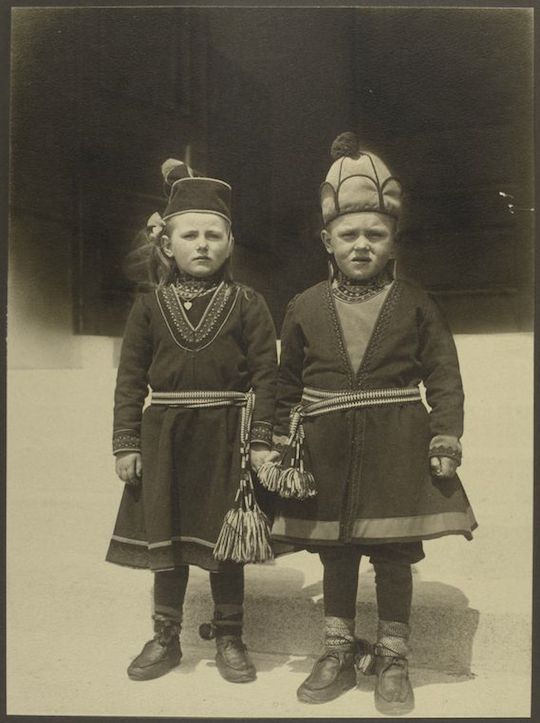
Children-from-Lapland

Children from Lapland

Norwegian-woman

A Norwegian woman