…those who don’t know history are condemned to repeat it: Trump’s America First policy

So many world events seem to be trending toward a repeat of World War II: China’s decision to “own” all the islands in the East China Sea and its vocal and powerful minority calling for a return to strict Maoism; Japan’s corresponding military build-up and refusal to acknowledge war crimes its soldiers committed before and during WWII; ethnic violence and the upswing in the growth of neo-Nazi groups (both official political parties and grassroots organizations) in Europe…

…and the racial, ethnic, and xenophobic hatred being brought to its logical conclusion by the Trump campaign in the U.S. Since the 1970s, the Republican party has been taken over by neoconservatives who have urged white Americans—rich and poor—to hate any American who isn’t white and to blame them for all the white people’s (perceived) problems. The hatred has extended to gay Americans, non-Republicans, feminists, and any other group that isn’t toeing a traditional line.

The hatred has also been extended to the federal government. It has been openly described as “the problem” since Reagan, and white Americans have been relentlessly urged to destroy it by starving it of tax money, electing people to office who are devoted to tearing it apart from the inside, and, frankly, ignoring it.

Now there is a man who is willing to admit this is the party policy and reap the harvest of all those decades of hate-mongering, who is not afraid to actually destroy our system of federal government. Other Republicans had not been willing to do this because they make their living in government work. Trump does not, and he is happy to wreck our federal government for a few reasons: he doesn’t understand how it works, and therefore will push it to do things it can’t and then blame it/shut it down; his most passionate supporters want this and he wants their admiration; and since he will be incapable of serving as president, he will appoint people to do that work for him from the ground up.

Trump has contributed to the 1930s feel of the world today in many ways, but his “America First” foreign policy, delivered in a speech on April 27, is very clear. As CNN.com reminds us:

It is extremely unfortunate that in his speech Wednesday outlining his foreign policy goals,Donald Trump chose to brand his foreign policy with the noxious slogan “America First,” the name of the isolationist, defeatist, anti-Semitic national organization that urged the United States to appease Adolf Hitler.

The America First Committee actually began at Yale University, where Douglas Stuart Jr., the son of a vice president of Quaker Oats, began organizing his fellow students in spring 1940. He and Gerald Ford, the future American president, and Potter Stewart, the future Supreme Court justice, drafted a petition stating, “We demand that Congress refrain from war, even if England is on the verge of defeat.”

—We have to break in to say that Stuart’s involvement is no surprise. For decades into the 20th century the Quaker Oats slogan outside the U.S. was “Wherever white men live, Quaker Oats will be sold.”

Their solution to the international crisis lay in a negotiated peace with Hitler. Other Yale students — including Sargent Shriver, who served in the Kennedy and Johnson administrations, and Kingman Brewster, the chairman of the Yale Daily News, future president of Yale and ambassador to the Court of St. James — joined their isolationist crusade.

Robert Wood, the board chairman of Sears, Roebuck, agreed to act as their group’s temporary chair. The growing organization soon included powerful men like Col. Robert McCormick of the Chicago Tribune; Minnesota meatpacker Jay Hormel; Sterling Morton, the president of Morton Salt Company; U.S. Rep. Bruce Barton of New York; and Lessing Rosenwald, the former chairman of Sears.

…After Pearl Harbor, the America First Committee closed its doors, but not before Lindbergh made his infamous speech at an America First rally in Des Moines, Iowa, in September 1941. After charging that President Roosevelt had manufactured “incidents” to propel the country into war, Lindbergh proceeded to blurt out his true thoughts.

“The British and the Jewish races,” he declared, “for reasons which are not American, wish to involve us in the war.” The nation’s enemy was an internal one, a Jewish one.
“Their greatest danger to this country lies in their large ownership and influence in our motion pictures, our press, our radio, and our government,” he contended. Booing began to drown out the cheers, forcing him again and again to stop, wait out the catcalls, and start his sentences over.

The America First foreign policy announcement comes after Trump began asking his supporters to stretch out their right arms as a sign of support… in a gesture that can only be described as the Hitler salute.

Trump’s response? The Republican front-runner at first dismissed the controversial comparison, calling it “ridiculous” and “a big stretch,” and insisting rally attendees were just “having fun.” “Well, I think it’s ridiculous, I mean we’re having such a great time,” Trump said. “Sometimes we’ll do it for fun, and they’ll start screaming at me, ‘do the swear-in, do the swear-in!'” …pressed [to state whether] he would stop asking supporters to make the pledge now that he was aware of the controversy, Trump said, “Well, I’ll certainly look into it.” “I mean I’d like to find out that that’s true, but I would certainly look into it, because I don’t want to offend anybody. But I can tell you that it’s been amazingly received, but I will certainly look into that.”

The more important Hitler comparison lies not with Trump, but with the American people. Most Germans though Hitler was a nut when he came on the scene. But he stayed, and after a few years people accepted him as a part of the political scene, albeit a nut. The shock and annoyance of hearing his crazy statements wore off as people became used to it. As he grew in power with the fringe, mainstream Germans began to shift from saying he would never be in power to speculating about what it would be like, and how he could be managed by “real” politicians. And then he took power, and that was that.
Let’s hope mainstream Americans are not doing the same thing. Would a Trump presidency  mean fascism? Not all at once. But even this election campaign has been the thin end of a wedge that will allow more radical, more hate-filled candidates to run in the future, and each time they do the shock will wear off a little more, and we will treat them a little more like normal candidates, and eventually, the worst will happen, if we are not vigilant. Historians always watch the long-tail past and the long-horizon future. Let’s hope non-historians will start doing the same.

A voice for justice in Mississippi

We were pleasantly shocked to hear an NPR interview with a baker in Mississippi who took a stand against the new state law, signed by Governor Phil Bryant, allowing religious organizations, individuals and businesses to refuse service to lesbian, gay, bisexual and transgender people if they feel offering such services violates their religious beliefs.

These sexuality laws are identical to the laws that allowed whites to refuse service to blacks in all but one way: the racial laws claimed a biological justification (that black people were biologically inferior to white people), while the sexuality laws claim a religious justification (famously summed up by some anonymous bigot years ago as “God hates fags”).

Somehow the example most commonly used to illustrate the anguish of being a business owner who has to serve someone they don’t approve of is the baker: Christian bakers shouldn’t be forced to bake gay wedding cakes.

This is bogus in all respects, legally and morally. As we said just a few posts ago,

Remember: if you don’t want to serve gay or trans people, don’t open a public business. Once you open a public business, you are obliged to serve the public—no exceptions. There’s no difference between these anti-gay laws and the anti-black laws that kept black people from eating in restaurants with white people, going to movie theaters with white people, and riding city buses with white people. Anti-gay laws are discrimination, and America finally got rid of that curse through the hard work of the civil rights movement in the 1950s-70s. You can’t teach kids in school that Rosa Parks was a hero if you then vote for a law that says you can keep trans people off your bus or out of your bakery.

But why listen to us repeat ourselves when you can listen to Mitchell Moore, a baker in Jackson, MS and an American who understands the civil liberties he has an obligation to uphold as an American:

RENEE MONTAGNE: As a baker, this bill would allow you to refuse service to people you don’t want to bake for. Have you ever felt forced to bake for clients that you didn’t want to serve?

—Right away, Montagne’s question points up the illegitimacy of the sexuality laws. Of course the answer is yes. Bakers, like other people who run public businesses, probably have customers they don’t like, whether it’s because those customers swear, or dress provocatively, have foreign accents, or tattoos, or wear head scarves, smell like marijuana, act rude and condescending, or do any of the other hundred things that can put people off.  But are there laws saying business owners don’t have to serve people whose clothes they don’t like? or smell? or language? No. Only sexuality. So we see immediately that the sexuality laws are singling out one type of potentially problematic customer, which is un-American and illegal under federal law.

MITCHELL MOORE: No, no that is not a problem. I am here to bake cakes and to sell those cakes. I’m not here to decide arbitrarily who deserves my cake and who doesn’t. That’s not what I do. That’s not my job.

MONTAGNE: Have you heard from others that they do have these objections?

MOORE: Not to my knowledge, no. Everyone that I know in the greater, say, wedding-service industry – we’re here to serve. The public’s made up of a lot of people. I don’t have to agree with what they do. I don’t have to support them. I serve them.

—So well-said: “I don’t have to agree with what they do. I don’t have to support them. I serve them.” When did we lose sight of this basic premise?

MONTAGNE: Well, I do gather that you are a Republican. But you oppose this bill. So what are your particular objections, other than it sounds like you don’t think it’s needed?

MOORE: So leaving aside the stupidity of passing it because it decriminalizes discrimination – which, that really is kind of the biggest issue – but I can actually say I think the law of unintended consequences is going to come back to bite the people who signed this bill. If it is my sincerely held religious belief that I shouldn’t serve them, then I can do that. And I can hide behind that language. But that language is so vague it opens a Pandora’s box. And you can’t shut it again.

—Why isn’t Mitchell Moore running for president? Yes, these laws do “decriminalize discrimination”. And yes, claiming religious frailty is just a way of hiding that discrimination and bigotry. And if these sexuality laws are allowed to stand, soon the laws about tattoos and clothing and language will all be crowding the state legislatures, too.

MONTAGNE: Well, do you consider yourself a religious person or would you…

MOORE: Yes.

MONTAGNE: …consider that maybe you don’t understand what it means to have a deeply held religious belief?

MOORE: I don’t think that there is such a thing as a deeply held religious belief that you should not serve people. There is no sincerely held religious belief to think that I am better than other people – to think that my sin is different than other people. And so I am a deeply Christian man, and those go counter to my belief system.

—Precisely: “there is no such thing as a deeply held religious belief that you should not serve people.” The Bible doesn’t say anything about who to sell a cake to. Neither does the Koran, or the Torah. And again, if you don’t want to risk violating your religious principles by opening a public business, don’t open one.

MONTAGNE: Why do you think your state elected officials, who presumably think they’re looking out for the best interests of exactly people like you – why do you think that they passed this bill?

MOORE: The assumption that they think that they’re looking out for us – that’s not what they are doing. A report just came out. We rank number one – our state government is the most dependent on federal money. We are the third most obese state. We rank at the bottom in unemployment, in education. We’ve got crumbling infrastructure. None of them are being tackled. Instead, we are passing, hey-let’s-discriminate bills.

—This is the first time we’ve heard someone state this so clearly: state governments that “protect” their people by passing laws that do nothing to stop poverty, illness, and lack of education are really using people’s religion to keep them down.

MONTAGNE: Coming from Mississippi, do you have concerns that this bill reflects on your state in a way that you wouldn’t like it to be seen?

MOORE: Yeah – Mississippi is an amazing place. And it’s filled with amazing people. But if you aren’t from here, if you don’t know that, you’re going to choose to not come here because of bills like this – because you see the state government as taking no action on hundreds of other priorities and taking action instead on trying to solve a problem that doesn’t exist. It boggles my mind.

MONTAGNE: Well, thank you for sharing this with us.

MOORE: Certainly – you’re welcome.

MONTAGNE: Mitchell Moore is a baker, and he owns Campbell’s Bakery in Jackson, Miss.

Anyone want to build a memorial to this Southern hero? We do.

If Trump could save the Union by bombing Europe with nuclear weapons…

Do you remember how, back in April 2008, we posted an analysis of the Emancipation Proclamation? It was called “If I could save the Union without freeing any slaves…”: The victory of the Emancipation Proclamation,” and it referred to the famous Lincoln-Greeley exchange:

In the months before Lincoln published his proclamation, Horace Greeley, of the New York Tribune, wrote an editorial letter on August 20, 1862 blasting the president for not abolishing slavery already. No one outside Lincoln’s cabinet knew he had the EP written and waiting. Lincoln’s response is famous, or infamous, to us now. It is the letter in which he said that if he could save the Union by freeing all the slaves, he would, and it he could save it by freeing none, he would, and if he could do it by freeing some and leaving others, he would do that.

In our effort to explain why Lincoln’s statement is not disgustingly pro-slavery but revolutionary in its essence, we said this:

Lincoln starts by saying that his main aim in the war is to preserve the Union. He sees a few options when it comes to saving the Union. He might be able to do it by freeing all the slaves. If that was the best option, he would take it. He might, though, be able to save the Union without freeing any slaves. If so, he would take that option. Or, he might be able to save the Union by freeing some slaves.

You, by now, should see that he is hinting very broadly at his Proclamation, which did just that: it freed some enslaved people and left others (in the border states) enslaved. (For the reasons we have already described—under war powers, he could only free slaves in territory at war with the U.S. without Taney and the courts striking the measure down.)

We still shudder at Lincoln calmly talking about not freeing anyone. But people at the time saw what was really shocking: Lincoln was saying that ending slavery was on the table. For the first time in the history of the United States, a president was saying he would outlaw slavery. This had never been on the table before.

It would be like an American president today saying, “If I can bring peace to the Middle East without using nuclear weapons, I won’t use them. If I have to launch a few nuclear strikes to bring peace, I’ll do that.” We would say, wait a minute—when did nuclear weapons come into this question? No one has ever talked about nuclear war in the Middle East before, but now the President is saying it’s on the table.

When we wrote that, we deliberately tried to think of the most exaggerated, not remotely possible scenario we could—a U.S. president saying s/he would use nuclear weapons on the Middle East.

But Republican presidential candidate Trump has yanked this scenario into the realm of the possible. He has in fact made our outlandish scenario look modest by saying he would bomb not just ISIS-held areas of the Middle East, but our allies and friends in Europe. Here is the relevant part of his interview with Chris Matthews:

Donald Trump: “First of all, you don’t want to say take everything off the table because you would be a bad negotiator if you do that.”

Chris Matthews: “Just nuclear?”

DT: “Look, nuclear should be off the table, but would there be a time that it could be used? Possibly.”

CM: “The problem is when you say that, the whole world heard that. David Cameron heard that in Britain, the Japanese where we bombed them in ’45 heard it. They are hearing a guy running for President of the United States talking about maybe using nuclear weapons. Nobody wants to hear that about an American president.”

DT: “Then why are we are making them [nuclear weapons]? Why do we make them?”

CM: “Because of the old mutually assured destruction, which Reagan hated and tried to get rid of.”

DT: “I was against Iraq, I would be the last one to use the nuclear weapons because that’s sort of like the end of the ball game.”

CM: “Can you tell the Middle East we’re not using nuclear weapons?”

DT: “I would never say that. I would never take any of my cards off the table.”

CM: “How about Europe? We won’t use in Europe?”

DT: “I’m not going to take it off the table for anybody.”

CM: “You’re going to use it in Europe?”

DT: “No! I don’t think so. But…”

CM: “Just say it, say ‘I’m not going to use a nuclear weapon in Europe’.”

DT: “I am not taking cards off the table. I’m not going to use nukes – but I’m not taking any cards off the table.”

And thus we have it: an American presidential front-runner, if not an actual president, saying he would use nuclear weapons on Europe. Lincoln’s statement that he would end slavery to win the war now takes second-place in the list of astonishing political statements made by presidents and/or presidential contenders. If we jinxed this by making the analogy, and by using the very words “on the table” that Trump used,  believe us, we’re sorry.

“Money talks and BS walks”—corporate reaction to “religious freedom” bills in Georgia and North Carolina

Fans of This is Spinal Tap will recognize that immortal line, spoken by Bobbi Flekman, AR tour de force for Polymer Records. When the band find their album is being banned “by both Sears and K-Mart stores” because of its sexist cover art, Bobbi overrides the band manager’s protests and justifications to say “money talks, and b*** walks”. It became an instant mantra in many industries. (See the clip here.)

And it’s proving true in the real world as well: corporations in Georgia and Atlanta have responded forcefully to the anti-American “bathroom bills” and “religious freedom” laws those states have passed or are about to vote on. In North Carolina, PayPal, Bank of America, and Dow Chemical, all headquartered in the state, have denounced the state-wide law requiring people to use the bathroom earmarked for their biological or “birth sex” (not a real term) that was conjured up to overturn a Charlotte, NC law that banned discrimination against LGBT citizens. The NBA has threatened to move the All-Star game from Charlotte.

In Georgia, HB 757, protects “religious liberty” by allowing anyone calling themselves religious to deny service in a public business to LGBT people. Disney and Unilever now threaten to pull business from the state, and the NFL says Atlanta will not host the Super Bowl if the bill is passed. Through the group Georgia Prospers, Coca-Cola, Home Depot, UPS, Delta Airlines, and Marriott Hotels have all said they will reconsider investment in Georgia or move their operations if the bill passes.

You may recall that in 2014 the NFL successfully threatened to move the Super Bowl from Arizona if its governor signed a pro-discrimination “freedom” bill, and that pressure led Gov. Brewer to decline signing the bill.

In one way this is heartening: it’s good to see corporations, which usually bend most of their efforts to breaking the law and violating the Constitution, united behind the cause of justice.

But in another way, it’s depressing: voters, lawmakers, and elected officials in many states are kept from exercising tyranny of the majority not by their love of American principles of liberty and justice for all, but by their fear of losing money. Keeping Coke or NBA dollars in their state is more important than anything, even their supposedly deeply held “religious” beliefs.

Of course, the companies are motivated by money, too; they don’t want to alienate a portion of the population that is supposed to have a lot of money to spend (an enduring though fatally outdated corporate myth about gay people is that, since they don’t have children, they spend all their money on consumer goods. The “gay American” to most companies is a white man living in a city with his partner and more money than he knows what to do with).

We can’t rely on corporations to be the guardians of justice because they are very unreliable. They are motivated by profit, and if they ever sensed that not all LGBT Americans are rich and white, they would jump off the LGBT bandwagon pretty quickly. We all have to keep working in our cities and states to remind people that what makes America great is its commitment to liberty and justice and separation of church and state.

Remember: if you don’t want to serve gay or trans people, don’t open a public business. Once you open a public business, you are obliged to serve the public—no exceptions. There’s no difference between these anti-gay laws and the anti-black laws that kept black people from eating in restaurants with white people, going to movie theaters with white people, and riding city buses with white people. Anti-gay laws are discrimination, and America finally got rid of that curse through the hard work of the civil rights movement in the 1950s-70s. You can’t teach kids in school that Rosa Parks was a hero if you then vote for a law that says you can keep trans people off your bus or out of your bakery.

In an election year where people stumble over themselves to love America the most, one easy test of who really means it is whether they support anti-American discrimination laws.

“Hearing Harriet Smith”: a new take on WPA recordings of people born into slavery

Most American know about the FWP interviewers who, in the 1930s, went into southern states and recorded the stories of black Americans who had been born into slavery. The FWP (Federal Writers’ Project) wanted to capture their stories as living history. About 2,300 people were interviewed before the FWP project expired, but the project was continued by the Library of Congress and the Julius Rosenwald Foundation into the 1940s in an attempt to find every living witness to and survivor of slavery in the United States.

Most of us who encounter these interviews read them as transcripts, usually heavily edited from hour-long conversations to just those stories of slavery that really bring its horror most vividly to life. We don’t even notice how they are written in “black dialect” (we all remember reading Huckleberry Finn), and we don’t think too much about the lives of the interviewees as they were in the 1930s and 40s when they were recorded—we assume their lives are much better.

But there’s a great article that goes in-depth into the socio-political context of the interviews, the backgrounds of the white interviewers and the pressures on the black interviewees: Hearing Harriet Smith focuses on one interviewer, John Henry Faulk, and one interviewee, Harriet Smith, to go behind the scenes and shed some light on some troubling questions that linger over the interviews.

—How did the black interviewees perceive the process? Did they feel like they were expected to tell certain types of stories and omit others?

—Why did so many black subjects talk about how wonderful slavery had been?

—Who were the interviewers? What drove them to participate in this project?

—Why was “black dialect” used so insistently by interviewers writing the transcriptions? Why didn’t they ever use standard English? (One of the answers will surprise you.)

—What errors crept into the transcripts, which were supposed to be primary resource historical artifacts, and why?

—What stories were left out of the transcripts, and why?

The site has many links out to the actual recordings so you can listen for yourself. It’s worth it to hear Harriet Smith rather than read her.


CNN’s 10 “most bizarre” elections in U.S. history

We were looking for the video CNN uses in its ads for its new series Race for the White House, which shows the changing face of the White House from the mid-1800s to the present (very interesting—more and more barriers put between the street and the building). We couldn’t find it, but in the mayhem of features on the site we did find “10 of the most bizarre elections in American history”. The name implies that many more than 10 American presidential elections were bizarre, but likely they just mean 10 were actually bizarre.

At any rate, they do a pretty good job describing the 10 elections/campaigns they list. No glaring errors. They don’t say the 1824 election really was a corrupt bargain, they just note that Jackson claimed it was. They admit that the 1876 election was rigged by racist southerners to give the Republican candidate the presidency if he would end Reconstruction. And they focus on the real issue of the 1964 campaign—Johnson’s commitment to ending institutional racism—instead of talking about the Daisy ad.

This was more than we expected of CNN, so we thought we’d pass it along with our commendation.

Make America great again–by supporting its federal government

We’re re-running this post from a few years ago to counter the constant message of the Republican presidential campaigners and those of their supporters who get on TV and the radio saying that what makes America great is its people, not its government. Marco Rubio just made this statement a few days ago at a rally.

How the Founders would shudder to hear this. If the American people are great, it’s because of their government, which empowers and ennobles them, gives them national, political, and individual freedom, and relies on the people themselves to participate in the government, by voting and/or serving in public office.

When you have a government like that, you are free, even determined to offer free public education for all, to make sure everyone gets enough food, to sit on juries so your fellow Americans can get justice. Our representative democracy—still so very rare in the world, the first of its kind, and in the minority even in the 21st century—is what gives us our national character, our optimism, our passion for justice, our sense of fair play. We infuse our government with these good things.

When we decide the federal government is the root of all ills, that decision is usually led by  selfish people who don’t want to help their fellow Americans eat or get justice or live in decent housing; they are out for themselves and themselves alone. They call themselves libertarians or rugged individuals, and they claim that they are returning to original American values that made the country great.

These people are voted into office and there they pervert the federal and state governments into criminal systems that oppress the poor and non-white and female. It’s vicious circle: People who hate the government go into it to destroy and pervert it, and then the government actually becomes the root of all evils they said it was. It’s a self-fulfilling prophecy. If America is no longer great, it’s because of these people saying they themselves will make it great again by destroying the government.

But we need to cling to our representative democracy, our principles of liberty and justice for all, taxation with representation that helps people get the things they need. We need to let it keep us generous and fair-minded. A woman on the radio this morning said she voted for Trump because “I just want a change. I want a change.”

Change in and of itself is not positive. You can’t just say I’m fed up and I will throw the baby out with the bathwater. You can’t say “change” when you mean “I want to get my own way all the time and not help anyone else.” You will get a change for the worse, and you might find that it’s a change you don’t end up liking.

Here’s the original post. We’re in it for the long haul to November and beyond.


We saw in the last post that Americans live in a unique situation: we enjoy all three types of basic freedom, national, political, and individual. Listing the nations that have offered all three freedoms to all of their citizens is a counting-on-one-hand proposition. Successfully providing and defending all three freedoms is what makes the United States great.

But it also presents some problems. Over the generations, Americans have veered between putting national freedom first and putting individual freedom first. We’re sometimes willing to give up individual freedom to be safe from attack, and sometimes unwilling to perform our duties of national and political freedom in the name of individual freedom. When the U.S. faces attack or threats to its safety, many Americans want to put laws in place curtailing individual freedoms like freedom of speech, religion, and assembly in order to at once weed out troublemakers and create a more homogenous society. Conversely, when the federal government tries to put sweeping legislation into effect, such as government-paid health care or social security or gun control, many Americans loudly protest the move as an infringement of their individual rights.

Individual rights also lead many Americans to neglect their political freedom to participate in government by holding office and/or voting. The feeling that participation in our democracy  is unnecessary, an extra rather than a basic tenet of American citizenship, is pervasive. Resentment of “big government” leads many people not to want to participate in government at all, as if they would be supporting an invasive federal government by voting or running for office, although the way to change the nature of government is to join it or vote in those you wish to have representing your views. The belief that our government is an impediment to individual freedom is sadly prevalent.

Holding all three freedoms in equal esteem is difficult. Many Americans have come to see our individual freedoms as the wellspring from which national freedom is born, and thus individual freedoms are the most important. But these individual freedoms come from our government, from the Constitution, and last only as long as we have our national freedom. Without national freedom, there is no individual freedom, and national freedom only lasts as long as we have political freedom. Giving up our right to vote—for refusing or failing to vote is tantamount to giving up that right—is a dangerous step toward losing national and individual freedom. Once we stop demanding that our government really represent us, our democracy is crippled, and then the nation is open to outside threats. If individual freedoms are seen as separate from or at odds with national and political freedom, then we begin to prioritize our liberty to do whatever we want at the expense of national safety.

Individual freedom is really our freedom to live up to the founding principles of our nation. It’s our freedom to speak and worship and serve our country as we each see fit, and not really the freedom to be lazy and uninvolved and prioritizing our own choices over other people’s choices. It is the freedom to live together as one without having to be the same, not the freedom to push our own ways at the expense of everyone else’s.

Political freedom is our freedom to have a democracy, to be represented accurately in the federal government, and to preserve the individual freedoms we enjoy.

National freedom is the end result of the first two freedoms, because we who value our individual and political freedom will not allow our country to be destroyed by outside forces—or by those Americans who don’t believe in the full triad of freedoms.

Going forward, we’re seeking to bring our three freedoms into balance and remember that each is equally valuable, and each demands our equal time and effort to maintain.

Michael Hayden: don’t be ashamed of torture

We were innocently listening to the radio when an interview with retired Air Force General Michael Hayden came on. He ran the NSA for a decade (1999-2009) and was director of the CIA. He’s just written a memoir, which unfortunately over the past 15 years has come to mean a high-level military director reveals all the ways he violated our Constitution. Whether he expresses regret or not is always the question; Hayden answered that question in the negative very quickly. The transcript we’re relying on can be found here.


In explaining the monitoring of all Americans’ phone calls by the NSA, Hayden was unapologetic:

SIEGEL: …in order for this program to work over the years – and we’re talking about a threat that we foresee existing for many years…

HAYDEN: …Right.

SIEGEL: You’re going to store my data through many different CIA directors, NSA directors, FBI directors, members of Congress, presidents, all the while telephonic history – at least the metadata history – is going to be accessible to the government.

HAYDEN: It’s going to be preserved. And access was a very important part of this program. And it was accessible by about two dozen people at NSA whose access to the database had keystroke monitoring on it. Now, look, any power in the government can be abused. But what you’ve just described is an equally powerful argument against arming policemen. That can be abused too, Robert.

SIEGEL: That can be abused.

HAYDEN: We actually need to give government some power to protect us…

—How the argument that the federal government monitoring all phone calls at all times and keeping that data seemingly forever is comparable to refusing to let the police carry weapons is beyond us… except that it’s actually a dead-on comparison: our police are fatally over-armed, carrying military-grade weapons they don’t need that they come to abuse, and our government is violating the Constitution by stripping us of our privacy, a power which can only end in one of two results: either the monitoring is so light and uninformative that it’s never consulted and therefore ignored; or it is gradually and inevitably used to monitor more and more citizens for its’ own sake (i.e., abused).


…SIEGEL: Toward the end of your tenure at the Center Intelligence Agency, the question of interrogations became extremely controversial. You advised your successor – President Obama’s nominee, Leon Panetta – what to say about waterboarding. I want you to tell us what your guidance was.

HAYDEN: Yeah. I simply said do not use the word torture and CIA in the same sentence ever again. You can object to some of the enhanced interrogation techniques. You can, in your heart of hearts, believe they meet some legal definition of torture. But Leon, you’re taking over a workforce that did these things in good faith, that did these things with the assurance of the attorney general that they indeed were not torture. Do not accuse them of felonies.

SIEGEL: As a matter of institutional politics or as a matter of truth?

HAYDEN: Well, certainly as a matter of truth. Look, I get it. Honest men differ. A lot of good people describe these things as torture. The definitive legal judgment under which the agency was operating – and, you know, sooner or later, Robert, somebody’s got to call balls and strikes, and that’s the way it is.

—“Interrogations” is the new euphemism for torture. So is “enhanced interrogation”. What is interrogation enhanced by? Torture. We don’t think one has to consult one’s “heart of hearts” to know that water boarding and electro-shocking and force-feeding is torture: if you wouldn’t want it to happen to you if you were in military custody, it’s torture. The idea that you can do something bad “in good faith” is already tenuous: it’s technically possible, but only if you don’t know that what you’re doing is bad. No one tortures in good faith because everyone knows it’s bad. Hayden’s argument is, frankly, exactly what Nazi soldiers said after the war: I didn’t know it was bad, I was told it was good.

And we would add that Hayden sort of protests too much: you don’t threaten people and try to stop them from calling something torture if you really don’t believe it was torture, or if you really believe there’s nothing wrong with torture. You do that when you know it was torture, and that torture is wrong, and you want to hush it up.

The last statement is beyond belief. “Honest men differ”? And the last sentence is telling: he starts to say the definitive legal judgment is that it was not torture, then right-turns into saying well, the judgment the NSA was working from (a cobbled-together judgment created to justify NSA’s actions as opposed to an official legal judgment), then just drops it and says “we just decided it was necessary.” Anyone who resorts to baseball analogies to justify torture is beyond callous; they’re not in their right mind.

We’ll break the next section down bit by awful bit:

SIEGEL: But if we read accounts of ISIS waterboarding hostages somewhere in Syria or Iraq, I don’t think we’d hesitate but to say they’re torturing these people.

HAYDEN: Well, did ISIS have someone present who was legally and morally responsible for the well-being of the hostage? Did ISIS have someone there with monitoring devices on the body of the hostage? Does ISIS have a rule that anyone in the room can call knock it off if they believe the interrogation..

—Hayden conjures up a 1984 image of an American sitting quietly in the corner while someone is tortured making sure that the person being tortured is happy. And telling the torturers to stop if the torture impacts the prisoner’s well-being.

SIEGEL: …Now the person that’s being waterboarded can’t call knock it off.

HAYDEN: No.

SIEGEL: You’re saying somebody who’s part of the team.

HAYDEN: Right, who’s part of the team.

—If you’re “part of the team”, are you likely to tell your fellow-torturers to stop? If, as Hayden claims, the torturing was done in good faith because Americans felt it was the right thing to do, when would anyone step up and say to stop?

SIEGEL: I will – I checked reference books. Merriam Webster’s Dictionary cuts you a break. They say it’s a form of interrogation, waterboarding. The Encyclopaedia Britannica calls it a method of torture. The Oxford English Dictionary calls it a form of torture. I mean, must one take a very legalistic and narrow view of torture rather than say look, you guys – what you did, you believed to be legal. You were acting in the flush of 9/11 with the expectation of further attacks, but this was wrong. What you did was wrong.

HAYDEN: Oh, that’s a totally honorable position. I get that. What I don’t get is someone who says by the way, it didn’t work anyway.

—Hayden uses the word “honorable” in a despicable way here to mean “bleeding hearts who don’t want to live in the real world”. That’s why he then takes an otherwise baffling left-turn to say it’s crazy to claim that torture doesn’t get results.

SIEGEL: You would say it worked?

HAYDEN: I would say we got information from the people against whom we used enhanced interrogation techniques. We moved them from a zone that was pretty much represented by defiance to a zone where they were at least more compliant, more willing to talk about the things we believed we needed to know to keep the country safe.

—Of course they got information; people who are being tortured will say anything to stop the torture. It’s terrible and telling that Hayden refers to that information as “things we believed we needed to know”—the torturers decided to believe what they heard. Of course they did; you have to find a way to sleep at night.

The interview moved on, but we were left a wreck in the wake of this passage. Americans do not torture. We led the world in banning torture of prisoners of war. We believe in justice for all. If you can find an American who believes an American military service member should be water-boarded if captured by an enemy, then we might change our minds, but that won’t happen.

It reminds us of something Abraham Lincoln said in a debate with Stephen Douglas where Douglas had gone on for a half-hour justifying slavery as not so bad. Lincoln basically said, Douglas seems to think slavery is good but if you asked him to be a slave himself he would say no.

We don’t want to be tortured, so we shouldn’t torture—even if it produced good information (which is does not). We can’t let people like Michael Hayden convince us otherwise.


Confusion on the campaign trail in South Carolina

We were listening to NPR yesterday morning and heard yet another story about the upcoming primary in South Carolina, this one focused on the drive to win the votes of military personnel, who make up about 25% of eligible voters in that state. It very quickly changed from just another story to one that brought up several boggling contradictions. For this post, we’re working from the transcript of the story.

Just outside the small town of Walterboro in South Carolina’s low country yesterday, the stage for a big outdoor rally featured giant American flags and camouflage bunting.

—Camouflage bunting? This is very hard to picture. The whole point of bunting is that it is another way to display the colors of the U.S. flag, which is desirable because it shows loyalty to and support for the United States. Using camouflage bunting creates a queasy equivalence of the nation with the armed forces, and we wondered who made it. A quick look online did not uncover U.S. flag-type bunting, though camouflage-pink baby bunting is available… it made us wonder if one of the campaigns created it especially for South Carolina campaigning, which again creates a queasy one-to-one identification of the U.S. with its military (and nothing but its military).

…in the hours before that speech by Donald Trump began, a long line formed on the wooded property, including many voters with military ties, among them 58-year-old Jim Shinta, a veteran of both the Army and the Air Force.

JIM SHINTA: I never registered to vote before until this election.

—If you are eligible to vote and never vote, you are not doing your duty as an American. Participating in our representative democracy is crucial. When people do not vote, the system becomes rigged in favor of those who know they can push through un-American policies and laws simply because no one will turn up to vote against them. Serving in the armed forces can be a way to serve your country, but voting—keeping our democracy alive and in good working order—is far more important. There’s no America to defend if there’s no participatory democracy.

GONYEA: He says Trump is the reason. Shinta likes Trump’s promise to restore U.S. respect around the world.

What do you want to see Trump do in that regard?

SHINTA: Defeat ISIS number one, close the borders – that’s number two.

—We have commented recently on this mindset (at Nation of Refugees and Immigrants have always been scary looking, but that’s never stopped us before); here the desire to defeat ISIS is oddly connected with closing the U.S.-Mexican border, and the message is that all outsiders are evil threats and the U.S. must destroy the worst of them and keep out the rest of them, and live in a splendid isolation of perfection. The day the U.S. closes its borders is the day we should dismantle the Statue of Liberty. But we get the feeling Shinta does not mean all borders—he probably doesn’t mind non-Latin or non-Syrian immigrants coming in. It’s a partial border closing, a racially based border selection, that again sits ill with the concept of liberty and justice for all.

…Nearby is 49-year-old Shawn Sauerbrei, who was in the Marines for 23 years. He has no doubts about Trump, saying it’s great to have a candidate who’s truly committed to helping veterans. He also says people should take some of Trump’s over-the-top rhetoric with a grain of salt.

SHAWN SAUERBREI: You know, if he uses the language, it’s Donald. He makes people cheer. He makes people think that OK, he’s going to do something.

—The conflation here is dangerous: Trump says he’s going to do some crazy things that you can ignore because they’re meaningless… yet these are the things that make people happy—they’re the things people want him to do. So which is it: we can ignore it because no one really means it, or it’s exactly what people want? This question is immediately answered:

GONYEA: But on some of Trump’s very tough talk, Sauerbrei says it’s warranted, like when Trump says he’ll bring back waterboarding and worse.

SAUERBREI: I think we’ve got to do what we’ve got to do for terrorism. If he wants to bring it back – hey, if it works it works. If it doesn’t, I’m sure he’ll try something else.

—This is a prime example of deciding something is okay and then ignoring all evidence it is not. Torturing prisoners has been proved over and over to be worthless, because people will say anything to stop the torture. So it doesn’t work. Sauerbrei himself goes back and forth: at first torture is “what we’ve got to do”, and then “if it works it works”, and finally “if it doesn’t, we’ll try something else”. Deep down he knows torture is pointless and even counter-productive, but like the people he discounts in his previous statement, the talk of torture makes him cheer because it means Trump will do something.

Even if torture did get good, solid results, a nation devoted to justice can never, ever use it. The U.S. led the global campaign against torturing prisoners of war in the 20th century. We can’t let it now lead a global campaign promoting torture. It’s not compatible with our founding principles, and we would think someone who took an oath to protect his nation would be more interested in protecting it from tearing its integrity to shreds.

…Meanwhile, at a Jeb Bush event in North Charleston, 48-year-old Derek Robbins says the military has been neglected under President Obama. Robbins’ son currently serves in the Air Force.

DEREK ROBBINS: We have one in the service. And so we see how important that is. And to see the military, you know, to be downgraded – it’s very important to rebuild that strength.

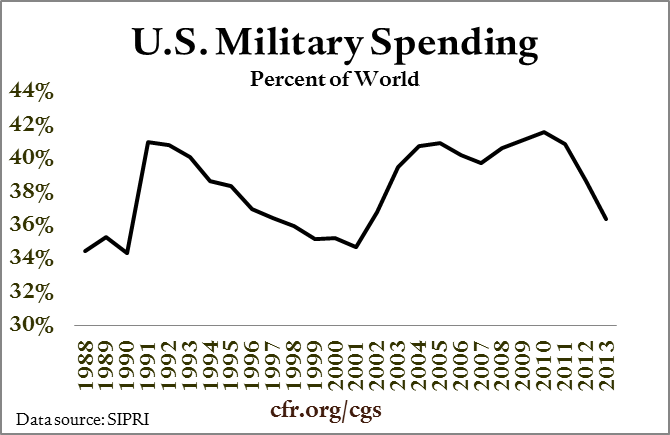
—The idea that the military is being pushed into a dark corner and allowed to rot is just another example of deciding something is true and sticking to it no matter how many proofs to the contrary you see around you every day. Let us offer just two graphics:

001_military_spending_dollars

002_military_spending_percent_of_world

Since September 11th, military spending has skyrocketed, and actually had a strong surge upward during President Obama’s first term (after a slowdown during Bush’s second term). Even the decline in Obama’s second term leaves spending levels far higher than they’ve been for nearly 40 years. So the military  has not been neglected…

…unless you mean spending on people, not equipment. What these veterans in South Carolina are really talking about is support for people in active service and for veterans, especially those with health problems related to their service. The U.S. treats its veterans shamefully for the most part, providing little to no health care, counseling, insurance, or just plain money and time and people and care for the men and women who serve in its ranks. Veterans dying on a wait list for VA hospitals make the news, then fade away. The high suicide and murder rate among veterans is well-known, yet the government does almost nothing about it.

When this is the problem, people should say so plainly instead of making broad statements about the military being downgraded and needing to rebuild its strength. No military is stronger technology and materiel-wise than ours. But our military is weak and tottering when it comes to the mental and physical health, the income, and the security of its members. If Trump torturing POWs and bombing the sh** out of China will fix those things, then we’re all for it. But it won’t.

And so we leave South Carolina with a sense of foreboding. Simply being in the military is not patriotic. You have to support, and vote to support, the founding principles of this nation if you want to protect and defend it. Let’s hope the vote turns out well for the democracy and justice the U.S. is meant to stand for.

We never used to claim America was a Christian nation

It’s short but sweet: in 1797 the Senate ratified the Treaty of Peace and Friendship with the Barbary States (today’s Tunisia, Algeria, and Morocco, and what was called Tripolitania). These were autonomous provinces of the Ottoman Empire in North Africa that made a living harassing shipping in the Mediterranean. Barbary pirates were a scourge to Ottoman, European, and U.S. shipping, and the U.S. attempted to use diplomacy to protect its shipping (though the U.S. would eventually fight two wars with the Barbary States in 1801 and 1815 to put a stop to pirate attacks).

Article 11 of the treaty reads thus:

As the government of the United States of America is not in any sense founded on the Christian Religion,-as it has in itself no character of enmity against the laws, religion or tranquility of Musselmen,-and as the said States never have entered into any war or act of hostility against any Mehomitan nation, it is declared by the parties that no pretext arising from religious opinions shall ever produce an interruption of the harmony existing between the two countries

Let’s break that down: 1) the U.S. is not founded on Christian principles; 2) the U.S. would not sign a treaty with any state that had “entered into any war or act of hostility” against a Muslim nation; 3) religious difference can never be used as an excuse for war between the U.S. and the Barbary States.

We offer this not to the ongoing debate about accepting Muslim refugees from the wars in the Middle East, nor to say there is no difference between Islam as practiced in 1797 in North Africa and Islam as practiced today in nations the U.S. is in conflict with. We offer it as rebuttal, from the Senate itself, of the poisonous idea that the U.S. was founded to be a Christian nation with a religious mission. Read any founding text and you will fail to find that belief proffered in any way. The mission of the U.S. is to promote representative democracy, liberty and justice for all, and that’s it.