Classic Truth v. Myth: The first Thanksgiving

We’re still slogging our way through the unbelievably myth—no, it’s really worse: lie-packed Saints and Strangers series about the Pilgrims on National Geographic, so this week we present once again our TvM post on the first Thanksgiving. Enjoy, and have a good holiday weekend.

The first Thanksgiving: it’s a hallowed phrase that, like “Washington crossing the Delaware“, “Don’t fire until you see the whites of their eyes” or “Damn the torpedoes!”, does not bring up many solid facts. Unfortunately, “the first Thanksgiving” is usually either completely debunked, with people saying no such thing ever happened, or used as a weapon against the Pilgrims—i.e., they had a lovely Thanksgiving with the Indians and then killed them all.

The truth about the first Thanksgiving is that it did happen, in the fall of 1621. The Pilgrims had landed in what is now Massachusetts the previous November—a terrible time to begin a colony. Their provisions were low, and it was too late to plant anything. It is another myth that they landed so late because they got lost. They had intended to land south of Long Island, New York and settle in what is now New Jersey, where it was warmer, but their ship was almost destroyed in a dangerous area just south of Cape Cod, and the captain turned back. They then had to crawl the ship down the Cape, looking for a suitable place to land. Long story short, they ended up in what is now Plymouth.

Most Americans know how so many of those first settlers died from starvation and disease over the winter, and how it was only by raiding Wampanoag food caches that the colony survived at all. By the spring, there were not many colonists left to plant food, but they dragged themselves out to do so. They had good luck, and help from the Wampanoags, who showed them planting techniques—potentially just to keep the Pilgrims from raiding their winter stores again. By November 1621, a very good harvest was in, and Governor William Bradford called for a day of thanksgiving.

The Pilgrims often had days of thanksgiving. In times of trouble, they had fasts, which were sacrifices given for God’s help. In celebration times, they had thanksgivings to thank God for helping them. So thanksgivings were a common part of Pilgrim life, and calling  for a thanksgiving to praise God for the harvest would not have been unusual, and would have been a day spent largely in church and at prayer.

So the men went out to shoot some “fowls” for the dinner, and perhaps they ran into some Wampanoags, or maybe a few Wampanoags were visting Plymouth, as they often did, and heard about the day of celebration. At any rate, here is the only—yes, the one and only—eyewitness description of what happened next:

“Our harvest being gotten in, our governor sent four men on fowling, that so we might after a special manner rejoice together after we had gathered the fruit of our labors.  They four in one day killed as much fowl as, with a little help beside, served the company almost a week.  At which time, amongst other recreations, we exercised our arms, many of the Indians coming amongst us, and among the rest their greatest king Massasoit, with some ninety men, whom for three days we entertained and feasted, and they went out and killed five deer, which they brought to the plantation and bestowed on our governor, and upon the captain and others.  And although it be not always so plentiful as it was at this time with us, yet by the goodness of God, we are so far from want that we often wish you partakers of our plenty.”

That’s Edward Winslow, writing about the thanksgiving in his journal of Pilgrim life called “Mourt’s Relation”, published in 1622. We see that Massasoit and 90 of his men arrived at some point, having heard about the feast, and the Pilgrims hosted them for three days, and had some rather Anglican sport firing their guns. Certainly the Wampanoags had a right to feel they should join in, since it was their help that had led to the good harvest. A one-day thanksgiving turned into three days of feasting and games.

And that was it. People often wonder why there wasn’t another thanksgiving the next year—we have seen that thanksgivings were not annual events, but came randomly when the people felt they were needed as a response to current events, and the idea of celebrating the harvest every year didn’t make sense to the Pilgrims. They had only held a thanksgiving for the first good harvest because it was a life-saving change from the previous fall. Once they were on their feet, they expected good harvests, and didn’t have to celebrate them. It was also against their Separatist beliefs to celebrate annual holidays—like the Puritans, they did not celebrate any holidays, not even Christmas. Holidays were a human invention that made some days better than others when God had made all days equally holy. So to hold a regular, annual harvest thanksgiving was not their way. When things were going well, Separatists and Puritans had days of thanksgiving. When things were going badly, they had days of fasting. None of them were annual holidays or cause for feasting (of course fast days weren’t, but even thanksgivings were mostly spent in church, with no special meal).

That one-time harvest thanksgiving was indeed a happy event, shared in equally by Pilgrim and Wampanoag. If only that first thanksgiving–an impromptu, bi-cultural celebration–had set the tone for the rest of the interactions between the English colonizers and the Indigenous peoples of North America. Since it did not, we can only think happily of the Thanksgiving called for by President Lincoln, who made an annual Thanksgiving a holiday in 1863.

The hype around the Pilgrims’ first thanksgiving only began after 1863, when historians noted the tradition of impromptu thanksgivings in the 1600s and made an unwarranted and improper connection to the new holiday to make it seem less new and more traditionally American. Before then, their many days of thanksgiving and fasting were completely forgotten. The Pilgrims certainly weren’t the inspiration for the holiday we celebrate today—they were retroactively brought into that in the worst, most ironic way: after the Civil War, southerners resented Thanksgiving as a “Union” holiday celebrating U.S. victories in the war and so the focus was changed from fighting slavery to the Pilgrims… who supported slavery.

This year, spend Thanksgiving however you like, and share the truth about where the holiday really comes from—the depths of a terrible war fought for the greatest of causes. Let Thanksgiving inspire you to stand up for the founding principles of this nation and re-commit to upholding them in your own daily life of good times and bad.
Sons of Liberty on “History” is terrible and stupid and partly accurate

Everyone by now is talking about History.com’s Sons of Liberty and how blazingly inaccurate it is. Everything that can be falsified has been falsified, from the ages of the leading participants to their motives to their actions. The AV Club sums it up better than we can here.

We went to the History.com website to take a look and were intrigued, given the circumstances, to see a box called “Historians’ View” on the landing page. Once clicked, we came to a page that begins with this statement:

“SONS OF LIBERTY is a dramatic interpretation of events that sparked a revolution. It is historical fiction, not a documentary. The goal of our miniseries is to capture the spirit of the time, convey the personalities of the main characters, and focus on real events that have shaped our past. For historical information about the Sons of Liberty and the dawning of the American Revolution, please check out the links below.”

A slew of links out to other resources follow this, and most of them are accurate, which seems baffling at first—if you know the real story, why not tell it?

But that brief statement explains all. Should the “History” channel offer historical fiction rather than fact? No. Should it present historical fiction as a documentary for TV viewers, with this disclaimer buried below the episodes on the website? No. Should it promote 21st-century gun values by claiming that they are part of our hallowed revolutionary history? No.

The latter is most important, because the Revolution was all about our evolution from a tradition of mindless, horrible violence to a focused legal, philosophical, and military fight for liberty and justice. In our post The Boston Tea Party and a Tradition of Violence, we describe the terrible violence and destruction that Americans felt no qualms about using when they were upset, or for no real reason at all. Violent action was sanctioned in the American colonies in ways it never was in Britain. Mobs formed at the drop of a hat, and destroyed people’s homes and businesses—literally tearing them apart brick by brick—to settle personal grudges as well as political arguments. Tarring and feathering, which is somehow presented as a harmless prank today, involved holding people down naked and pouring boiling tar over their bare skin, then covering them with feathers. At the time, it was called “the American torture”. It cost many lives.

It was this kind of violence that the real Sons of Liberty’s leaders began to realize had to go if Americans wanted to claim they were calling for a just war against Britain. The Boston Tea Party was the striking departure from that tradition of violence. It was deliberately carried out without costing a single life—the men who called for the protest and led it in the harbor read the riot act to all participants: no one was to use any violence against any one. The protest had to be completely nonviolent for the same reason Martin Luther King wanted civil rights protests to be nonviolent: to show the injustice of the inevitable hostile reaction when compared with the high ideals of the protestors. And it was successful. The Tea Party was completely nonviolent, and that’s what aroused general public sympathy throughout the American colonies when the British cracked down so hard on Massachusetts in retaliation.

So making “Sons of Liberty” violent is indeed to “capture the spirit of the times”, as the disclaimer says, and if early episodes showed the unthinking violence our forefathers used early in the run-up to revolution, it would be completely accurate. But then it has to show the evolution away from violence in late 1773. It has to focus on the efforts of John Hancock, the Adams cousins, and others to swerve the growing energy for revolution away from mindless personal attacks to directed, politically powerful stands for liberty that could serve as building blocks for that liberty.

Instead, this series unsurprisingly focuses on imaginary affairs and other forms of make-believe that just confirm our judgment that the series’ producers and the “History” channel either a) did not know the real story or b) did not believe the facts were interesting enough to present, or both. It’s baffling how many shows about historical events believe those events were so incredibly boring they’re not worth making a show about, and fill in with guns and sex and made-up speeches and events instead. If you think the facts are boring, just write your fictional show and be done with it. Why call it Sons of Liberty when it’s not about them?

Perhaps one day, 100 years from now, someone will write a miniseries about the producers and management at the History Channel that shows them all as ex-cons who commit terrorist activities on the weekends. They could hardly complain, could they, from beyond the grave?

Paul Revere’s time capsule opened to reveal… a pine tree

The Old State House in Boston has been undergoing renovations, and two time capsules have been found in it. The first, laid away in 1901, was found inside the head of the gold-plated lion atop the building and was opened in October 2014 to reveal letters and business cards from Massachusetts politicians, and multiple newspapers from that great age of newsprint. The contents of the second capsule, which was found under a foundation stone, were just revealed to the public.

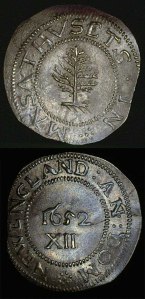
This second capsule is by far the more exciting. It was placed under the State House on July 4, 1795 by Governor Samuel Adams and Paul Revere, among others, to commemorate the impressive 20th anniversary of American independence. A rundown of the capsule and all of its contents is here, but we want to focus on one particular item in it: a “1652” pine tree shilling.

1652-massachusetts-pine-tree-shilling-large-planchet

This humble coin was one of the first revolutionary acts to take place in English America, but merely one in a string of stands for independence made by the Puritans of the Massachusetts Bay Colony.

In colonial America—from its beginnings in 1607 right up to independence—actual money was scarce. There were no mints in North America to mint coins. (Paper money as we know it did not exist.) In most colonies, there was either no metal to coin, or, as in Virginia, metal was available but the colonists did not have the wherewithal to mine it. Colonists had to rely on coins coming from England, usually via the Caribbean, where trade was strongest. Items called “Spanish dollars” were used most often as currency. These were not real coins produced in a mint. They were round slugs of silver with no markings that were quickly cut in New Spain so they could be sent to Spain and melted down for different purposes, from silverware to coins. But since these “cobs”, as they were called, were made of silver, they were hijacked in the Americas to be used as currency. As with all coins through human history, they were clipped: someone would trim the edges of the coins to make them slightly smaller, save the trimmings, and melt them down to make more coins for themselves. This meant that the value of the Spanish dollar was unreliable—one might weigh 3 ounces while another weighed 5. On top of that, counterfeiters would reproduce Spanish dollars by mixing silver and alloy. No one could be sure if their Spanish dollars were really worth what they were supposed to be worth. In New England, it was far more reliable to use wampum, which American Indians manufactured to strict standards of quality. Wampum was the most valuable currency in colonial America for many decades in the 1600s.

But Europeans still valued silver, too, and all that suspect Spanish silver coming into North America was causing enormous economic problems, so the MBC came up with a solution. In 1652, the General Court (Massachusetts’ elected legislature) ordered that the colony would begin producing its own silver coins. Here is part of that order:

…all persons what
soever have liberty to bring in unto the mint house at Boston all 
bullion plate or Spanish Coin there to be melted & brought to the
 allay of sterling Silver by John Hull master of the said mint and his sworn officers, & by him to be Coined into 12d : 6d : & 3d pieces which 
shall be for form flat & square on the sides & stamped on the one
side with N E & on the other side wth the figure XIId VId & IIId—
according to the value of each piece, together with a privy mark—which shall be Appointed every three months by the Governor & known 
only to him & the sworn officers of the mint.

The denominations represented in Roman numerals in the order are threepeence, sixpence, and one shilling. The coins are known as “pine tree shillings”  because they had an image of a pine tree on one side. Trees were a major export from the MBC, as the huge trees of North America made perfect masts for ships. All coins read 1652, to mark the year of the mint’s founding, which is why they are referred to today as “1652” shillings even if they were minted in 1662, 1673, etc.

The people of Massachusetts were willing to bring in their shifty Spanish dollars and bullion that had no practical use value to be melted down into MBC coins at the new mint. Indeed, they brought in silver bars, candlesticks, jewelry, and other items that were of no use to them and had likely been brought over with the emigrants from England for fear they might be stolen or lost track of by their agents and/or relatives.

The Boston shilling, as the coins came to be known, was enormously and immediately popular, and began circulating throughout North America, much to the chagrin of the Massachusetts government. The whole point of minting its own coins had been to keep silver money in Massachusetts to steady the economy. But the coins were flowing out of the MBC to other colonies, which meant that Massachusetts wealth (its people’s silver) was accruing in and enriching Virginia, New Amsterdam, and New France.

Its mint caused political problems for the MBC as well. Minting coins was something only a royal government had the authority to do. Colonists in America had absolutely no authority to mint coins—only the king of England could grant that. In 1652, of course, England had no king: Charles I had been executed in 1649 during the English Civil War, and the country was being governed by Oliver Cromwell, the Puritan Lord Protector. Remember how the pine tree shillings had an image of a pine tree on them? This was in place of an image of a king, which had always been on English coins. The establishment of a Puritan government in England led the Puritans in Massachusetts to believe that they had a good chance of getting away with establishing their own mint, and for eight years, they did. But when Charles II came to the throne in the 1660 Restoration of the monarchy (after Cromwell’s death and his son’s short stint in office) the renegade mint eventually came under attack from London. Charles II had no love for the Puritans who had executed his father, and he lent a friendly ear to those in his government who hated the Massachusetts Bay Colony in particular as a hotbed of treason and independence. These royal agents visited Boston in 1665 to “review” its laws and statutes, and demanded that the General Court of the colony change 26 of them to fall in line with British law. One of the demands was to immediately stop production at the mint.

The MBC resisted, sending two “very large masts” to the royal navy as a gift in 1666 and another shipload of masts two years later. (Charles II’s government was of course very wrapped up in government at home after 11 years of the Protectorate and the religious upheaval the Restoration caused, so the efforts to bring Massachusetts to heel took a back seat to more pressing matters during this time.) More masts were delivered over the years and this sufficed to keep the mint running while colonial agents tried to win permanent and official royal approval, pleading the colony’s loyalty to the king. They argued that the coins only grew the colonial economy, which could only mean more goods and profits flooding into England at a time when the country’s finances were precarious. But that argument was used by the crown against the colonists: to recover from its depression, the English economy needed to control its coinage, and issue and enforce the use of one English currency throughout its dominions.

Boston kept its mint open despite the mounting problems it was facing. In 1675-6, the devastating civil war known as King Phillip’s War weakened the economy and destroyed political unity in New England. Bickering between New England colonies after the war, which included appeals to London for mediation, contributed to the crown’s decision to revoke Massachusetts’ charter in 1684. The colony was no longer politically independent. It had to accept a governor appointed by the king rather than voted by representatives of the people. The mint was closed. Massachusetts would continue to struggle for independence, and one of the ways it did so was to begin printing paper money in 1690. It was the first government known to have established a paper currency in the history of western civilization.

But that’s another story. We keep our eyes on the pine tree shilling. It’s clear why one was saved, and placed with great pomp and ceremony into the time capsule in 1795. The pine tree shilling represented an early strike for American independence. It represented the Puritan commitment to independent government, and the role of Massachusetts in opposing royal political interference and control. Pine tree shillings were prized by Americans who knew them. With the pine tree shilling found in the time capsule now on temporary display, more Americans can learn about them.

The plan is to return the capsule to the State House foundation with its original contents, and items from 2015. The pine tree shilling that is now seeing the light of day for the first time in 220 years will return to the darkness of history. But one day it will be unearthed again, and it seems that nothing we could add to that time capsule today will outweigh the importance of that small coin, and when it is unearthed again it will steal the show once more.

The First Thanksgiving was not a scam!

In honor of the season, we’re re-posting our classic Truth v. Myth post on Thanksgiving. This is the time of year when people take a moment to wonder about the Pilgrims: why were they so cruel to the Indians? The Thanksgiving celebration is marred by this concern. There are many reasons why it shouldn’t be. First, Thanksgiving has only been a holiday since 1863. It’s fitting that President Lincoln instituted this holiday during the Civil War to unite the U.S. in thanks for its blessings even in the midst of that terrible war. Here’s how he put it:

In the midst of a civil war of unequaled magnitude and severity, which has sometimes seemed to foreign States to invite and to provoke their aggression, peace has been preserved with all nations, order has been maintained, the laws have been respected and obeyed, and harmony has prevailed everywhere except in the theatre of military conflict; while that theatre has been greatly contracted by the advancing armies and navies of the Union.

—Britain and France have refused, in the end, to support the Confederacy, the U.S. itself is still intact and strong, and the U.S. Army and Navy are driving back the enemy.

Needful diversions of wealth and of strength from the fields of peaceful industry to the national defence, have not arrested the plough, the shuttle or the ship; the axe has enlarged the borders of our settlements, and the mines, as well of iron and coal as of the precious metals, have yielded even more abundantly than heretofore. Population has steadily increased, notwithstanding the waste that has been made in the camp, the siege and the battle-field; and the country, rejoicing in the consiousness of augmented strength and vigor, is permitted to expect continuance of years with large increase of freedom.

—The U.S. economy has not fallen apart for lack of slave-produced cotton, as the South had always predicted it would. Industry and agriculture are stronger than ever and the U.S. continues to expand.

No human counsel hath devised nor hath any mortal hand worked out these great things. They are the gracious gifts of the Most High God, who, while dealing with us in anger for our sins, hath nevertheless remembered mercy. It has seemed to me fit and proper that they should be solemnly, reverently and gratefully acknowledged as with one heart and one voice by the whole American People. I do therefore invite my fellow citizens in every part of the United States, and also those who are at sea and those who are sojourning in foreign lands, to set apart and observe the last Thursday of November next, as a day of Thanksgiving and Praise to our beneficent Father who dwelleth in the Heavens.

—God has punished the U.S. with this war for the sin of slavery, but is showing encouraging signs of his support for the U.S. war effort.

And I recommend to them that while offering up the ascriptions justly due to Him for such singular deliverances and blessings, they do also, with humble penitence for our national perverseness and disobedience, commend to His tender care all those who have become widows, orphans, mourners or sufferers in the lamentable civil strife in which we are unavoidably engaged, and fervently implore the interposition of the Almighty Hand to heal the wounds of the nation and to restore it as soon as may be consistent with the Divine purposes to the full enjoyment of peace, harmony, tranquillity and Union.

—While thanking God for his mercies to the U.S. so far, Americans should also offer up prayers asking for his care for all those who have lost someone in the war, and asking for his help in ending the war as quickly as possible.

So the First Thanksgiving was in November 1863 and inaugurated for a good cause. The first thanksgiving in what would become the U.S. was held in November 1621 and was merely the first of many, many days of thanksgiving observed by the Pilgrims and was not celebrated as an annual holiday at all. Let’s go back to the original article to learn the real story:

____

The first Thanksgiving: it’s a hallowed phrase that, like “Washington crossing the Delaware“, “Don’t fire until you see the whites of their eyes”, or “Damn the torpedoes!”, does not bring up many solid facts. Unfortunately, “the first Thanksgiving” is usually either completely debunked, with people saying no such thing ever happened, or used as a weapon against the Pilgrims—i.e., they had a lovely Thanksgiving with the Indians and then killed them all.

The truth about the first thanksgiving is that it did happen, in the fall of 1621. The Pilgrims had landed in what is now Massachusetts the previous November—a terrible time to begin a colony. Their provisions were low, and it was too late to plant anything. It is another myth that they landed so late because they got lost. They had intended to land south of Long Island, New York and settle in what is now New Jersey, where it was warmer, but their ship was almost destroyed in a dangerous area just south of Cape Cod, and the captain turned back. They then had to crawl the ship down the Cape, looking for a suitable place to land. Long story short, they ended up in what is now Plymouth.

Most Americans know how so many of those first settlers died from starvation and disease over the winter, and how it was only by raiding Wampanoag food caches that the colony survived at all. By the spring, there were not many colonists left to plant food, but they dragged themselves out to do so. They had good luck, and help from the Wampanoags, who showed them planting techniques—potentially just to keep the Pilgrims from raiding their winter stores again. By November 1621, a very good harvest was in, and Governor William Bradford called for a day of thanksgiving.

The Pilgrims often had days of thanksgiving. In times of trouble, they had fasts, which were sacrifices given for God’s help. In celebration times, they had thanksgivings to thank God for helping them. So thanksgivings were a common part of Pilgrim life, and calling  for a thanksgiving to praise God for the harvest would not have been unusual, and would have been a day spent largely in church and at prayer.

So the men went out to shoot some “fowls” for the dinner, and perhaps they ran into some Wampanoags, or maybe a few Wampanoags were visting Plymouth, as they often did, and heard about the day of celebration. At any rate, here is the only—yes, the one and only—eyewitness description of what happened next:

“Our harvest being gotten in, our governor sent four men on fowling, that so we might after a special manner rejoice together after we had gathered the fruit of our labors.  They four in one day killed as much fowl as, with a little help beside, served the company almost a week.  At which time, amongst other recreations, we exercised our arms, many of the Indians coming amongst us, and among the rest their greatest king Massasoit, with some ninety men, whom for three days we entertained and feasted, and they went out and killed five deer, which they brought to the plantation and bestowed on our governor, and upon the captain and others.  And although it be not always so plentiful as it was at this time with us, yet by the goodness of God, we are so far from want that we often wish you partakers of our plenty.”

That’s Edward Winslow, writing about the thanksgiving in his journal of Pilgrim life called “Mourt’s Relation”, published in London in 1622. We see that Massasoit and 90 of his men arrived at some point, having heard about the feast, and the Pilgrims hosted them for three days, and had some rather Anglican sport firing their guns. Certainly the Wampanoags had a right to feel they should join in, since it was their help that had led to the good harvest. A one-day thanksgiving turned into three days of feasting and games.

And that was it. People often wonder why there wasn’t another thanksgiving the next year, but the idea of celebrating the harvest every year didn’t make sense to the Pilgrims. They had only held a thanksgiving for the first good harvest because it was a life-saving change from the previous fall. Once they were on their feet, they expected good harvests, and didn’t have to celebrate them. It was also against their Separatist beliefs to celebrate annual holidays—like the Puritans, they did not celebrate any holidays, not even Christmas. Holidays were a human invention that made some days better than others when God had made all days equally holy. So to hold a regular, annual harvest thanksgiving was not their way. When things were going well, Separatists and Puritans had days of thanksgiving. When things were going badly, they had days of fasting. None of them were annual holidays or cause for feasting (of course fast days weren’t, but even thanksgivings were mostly spent in church, with no special meal).

That one-time harvest thanksgiving was indeed a happy event, shared in equally by Pilgrim and Wampanoag. If only that first thanksgiving–an impromptu, bi-cultural celebration–had set the tone for the rest of the interactions between the English colonizers and the Indigenous peoples of North America. Since it did not, we can only think happily of the Thanksgiving called for by President Lincoln, who made an annual Thanksgiving a holiday in 1863.

The hype around the Pilgrims’ first thanksgiving only began after 1863, when historians noted the tradition of impromptu thanksgivings in the 1600s and made an unwarranted and improper connection to the new holiday to make it seem less new and more traditionally American. Before then, their many days of thanksgiving and fasting were completely forgotten. The Pilgrims certainly weren’t the inspiration for the holiday we celebrate today—they were retroactively brought into that in the worst, most ironic way: after the Civil War, southerners resented Thanksgiving as a “Union” holiday celebrating U.S. victories in the war and so the focus was changed from fighting slavery to the Pilgrims… who supported slavery.

This year, spend Thanksgiving however you like, and share the truth about where the holiday really comes from—the depths of a terrible war fought for the greatest of causes. Let Thanksgiving inspire you to stand up for the founding principles of this nation and re-commit to upholding them in your own daily life of good times and bad.

The Federalist vision of the American Republic

In part 6 of our series on the Federalist debates that gave us our Constitution, we rebound off the Federalists’ weak attempts to claim that the federal government they envisioned could indeed have its power checked by the states (which was not really true) to their more powerhouse vision of what a modern, American republic would really mean.

We, like the Federalists, have looked at the traditional republics of antiquity and seen that they were all very small geographically, very dependent for their success on the civic virtue of their citizens, and, perhaps consequently, very short-lived. The Anti-Federalists worried that the United States was already far larger geographically and population-wise than any previous republic, and that any central, federal government would necessarily be far removed, physically and spiritually, from the heart of the people—the farmer. Anti-Federalists said that the honest, virtuous yeoman farmer was and should be the backbone of the nation, because he could be counted on to do the right thing (the merits—or lack thereof—of this dubious argument can be set aside for now). The whole point of government should be to educate the people in civic virtue by giving them local government they could be actively involved in. That could not happen in a federal state, especially one where the states had no right to check the power of the federal government. What you want in a republic, the Anti-Federalists said, is all the people involved in all the government all the time, united in their virtue and commitment. And in this argument, they were backed by historical opinion.

The Federalists rejected this. Instead, they offered the world a radical new definition of a republic. Direct popular rule, they said, is exactly what you don’t want in a republic. Why? Because whenever human beings gather together, they fight. It’s just human nature. People break into factions. They group together, united by some common interest they discover or invent, and then they want to push their own agenda, gaining more rights for themselves at the expense of the common good in general, and the “them” they see as threatening them in specific. This “us against them” mindset is unavoidable in human society. And it leads to one thing: tyranny of the majority.

We’ve discussed this concept in several places on the HP; here, the thing to focus on is that the classical republican ideal of a populace united in virtue is a complete fantasy, according to the Federalists. No population is ever going to be united, for a good or a bad goal. It will break into factions and each faction will attempt to impose its way on the others (tyranny). And even if the majority of the population is in one faction, it’s still wrong, the Federalists insist, for that majority to impose its will on others (tyranny of the majority). As we put it elsewhere, this tyranny of the majority:

…ends up perverting democracy by forcing injustice on the minority of the public. Slavery is a good example. Most Americans in the slave era were white and free. White and free people were the majority, and they used their majority power to keep slavery from being abolished by the minority of Americans who wanted to abolish it. The rights of black Americans and white abolitionists were trampled by the tyranny of the majority.

Before Brown v. Board of Education in 1954, the majority of Americans were fine with segregated schools, for various reasons. They used their majority power to oppress the minority of Americans who were black, or who were white and wanted desegregation. In each of these examples, the majority is imposing and enforcing injustice, which is incompatible with democracy. They are tyrannizing rather than governing.

Faction, the Federalists say, will always trump the goal of a united populace. So what do you do to get real democracy? You avoid direct rule and embrace faction.

Here’s the argument: work with factions, don’t try to suppress them with an education program to create virtuous citizens, because that will never work. Instead, embrace all the problems the Anti-Federalists see with creating an American republic—the large size of the nation, representatives working far away from their constituents, farmers not having time to travel to a far away central government. All of these things will make a new kind of republic possible. First, the large size of the nation means that many diverse people will populate the country and it will be hard for them to join together to make large factions that threaten tyranny of the majority. The large size of the nation also means that if a faction does gain traction in one region, it will likely remain in that region—it won’t spread, because the factors in its region that promoted its growth won’t be found in other regions. And in a large nation, representatives will be physically far away from the people, and that’s good because it keeps them away from the pressure of the mob, from factions banging down their doors.

And in our large nation, members of Congress will have such diverse constituencies that they will have to compromise in order to try to satisfy as many people as possible (something that gerrymandering was quickly invented to remedy). But even with gerrymandering, this did work for many decades: one great example is slavery. The two main American political parties of the first half of the 19th century, the Whigs and the Democrats, were evenly and equally represented North and South. There were no red or blue states—each region had Whigs and Democrats. Because of this, few politicians could take a bold stance on the divisive issue of slavery, because politicians North and South knew that they had pro- and anti-slavery constituents. And so there was compromise on slavery, from the big compromises we all know, like the Missouri Compromise and the Compromise of 1850, to many smaller ones. Only a few people, like John C. Calhoun of South Carolina or Thaddeus Stevens of Pennsylvania had unified enough constituencies to take hard-line stances on slavery (Calhoun for, Stevens against).

Now, we regret today that slavery was ever an issue of compromise, but those compromises did prevent a civil war from breaking out in, say, 1820, when it would have been even more devastating to the young, unstable nation than it was in the 1860s. And we see that as the sections (North and South) became more polarized throughout the 1850s, the Whig party disintegrated, its Northern members unwilling to compromise over slavery and leaving to join the antislavery Free Soil or Republican parties, and the Democratic party became a South-only party, completely devoted to promoting and protecting slavery and nothing else. The Democratic party was able to exercise tyranny of the majority over the other parties for many years because of its unity, its factional devotion to one “us against them” issue. And so the civil war came.

So the Federalists argued that faction could be controlled by sheer size, on the one hand, but also by virtue, on the other. Yes, Anti-Federalists, there is still need for citizen virtue, said the Federalists, but instead of all the citizens needing to be ideal people who rise far above human nature’s need for tyranny and faction, only a few citizens need to do that. First of all, only a few citizens really can do that, said the Federalists, people who are well-educated and devoted to justice. If we urge our best people to go into government, then not only will our government be good, but the average person will respect their leaders and their government, and will give up some of their factional mob nature and support both instead.

In a way, the federal government in this vision of a republic is like a Play-doh fun factory: the misshapen mass of factional mob demands are fed into Congress, where members of Congress shape them into good laws by focusing on what is best for the people. In go irrational, factional demands, and out come good laws. And those good laws will inspire and educate the people, and make them less factional. So public virtue does not rise from the ground up, but moves from the top down.

This was indeed a vision of the republic that was completely new. It turned classical republicanism on its head. It said that allowing the people direct rule was just a way to make sure that their destructive factional demands destroyed their government. The Federalists said that removing the government from the destructive impulses of the people was the best way to improve the people over time.

It seems clear today that the Federalists were right to dismiss the Anti-Federalists’ devotion to the classical ideal, which was based on a fantasy version of heroic farmer politicians who would never do wrong, all citizens having direct control over government, local governments that would never become corrupted, government devoted to educating its citizens rather than governing them, and sovereign states united by ties so weak that any conflict could dissolve them.

Next time we’ll look at the arguments over representation to Congress. If that one body was going to house the powerful federal government, and somehow represent all citizens fairly, it was going to have to be composed fairly, out of a huge population. This would be no easy task. In fact, before representation could even be discussed, the structure of Congress would have to be argued out.

Christmas in Puritan New England, or not

Re-running our Christmas Classic this year. Enjoy the holiday break!

In December we think of Christmas and the ever-evolving forms of celebration of that holiday in America. And being the HP, we think of the very long period over which Christmas was not celebrated in New England.

The Separatist Pilgrims and the Puritans, the two English groups who settled what is now New England, did not celebrate Christmas because they did not celebrate any holidays, because they believed that every day was given by God, and so every day was holy. It was humans who picked and chose certain days to be better than the rest, thus impugning God’s holy creation by identifying some days as unimportant and boring. Holidays were the creation of humans, not God, and an insult to God in more ways than one: not only was the creation of holidays a disparagement of other days, but the usual form of celebrating holidays in England involved raucous immorality. There were few silent nights during religious holidays in Europe. They were times of drunkenness, gaming, gambling, dancing, and licentiousness, and as a major Christian holiday, Christmas involved high levels of all these things—let’s just say there were a lot of babies born the next September. “Men dishonor Christ more in the 12 days of Christmas,” wrote the reformist Bishop of Worcester Hugh Latimer in the mid-1500s, “than in all the 12 months besides.”

While they lived in England, the Pilgrims and the Puritans withdrew from Christmas celebrations, conspicuous by their absence from the debauched partying in the streets. When they removed to America, both groups took great pleasure in putting an end to the observance of holidays, Christmas in particular. Both groups observed many special days, either of thanksgiving or fasting. When something particularly good happened, a thanksgiving was held. This involved a church service and then gatherings at home or in groups (see Truth v. Myth: The First Thanksgiving for more). When danger threatened, or something bad happened, a fast was held. This involved a day of church services preceded by fasting, which meant not eating and even refraining from sex the night before. (Puritans knew that nothing humbled people like hunger and celibacy.) No other special days were observed.

So December 25 was just like any other day for the Pilgrims and Puritans. If it was a Sunday, you’d go to church and perhaps hear a sermon that referenced Jesus’ birth. If it was a Tuesday, you got up and went to work as usual. In Plimoth, where the Separatist Pilgrims were outnumbered by unreformed Anglicans, Governor Bradford had a hard time stopping the Anglicans from celebrating Christmas. The Anglicans would not learn from the example of the Separatists, who were hard at work on Christmas day 1621. Here is Bradford’s good-humored account of a run-in he had with unreformed celebrants that day (he refers to himself in the third person here as “the Governor”):

“And herewith I shall end this year. Only I shall remember one passage more, rather of mirth than of weight. One the day called Christmas day, the Governor called them out to work, as was used. But the most of this new company excused themselves and said it went against their consciences to work on that day. So the Governor told them that if they made it matter of conscience, he would spare them till they were better informed; so he led away the rest and left them. But when they came home at noon from their work, he found them in the street at play, openly; some pitching the bar and some at stool-ball, and such like sports. So he went to them, and took away their implements, and told them that was against his conscience, that they should play and others work. If they made the keeping of [Christmas a] matter of devotion, let them keep [to] their houses, but there should be no gaming or revelling in the streets. Since which time nothing hath been attempted that way, at least openly.” [Of Plymouth Plantation, 107]

When the Puritan Massachusetts Bay Colony absorbed the Pilgrim Plimoth Colony into itself, and Massachusetts came under direct royal control in 1681 (losing its political independence), the Anglican governor assigned to the colony brought back Christmas celebrations. In 1686, when King James II created the Dominion of New England, composed of Massachusetts, Vermont, New Hampshire, Connecticut, Rhode Island, New York, and East and West Jersey, and designed specifically to destroy Puritan political independence and religious identity, the royal governor James chose, Edmund Andros, was bitterly resented by all his new subjects. When Andros went to church to celebrate Christmas in Boston in 1686 he needed an armed escort to protect him.

Now Christmas was associated with royal dictatorship and all the grief of the Dominion, and the people of New England and especially Massachusetts continued to boycott the holiday well into the 18th century. When the Revolutionary War began, Christmas boycotts rose in popularity as the day was again tied to royal control and tyranny. After the war, Congress met on Christmas Day, businesses were open, and while private celebrations were not uncommon, there was no official recognition of Christmas in New England. In fact, no state recognized Christmas as an official holiday until Alabama took the plunge in 1836. President Grant made it a federal holiday in 1870, and that was about the time that New England at last gave up the remnants of its ancient resistance. (Readers of Little Women, which Louisa May Alcott began to write in Concord, MA in 1868, will remember that while the Marches celebrate Christmas with gusto as well as reverence, Amy March is able to go to a store first thing Christmas morning to exchange a gift, revealing that Christmas was still a day of business in Massachusetts at that late date.)

It’s ironic, given this history, that the winter scenes created by Massachusetts-based lithographers Currier and Ives became the template for “a traditional New England Christmas” in the 1870s, complete with one-horse open sleighs and jingle bells. Sleigh rides, roasting chestnuts, spiced apple cider—all these Christmas traditions originated in New England, but they were not specific to Christmas when New Englanders enjoyed them in the 18th century. They were just part of winter. Even the “traditional” white Christmas relies on a cold northern winter, a defining characteristic of the region that no one in colonial times associated with the holiday.

Today, there are still branches of Protestantism that look down on “the observance of days”, and urge that all days be seen as equally holy and important. But Christmas is here to stay… for the foreseeable future, anyway.

The End of Witchcraft Trials in New England

Part the last of our short series on the practical whys and wherefores of witchcraft cases in Puritan New England ends with a look at reasons for the decline and disappearance of these cases. Again we are relying on John Demos’ priceless book Entertaining Satan: Witchcraft and and the Culture of Early New England for many of our specific examples.

As Demos points out, and as we noted in part 1 of this series, one of the exacerbating factors in witchcraft accusations was close proximity: in early New England towns, the entire population lived in small houses crowding the small square, saw each other daily in a variety of roles, socialized together, worshipped and worked together, and basically could not get out of each other’s hair for one minute. If you disliked someone in town, you would not be able to avoid interacting with them every day, and, in their blunt Puritan way the person you disliked would likely barge into your yard and home whenever they wanted, sometimes just to bother you. We have seen that most people accused of witchcraft were difficult people who demanded favors, gifts, and intimacy from those around them, giving nothing back in return. If a neighbor refused a gift or favor, the difficult person might curse or threaten them. Then, if by coincidence some harm befell the neighbor, the difficult person would fall under suspicion of having used witchcraft to make good their threats.

So if witchcraft accusations were provoked in some part by too-close proximity, it makes sense that once New England had expanded enough to conquer its frontier, and it was safer and less laborious to start new towns, two things happened to slow witchcraft accusations: towns began to grow, and people began to move more often. As Demos puts it:

“Eventually witchcraft would disappear as a matter of formal proceedings. This last part of the sequence is extremely hard to analyze from a distance of three centuries; perhaps, however, one key factor was a certain loosening of the social tissues themselves.  …The growth and dispersion of the local populace, a somewhat broadened range of economic activity, an increasingly firm system of social stratification: these interlocking trends seem gradually to have modified the tensions amid which witchcraft had flourished.” (371)

If the average town goes from 150 people to 1,000, you are less likely to constantly deal with the same people each day, and your neighbor is less likely to focus his full attention on you 24 hours a day simply because there are more people to be interested in. Your neighbor is also less likely to also be your tax collector, fence inspector, pew-fellow, midwife, cattle-driver, etc. A small number of intensely intimate relationships are replaced by many more casual ones.

When Demos talks about loosening of the social tissues, remember that the Puritans were dedicated to the principle of mutual watch: the loving oversight of their community. This meant playing a role in the spiritual lives of your community, and welcoming your community’s involvement in your own spiritual life. Puritans worshipped, prayed, and debated together on a regular, almost daily basis, and their ideal was to work out all conflicts through loving negotiation. Ideally, no matter would ever have to go to court. Many times, when a problem did go to court—including witchcraft cases—it was sent back to the town by the judge with a recommendation that the problem be solved privately, by the interested parties, through prayer, negotiation, and applied goodwill. Ministers, deacons, and especially godly church members were on constant call to mediate conflicts, and were successful far more often than might be expected.

As towns grew, and people knew each other less well, mutual watch became difficult and then impossible to carry out. Just as a growing population meant less intimate, less frequent contact between townspeople, so too it meant less conviction that the community was bound, or able, to mediate conflicts. And larger, more mobile populations meant fewer personal problems between individuals had the chance to fester and grow. Problems went directly to court and were settled there. This meant that the weeks, months, or even years of private tension over a suspected witch, and the weeks, months, or years of attempted mediation and accumulated anxiety and bad feeling were done away with. Without that long history of conflict, fewer accusations of witchcraft were made. Without that long history of conflict to produce dozens of witnesses for and against the accused, those witchcraft cases that did go to court were weaker and taken less seriously. It was easier to see the case as the result of a personal conflict. The wind was taken out of the sails of witchcraft.

So we see that by the end of the 17th century, a century of intense population growth in New England, witchcraft cases are dwindling to nothing. In fact, after the Salem witch trials in 1692, there were “no more executions, no convictions, indeed no actual indictments” related to witchcraft in any New England court. (Demos 387) We talked in part 2 about why Salem, the largest witch trials, happened as witchcraft trials themselves were dying away. Here we want to focus on its aftermath. The hysteria at Salem deeply shocked and shamed New Englanders, who saw government go off the rails, replaced by accusation and panic, and they were embarrassed to think of how they looked to the outside world. The Age of Reason was influencing how people thought about natural and unnatural phenomena, even New England Puritans.

Thomas Brattle is a good example of this. Brattle lived in the town of Cambridge and wrote a letter to a friend about the events in Salem just as they were ending, in October 1692. Brattle’s account of the way the trials were conducted is a powerful example of a good Puritan completely rejecting the irrationality of the Salem trials:

“First, as to the method which the Salem Justices do take in their examinations, it is truly this: A warrant being issued out to apprehend the persons that are charged and complained of by the afflicted children, (as they are called); said persons are brought before the Justices, (the afflicted being present.) The Justices ask the apprehended why they afflict those poor children; to which the apprehended answer, they do not afflict them. The Justices order the apprehended to look upon the said children, which accordingly they do; and at the time of that look, (I dare not say by that look, as the Salem Gentlemen do) the afflicted are cast into a fit. The apprehended are then blinded, and ordered to touch the afflicted; and at that touch, though not by the touch, (as above) the afflicted ordinarily do come out of their fits. The afflicted persons then declare and affirm, that the apprehended have afflicted them; upon which the apprehended persons, though of never so good repute, are forthwith committed to prison, on suspicion for witchcraft.

…I cannot but condemn this method of the Justices, of making this touch of the hand a rule to discover witchcraft; because I am fully persuaded that it is sorcery, and a superstitious method, and that which we have no rule for, either from reason or religion. [This] Salem philosophy, some men may call the  new philosophy; but I think it rather deserves the name of Salem superstition and sorcery, and it is not fit to be named in a land of such light as New-England is… In the mean time, I think we must [be] thankful to God for it, that all men are not thus bereft of their senses; but that we have here and there considerate and thinking men, who will not thus be imposed upon…

What will be the issue of these troubles, God only knows; I am afraid that ages will not wear off that reproach and those stains which these things will leave behind them upon our land. I pray God pity us, humble us, forgive us, and appear mercifully for us in this our mount of distress.”

Puritans had always treasured reason. They believed it was God’s greatest gift (after saving grace), given to humans to allow them to comprehend God’s creation and to seek to understand God’s will. Their legal code was a model of reason. As the 17th century drew to a close, Puritans began to doubt that their courts should be hearing witchcraft cases. Like Thomas Brattle, they felt there was no way for a judge to ” discover witchcraft” because witchcraft was supernatural—it could not be addressed in a human court: witchcraft was “that which we have no rule for, either from reason or religion.” Most Puritans felt the same, and witchcraft accusations were handled privately after Salem.

They were handled privately because witchcraft accusations didn’t disappear after Salem; they dwindled, and  they entered the realm of ambiguity. “Witchcraft was hard to square with ‘enlightened’ standards and values, yet it could not be dismissed entirely” [Demos 387], and in this state of limbo witchcraft accusations were reduced to the status of gossip and private fulminations and, eventually, legend. Ministers reported strange cases that alarmed them, but never led them to publicly reveal the suspected culprits. Almost every little town seemed to have a local witch who fueled gossip and folklore but was mostly left in peace. “The figure of the witch was effectively scaled down, so as to shrink the elements of death-dealing power, and to emphasize those of sheer eccentricity. …The harm attributed to witchcraft was confined more and more to routine domestic mishap, nightmares, and simple ‘mischief’… such elements had always been part of the witch’s maleficium, but now they were virtually the whole of it.” [Demos 390]

Puritans had always been skeptical of claims that someone was truly a witch in league with and empowered by the devil, and required many witnesses and much evidence in trials, and even then dismissed most cases. By the 1700s, that skepticism was complete. 1630-1700 is a pretty brief window for witchcraft, and since we see that witchcraft cases really began in Puritan New England in the mid-1640s and ended after 1692, the window is even briefer. It is odd, therefore, that Puritan New England is so identified with witch trials and witch hunts. Poor Thomas Brattle was right, it seems, to fear that “ages will not wear off that reproach and those stains which these things will leave behind them upon our land.” Americans love to reproach the Puritans with their “witch mania”, unfair though that accusation may be, given that English colonists throughout North America believed just as firmly in witches. If only there had been a Salem in Virginia, another anomaly that drew attention away from its laser focus on Massachusetts, we might have a better general understanding of the role of witchcraft belief in the early modern western world.

As it is, we will leave off here feeling we’ve done our small part to set the record straight.

Puritans and Witchcraft: more method, less madness

John Demos’ invaluable book Entertaining Satan: Witchcraft and and the Culture of Early New England is a worthy read for anyone seeking scientific analysis of witchcraft amongst the Puritans—not just trials and executions, but the daily lived experience of witchcraft. It is a mark of the book’s soundness, in some ways, that it does not discuss the Salem Witch Trials (they are mentioned in passing a few times). This confirms our opinion that the Salem trials were an anomaly in New England, and tell us about the Puritans’ experience and understanding of witches only by spelling out what they were not.

It is clear from Demos’ study that most 17th-century Puritans did believe that a few people around them practiced witchcraft, but the myth-busting corollary to this is that few people suspected of practicing witchcraft were actually tried, and fewer of those were convicted. It is amazing to read dozens of stories of people who were suspected of practicing witchcraft and repeatedly accused of it over many years—sometimes decades—who were never convicted in court, and who often had many public arguments over their suspected witchcraft before charges were even made against them.

The usual (though not universal) profile of a suspected witch was a middle-aged man or woman (more often a woman) with few or no children and an aggressive personality who made a habit of barging into people’s homes uninvited, demanding jobs or favors from people, and meddling or attempting to meddle with the treatment of the ill. The usual victim was an infant or child, or a woman who had recently given birth. This, Demos argues, could illustrate the difficulties for childless women or women who lived past their childbearing years in early modern society: they had no children to do chores or bring in income for them, and therefore frequently asked for favors from others; and those in menopause had no hope of having (more) children and envied women who were younger and having children, which led them to insistently barge in on women in childbirth or to demand to touch and hold infants. In a society where the average family had 5 children, to be childless or to have only one child was to stand out, and once your only child grew up and perhaps moved away, you were alone, which was difficult in a frontier situation.

The almost universal aggressiveness of suspected witches is interesting. Today we tend to think of the accused as kind and helpless old women singled out for no good reason. But the men and women accused of witchcraft were always difficult people. They complained and took people to court even more frequently than the average litigious Puritan. They called people names and spread malicious gossip. They threatened people’s livestock and livelihoods, predicting death or destruction. They made unreasonable demands on their neighbors for food, goods, and labor, and threatened illness, death, or worse when their demands were not met. Many of the couples accused of witchcraft had difficult marriages that sometimes resulted in physical abuse. A surprising number of accused witches actually boasted about their familiarity with the devil and sorcery, and while one can imagine the thrill of holding an audience spellbound with your stories about what you’ve heard the devil and his consorts do at night, one can’t imagine that this display of intimate knowledge of satanism wouldn’t come back to haunt the teller of the tales.

Demos’ book concludes with some valuable generalizations about Puritans and witchcraft that we will spell out and amplify here and in the next post. But first, we want to make our own claims, which are these:

1. Too often the Puritans of New England are singled out for studies in witchcraft. One can be forgiven for thinking that the Puritans were the only group in North America who believed in or prosecuted witches. But witchcraft was an accepted reality throughout the early modern world, and the settlers in Virginia, Maryland, and New York were just as firm in their belief in witches as the settlers of Massachusetts and Connecticut. New Spain was constantly battling against native American witchcraft, and the meager Christian outposts of New France were happy to keep their distance from the witchery of the native Canadians.

Indeed, we posit that the only reason New England is the witchery upon a hill is the notoriety of Salem, and if that anomaly had not taken place the number of people interested in New England witchcraft would be equal to the minuscule number of people studying witchcraft in Jamestown.

2. We tend to cut the New England Puritans far too little slack for being a pioneer people. We somehow block out the fact that most Puritans in the mid-17th century, when witchcraft claims and trials were at their height, were living in mud huts in isolated villages of about 100-150 people, wary of Indian attacks, and suffering all the hunger, fatigue, and strain of founding a frontier settlement. The houses in a new settlement were literally all in one place, lining the road through the village, and everyone was almost astoundingly interconnected: your neighbors next door were also likely sitting next to you at church; serving in the militia with you; plowing the field next to yours; hosting your son or daughter as a live-in worker; performing some task, like weaving or cattle-driving, for you; deciding the borders of your land; having their baby delivered by your wife the midwife; serving on a committee with you; etc. The list goes on and on. Such frequent, intimate contact in an already stressful frontier situation was bound to create arguments, grudges, and other conflicts. If you disliked someone and then had to endure this kind of constant presence in your life, those arguments could grow, over months or years, into more serious accusations of witchcraft. If that hated neighbor was driving your cattle and one was lost, and he didn’t apologize for it, longstanding tension could quickly escalate.

The point here is that most Puritans in the mid-1600s in New England lived in very stressful situations, and they lived in those stressful situations at a time when everyone in the western world believed in witchcraft. It is logical that they would blame witchcraft for the inevitable problems of losing livestock, suffering disease and death, failed crops, and, quite often, just a powerful sense of confusion and uncertainty.

The wonder is not that people were accused, but that so relatively few of the accused were convicted. That means that if you finally accused your neighbor of witchcraft, and testified against him in court, it was most likely that, after spending some weeks or months in prison awaiting trial, that neighbor was returned to your village, to resume life next door to you. Sometimes the neighbor would move away from an unendurable situation. But many other times, the two parties continued to live next to each other, and sometimes renewed accusations would break out.

That’s because, amazingly, people once accused of witchcraft seemed to have no fear of provoking another accusation. Even people who were tried and acquitted, sometimes very narrowly, often returned home and picked up where they left off with their aggressive, argumentative behavior, and even their claims to know all about Satan and his minions.

Next time, we’ll go further into the patterns and logic of witchcraft accusations outlined by Demos.

Why the American Revolution is not a model for gun ownership today

Often one hears Americans on the news saying that the Second Amendment is necessary to us today because we may need to take up arms against an oppressive government in the 21st century, just as we did in 1775, and that those who anticipate doing so in the near future share the motivations of Americans during the Revolutionary War. Our thoughts on the Amendment can be found here; in this post, we will spell out why our situation in this century is not at all like that on the eve of Revolution in the 18th century, although we have the feeling this should be obvious without our intervention.

—During the Revolution, we fought a foreign government and a foreign occupation.

This is the key item to note. Granted, we overstate a little, so let’s go through it and be clear. The American colonies generally had popularly elected legislatures and royally appointed governors, so laws in the colonies came from two very different sources: representatives of the American people, and representatives of the British crown. Our experience of law was mixed. Legislatures generally made life difficult for governors who betrayed the people’s interests, especially in the realm of taxation, and so the influence of royal governors, who technically reported to no one but the king, was limited. Until, that is, the 1760s, post-French and Indian War, when London began direct rule of its colonies in North America. Parliament passed Acts (Stamp Act, Sugar Act, Tea Act, Coercive Acts) which were to be enforced without any input from legislatures. Indeed, even the governors were bypassed eventually as British soldiers were sent to America to make sure Acts were enforced. Americans who disobeyed Acts were to be sent to London for trial. This is the key moment, in the 1760s, when long-standing doubts about how much the American colonies owed to Britain were crystallized for many into clear convictions that London and Parliament did not consider Americans to be British citizens and did not grant them the rights of citizens, and were thus, through these Acts, imposing a foreign government on the American colonies. By refusing to allow American representatives in Parliament, the British government was confirming this. By sending troops to maintain order, the British government was occupying lands it believed to be hostile possessions; Americans were alien combatants.

It’s very clear that we are not remotely in that position today. Any Americans who oppose the government and/or its actions (taxation, immigration, welfare) are opposing their own government, popularly elected by their fellow Americans and even, perhaps, by they themselves. We don’t need to resort to arms to oppose our government because soldiers from another country are not in our streets and homes enforcing foreign laws. We resort to the voting booth, the referendum, and the ratification process to change or oppose our government. U.S. citizens today have rights that their government enforces and upholds—and if it doesn’t, we work through the courts and the political bodies to make it do so.

—Americans during the Revolution did not fight on their own.

They fought in their locally organized militias, which joined the Continental Army led by George Washington. They fought in the army, not as a vigilante group. Individual citizens submitted themselves and their guns to a government-authorized national army. That’s hardly what people today are picturing when they say they need guns to fight the government if it becomes oppressive. In 1775, Americans were fighting a formal war against a formal army. They weren’t sitting in their homes waiting for someone to challenge them and get blown away.

—Americans during the Revolution were fighting to keep their government alive.

Americans who fought in the Revolution were hoping to see the new government, represented by the Continental Congress in Philadelphia, firmly and officially established as the government of their nation. They were not fighting to get rid of government, as so many Second Amendment fans seem to want to do today. They knew that the nation needed a strong government (though not necessarily fully centralized) to survive, and their aim was to make sure that government was fair once it was established—that’s why the Constitution was ratified by popularly elected officials, and why even common people clamored for a Bill of Rights to be added to it. Americans in the 1770s were fighting for government, not against it. They did not believe that armed individuals were a proper substitute for state and federal government.

So we have three good distinctions to draw between ourselves and our ancestors, and hopefully we can put this ridiculous argument to rest. We no longer have to use guns to maintain our freedoms; we have to use our rights as citizens to vote and participate in government to maintain our freedoms.

But what if our government becomes perverted and undemocratic, people ask? What if our political system fails? Then we’ll have to use force to protect ourselves.

it seems clear that the only way this could happen is if the American people fail in their participatory duty as citizens, so we are back to our original argument, which is that as long as we do our duty, the government we elect can never fail to be what we want it to be. It’s only by withdrawing from participation in our democracy that we lose it, and by looking for reasons to rise up in arms that we threaten ourselves with that dire possibility.

Puritan Smackdown: Be round if you would

My favorite passage from John Winthrop’s diary is this, from August 3, 1632:

“After dinner the deputy [Thomas Dudley, Winthrop’s periodic rival] then demanded of him [Winthrop—he wrote about himself in the third person in his diary] the ground and limits of his authority, whether by the patent [the colony’s charter] or otherwise. The governor [Winthrop] answered that he would challenge no greater authority than he might by the patent. The deputy replied that then he had no more authority than every assistant (except power to call courts and precedency for honor and order). The governor answered he had more, for the patent making him a governor by common law or the statutes, and desired him to show wherein he had exceeded, etc.

“In speaking this somehwat apprehensively, the deputy began to be in passion and told the governor that if he were so round he would be round too. The governor bade him be round if he would. So the deputy rose up in great fury and passion and the governor grew very hot also, so as they both fell into bitterness, but by mediation of the mediators they were soon pacified…”

So if you ever time travel back to Puritan New England in the 1630s, you’ll know what to say if you want to fight. Just bid someone be round if they would.