We were reading an article about a student at Georgia Southern University who recently gave a presentation in class in which he endorsed racism and white supremacy. You can read the article here. The abstract of the article was this:
Georgia Southern freshman promotes white supremacist ideology in a class presentation. The university says the presentation falls within his free speech rights. Now students of color say they feel unsafe because of his protected speech.
We were struck by this summary. The idea that non-white students feel unsafe because of protected hate speech is meant, we think, to represent a failure of the American system. But that is exactly the situation our Constitution and our legal precedent support and protect–even promote. Hate speech should be protected and it should make people who are targets of the hate, and people who are not targets but support liberty and justice for all, feel unsafe.
Why? Because real democracy is not a “set it and forget it” mechanism. People don’t establish a just system and then sit back while it runs. In our real democracy, people are allowed freedom of speech, even some (not all) forms of hate speech, because we didn’t want to go down the rabbit hole of someone saying that anything they disagree with is hate speech. That’s what dictators do: they say that their opponents are attacking them. The student who supports white supremacy would probably say that non-white people who protest him are using hate speech against him.
Instead, our government and laws say that most hate speech is protected for two solid reasons: first, we all have the right to freedom of speech; and next because we have laws in place that protect people against physical violence and legal discrimination based on race, sex, and religion.
And, crucially, the main reason we protect even hate speech is that outlawing it simply does not work. There will always be people who feel they can profit by hate. You cannot eradicate this human characteristic. Attempts to outlaw it only give it more power: if all hate speech is illegal, just spouting it makes the speaker a hero to the haters because the speaker seems brave–they’re risking their freedom to speak out. If it’s legal, that power is stripped away from it. So rather than outlaw it, we allow it within a system that contains it to speech alone. Speech is one thing; actual harm to life, liberty, and the pursuit of happiness in business, relationships, society, etc., are another. The former is protected while the latter is not.
When someone promotes racism, the answer is not to silence them. The answer does not lie with the perpetrator. It lies with all those who hear the perpetrator. It’s our reaction and our response that are the solution. When we hear hate speech, the answer is not just to hound that person off the stage. When we read that non-white students feel unsafe, we can’t shake our heads and say “I wish the university would expel that student. Then the problem would be solved.” We know the problem would not be solved, because that student is not the problem–he’s just one representative of it.
The real solution is to work harder, redouble our efforts, to ensure that our actual laws are not changed to protect actual harm (as defined above). Monitor your local and state government as well as the federal government. Support candidates who vow to protect legal equity. Efforts are going on in many state legislatures to overturn voting rights, access to health care and education, and other pillars of equity. A student giving a presentation is not the problem here. The problem is the ever-present minority attempt to undermine our system, to undo liberty and justice for all, which ebbs and flows, shrinks and expands, over time. We are in a period of expansion that we need to fight.
Monitoring our system of government is hard and incremental. People feel impatient with this, and convince themselves that an immediate, violent protest will do the trick. But as we say in our post The Boston Tea Party and the tradition of American violence, that’s not the strategy that built our nation. It’s a strategy of revolution that we left behind long ago:
When you read about the events leading up to the Tea Party, you quickly become a little uncomfortable with the readiness of Bostonians to physically attack people and destroy their property as the first means to their ends. Violence was sanctioned in odd ways in colonial Boston.
…In August 1765, effigies of a British minister and an American stamp distributor (of the unpopular Stamp Act) were hung in the South End; at dusk the effigies were taken down by a crowd who then completely destroyed a building owned by the stamp distributor, went to the man’s house and threw rocks at the windows, broke in, and destroyed some furniture. When Governor Hutchinson tried to reason with the rioters, they threw bricks at him. The stamp distributor resigned the next day.
…Tea commissioners were routinely summoned to public meetings by anonymous letters which threatened their lives as well as their jobs if they did not show up. Commissioners and others deemed hostile to the patriot cause were tarred and feathered—the “American torture.”
…This willingness to use violence got mixed reviews from patriot leaders. Some felt it was justifiable because it was in protest of an unfair government. Others felt it gave the patriot cause a bad name, and attracted lowlifes who weren’t fighting for democracy. All knew it had to be carefully managed to keep it under control: at any moment a mob nominally in the service of colonial leaders could become a force that knew no loyalty and could not be controlled by anyone.
…Patriot leaders like Samuel Adams knew they would have to keep violence out of their official platform, disassociating the decisions of the General Court from the purveyors of mob violence.
Violence for violence is the classic “two wrongs make a right” argument. Hate speech on campus or anywhere must be met with substantive, long-term action, not a brief storm of vocal outrage. Individuals are symptoms, not causes. Anyone who promotes white supremacy or any other kind of hate speech can only be successfully countered by efforts to protect the legal system and system of government that contain them and limit their hate to speech alone. Letting hate speech incidents turn into shouting matches in the street and nothing else does not fix the problem. When people finish shouting, those lawmakers who feel they have more to gain by subverting our system than protecting it will quietly go about rewriting the laws in their state or our nation to keep “minorities” down, denying them fair access to housing and jobs and education and voting.
In the article, Daniela Rodriguez, an organizer for the Savannah [Georgia] Undocumented Youth Alliance made these statements:
“He feels safe to speak up, and now I can only imagine how many more are out there with this racist mentality of hate,” said Rodriguez, who is the lead organizer for the Savannah Undocumented Youth Alliance, or SUYA, which advocates for the rights of undocumented immigrants in Georgia.
“Now they feel very comfortable, very brave to do something worse,” Rodriguez said. “The administration should do something before something else happens.”
…“That’s really a problem,” Rodriguez said. “Students of color don’t feel safe speaking up, but white supremacists feel safe.”
Rodriguez is out there doing the long, hard, invisible work of keeping our system just, and we applaud her. She was doing this work before the uproar at SGU, and will likely continue to do it long after we’ve all forgotten about it. We take slight issue with her overall message, though; yes, we can imagine there are more people out there who feel that being racist will help them in some way, and feel a little more bold about it after this student made his public stand. Maybe some white supremacists feel a little more safe now, at least at SGU or in Georgia.
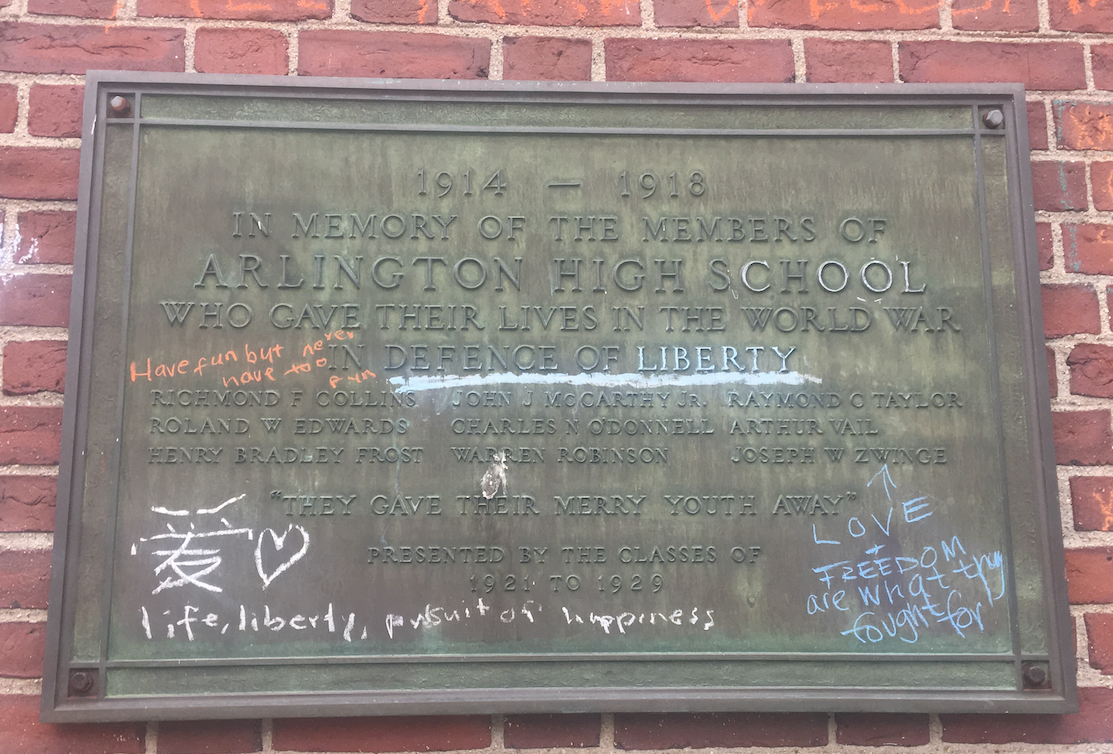
But that’s the story of humankind. It seems there will never be a human society that is not plagued by members who want to profit by hate if that’s an option. The story of America, on the other hand, is people who know that we are committed by our founding principles to do better than this. People who pledge allegiance to a flag that symbolizes a republic dedicated to liberty and justice for all. People who know that the battle to live by those principles is never done. That every generation must re-commit to that battle personally. Some Americans feeling unsafe is not an indictment of our system, it’s a bat-signal to us to rise up to protect our system, to activate it to do its job, which is protecting those Americans. In America, not feeling safe is not the end of the story. It’s the catalyst to reclaim safety for all. It’s a challenge we must–and do–rise to, every time.


 The Historic Present