We at the HP got early access to a new book by the great historian Linford Fisher called Stealing America: The Hidden Story of Indigenous Slavery in U.S. History. It’s available next month (April 28, 2026). It’s an amazing, deeply researched journey through Indigenous slavery from Canada to the Caribbean that astounds even the most tuned-in student of American history, Atlantic history, Black history, colonizing history, and the history of modern slavery. If you, like most of us, thought very few “Indians” were ever enslaved, and that the enslavement of Black people dwarfed that of Indigenous people, you’ll learn how deeply wrong that is.
But it’s also a history of Indigenous agency, resilience, and ongoing political activism, with an Author’s Note at the end that discusses how we can support Indigenous rights and sovereignty today. Check it out next month!
For now, one passage struck us forcibly because it applies so well to the current situation of broadening fascism in the U.S. For centuries, Indigenous people fought enslavement in the courts, the churches, and the streets. They were open targets for any white person who wanted to enslave them, and the situation was made even worse by the fact that white governments and courts decided that Indigenous slavery was different from Black slavery. It wasn’t “really” slavery at all. And so Indigenous people who were enslaved were not officially identified as being enslaved. They were listed as apprentices and servants instead, erasing their bondage and making it harder for them to legally protest enslavement.
Here’s the passage concerning this situation that struck us:
All of these factors created immense challenges to Native sovereignty and concern for everyday living–fear of arbitrary enslavement for debt and minor infractions, of having one’s children stolen, of being hunted down during war, of white people constantly questioning one’s freedom, and of being denied one’s Native identity and community. [p. 182]
There could hardly be a better description of America today. Anyone who seems “foreign”, and not white, now fears the arbitrary enslavement of ICE concentration camps, their children being stolen, and of white people constantly challenging their freedom and their citizenship, while their ethnic identity and community are denied them through terrorization.
And, as any student of history knows, what begins with targeting one group of people quickly expands to target all. While ICE remains focused on non-white people, they now extend their violence to anyone who attempts to interfere in or even peaceably protest ICE attacks.
When Fisher uses the term “hidden history” he means that events that took place in the open, completely unhidden, were deliberately covered up later to erase them. He doesn’t mean that at the time, the events weren’t considered important, or that no one thought they were wrong. We see ICE and government at every level from federal to local destroying democracy and enforcing a fascist police state. It’s not hidden. We see the footage. But the media and the government are working in the moment to erase it, by starting wars and silencing reporters, protesters, and other witnesses.
It’s our job to work together to stop these crimes, first, and then to make sure they are not erased, now or later.
Good historians are extremely cautious about comparing problems–even very serious ones–to Nazism. Claiming that someone is “like Hitler” or “as bad as Hitler” cannot be done lightly. The enormity of the crimes committed by fascists in Europe before and during WWII is so overpowering that a slipshod or weak comparison diminishes both the horror of the Nazis and the credibility of the warning one is trying to raise in the present day.
This post is even more relevant today, and we were never more furious and distraught at being right.
If the link doesn’t work, or you don’t have access to the NYT, here’s the outline, with terrible yet completely foreseen updates.
2018: Historian Jason Stanley begins by saying “it might seem like an exaggeration to call Trump a fascist: after all, he’s not imprisoning his own people without due process.”
2026 update: there will always be those who cling to what Trump and his lackeys are not yet doing, no matter how much what they are doing clearly demonstrate what they are eventually going to do.
2018: “Fascism begins when politicians conjure up faith in a mythic past supposedly destroyed by liberals, feminists, and immigrants. Fascists create an overwhelming sense of nostalgia for a past that is racially pure, traditional, and patriarchal.”
2026: We’re living this every day in America, where a white male straight Christian past that never happened must be our future. Which can also never happen, and the fascists know that, and they embrace the perpetual war this creates, because that gives people a sense that someone powerful should be in charge during wartime…
2018: “As long as he remains in power, everything is possible. Without him the whole system collapses.”
2026: And that’s why the U.S. will either have rigged mid-term elections this year or no elections at all.
2018: “Once you’ve got your mythic past, you need the next ingredient: division. Whether it’s citizens and foreigners, whites and blacks, fascists succeed by turning groups against each other. The Nazis said Jews had no value because they supposedly did not mental or physical work… When you divide, it’s easier to control.”
2026: The obvious relevance of this to the war on people of color, all of whom are now treated as some kind of “immigrant” because America is naturally white, and on all women who must be reduced to service animals to bear white children, is infuriating.
2018: Then you attack the truth because truth is central to a free democracy. This creates a petrie dish of conspiracy theories… including that the “deep state” is trying to bring down Trump. With truth under attack and lies running wild, no one can agree on what’s true anymore, and fascists love that.
2026: We are now barricaded behind whatever we choose to believe is true, and those who believe fascism is truth walk our streets with submachine guns and unlimited license to kill.
2018: “I want you to be scared about encroaching fascism in America, because if you don’t, before long, it will start to feel normal. And when that happens, we’re all in trouble.”
2026: That has happened, and we’re all in trouble.
We all celebrated the holidays last month as if we still lived in a democratic America. We all talk about summer vacation and school, we commute to work and try to make our deadlines. We watch TV and shovel snow. Those things have to go on, maybe, but they should be what we do in our spare time, time we’re not devoting to fighting fascists in our government, local and state and federal.
Demand more of your elected officials. Attend protests. And be ready to fight right now to protect what should be our mid-term elections. Those happen locally, in your local school gyms and town halls. Don’t let anyone tamper with those elections, and if federal officials interfere, be ready to protest to whatever level is required to stop them.
Fascism is not entirely in place right now. Real Americans will put demolishing it ahead of any other work or concern in 2026.
We first became aware of this via a TikTok from ThePeopleUS, who documented their multiple phone calls to the Library of Congress, whose ConstitutionAnnotated website shows the Constitution without Article 1, Sections 9 and 10.
ThePeopleUS was told by the person who answered the phone at the LOC’s main reading room that this was the result of a “coding error”.
If you go to the National Constitution Center and read its faithful documentation of the Constitution, you can see the text of these erased sections:
Section 9: Powers Denied Congress
The Migration or Importation of such Persons as any of the States now existing shall think proper to admit, shall not be prohibited by the Congress prior to the Year one thousand eight hundred and eight, but a Tax or duty may be imposed on such Importation, not exceeding ten dollars for each Person.
The Privilege of the Writ of Habeas Corpus shall not be suspended, unless when in Cases of Rebellion or Invasion the public Safety may require it.
No Bill of Attainder or ex post facto Law shall be passed.
No Capitation, or other direct, Tax shall be laid, unless in Proportion to the Census or enumeration herein before directed to be taken.
No Tax or Duty shall be laid on Articles exported from any State.
No Preference shall be given by any Regulation of Commerce or Revenue to the Ports of one State over those of another: nor shall Vessels bound to, or from, one State, be obliged to enter, clear, or pay Duties in another.
No Money shall be drawn from the Treasury, but in Consequence of Appropriations made by Law; and a regular Statement and Account of the Receipts and Expenditures of all public Money shall be published from time to time.
No Title of Nobility shall be granted by the United States: And no Person holding any Office of Profit or Trust under them, shall, without the Consent of the Congress, accept of any present, Emolument, Office, or Title, of any kind whatever, from any King, Prince, or foreign State.
The first item is a revolting protection of the “slave trade”, which Congress was protecting.
The next two are key:
The Privilege of the Writ of Habeas Corpus shall not be suspended, unless when in Cases of Rebellion or Invasion the public Safety may require it.
—The U.S. government is currently violating this section of the Constitution. What “habeas corpus”, as it is commonly abbreviated, means is no person can be sentenced to prison or any other type of detention without a court ensuring that the detention is legal. This article of the Constitution protects Americans against unlawful imprisonment and allows anyone detained by the government to challenge their detention in court.
With the federal government currently rounding people up and putting them in concentration camps here and in other countries without trial and without proof that their imprisonment is legal, we currently have no habeas corpus protections in this country anymore. The Trump administration has erased this section of the Constitution to make that permanent.
No Bill of Attainder or ex post facto Law shall be passed.
—The U.S. government is currently violating this section of the Constitution. A Bill of Attainder is a piece of legislation that declares a person or group guilty of a crime and sentences them to punishment–all without a trial. This is a centuries-old weapon of dictatorship. And the federal government is currently using it without any effective resistance from members of Congress.
And now the last:
No Title of Nobility shall be granted by the United States: And no Person holding any Office of Profit or Trust under them, shall, without the Consent of the Congress, accept of any present, Emolument, Office, or Title, of any kind whatever, from any King, Prince, or foreign State.
—The U.S. government is allowing the Trump administration to prepare to violate this by prepping us for a third presidential term for Trump. He will become our King. Likely with the consent of Congress. And he has accepted many presents from foreign states, including his new AirForce One jet from Qatar.
Section 10: Powers Denied to the States
No State shall enter into any Treaty, Alliance, or Confederation; grant Letters of Marque and Reprisal; coin Money; emit Bills of Credit; make any Thing but gold and silver Coin a Tender in Payment of Debts; pass any Bill of Attainder, ex post facto Law, or Law impairing the Obligation of Contracts, or grant any Title of Nobility.
No State shall, without the Consent of the Congress, lay any Imposts or Duties on Imports or Exports, except what may be absolutely necessary for executing it’s inspection Laws: and the net Produce of all Duties and Imposts, laid by any State on Imports or Exports, shall be for the Use of the Treasury of the United States; and all such Laws shall be subject to the Revision and Controul of the Congress.
No State shall, without the Consent of Congress, lay any Duty of Tonnage, keep Troops, or Ships of War in time of Peace, enter into any Agreement or Compact with another State, or with a foreign Power, or engage in War, unless actually invaded, or in such imminent Danger as will not admit of delay.
No State shall enter into any Treaty, Alliance, or Confederation; grant Letters of Marque and Reprisal; coin Money; emit Bills of Credit; make any Thing but gold and silver Coin a Tender in Payment of Debts; pass any Bill of Attainder, ex post facto Law, or Law impairing the Obligation of Contracts, or grant any Title of Nobility.
–This ties into Section 9, by reiterating that, like the federal government, the states can’t create a King or suspend habeas corpus either.
In a post to X (archived) on Aug. 6, 2025, the Library of Congress explained that it was aware some sections of Article 1 were missing from the Constitution’s text on its site. It said this was “due to a coding error” and that it expected the issue to be resolved soon. There was also a disclaimer at the top of the website on Aug. 6, 2025, that read, “The Constitution Annotated website is currently experiencing data issues. We are working to resolve this issue and regret the inconvenience.”
The Library of Congress did not respond to a Snopes request for more information on why that portion of the Constitution was missing from on the website. However, the full text of the Constitution is also available on the National Archives’ website. That version of the text was not missing any sections from the Constitution on Aug. 6, 2025.
Did you read through the sections above in full, or just look at what was highlighted in bold? The government is counting on Americans’ complete ignorance of what is in the Constitution.
They’re counting on a mind-bending contradiction wherein people claim the government must follow the Constitution to the letter, and never interpret it, and so we should reinstitute slavery, because the Constitution is our sacred white nationalist founding document AND that the Constitution can be re-written whenever Republicans want to to say whatever they want.
Heartfelt thanks to everyone, like ThePeopleUS, who realized this fascist coup move and brought it to public awareness. The majority of Americans will either not care or actively support this. It’s up to the minority to push back.
We just watched President Biden’s short farewell address. In it he reiterated that America is great when it offers possibility to everyone, sustains its democratic institutions, keeps the three powers separate, and does not put the president above the law.
These principles were once considered givens in any discussion of what America means, how our government works and what it protects, and what our society represents. Now they are reclassified as liberal talking points, partisan ideals actively opposed and scorned by the majority of Americans.
Last week, on January 10, the president-elect appeared in court onscreen to have any punishment for his felony conviction waived–an “unconditional discharge”–by judge Juan Merchan. Here’s how the New York Times described it:
“Donald Trump the ordinary citizen, Donald Trump the criminal defendant” would not be entitled to the protections of the presidency, Justice Merchan said, explaining that only the office shielded the defendant from the verdict’s gravity.
“This court has determined that the only lawful sentence that permits entry of judgment of conviction without encroaching on the highest office of the land is an unconditional discharge,” Justice Merchan said.
He then wished Mr. Trump “godspeed” and departed the bench.
Despite the lenience, the proceeding carried symbolic importance: It formalized Mr. Trump’s status as a felon, making him the first to carry that dubious designation into the presidency.
Yesterday, January 14, Special Counsel Jack Smith (again reported by the NYT) issued his final report:
Jack Smith, the special counsel who indicted President-elect Donald J. Trump on charges of illegally seeking to cling to power after losing the 2020 election, said in a final report released early Tuesday that the evidence would have been sufficient to convict Mr. Trump in a trial, had his 2024 election victory not made it impossible for the prosecution to continue.
“The department’s view that the Constitution prohibits the continued indictment and prosecution of a president is categorical and does not turn on the gravity of the crimes charged, the strength of the government’s proof or the merits of the prosecution, which the office stands fully behind,” Mr. Smith wrote.
He continued: “Indeed, but for Mr. Trump’s election and imminent return to the presidency, the office assessed that the admissible evidence was sufficient to obtain and sustain a conviction at trial.”
One president goes out, struggling to get the words out as he repeats what Americans used to take for granted, whether they liked it or not, and another comes in, effortlessly destroying what he doesn’t like, to the delight of his followers.
There’s been a lot of talk about what Vice President Kamala Harris “did wrong” in her campaign for president. If only she had done this or that… but it’s all too clear that she lost not because of anything she did or didn’t do, but because the majority of people in this country don’t want democracy and so voted against it. Those who didn’t vote fall into this category.
We reference history here, but there is no historical precedent for what we’re going through, or for what’s to come. At least not in American history. There are many historical precedents for it in other nations. The comparison to Nazi Germany is not overblown.
So what’s the role of the historian in America now? President Biden said it’s our turn to stand guard. Standing guard means a dogged fight, as we now from our own history. It means young children walking a gauntlet of armed mobs to desegregate our public schools. It means women withstanding violence and discrimination for the right to vote. It means gay people marching in the streets through hate-filled crowds to claim their citizenship. It means fighting a civil war to end slavery. Standing guard is not silent, passive work but a daily, active resistance to the forces of fascism. It means standing by the truth and refusing to go along with lies. All battles for civil rights are long and terrible ordeals. But the results when we win those battles are what make life worth living.
So that’s what we’ll be doing, here and elsewhere. People sometimes comfort themselves in dangerous times by saying “history is cyclical–these troubled times will pass.” And that’s true. But the cycle of history only moves when people put their shoulders to the wheel to move it. We’ve seen anti-democracy Americans throw their bodyweight into pushing the nation into a future of destruction, and so we’re moving in that direction. But an equal and opposite reaction can come–if we work at it. It won’t just happen. It will take decades to turn that tide. But what else is worth doing? We can’t think of a better way to spend our time.
Hello and welcome to part the last of our short series on Radio and the Great Debate over U.S. Involvement in World War II, by Mark S. Byrnes. As we said in part 1, Mark painstakingly documents the many Americans who made their cases for the intervention and anti-intervention sides of the argument between September 1939 and December 6, 1941, when the Japanese attack on the U.S. Navy at Pearl Harbor, Hawaii settled the question.
His main focus is disproving the established anti-interventionist (“isolationist”) claim that the interventionists got special treatment–more time on the air, and support from a Democratic-controlled Congress that did whatever the popular and clearly interventionist Democratic president, Franklin Roosevelt, said to do. Both sides got equal time, and both sides made points that resonated with Americans.
In part 1 we covered the first argument in the anti-interventionist side of the debate: the wishful thinking Americans engaged in that the war could be won without them. In part 2, we looked at the second, even more alarming argument against going to war: that the U.S. could get along just fine–even thrive–in a world where fascism had conquered Europe and Asia.
Now we conclude with the final, fainter argument made most explicitly by the American Socialists who entered the debate. Not faint because it was presented timidly, but because it was a more complex argument than the overall “it is our business–no it’s none of our business” debate generally encouraged.
In April 1941, author Stanley High, of the FFF (a recently formed pro-intervention organization), debated Norman Thomas, chair of the Socialist Party. Stanley presented the stark choice: “Either Hitler’s defeat is of desperate, deadly importance to us or it’s of no importance whatsoever.” He believed it was of desperate importance, and that America should enter the war as a belligerent, not just send aid to allies. He concluded his opening statement by saying “We can either beat Hitler now–or we can deliver into his hands the power to fashion our future.” (273)
Norman Thomas didn’t disagree on the main point–he agreed that Hitler and fascism were a threat. Where he took issue was on that last idea that fighting and defeating Hitler would make sure fascism did not dictate America’s future.
Norman said that entering the war with the honest intention of defeating fascism would, in fact, dictate that fascism rose to power in America: “I believe that we should go not so far as to insure the triumphs of an American Hitlerism, and that would be the probably consequence of our entry into total war.” (273)
His point was that fighting fascism on three continents would require a mobilization of people, industry, government, and society unparalleled in U.S.–or perhaps even human–history. The U.S. would have to fundamentally change all four to make the turn on a dime that would be entering a war that was already in full swing. Government would have to be given new powers to take over industry, which would mean mobilizing people as workers, turning over food production to the war effort, food rationing, and a complete halt to the manufacture of cars and appliances for private use. Trains, the main means of long-distance transportation in the country, would be reserved for transporting soldiers, other war personnel, raw materials, and finished war goods. Government spending would skyrocket while wages dropped.
To do all of this, the federal government would expand almost beyond reckoning, and that’s what Norman and the Socialists feared. As Mark puts it, Norman “feared that the result of a total war effort would be an irreversible centralization of power that would threaten American liberty. Total war, [Norman] argued, ‘will require us to lose our internal democracy for the duration.'”
He was likely remembering WWI, when freedom of speech was basically thrown out the window by the federal Espionage Act of 1917 and the Sedition Act of 1918. These Acts basically made it illegal to criticize the U.S. government or the war effort by giving a wide, ever-changeable definition of espionage and sedition. The “Red Scare” immediately after the war was used as a reason to prosecute American citizens charged with being Communists. The Sedition Act was repealed in 1920, but the Espionage Act was still in force. The scaffolding was already in place on which fascism could be erected in the U.S.
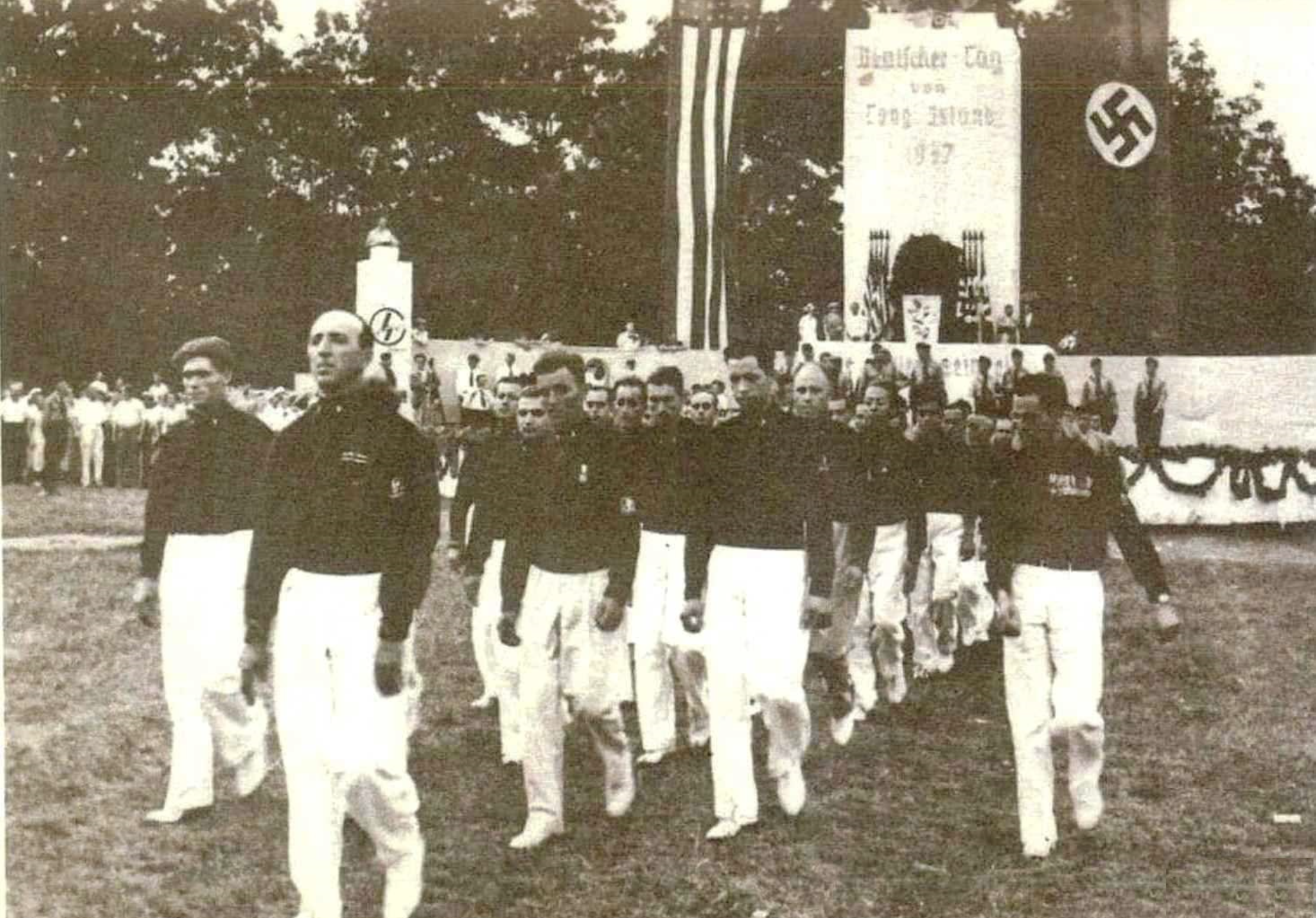
American Nazis existed, and they had grown louder and more unashamed as the crimes of the Nazis in Europe unfolded in the late 1930s. You can see a good documentary of the American Nazis (the “German American Bund” as they called themselves) of that time at PBS: Nazi Town, USA. The town of Yaphank, New York, on Long Island, was one of their strongholds, and Nazi youth camps, called “Camp Siegfried”, operated in five states. This is a photo from the Camp Siegfried in Yaphank:
American Nazis were a minority of the population. But German Nazis were, too, yet they were able to take over their government and country. If the U.S. expanded the federal government and stripped state and local governments of some of their power in order to mobilize for the war, and passed acts to eviscerate freedom of speech, this would open the door to American Nazis. Even if the U.S. won the war against fascism abroad, it would lose the war to fascism at home.
And if the U.S. won the war at a moment when it had its troops all over the globe, would it be willing to withdraw those troops? or would it seize the opportunity to expand its own empire?
And if the U.S. won the war, would it really return industry back to private, commercial manufacture? Or would the federal government continue to massively fund the military, in the name of preventing another war, but in reality to protect the new lands it now controlled?
And if the U.S. won the war, would it really restore full civil rights to its citizens? or would it continue to curb them in order to squash protest against the imperial expansion and the military spending?
“The primary consequence [of a U.S. victory] would be ‘an American… imperialism which would perpetuate armaments, and for which Fascism at home in this generation must be the inevitable accompaniment,” Norman warned. As Mark sums it up, for Norman Thomas and the Socialists, “War was, in every possible scenario, a no-win proposition.” (273-4)
Their argument was overshadowed at the time, and easy to dismiss in the years immediately after the war, when the U.S. seemed to indeed reverse all its wartime emergencies and return to normal. But the key word there is seemed. The American Nazis officially disbanded, and the Nazi youth camps shut down. Industry returned to commercial production and spawned the boom of consumerism that made the 1950s and 60s a high-water mark of personal and household purchasing. The Civil Rights movement was revived in the 1950s and won huge gains in the 1960s, including desegregation and voting rights.
But this is not the whole story. Those American Nazis closed their camps, but they didn’t go away. They lived on to pass down their hatred to their next generation, to wave Confederate flags at lynchings, and threaten, torture, and kill Civil Rights activists. Industry created out-of-control consumerism but not at the expense of military production. Military production continued apace with the excuse of the Cold War. The U.S. went into permanent wartime military spending, and military spending is still by far the largest slice of the federal budget pie to this day.
In 1961, outgoing president Dwight Eisenhower warned Americans that all was not well. In his farewell address he coined the phrase “the military-industrial complex”:
A vital element in keeping the peace is our military establishment. Our arms must be might, ready for instant action, so that no potential aggressor may be tempted to risk his own destruction. . . . American makers of plowshares could, with time and as required, make swords as well. But now we can no longer risk emergency improvisation of national defense; we have been compelled to create a permanent armaments industry of vast proportions. . . . This conjunction of an immense military establishment and a large arms industry is new in the American experience. . . .Yet we must not fail to comprehend its grave implications. . . . In the councils of government, we must guard against the acquisition of unwarranted influence, whether sought or unsought, by the military-industrial complex. The potential for the disastrous rise of misplaced power exists and will persist.
Dwight Eisenhower was proven to be as prescient in 1961 as Norman Thomas had been twenty years earlier in 1941. The U.S. government and military have been involved in other nations’ governments since the war, carrying out crimes and terrorism when needed to meet U.S. interests. Our military power was impossible to walk away from, especially with the Cold War providing a constant justification for imperialism in the name of promoting democracy. The influence of unchecked military and industrial spending is seen in the very innovation that drove consumerism from the start–constant new inventions, new technology, from microwave ovens to computers to the Internet to cell phones. Many commercial products have their origin in military experimentation. More dangerously, the invisibility of the people who control our destiny that began with the top-secret Manhattan Project that created atomic bombs continues, as a small group of people, mostly white men, develop AI without any guardrails or intervention, oversight, or control from outside.
Finally, all the money that the military-industrial complex generates has corrupted our government at every level, as lobbyists, kickbacks, and insider trading demonstrate over and over.
America still struggles to achieve full democracy, but it is, in the end, an always-difficult fight that has indeed been made much more difficult by our victory in World War II. This is not to say we should not have entered the war. Of course we had to, and should have done it sooner.
What it is to say is that American democracy would be in much better shape if Americans had cared to intervene in European and Asian politics in the 1920s, after the first world war had enriched America and devastated many European nations as well as Japan. Rather than accept that wealth as deserved, the U.S. could have used it to level the playing field, support democracy at home and abroad, and used the Paris Peace Conference to really change the status quo, rather than consolidate its own gains. Then there may not have been a WWII to consider entering into.
Such “what if” history is usually frowned upon, but it’s worth considering. It’s no more wishful thinking than the idea that America really did emerge from the total war effort unscathed.
Good historians are extremely cautious about comparing problems–even very serious ones–to Nazism. Claiming that someone is “like Hitler” or “as bad as Hitler” cannot be done lightly. The enormity of the crimes committed by fascists in Europe before and during WWII is so overpowering that a slipshod or weak comparison diminishes both the horror of the Nazis and the credibility of the warning one is trying to raise in the present day.
This post is even more relevant today, and we were never more furious and distraught at being right.
If the link doesn’t work, or you don’t have access to the NYT, here’s the outline, with terrible yet completely foreseen updates.
2018: Historian Jason Stanley begins by saying “it might seem like an exaggeration to call Trump a fascist: after all, he’s not imprisoning his own people without due process.”
2026 update: there will always be those who cling to what Trump and his lackeys are not yet doing, no matter how much what they are doing clearly demonstrate what they are eventually going to do.
2018: “Fascism begins when politicians conjure up faith in a mythic past supposedly destroyed by liberals, feminists, and immigrants. Fascists create an overwhelming sense of nostalgia for a past that is racially pure, traditional, and patriarchal.”
2026: We’re living this every day in America, where a white male straight Christian past that never happened must be our future. Which can also never happen, and the fascists know that, and they embrace the perpetual war this creates, because that gives people a sense that someone powerful should be in charge during wartime…
2018: “As long as he remains in power, everything is possible. Without him the whole system collapses.”
2026: And that’s why the U.S. will either have rigged mid-term elections this year or no elections at all.
2018: “Once you’ve got your mythic past, you need the next ingredient: division. Whether it’s citizens and foreigners, whites and blacks, fascists succeed by turning groups against each other. The Nazis said Jews had no value because they supposedly did not mental or physical work… When you divide, it’s easier to control.”
2026: The obvious relevance of this to the war on people of color, all of whom are now treated as some kind of “immigrant” because America is naturally white, and on all women who must be reduced to service animals to bear white children, is infuriating.
2018: Then you attack the truth because truth is central to a free democracy. This creates a petrie dish of conspiracy theories… including that the “deep state” is trying to bring down Trump. With truth under attack and lies running wild, no one can agree on what’s true anymore, and fascists love that.
2026: We are now barricaded behind whatever we choose to believe is true, and those who believe fascism is truth walk our streets with submachine guns and unlimited license to kill.
2018: “I want you to be scared about encroaching fascism in America, because if you don’t, before long, it will start to feel normal. And when that happens, we’re all in trouble.”
2026: That has happened, and we’re all in trouble.
We all celebrated the holidays last month as if we still lived in a democratic America. We all talk about summer vacation and school, we commute to work and try to make our deadlines. We watch TV and shovel snow. Those things have to go on, maybe, but they should be what we do in our spare time, time we’re not devoting to fighting fascists in our government, local and state and federal.
Demand more of your elected officials. Attend protests. And be ready to fight right now to protect what should be our mid-term elections. Those happen locally, in your local school gyms and town halls. Don’t let anyone tamper with those elections, and if federal officials interfere, be ready to protest to whatever level is required to stop them.
Fascism is not entirely in place right now. Real Americans will put demolishing it ahead of any other work or concern in 2026.
We were reading an interview with Jason Stanley, who has a new book out called How Fascism Works: The Politics of Us and Them. Of course when he mentioned truth v. myth, the HP’s bat senses were alerted:
Q: Anti-intellectualism has been present throughout much of American history. How is the kind of anti-intellectualism linked to fascist ideas different? Or is it the same?
A: Our suspicion of elites and what could be seen as anti-intellectualism can be healthy at times; we can see the American philosophical traditions of pragmatism and empiricism in this light, which can in fact serve as counterweights to the grandiose myths of fascist politics. But even this version has proven to be a weakness, one that makes us more susceptible to being manipulated politically. We have seen this play out in the case of climate change, where essentially apolitical scientists were successfully demonized as ideologues. We also have a history of what I think of as more classically fascist anti-intellectualism.
Fascist anti-intellectualism sets the traditions of the chosen nation, its dominant group, above all other traditions. It represents more complex narratives as corrupting and dangerous. It prizes mythologizing about the nation’s past, and erasing any of its problematic features (as we see all too often in histories of the Confederacy and the Reconstruction period, or of the treatment in history books of our indigenous communities). It seeks to replace truth with myth, transforming education systems into methods of glorifying the ideologies and heritage of the members of the traditional ruling class. In fascist politics, universities, which present a more complex and accurate version of history and current reality, are attacked for being places where dominant traditions or practices are critiqued. Fascist ideology centers loyalty to power rather than truth. In fascist thinking, the university is simply another tool to legitimate various illiberal hierarchies connected to historically dominant traditions.
If readers of the HP know anything, it’s that history is complex. That’s why we end up writing so many 12-part series on what seem like the simplest events. Anyone looking for a quick fix on the “Sinners in the Hands of an Angry God” sermon we all read in college or high school, or on the Bryan’s “Cross of Gold” speech, or “Who was Anne Hutchinson?” will look in vain for the “short version,” the crux of the argument, in the first 3 or even 4 posts. A lot of context has to be set to make sense of that crux when it does come.
So while the words “Welcome to our series on…” may strike boredom or terror in the hearts of HP readers, we feel that in the end that careful and thorough setting up of a problem or question or person or event is necessary. That’s all we have to say here.
There’s a second threat to our democracy. And this one is as old as our nation itself.
After my election there was talk of a post-racial America. And such a vision, however well intended, was never realistic. Race remains a potent…
(APPLAUSE)
… and often divisive force in our society.
Now I’ve lived long enough to know that race relations are better than they were 10 or 20 or 30 years ago, no matter what some folks say.
(APPLAUSE)
You can see it not just in statistics. You see it in the attitudes of young Americans across the political spectrum. But we’re not where we need to be. And all of us have more work to do.
—The last comment is important. Older members of the HP who describe their childhoods in the 1970s to teenager today may as well be talking about another planet. While it’s true that hidden racism is no better than outright racism, it’s easy to forget what outright racism represents: a consensus that there’s nothing wrong with it. Overt racism is a sign that people feel comfortable expressing racism; they don’t expect anyone to challenge or reproach them. In America 50 years ago, it was okay to be openly, outrageously racist. In America today, it isn’t, because those 50 years were spent stripping away the social justifications of and legal supports for racism. The biological arguments for racism, the “oh come on, it’s just a joke” arguments for racism, the “this is the way it’s always been” arguments, the “this is how God intended” arguments—all were at last relentlessly, righteously assaulted as the nation pushed to live up to its mandate of liberty and justice for all.
But, as the president says, that doesn’t mean racism ended. Racism will never end. It’s part of human nature. And that means the fight against racism must never end. We have to rise above our nature. All of us will always have more work to do, but if we do it, we will get closer to being free of racism, as close as it is possible to come. We cannot afford to have the work of the last 50 years undone by anti-Americans who want to go back to the old days. Their mythical view of an all-white America that was happy and strong and rich would be laughable if it weren’t so dangerous to this nation.
If every economic issue is framed as a struggle between a hardworking white middle class and an undeserving minority, then workers of all shades are going to be left fighting for scraps while the wealthy withdraw further into their private enclaves.
—This single sentence says so much. Here the president is frank about how neo-conservatives and white supremacist/fascists do indeed frame every economic issue. This began with Reagan. His 1984 “Morning again in America” ad (you can find it easily on YouTube) was 90 seconds of showing only white Americans while a voiceover talked about hardworking people buying houses and getting married and thriving. (Yes, for exactly two seconds a black and a Latino child are shown watching an American flag being raised. But apparently when they grow up these non-white children will not contribute to America’s wealth, strength, and happiness.) Since then, “hardworking” and “middle-class” have come to be code words for “white” and “native-born”. Anyone who isn’t hardworking and middle-class is a non-white criminal. In the last presidential campaign, these ceased to be unspoken codes, as neo-conservatives and fascists and other Trump supporters applauded his description of Mexicans, Muslims, and other non-white immigrants as criminals, and stood by Trump’s refusal to call the KKK a hate/terrorist/white supremacist group.
If we’re unwilling to invest in the children of immigrants, just because they don’t look like us, we will diminish the prospects of our own children — because those brown kids will represent a larger and larger share of America’s workforce.
(APPLAUSE)
And we have shown that our economy doesn’t have to be a zero-sum game. Last year, incomes rose for all races, all age groups, for men and for women.
So if we’re going to be serious about race going forward, we need to uphold laws against discrimination — in hiring, and in housing, and in education, and in the criminal justice system.
That is what our Constitution and highest ideals require.
—A loud minority of Americans want a zero-sum game. They feel that any and every advance by people unlike them (non-white, immigrant) comes only at their expense. If anyone else wins, it’s because they lose. That’s why they want to repeal laws against discrimination, ironically by claiming those laws discriminate against whites/white men/native-born white Americans. These people are Americans in name only, as they would violate our Constitution to enrich and (so they think) protect themselves.
But laws alone won’t be enough. Hearts must change. It won’t change overnight. Social attitudes oftentimes take generations to change. But if our democracy is to work the way it should in this increasingly diverse nation, then each one of us need to try to heed the advice of a great character in American fiction, Atticus Finch, who said “You never really understand a person until you consider things from his point of view, until you climb into his skin and walk around in it.”
For blacks and other minority groups, that means tying our own very real struggles for justice to the challenges that a lot of people in this country face. Not only the refugee or the immigrant or the rural poor or the transgender American, but also the middle-aged white guy who from the outside may seem like he’s got all the advantages, but has seen his world upended by economic, and cultural, and technological change.
We have to pay attention and listen.
—It’s hard to feel a lot of compassion for white men in western society. They still have every advantage when it comes to being educated, hired, well-paid, catered to politically, and identified as the “average person”. White men do still have all the advantages, even after 50 years of economic, cultural, and technological change. Again, it’s the zero-sum mentality at work: any change for white men is seen as an alarm bell that the God-ordained proper world order is being destroyed. Not all white men feel this way. But the ones who do should only be paid attention and listened to as part of an effort to re-educate them to be Americans.
For white Americans, it means acknowledging that the effects of slavery and Jim Crow didn’t suddenly vanish in the ’60s; that when minority groups voice discontent, they’re not just engaging in reverse racism or practicing political correctness; when they wage peaceful protest, they’re not demanding special treatment, but the equal treatment that our founders promised.
(APPLAUSE)
For native-born Americans, it means reminding ourselves that the stereotypes about immigrants today were said, almost word for word, about the Irish, and Italians, and Poles, who it was said were going to destroy the fundamental character of America. And as it turned out, America wasn’t weakened by the presence of these newcomers; these newcomers embraced this nation’s creed, and this nation was strengthened.
(APPLAUSE)
So regardless of the station we occupy; we all have to try harder; we all have to start with the premise that each of our fellow citizens loves this country just as much as we do; that they value hard work and family just like we do; that their children are just as curious and hopeful and worthy of love as our own.
(APPLAUSE) (CHEERING)
And that’s not easy to do. For too many of us it’s become safer to retreat into our own bubbles, whether in our neighborhoods, or on college campuses, or places of worship, or especially our social media feeds, surrounded by people who look like us and share the same political outlook and never challenge our assumptions. In the rise of naked partisanship and increasing economic and regional stratification, the splintering of our media into a channel for every taste, all this makes this great sorting seem natural, even inevitable.
And increasingly we become so secure in our bubbles that we start accepting only information, whether it’s true or not, that fits our opinions, instead of basing our opinions on the evidence that is out there.
—Bubbles have always existed. They’re not the product of social media. Newspapers in the 19th and early 20th centuries in America were always firmly ideological—Republican or Democrat, nativist or pro-immigrant, for blacks or for whites or for Jewish people, etc. But the harm of bubbles is intensified by social media. Now we don’t even have to know that we are buying “our” paper for “our” people; we can go online to a site that pretends to be objective while it peddles ridiculous and harmful, divisive and undemocratic opinions, or, more and more often, lies. People become used to arguing with other people only when they leave those social media bubbles, not within them, and the right to argue a point is confused with the right to win an argument. It’s enough to make one wonder whether the “information wants to be free” movement that destroyed paid journalism was an anti-democratic plot after all…
Hello and welcome to part 2 of our short, indeed two-part series on the History Channel’s new series The World Wars. In the first part of our mini-series, we looked at the shortcomings of both “great man theory” history and misogyny. Here, we focus on a main theme of Episode 1 that we can’t quite live with: the radicalization theory.
We are told repeatedly that Hitler was radicalized by his experiences serving as a private in WWI. The same claim is made about Mussolini, but not as often, as he only makes two brief appearances. Both men, but especially Hitler, saw brutality, random violence, pointless and awful death, and other horrors of war, and then Hitler had to suffer through his country’s defeat and surrender (or, as he saw it, its sure victory and inexplicable surrender). All this changed him from an anonymous putz to a demonic fascist.
The problem with this is twofold: first, millions of soldiers had the same experience of the horrors of war but did not turn into monsters; and second, war horror is not a logical explanation for what Hitler became and did. Many men wrote about their horrible experiences in the war afterward. They all suffered in the same way Hitler did. Many of them questioned the social and political status quo, and gave up on religion. But they did not all become fascists overthrowing governments and using murder to establish power. So to repeatedly show Hitler taking in the horrors of war is not adequate as an explanation of his evil. There was something about Hitler’s mind and character that allowed him to drift into fascism, and while that something was present before the war, it really flowered after the war.
The best part of Episode 1, which is really well done, is the sequence after the war showing Hitler begging for work from the army and being sent to monitor a podunk political leftist group, mostly just to get him out of the army’s hair, and sitting there at the meetings, defensive and wary, until he begins to be drawn in, correcting the speakers’ arguments and becoming a leader. The response of the men at the meetings is very natural: here is a man who wants to stand up for Germany and assert its virtues and innocence of war guilt at a time when the whole world is making Germany a pariah among nations. Here is a man who has patriotism and confidence—two things that were very scarce in Germany after WWI—who makes us feel good about our own personal participation in the war and status as war veterans. He’s not suggesting holocaust at this point. He’s just asserting the right of Germans to be proud of being German. At that point, that was a radical but not morally repellent stance. It’s clear that Hitler progressed from this neutral status to his warped plans for a bigger and better Germany that involved the goals of patriotism driven to an illogical extreme of imperial conquest and genocide.
What shaped Hitler was not so much the war as its aftermath. If he had been selling fascism in the trenches he would have been rejected. But in the 1920s, there were men and women who were ready for radical ideas, and willing to be radicalized, as a sort of wild pendulum swing from overwhelming shame to unthinking pride, and all of it based on national identity turned into racial identity. Hitler was not interested in fascism in the trenches, and not even thinking about it when he first attended the political meetings. But he got the idea from the times after the war, and then his personal chemistry and mindset allowed him to take it to undreamed-of levels.
So we’re not buying the idea that The World Wars episode 1 so consistently urges on us, that it was war that made Hitler. It was peace: Hitler was radicalized by a peace he could not accept. If the war made Hitler, it should have made tens of thousands of Hitlers, all over the world, in England and France and the U.S., and perhaps Belgium in particular. Fascism should have swept the world and become the dominant form of government. There should never have been a WWII. Japan was on the Allied side in WWI, experienced no fighting on Japanese soil, suffered few causalities, and should therefore have been safe from fascism after the war. But that was not the case. The fascism that characterized the 1920s and 1930s was a force many decades in the making that was set free to grow in the despair and political chaos and opportunism of the postwar period.
We end our analysis of The World Wars here; we can’t hang on for two more episodes. But if you watch them, let us know. Send a comment and tell us what happened. We’re indebted to an HP reader for recommending we watch Episode 1. (The History Channel is not really on our radar, as it is rarely devoted to history.) We’d love to find out that the series improves, but we’ll leave it to you to let us know.
 The Historic Present