The Republican National Convention, Cleveland 2016 (and Charleston 1860)

As we write this, our fifth entry in our series on the serious and striking comparisons between the U.S. in the months (and years) before the 1860 presidential campaign and the 2016 presidential campaign, the Republican National Convention is just beginning in Cleveland. And so we turn to May 1860, and the Democratic National Convention that fell apart in Charleston, SC that month over sectionalism.

Again, our point of comparison between the 1860 and the 2016 presidential campaigns is sectionalism. In 1860, slavery drove sectional division north and south. In 2016, as we say in our first post,

Today’s sectionalism, then, represents a divide between liberals and conservatives that seems as strong as the divide between North and South ever did. Liberals and conservatives are found in every geographic region of the country, which means there is no region that serves as a safe haven for either…

Sub out “slavery” for “gun control”, “immigration”, or “religious freedom”, and you find that the language used in the 1860 campaign is strangely similar to the language used so far in the 2016 campaign.

The 2016 Republican convention has just begun, so we cannot compare it fully to the 1860 Democratic convention, but the anticipation that there will be some measure of delegate revolt against Donald Trump at the Republican convention this week, and perhaps a real fight to ensure his official nomination as many Republicans skip the convention, and some delegates lobby for the right to set aside the commitment they made during the primaries to vote for Trump, and others predict that a last-minute alternative candidate will be presented during the convention all lead us to think of the collapse of the 1860 Democratic convention.

It could be that none of the things we describe will happen this week, and the Trump nomination will be seamless. But let’s take a look at what can happen when a convention is torn apart by sectionalism.

In 1860, the Democratic party was perilously divided between proslaveryites and antislaveryites. The Whig party had already dissolved over the issue, as slavery divided its members and made compromise on that or any other issue impossible. Now the Democratic party faced the same threat: could it unite behind a candidate to run against the new Republican party? Stephen Douglas, the author of the Kansas-Nebraska Act that destroyed the Compromise of 1850 by allowing people in any territory, regardless of geography, to vote on whether they would enter the Union as a free or a slave state, was the presumptive nominee going into Charleston.

But Southern proslaveryites were not satisfied with Douglas, because to get re-elected in free Illinois in 1858, Douglas had had to backtrack on the KNA that free Illinoisans hated by coming out against the Dred Scott decision in which the Supreme Court stated that not only were black Americans not U.S. citizens, but they never could be, and slavery could never be abolished by the U.S. judicial or legislative systems.

At the Charleston convention, U.S. Rep. William Yancey of Alabama, a violent proslaveryite, led a protest of the Douglas candidacy by representatives of seven deep-South states who formed a caucus within the party that re-wrote the Democratic presidential platform to be aggressively pro-slavery. They knew Douglas could not accept the nomination on those terms.

The rest of the delegates went on with the nomination process, but they could not reach the necessary two-thirds majority for Douglas, in part because the party chairman Caleb Cushing insisted that the proslavery caucus that had withdrawn from the convention had to be counted. Without those delegates, Douglas could not get a two-thirds majority of all delegates. On May 3, the convention was dissolved, and rescheduled to try again in Baltimore, MD, six weeks later.

In the end, the Democratic party could not recover from the divide driven into it by slavery. 110 proslavery delegates walked out of Baltimore. The remaining moderates nominated Douglas, while the fire-eaters who left created their own “Southern Democratic” party and nominated John C. Breckinridge of Kentucky. (Adding to the chaos was one more candidate: former Whigs created the Constitutional Union party and nominated John Bell; their only platform was to keep the Union together in the face of civil war over slavery.)

On May 4, the day after the Charleston convention folded, the New York Times featured a bitter editorial:

The Charleston Convention has abandoned the attempt to nominate a Democratic candidate for the presidency. …The contest between the two sections of the Union has at last penetrated the Democratic party and rendered it impossible for the two wings to agree upon a declaration of principles. When the majority adopted its platform the minority seceded. Thereupon the delegates who remained, and constituted the rightful Convention, resolved that a vote of two thirds, not of the actual body, but of the whole original number, should be essential to a nomination. In other words, the seceders were still to be counted, and to have all their original weight as members of the Convention! Upon what ground of reason or of common sense the majority, and especially the delegates from this State, thus put themselves bound hand and foot into the power of the seceding minority, it is not easy to conjecture. The result was to give the South the victory. They have controlled the Convention, and prevented the nomination of any candidate. Whether on reassembling at Baltimore they will harmonize their differences remains to be seen.

The disruption itself is a fact of very  marked importance, not only in the history of political parties but in of the country itself. It seems to sever the last link of nationality in the political affairs of the Union. When all other organizations have been gradually giving way, one after another, to the pressure of sectionalism, timid and conservative men have fallen back upon the national position of the Democratic Party, and felt that so long as this was maintained the Union would be secure. The first effect of this Charleston split will be to alarm this class by the dread of immediate dissolution.

Some of the Republican journals refer to this incident as only another proof of the “irrepressible conflict” between Freedom and Slavery—and as showing that the contest must go on until one or the other is extirpated. If we believed this to be the true view of the question, we too should despair of the Union. But we do not. We do not believe that the conflict is between Slavery and Freedom… we regard the struggle as one for political power—and Slavery as playing merely a secondary and subordinate part on either side. Unquestionably, thousands of Northern men seek the overthrow of Slavery, and thousands of Southern men seek its permanence and extension, as the aim of their political contests.But both would be disappointed. Neither class would reap the advantage which it anticipates from victory.

…The South believes sincerely that the North seeks power in order to crush Slavery. In our opinion it denounces Slavery mainly that it may acquire power.

The editorial goes on to say that power is unstoppably passing from South to North and the South needs to accept the new order since the North has no intention of abolishing slavery in the South (only in the territories). This power shift is only fair, the editorial claims, since the South has had all the power in Washington for too long, and now it’s the North’s turn. That’s the gist of the article—that the slavery issue is just a tool Northerners can use to restore an equitable balance of power in the nation.

This editorial is remarkable in many ways. Its description of Americans clinging to the hope of party unity in the face of mounting irreconcilable differences in society and politics rings true to us today, as we see desperate attempts to unify the Republican party behind a candidate who does not represent most Republican principles, and as we see Democrats desperately trying to unite the party behind Clinton after the excitement and revolutionary flavor of Sanders’ campaign. We must have party unity at all costs in our divided nation, or the last traditional political big tents will be gone, and with them the last vestiges of people with different opinions being able to find common ground and work together nationally.

The claim of the editorialist that slavery really has nothing to do with the battle between North and South is an intelligent insight that is almost correct. He is saying that people who want power will ride any bandwagon to get it, and that if slavery is the issue that you can use to gain power, people will use it even if they could not care less about slavery itself. Politicians can rise to power by taking a stand on slavery and making slavery the top issue—all while never doing anything to actually impact slavery by abolishing or expanding it. That’s what the writer means when he says stopping or extending slavery is merely “the aim of their political contests”, and that both sides would be disappointed if they won the battle, because if the battle ended there would be no way to ride to power anymore.

This is certainly true. We see politicians today taking strong stands on social issues simply because this will make them well-known and get them elected. The many instances of “family values”, “Christian values” candidates who have been found having affairs with women or with men, or being involved in corruption, or simply changing sides to join the family and Christian values vanguard when it became powerful enough to benefit them make this clear. If, for example, the right to abortion was suddenly no longer challenged, many politicians would no longer have a political identity and would have to find another divisive issue pronto on which to make their name.

But the editorialist is wrong in another sense. Slavery was really an issue and the breakup of the Democratic party was really caused by slavery and the breakup of the Union and the war that came were really about slavery. The editorialist will not admit that people actually cared about slavery because if he does, he must admit that war is coming, and he does not want to do that. The only way breaking up the 1860 convention could give the seceders power was if they knew that their constituents cared enough about slavery to support them walking out of the Charleston convention, and cared enough about slavery to split the party in an election year.

Those constituents cared about slavery as a political issue because they cared about it personally—as something within their society every day. They supported slavery, for a variety of reasons. Yes it’s true that the strong majority of Southerners did not enslave people. But that doesn’t mean they did not support slavery, as the basis of their economy, as a regional tradition, as a way to reserve political power to whites, etc. To say that slavery was just a word politicians used was wrong.

And the same is true today. Many people cling to the notion that America is not really divided, that politicians are just sowing division as a concept they can trade on. This was originally the case, when neo-conservatives began to sow that division in the late 1970s. By now, 40 years later, the division is real. It is flowering and bearing seed in every state as people who have been told for decades that the federal government is their enemy and that it should be overthrown take their chance to do so.

We can’t say what will happen this week in Cleveland. But we anticipate that the editorials written after it closes will bear close reading to see how much they echo the writer of 1860.

Next time: a tie between the 2016 Republican convention and the second 1860 Democratic convention

Trump and Lincoln’s Cooper Union speech

Welcome to part four of our series on the serious and striking comparisons between the U.S. in the months (and years) before the 1860 presidential campaign and the 2016 presidential campaign. Here we take a look at Abraham Lincoln’s speech at the Cooper Institute in New York City (now Cooper Union) on February 28, 1860 and compare one part of it with the rhetoric coming from Trump supporters in 2016.

Again, our point of comparison between the 1860 and the 2016 presidential campaigns is sectionalism. In 1860, slavery drove sectional division north and south. In 2016, as we say in our first post,

Today’s sectionalism, then, represents a divide between liberals and conservatives that seems as strong as the divide between North and South ever did. Liberals and conservatives are found in every geographic region of the country, which means there is no region that serves as a safe haven for either…

Sub out “slavery” for “gun control”, “immigration”, or “war on Christianity”and you find that the language used in the 1860 campaign is strangely similar to the language used so far in the 2016 campaign.

In the Cooper Union address, Lincoln represented the new Republican Party, in only its second presidential election season. He was in 1860 still walking the fine line of saying that while the Republican Party was dedicated to stopping the spread of slavery into the west, it would not try to abolish slavery in the south. In most of his speeches on the campaign trail, Lincoln tried to do two things at once: force southerners to accept a Republican victory, if it came, by emphasizing that winning the popular vote would mean that most Americans wanted to stop the spread of slavery and therefore southerners could not claim that the election had been hijacked by a radical minority; and convince southerners that this antislavery majority did not mean that the south would have to get on board with the rest of the nation and abolish slavery.

This is the context for the statement we’re about to quote from the Cooper Union address, in which Lincoln addresses proslaveryites and debunks their claim that they have a Constitutional right to enslave other people and, therefore, an implied right to secede from the Union if slavery is abolished or even limited to the south. Here is the candidate:

…But you will break up the Union, rather than submit to a denial of your Constitutional rights.

That has a somewhat reckless sound: but it would be palliated, if not fully justified, were we proposing, by the mere force of numbers, to deprive you of some right plainly written down in the Constitution. But we are proposing no such thing.

When you make these declarations, you have a specific and well-understood allusion to an assumed Constitutional right of yours to take slaves into the Federal Territories, and to hold them there as property. But no such right is specifically written in the Constitution. That instrument is literally silent about any such right. We, on the contrary, deny that such  right has any existence in the Constitution, even by implication.

Your purpose, then, plainly stated, is, that you will destroy the Government, unless you be allowed to construe the Constitution as you please, on all points in dispute between you and us. You will rule or ruin in all events.

Sub out “slaves” and the right to enslave for the right of anyone and everyone to buy and openly carry guns anywhere in public, even schools, or the right of self-professed Christians to deny public services to people who they feel offend Christianity, or the right of anti-choice legislatures to deny women access to health care from providers that also perform abortions, and you have a Democratic speech right out of 2016.

Many people today who self-identify as conservative in our new sectionalism of conservative v. liberal consistently claim a constitutional right to deprive others of their personal liberties. Yet the Constitution, as Lincoln points out, is “literally silent about any such right”. The Second Amendment does not protect private gun ownership for private use; it protects the right of American citizens to own guns so they can fight in local militias sanctioned and controlled by local governments. The Constitution does not mention Christianity in any way, and the Founders officially denied any Christian basis for the United States. Abortion or the rights of fetuses are not in the Constitution.

Too often an American’s right to freedom of speech, which actually is in the Constitution, is construed to protect “rights” that are not in the Constitution. Ever since the Supreme Court decided that actions could be identified as speech, this has happened. If it’s constitutional to protest outside an abortion clinic, clinics must be unconstitutional. If religious freedom is protected in the Constitution, then all of my religious beliefs must also be constitutionally protected (nope—see Gay Marriage, Religious Freedom, and the First Amendment for a rundown of the difference between religious worship and religious belief).

But conservatives who believe that all their beliefs are enshrined in the Constitution are often deaf to these arguments. As Lincoln put it, they will destroy the Government, unless they be allowed to construe the Constitution as they please, on all points in dispute between them and liberals. They will rule or ruin in all events. The eagerness of Trump’s supporters to destroy the federal government that they see as denying them their constitutional rights is a harvest sown by neoconservative Republicans for over thirty years now. This anti-government, Constitution-bending activist section may likely dispute the outcome of the presidential election if Clinton wins. And so we find ourselves, like Lincoln, facing a possible contested election over chimerical Constitutional rights. Secession seems slightly less likely today than in 1860… but it seemed unlikely to most observers in 1860.

Next time: on with the 1860 campaigns

Trump and the caning of Charles Sumner

In this our third post in our series examining the serious and striking comparisons between the U.S. in the months (and years) before the 1860 presidential campaign and the 2016 presidential campaign, we look at another event that preceded the 1860 presidential campaign but cast a long shadow over it: the caning of Massachusetts Senator Charles Sumner.

As you know, Sumner was an abolitionist who gave a speech condemning the Kansas-Nebraska Act in May 1856. In his speech, Sumner excoriated the authors of the Act, which potentially allowed slavery into the North; these were Stephen A. Douglas of Illinois and Andrew Butler of South Carolina. In his devastation of Butler, Sumner said in part,

The senator from South Carolina has read many books of chivalry, and believes himself a chivalrous knight with sentiments of honor and courage. Of course he has chosen a mistress to whom he has made his vows, and who, though ugly to others, is always lovely to him; though polluted in the sight of the world, is chaste in his sight—I mean the harlot, slavery. For her his tongue is always profuse in words. Let her be impeached in character, or any proposition made to shut her out from the extension of her wantonness, and no extravagance of manner or hardihood of assertion is then too great for this senator.

Brooks’ nephew, Preston Brooks, was a Representative to the House at the time. Declaring his uncle insulted, Brooks fulfilled the contemporary Southern ideal of chivalrous honor by waiting until Sumner was almost alone in the Senate chamber, then going up to him supported by two friends and stating “Mr. Sumner, I have read your speech twice over carefully. It is a libel on South Carolina, and Mr. Butler, who is a relative of mine,” and then began beating Sumner, who was still sitting at his desk, on the head with a heavy gold-topped cane.

Sumner fell to the floor unconscious and covered in blood as Brooks continued to beat him, while Brooks’ friends, Virginia Congressman Henry Edmundson and South Carolina Representative Laurence Keitt, held back the few men present who tried to intervene. Keitt actually took out his revolver and threatened them. Finally, two Representatives were able to stop Brooks, and Sumner was carried out of the Senate.

Sumner’s recovery was long and difficult, and he was out of office for months. Brooks resigned when a motion to remove him was raised, then voted back into office by his constituents, and continued to serve until his sudden death in 1857.

Northern public opinion was beyond outraged: that someone could attack a U.S. Senator in the Senate and get away with it was beyond belief. Southern public opinion was jubilant: abolitionists who had been “suffered to run too long without collars [had been] lashed into submission”, according to the Richmond (VA) Enquirer.

Everyone expected that this event would break the camel’s back—if it did not start a literal war over slavery, it would start a legal war on slavery led by antislavery and, hopefully, formerly neutral Congressmen who would kill it through legislation. But that did not happen. In fact, very little happened as a result of the caning. Few Northern lawmakers wanted to be responsible for starting a war. But more importantly, even fewer had any faith left in the democratic system in the U.S. It had been taken over by the Slave Power, and compromise after compromise with slavery in Congress had made it impossible for Congress to kill it.

Here is what a New York Times editorial said about the caning on May 28, 1856, when hopes were high that such a completely out-of-bounds attack would lead to action:

…malignity always overreaches itself and neutralizes its bitterness by its own folly. The assault on Senator Sumner is a notable proof in point… If [Brooks] could have foreseen, as any but a maniac must have done, that for every blow inflicted upon the head of Mr. Sumner, the cause of Slavery must lose at the least ten thousand votes, he probably would have desisted from his foul and cowardly deed. …true to their instincts, and blinded by the madness that must lead to their utter defeat, [the South] has chosen to defend the outrageous scoundrelism of their self-appointed champion…

…Mr. Brooks may congratulate himself upon having done more to add to the [antislavery] Republican Party, and to give vigor and permanency to the Anti-Slavery sentiment of the North, than all the Free Soilers have done in Congress.

Flash forward to 2016 and Donald Trump, whose bigotry, xenophobia, and misogyny have led him to make statements considered beyond the pale on a regular basis for over a year now. Each time he crosses a new line, editorials like the one above appear, predicting that now he has finally gone too far and will assuredly lose his following and the presumptive Republican presidential nomination. Democratic politicians have confidently predicted a drop in Trump’s poll numbers, with former supporters potentially moving to support Clinton instead.

Yet it has not happened. Just as Brooks went calmly on with the full support of his like-minded constituents, so goes Trump. Americans know that Congress is just as paralyzed and poisoned in 2016 as it was in 1857, often unable to address immigration, women’s reproductive rights, gun control, or the other issues that stand in for slavery today for the same reason Congress couldn’t act on slavery in the 1850s—one side would not let it. Proslaveryites (at that time almost all Democratic) had a stranglehold on Congress. That’s what people back then meant when they talked about the Slave Power. Just as the Republican majority today will not even allow a vote in the House on gun control, having imposed a gag rule on the subject, so the Democratic majority then would not allow a vote on slavery, having imposed a gag rule on that subject in 1834 (it was rescinded a decade later, but had a long-lasting effect). When Congress does address these important issues today, the conservative majority is almost assured that the vote will go their way, stripping more Americans of their civil rights.

As liberals look on with dismay and continue to await the moment when Trump actually says or does something that strips him of his popularity with conservatives, one can’t help thinking about Preston Brooks, and fearing the worst.

Next time—into the 1860 campaign

…those who don’t know history are condemned to repeat it: Trump’s America First policy

So many world events seem to be trending toward a repeat of World War II: China’s decision to “own” all the islands in the East China Sea and its vocal and powerful minority calling for a return to strict Maoism; Japan’s corresponding military build-up and refusal to acknowledge war crimes its soldiers committed before and during WWII; ethnic violence and the upswing in the growth of neo-Nazi groups (both official political parties and grassroots organizations) in Europe…

…and the racial, ethnic, and xenophobic hatred being brought to its logical conclusion by the Trump campaign in the U.S. Since the 1970s, the Republican party has been taken over by neoconservatives who have urged white Americans—rich and poor—to hate any American who isn’t white and to blame them for all the white people’s (perceived) problems. The hatred has extended to gay Americans, non-Republicans, feminists, and any other group that isn’t toeing a traditional line.

The hatred has also been extended to the federal government. It has been openly described as “the problem” since Reagan, and white Americans have been relentlessly urged to destroy it by starving it of tax money, electing people to office who are devoted to tearing it apart from the inside, and, frankly, ignoring it.

Now there is a man who is willing to admit this is the party policy and reap the harvest of all those decades of hate-mongering, who is not afraid to actually destroy our system of federal government. Other Republicans had not been willing to do this because they make their living in government work. Trump does not, and he is happy to wreck our federal government for a few reasons: he doesn’t understand how it works, and therefore will push it to do things it can’t and then blame it/shut it down; his most passionate supporters want this and he wants their admiration; and since he will be incapable of serving as president, he will appoint people to do that work for him from the ground up.

Trump has contributed to the 1930s feel of the world today in many ways, but his “America First” foreign policy, delivered in a speech on April 27, is very clear. As CNN.com reminds us:

It is extremely unfortunate that in his speech Wednesday outlining his foreign policy goals,Donald Trump chose to brand his foreign policy with the noxious slogan “America First,” the name of the isolationist, defeatist, anti-Semitic national organization that urged the United States to appease Adolf Hitler.

The America First Committee actually began at Yale University, where Douglas Stuart Jr., the son of a vice president of Quaker Oats, began organizing his fellow students in spring 1940. He and Gerald Ford, the future American president, and Potter Stewart, the future Supreme Court justice, drafted a petition stating, “We demand that Congress refrain from war, even if England is on the verge of defeat.”

—We have to break in to say that Stuart’s involvement is no surprise. For decades into the 20th century the Quaker Oats slogan outside the U.S. was “Wherever white men live, Quaker Oats will be sold.”

Their solution to the international crisis lay in a negotiated peace with Hitler. Other Yale students — including Sargent Shriver, who served in the Kennedy and Johnson administrations, and Kingman Brewster, the chairman of the Yale Daily News, future president of Yale and ambassador to the Court of St. James — joined their isolationist crusade.

Robert Wood, the board chairman of Sears, Roebuck, agreed to act as their group’s temporary chair. The growing organization soon included powerful men like Col. Robert McCormick of the Chicago Tribune; Minnesota meatpacker Jay Hormel; Sterling Morton, the president of Morton Salt Company; U.S. Rep. Bruce Barton of New York; and Lessing Rosenwald, the former chairman of Sears.

…After Pearl Harbor, the America First Committee closed its doors, but not before Lindbergh made his infamous speech at an America First rally in Des Moines, Iowa, in September 1941. After charging that President Roosevelt had manufactured “incidents” to propel the country into war, Lindbergh proceeded to blurt out his true thoughts.

“The British and the Jewish races,” he declared, “for reasons which are not American, wish to involve us in the war.” The nation’s enemy was an internal one, a Jewish one.
“Their greatest danger to this country lies in their large ownership and influence in our motion pictures, our press, our radio, and our government,” he contended. Booing began to drown out the cheers, forcing him again and again to stop, wait out the catcalls, and start his sentences over.

The America First foreign policy announcement comes after Trump began asking his supporters to stretch out their right arms as a sign of support… in a gesture that can only be described as the Hitler salute.

Trump’s response? The Republican front-runner at first dismissed the controversial comparison, calling it “ridiculous” and “a big stretch,” and insisting rally attendees were just “having fun.” “Well, I think it’s ridiculous, I mean we’re having such a great time,” Trump said. “Sometimes we’ll do it for fun, and they’ll start screaming at me, ‘do the swear-in, do the swear-in!'” …pressed [to state whether] he would stop asking supporters to make the pledge now that he was aware of the controversy, Trump said, “Well, I’ll certainly look into it.” “I mean I’d like to find out that that’s true, but I would certainly look into it, because I don’t want to offend anybody. But I can tell you that it’s been amazingly received, but I will certainly look into that.”

The more important Hitler comparison lies not with Trump, but with the American people. Most Germans though Hitler was a nut when he came on the scene. But he stayed, and after a few years people accepted him as a part of the political scene, albeit a nut. The shock and annoyance of hearing his crazy statements wore off as people became used to it. As he grew in power with the fringe, mainstream Germans began to shift from saying he would never be in power to speculating about what it would be like, and how he could be managed by “real” politicians. And then he took power, and that was that.
Let’s hope mainstream Americans are not doing the same thing. Would a Trump presidency  mean fascism? Not all at once. But even this election campaign has been the thin end of a wedge that will allow more radical, more hate-filled candidates to run in the future, and each time they do the shock will wear off a little more, and we will treat them a little more like normal candidates, and eventually, the worst will happen, if we are not vigilant. Historians always watch the long-tail past and the long-horizon future. Let’s hope non-historians will start doing the same.

If Trump could save the Union by bombing Europe with nuclear weapons…

Do you remember how, back in April 2008, we posted an analysis of the Emancipation Proclamation? It was called “If I could save the Union without freeing any slaves…”: The victory of the Emancipation Proclamation,” and it referred to the famous Lincoln-Greeley exchange:

In the months before Lincoln published his proclamation, Horace Greeley, of the New York Tribune, wrote an editorial letter on August 20, 1862 blasting the president for not abolishing slavery already. No one outside Lincoln’s cabinet knew he had the EP written and waiting. Lincoln’s response is famous, or infamous, to us now. It is the letter in which he said that if he could save the Union by freeing all the slaves, he would, and it he could save it by freeing none, he would, and if he could do it by freeing some and leaving others, he would do that.

In our effort to explain why Lincoln’s statement is not disgustingly pro-slavery but revolutionary in its essence, we said this:

Lincoln starts by saying that his main aim in the war is to preserve the Union. He sees a few options when it comes to saving the Union. He might be able to do it by freeing all the slaves. If that was the best option, he would take it. He might, though, be able to save the Union without freeing any slaves. If so, he would take that option. Or, he might be able to save the Union by freeing some slaves.

You, by now, should see that he is hinting very broadly at his Proclamation, which did just that: it freed some enslaved people and left others (in the border states) enslaved. (For the reasons we have already described—under war powers, he could only free slaves in territory at war with the U.S. without Taney and the courts striking the measure down.)

We still shudder at Lincoln calmly talking about not freeing anyone. But people at the time saw what was really shocking: Lincoln was saying that ending slavery was on the table. For the first time in the history of the United States, a president was saying he would outlaw slavery. This had never been on the table before.

It would be like an American president today saying, “If I can bring peace to the Middle East without using nuclear weapons, I won’t use them. If I have to launch a few nuclear strikes to bring peace, I’ll do that.” We would say, wait a minute—when did nuclear weapons come into this question? No one has ever talked about nuclear war in the Middle East before, but now the President is saying it’s on the table.

When we wrote that, we deliberately tried to think of the most exaggerated, not remotely possible scenario we could—a U.S. president saying s/he would use nuclear weapons on the Middle East.

But Republican presidential candidate Trump has yanked this scenario into the realm of the possible. He has in fact made our outlandish scenario look modest by saying he would bomb not just ISIS-held areas of the Middle East, but our allies and friends in Europe. Here is the relevant part of his interview with Chris Matthews:

Donald Trump: “First of all, you don’t want to say take everything off the table because you would be a bad negotiator if you do that.”

Chris Matthews: “Just nuclear?”

DT: “Look, nuclear should be off the table, but would there be a time that it could be used? Possibly.”

CM: “The problem is when you say that, the whole world heard that. David Cameron heard that in Britain, the Japanese where we bombed them in ’45 heard it. They are hearing a guy running for President of the United States talking about maybe using nuclear weapons. Nobody wants to hear that about an American president.”

DT: “Then why are we are making them [nuclear weapons]? Why do we make them?”

CM: “Because of the old mutually assured destruction, which Reagan hated and tried to get rid of.”

DT: “I was against Iraq, I would be the last one to use the nuclear weapons because that’s sort of like the end of the ball game.”

CM: “Can you tell the Middle East we’re not using nuclear weapons?”

DT: “I would never say that. I would never take any of my cards off the table.”

CM: “How about Europe? We won’t use in Europe?”

DT: “I’m not going to take it off the table for anybody.”

CM: “You’re going to use it in Europe?”

DT: “No! I don’t think so. But…”

CM: “Just say it, say ‘I’m not going to use a nuclear weapon in Europe’.”

DT: “I am not taking cards off the table. I’m not going to use nukes – but I’m not taking any cards off the table.”

And thus we have it: an American presidential front-runner, if not an actual president, saying he would use nuclear weapons on Europe. Lincoln’s statement that he would end slavery to win the war now takes second-place in the list of astonishing political statements made by presidents and/or presidential contenders. If we jinxed this by making the analogy, and by using the very words “on the table” that Trump used,  believe us, we’re sorry.

Confusion on the campaign trail in South Carolina

We were listening to NPR yesterday morning and heard yet another story about the upcoming primary in South Carolina, this one focused on the drive to win the votes of military personnel, who make up about 25% of eligible voters in that state. It very quickly changed from just another story to one that brought up several boggling contradictions. For this post, we’re working from the transcript of the story.

Just outside the small town of Walterboro in South Carolina’s low country yesterday, the stage for a big outdoor rally featured giant American flags and camouflage bunting.

—Camouflage bunting? This is very hard to picture. The whole point of bunting is that it is another way to display the colors of the U.S. flag, which is desirable because it shows loyalty to and support for the United States. Using camouflage bunting creates a queasy equivalence of the nation with the armed forces, and we wondered who made it. A quick look online did not uncover U.S. flag-type bunting, though camouflage-pink baby bunting is available… it made us wonder if one of the campaigns created it especially for South Carolina campaigning, which again creates a queasy one-to-one identification of the U.S. with its military (and nothing but its military).

…in the hours before that speech by Donald Trump began, a long line formed on the wooded property, including many voters with military ties, among them 58-year-old Jim Shinta, a veteran of both the Army and the Air Force.

JIM SHINTA: I never registered to vote before until this election.

—If you are eligible to vote and never vote, you are not doing your duty as an American. Participating in our representative democracy is crucial. When people do not vote, the system becomes rigged in favor of those who know they can push through un-American policies and laws simply because no one will turn up to vote against them. Serving in the armed forces can be a way to serve your country, but voting—keeping our democracy alive and in good working order—is far more important. There’s no America to defend if there’s no participatory democracy.

GONYEA: He says Trump is the reason. Shinta likes Trump’s promise to restore U.S. respect around the world.

What do you want to see Trump do in that regard?

SHINTA: Defeat ISIS number one, close the borders – that’s number two.

—We have commented recently on this mindset (at Nation of Refugees and Immigrants have always been scary looking, but that’s never stopped us before); here the desire to defeat ISIS is oddly connected with closing the U.S.-Mexican border, and the message is that all outsiders are evil threats and the U.S. must destroy the worst of them and keep out the rest of them, and live in a splendid isolation of perfection. The day the U.S. closes its borders is the day we should dismantle the Statue of Liberty. But we get the feeling Shinta does not mean all borders—he probably doesn’t mind non-Latin or non-Syrian immigrants coming in. It’s a partial border closing, a racially based border selection, that again sits ill with the concept of liberty and justice for all.

…Nearby is 49-year-old Shawn Sauerbrei, who was in the Marines for 23 years. He has no doubts about Trump, saying it’s great to have a candidate who’s truly committed to helping veterans. He also says people should take some of Trump’s over-the-top rhetoric with a grain of salt.

SHAWN SAUERBREI: You know, if he uses the language, it’s Donald. He makes people cheer. He makes people think that OK, he’s going to do something.

—The conflation here is dangerous: Trump says he’s going to do some crazy things that you can ignore because they’re meaningless… yet these are the things that make people happy—they’re the things people want him to do. So which is it: we can ignore it because no one really means it, or it’s exactly what people want? This question is immediately answered:

GONYEA: But on some of Trump’s very tough talk, Sauerbrei says it’s warranted, like when Trump says he’ll bring back waterboarding and worse.

SAUERBREI: I think we’ve got to do what we’ve got to do for terrorism. If he wants to bring it back – hey, if it works it works. If it doesn’t, I’m sure he’ll try something else.

—This is a prime example of deciding something is okay and then ignoring all evidence it is not. Torturing prisoners has been proved over and over to be worthless, because people will say anything to stop the torture. So it doesn’t work. Sauerbrei himself goes back and forth: at first torture is “what we’ve got to do”, and then “if it works it works”, and finally “if it doesn’t, we’ll try something else”. Deep down he knows torture is pointless and even counter-productive, but like the people he discounts in his previous statement, the talk of torture makes him cheer because it means Trump will do something.

Even if torture did get good, solid results, a nation devoted to justice can never, ever use it. The U.S. led the global campaign against torturing prisoners of war in the 20th century. We can’t let it now lead a global campaign promoting torture. It’s not compatible with our founding principles, and we would think someone who took an oath to protect his nation would be more interested in protecting it from tearing its integrity to shreds.

…Meanwhile, at a Jeb Bush event in North Charleston, 48-year-old Derek Robbins says the military has been neglected under President Obama. Robbins’ son currently serves in the Air Force.

DEREK ROBBINS: We have one in the service. And so we see how important that is. And to see the military, you know, to be downgraded – it’s very important to rebuild that strength.

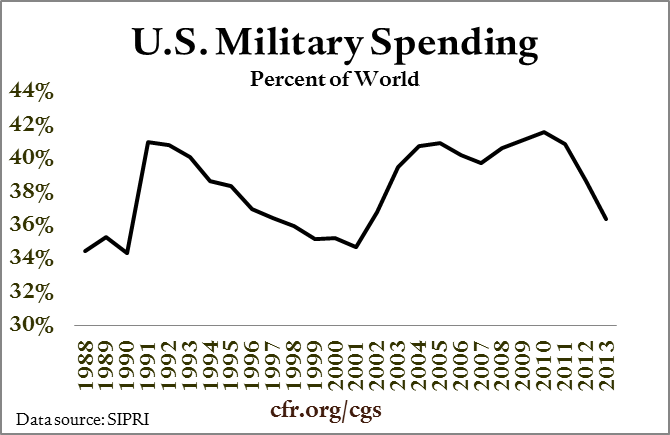
—The idea that the military is being pushed into a dark corner and allowed to rot is just another example of deciding something is true and sticking to it no matter how many proofs to the contrary you see around you every day. Let us offer just two graphics:

001_military_spending_dollars

002_military_spending_percent_of_world

Since September 11th, military spending has skyrocketed, and actually had a strong surge upward during President Obama’s first term (after a slowdown during Bush’s second term). Even the decline in Obama’s second term leaves spending levels far higher than they’ve been for nearly 40 years. So the military  has not been neglected…

…unless you mean spending on people, not equipment. What these veterans in South Carolina are really talking about is support for people in active service and for veterans, especially those with health problems related to their service. The U.S. treats its veterans shamefully for the most part, providing little to no health care, counseling, insurance, or just plain money and time and people and care for the men and women who serve in its ranks. Veterans dying on a wait list for VA hospitals make the news, then fade away. The high suicide and murder rate among veterans is well-known, yet the government does almost nothing about it.

When this is the problem, people should say so plainly instead of making broad statements about the military being downgraded and needing to rebuild its strength. No military is stronger technology and materiel-wise than ours. But our military is weak and tottering when it comes to the mental and physical health, the income, and the security of its members. If Trump torturing POWs and bombing the sh** out of China will fix those things, then we’re all for it. But it won’t.

And so we leave South Carolina with a sense of foreboding. Simply being in the military is not patriotic. You have to support, and vote to support, the founding principles of this nation if you want to protect and defend it. Let’s hope the vote turns out well for the democracy and justice the U.S. is meant to stand for.