Trump, protest, and being “fair”

In the days since the election, we’ve heard a few consistent messages:

—We need to come together and support Trump because the peaceful transfer of power is crucial to our democracy;

—We need to put aside our differences and unite as a nation;

—We need to acknowledge the other side and not automatically assume that anyone across the political aisle is evil.

The real issue at the heart of these three messages is relativism: there is no absolute, objective truth, like “Trump is bad” or “Democrats are good”. We have to support Trump’s election because accepting him, relative to the chaos that the failure of a peaceful transfer of power would bring, is necessary.We have to give every argument a fair hearing. One man’s meat is another man’s poison.

We’d like to challenge this relativism. One senses that many Americans would like to challenge it, feeling that there is something different about this situation, that rejecting Trump is not just petty party politics but a way to take a stand for justice. They are right.

What is our basis for saying this, our objective truth? Well, in this context, there is only one objective truth to turn to. We are Americans. We were educated so that we can understand how our government was framed, how it is supposed to work, and what its goals are—both literal, as in what tasks it is supposed to perform, and more figurative, as in what impact it is meant to have, what kind of nation and people it is meant to create.

Our federal government, as described in the Constitution, was created to balance power between three branches of government. Two of those branches are representative, in that we vote people into their offices. The judiciary is appointed by our representatives. The executive branch handles foreign policy and is the commander-in-chief of our armed forces. The legislatures creates laws. The judiciary reviews laws to be sure they are constitutional, and amends or invalidates laws that are not.

Our Constitution states that the goal of our nation is to offer liberty and justice to all, and to protect citizens’ right to life, liberty, and the pursuit of happiness. It says that we can only protect those rights for all if we offer them to all (that took a few amendments, to extend those rights to non-whites and women, but it got done). It says, in the Bill of Rights, that we have immense personal liberty to worship as we please, speak and write as we please, and generally do as we please—so long as we do not infringe on someone else’s rights by doing that. It’s a balancing act in which our right to liberty is checked by other’s rights to liberty.

Fulfilling these terms has led our judiciary and Congress to pass laws guaranteeing equality of opportunity; laws that give every American as level a playing field for success as we can, through public education that is mixed and equal, through sexual harassment laws, anti-discrimination laws, and more.

These are the objective truths of American government, our Constitution, and our goals as a nation.

Therefore, these are the standards by which we must measure any U.S. citizen. We judge presidents by them, we judge members of Congress by them, we judge state and local officials by them. We judge news outlets and social organizations by them.

And so we must judge Trump by them. When he says he will punish women who have abortions, when he says natural-born American citizens whose parents are not from the U.S. are biased and unworthy to serve in public office, when he says he doesn’t know if the Ku Klux Klan is a hate group, when he says he engages in sexual assault, when he says he will get rid of governmental organizations like the EPA that keep our air and water safe because they hurt big business—in all these cases, he is violating our principles of government and the goals of the American nation.

When his supporters say, as we heard many say over the past weeks and months, that a vote for Trump is a vote for the “angry white man”, and for white supremacy, they are violating liberty and justice for all. When his supporters say Muslims should not be allowed to live in America, they violate the First Amendment.

And most of all, when his supporters say what they want most is for Trump to destroy the federal government, they are striking at the very heart of our nation.

So there is an objective reason for Americans to oppose Trump. He opposes America.

Peaceful transfer of power is important in a democracy—but we have to put the democracy first. We will peacefully transfer power to Trump, but we will not peacefully give him the power to destroy our democracy once he is in office. If all we preserve of our democracy is transfer of power, we don’t really have anything left.

We do not need to come together and support Trump. We need to come together to do what we can to oppose him when he violates our Constitution and our laws and our heritage, and support him when he does not.

We cannot put aside our differences with those who would destroy the American way of life as expressed in our Constitution and system of law. We have to try to get them to see the error of their ways, not say that their opinions are equally valid.

Anyone who wants to destroy this nation’s system of government  and commitment to liberty and justice for all is, in our opinion, either evil or extremely dangerous. They cannot be allowed to carry out their mission on the basis of “fairness”. This is not a question of which political party you belong to. It’s a question of whether you hold the American commitment to liberty and justice for all dear.

This is the only objective truth we can call upon when discussing politics, the only way that does not degenerate into relativism. It’s the yardstick we must use as we move forward.


Trump and the Great American Experiment

Today we’re re-running a post written at the very start of this blog, for reasons that will become evident as you read, on the second day of living in anticipation of a new presidency that is dedicated to perverting and destroying America’s founding principles.

From this point on, the HP is going to increase its focus on civics, our founding principles, and the fight for liberty and justice for all under the Constitution, because all Americans will need that information going forward into a Trump presidency that will not only allow that man to exercise his ill-judgment, but open the door to all Americans who have no faith in their nation’s founding principles. To destroy those principles is treason. The HP fights treason in all forms.

So, with a quote from the great Liberator, William Lloyd Garrison’s antislavery newspaper, we begin this new era:

I am aware that many object to the severity of my language; but is there not cause for severity? I will be as harsh as truth, and as uncompromising as justice. On this subject, I do not wish to think, or speak, or write, with moderation. No! No! Tell a man whose house is on fire to give a moderate alarm; tell him to moderately rescue his wife from the hands of the ravisher; tell the mother to gradually extricate her babe from the fire into which it has fallen;—but urge me not to use moderation in a cause like the present. I am in earnest—I will not equivocate—I will not excuse—I will not retreat a single inch—and I will be heard. The apathy of the people is enough to make every statue leap from its pedestal, and to hasten the resurrection of the dead.


America is an experiment. From the time of its first white settlement, America has been a place where people came to experiment with doing things differently. It’s been a place to gamble, to see if you could be one of the lucky ones who became landowners or lawyers or independent merchants. You gambled on the weather, politics, your own skills, and your own ability to commit to the experiment of living in America, and being an American.

During the 18th century, the experiment deepened, as Americans began to speculate that they could form the first democratic nation in modern times. Intense experimentation went on from the 1760s to 1787, as Americans adapted and invented forms of government fit for the scope of their needs, the gaping hole of their inexperience, and the high and intense expectations for their future.

On and on went the experiment: could we create a strong and stable centralized government? Could we grow without destabilizing? Could we solve the problem of slavery? Could we truly create a melting pot in which to forge Americans out of peoples of all nations? Could we give women the vote? Could we accept Jewish people as true Americans? Could we desegregate? Could we assure civil rights regardless of sexuality?

America’s story is one of constantly tackling the big—the biggest—problems, ahead of everyone else, with very little to guide us but those founding principles that nag at our conscience. And each time we’ve made progress, extending civil rights to more and more people, it’s been because that old spirit of taking a gamble, of performing the ultimate experiment, took over and led us to the right decision.

As we think today about what divides Americans, I think it boils down to the fact that some Americans no longer want to experiment. They want to close the lab down. We’ve gone far enough into the unknown, making it known, they say; now let’s stop—let’s even go backward. We were wrong to conduct some of our experiments in liberty, and that’s the source of all our problems. Gay people shouldn’t be treated equally. Black people shouldn’t run the country. Women shouldn’t hold high office. Muslims shouldn’t be granted habeas corpus.

Whenever one of those Americans talks about the problem with our country today, they talk about how we should be like we once were, back when white people who defined marriage as one man-one woman and were Protestant veterans built this nation. They feel they are losing their birthright, their legacy.

But those Americans are wrong. What their ancestors really were was scientists. Experimenters. Radicals who always considered the impossible possible. To define those ancestral Americans as merely white or straight or Christian strips them of their most stunning feature, their near-supernatural qualities of optimism and defiance and willingness to go into the unknown and make it their home, to make the amazing the norm. They defied the status quo. That’s how they built America.

Americans who want to end the experiment are few, but boisterous. They clamor at the national microphone. But Americans who know that there is no America without the experiment will keep at it, and they will persevere. Barack Obama is such an American, and his election is proof that the lab is still open, and that America in general will always be at the drawing board, expanding its concept of liberty and justice and equality until we finally fulfill the founding principles that created this nation so long ago.

Election Day 2016: Vote for your life

We remember the 1992 election, when Bill Clinton ran against the incumbent George Bush, Sr. The election had been full of candidates duking it out throughout the primaries, which is how it used to be in America (unlike today when the winners in Iowa and New Hampshire and the first few southern primaries generally go on to win and the party conventions are pro-forma). Ultra-conservative Pat Buchanan, who had been a senior advisor to Nixon, Ford, and Reagan, and Reagan’s head of White House communications, made a strong run based on urging Americans to turn away from ungodly Democratic social progressivism, and he had a special anti-gay focus. It was Buchanan who introduced the phrase “culture wars” to U.S. politics, claiming that gays and other sinners were trying to destroy wholesome white, Christian American culture. President Bush was losing support because the economy was not doing well, so his campaign took a page from Buchanan’s by deciding to focus on bashing Clinton’s character: he was a Vietnam draft-dodger, he had smoked marijuana, he had an affair.

Clinton went through it all promising Americans a better economy, and to bridge the gap between rich and poor. This promise of equity gave him a fairly solid lead until independent Ross Perot got back into the race (after dropping out for two months) and, in three-way debates between Perot, Bush, and Clinton, Perot eroded a surprising amount of Clinton’s support. As election day drew near, there was more uncertainty about who would win than had been expected over the summer when Clinton seemed sure to become president.

The week before election day 1992, one of the HP remembers a full-page ad that ran in the Village Voice, a New York newspaper well-known for its principled stand on gay rights. The headline was “Vote for Your Life”, and it urged gay voters to vote for Clinton, which would be a vote against the right-wing’s homophobic, racist agenda of the “culture wars”.

It was a very dramatic ad. You can imagine why we think of it today, the week before election day 2016. The culture wars have only intensified and become more high-stakes.

The backlash against equal rights for gay Americans is growing.

There are more Americans than we’d like to think—though clearly fewer than they would like us to believe—who want nothing more than to destroy our system of federal government and live under monarchic rule by one man.

White supremacists and white nationalists, always a feature of American political life, are coming more out of the woodwork to boldly claim they represent mainstream opinion, and endorse the man they think will destroy Washington and allow them to do whatever they want.The KKK openly endorses Trump, who refuses to say he renounces them (claiming he’s never heard of them and therefore can’t judge).

Evangelical Christians who helped destroy Gary Hart’s campaign in 1988 because he had an affair now support a man who boasts about sexually assaulting any woman he finds attractive, and trying to lure many women into sex while he and they were married, all because they believe Trump will stop the gays and Planned Parenthood and women’s libbers and whoever else is attacking traditional Christian marriage and family.

Principles and ideas have been overthrown in favor of blind party loyalty: the only principle for an outspoken segment of Republicans is to destroy the Democrats. Many prominent Republicans in federal government have dropped being “the party of opposition” to become agents of obstruction, committing treason by refusing to perform their duties as members of Congress (including vetting a Supreme Court nominee) until and unless they have the Republican president they want.

Prominent Republican leaders and average Americans alike have said how much they hate and disavow Trump—but they will still vote for him, because they simply cannot vote for a Democrat. When you actively choose to vote for someone whose principles are anathema to you, one of two things is happening: either you’re lying about how much you dislike their principles, or you are committing treason against your country by voting in someone you know will impair or destroy our government.

And while Trump promotes and enables people who hate immigrants, Muslims, blacks, gays, and anyone who isn’t them, there has been a constant refusal by other Americans to call them out on this desecration of our founding principles. We constantly hear people saying “Trump supporters aren’t bad people, they’re just angry.” Angry that they are poor when they should be rich, angry that black people want equal rights, angry that gay people want equal rights, angry that people from other countries (who aren’t their great-grandparents) come to America to live and work, angry that women can still (just barely) get abortions, angry that Democrats exist, angry that they think they are being marginalized.

We have to draw a line: if your anger leads you to support someone whose goal is to destroy our federal government, endorse institutional racism, stop immigration by “undesirables”, put women in their place, and rescind gay rights, you are not a good person. You forfeit that status by your actions. Good people don’t stand for those things.

Good people don’t abandon empathy, common good, and collaboration because they feel slighted.

Good people don’t demand white rights.

Good people don’t call for people in public office to be executed for their misjudgments.

Good people don’t insist that a black president must be a criminal imposter from Africa.

Good people don’t support a man who insists he never said things he is on camera saying.

Good people don’t impatiently dismiss the fact that their candidate claims to have sexually assaulted many women and that those women love it.

Good people don’t support a man who urges them to vote multiple times because “that’s what Democrats do”, then whips people into a frenzy about the threat of voter fraud.

Good people don’t support someone who says he will not accept the results of a federal election if he doesn’t win, and will support his followers if they rebel against the federal government.

If you can support someone who does and claims and demands those things, you are no longer good. We can’t have it both ways. Having a complaint does not mean you are justified in spouting hate speech and attempting to destroy our election process and our government. Having a complaint does not mean you are justified in blaming racial minorities and immigrants and Muslims and women and gays for your problems. Having a complaint does not mean you are justified in voting for someone you say you cannot and do not support personally.

Americans who still support our founding principles of liberty and justice for all cannot call those who don’t “good people.” We just can’t. We undermine our own opposition to hate and lynch-mob mentality and anti-democracy when we do. We make it seem like they are still supporting democracy when they are not.

So fight the good fight. Call people out when they are not good people. Stand by the definition of “good people” as people who promote the common good, respect other people’s rights, support our representative democracy, and believe candidates for president should be subject to the rule of law. Stand up for democracy and representative government. And next week, vote for your life.

David Duke and the Klan and the NAAWP are deplorable

It’s not that hard to just say it. While Mike Pence feels that it crosses some line of civility to say that people who work for the destruction of black and Jewish Americans through terror and legal oppression are deplorable, we know that it doesn’t. It’s not “name-calling” when you accurately describe a hate group as hateful, and it’s only wrong to call a hate group “deplorable” if their actions are objectively recognized as nothing to deplore. Even in the midst of the racist backlash going on in the U.S. today, few people are willing to say out loud, on TV at least, that they don’t deplore hate and terror.

The two most important exceptions to this, of course, are Trump and Pence. Trump persistently uses hate speech against Mexicans, women, liberals, and anyone else he feels at odds with. And for someone who won’t stoop to “name-calling”, Mike Pence’s decision to run with Trump, who thrives on name-calling, is hard to understand.

David Duke’s life-work of fighting for the rights of white people is certainly nothing new in this country. There have always been white racists in America, and they have always found supporters. That’s why Duke can pursue his hate activism so glibly, describing the Republican Party as a “big tent” that welcomes all—including members what he describes as the “nonviolent Klan.” And that’s why Trump is afraid to denounce Duke; it would rob him of some votes.

But it’s not just fear. Trump just doesn’t see anything wrong with Duke. He sees him as a successful politician who leads a fairly large coalition of voters, and who has ties to a political organization that may once have been kind of a problem but is now just a kind of hard-core Republican base, along Tea-Party lines. If you don’t like the Klan or the National Association for the Advancement of White People (Duke’s new org), you’re just a knee-jerk liberal who doesn’t understand that the members of these groups are just good working-class Americans trying to get a fair deal by fighting big politics and the liberal oligarchy.

It is an insult to Republicans and even to some Tea Party members to make them equivalent to the Klan and white supremacists. And it’s an insult to all Americans to pretend that hate is a particularly American virtue. The Klan and all white supremacy groups are based on hate and they do nothing but advance hate and terror and death. There is no way to look at our nation’s history and deny this, and there’s no way to look at these groups’ present actions and deny it. There’s no grey area, or room for argument, or polite listening to “both sides of the story”. There’s one story to tell and it’s that the Klan and all white supremacy groups are repellent. That’s not a “liberal” stance. That is the truth, unaffected by political party.

It’s clear that “liberal” is becoming a code word on the right for “non-white”—for people, white or not, who fight for the civil rights of non-whites. The neoconservatives who use “liberal” as a shorthand for everything wrong with this country don’t have to call liberals deplorable because that meaning is built into their usage of the word. In a reversal of the pattern of oppressed groups taking hate words and turning them into badges of pride (“queer”), neoconservatives are trying to take a positive word and turn it into a badge of shame.

As historians we take the long view of things. Sometimes that’s reassuring. Other times it’s not. In this case, it’s depressing to see that the playbook for terrorizing black  Americans, and anyone else who supports them, that was written in the early 1800s still alive and well and having new life breathed into it. The only ground for optimism is that the civil rights movement in this country is as old as the hate it fights. So we keep fighting. As Eyes on the Prize puts it, “The one thing we did right/was the day we started to fight.”

Truth v.uninformed consensus: Wikipedia, Giuliani, et al.

We read about the latest edit-a-thon of Wikipedia, recently held by Dr. Elizabeth De Wolfe and carried out by students in her Introduction to Women’s and Gender Studies course at the University of New England. As Perspectives on History puts it,

A Wikipedia user survey reports that the average “Wikipedian” on the English-language version of the site is male, formally educated, and from a majority Christian, developed country in the Northern Hemisphere. This lack of diversity, according to a Wikipedia essay on systemic bias, reproduces imbalances on the site that extend (in the realm of history) to a lack of women’s history, the histories of people without access to the Internet (primarily “people in developing nations, the poor in industrialized nations, the disabled, and the elderly”), and the histories of minority demographic groups, which in the United States include African Americans, Latinos, and Native Americans.

Edit-a-thons are a popular model for highlighting these topical weak spots and encouraging broader participation in editing the site. Often hosted by libraries and museums around a particular theme, edit-a-thons provide participants with both the in-person training and the sources needed to create entries. But even the most successful edit-a-thons are no match for the second, more treacherous set of barriers that are built into the site and hinder its representation of history.

…Wikipedia is not designed to showcase expertise, and for good reason, explains Rosemont College associate professor Michelle Moravec: “The Wikipedians recognized early on that they were going to end up with academic wars if they allowed academics to edit entries that they themselves are the field expert in.” However, Wikipedia’s alternative to expertise—consensus—introduces its own biases. In theory, “if enough people weigh in you’ll eventually reach un-bias,” says Moravec. “But anyone with a brain would realize that’s nonsense. You’ll get the most persistent opinion winning.”

Founded in 2013, the Wiki Education foundation seeks to bridge these gaps between Wikipedia and academia by facilitating partnerships between them. The foundation provides online training and guidance for classroom projects designed to counteract some of Wikipedia’s weaknesses while working within the strictures of the site’s core policies. University of Texas at Austin associate professor Daina Berry worked with Wiki Education to develop a project for her Black Women in America undergraduate class. Berry says that she used the tension between Wikipedia’s standards and those of historical scholarship to teach her students about the false ideal of “neutral writing” and “the challenge of researching women and people marginalized from the historical record.”

The HP applauds these efforts to break the uninformed consensus that Wikipedia can fall prey to. And it leads us to return to a topic we covered a while back: getting history right.

We notice, as historians, that certain popular stories about historical figures are repeated in textbooks and other learning material even though they are untrue. The most glaring example we can think of at the moment is not from American history, but it’s illustrative: almost any resource you read will say that when Henry VIII divorced Catherine of Aragon, he renounced the Catholic Church and became a Protestant, and this was the beginning of the Protestant Reformation in England.

We are exposed to this story frequently as scholars of the English Puritans. The truth is that Henry remained a devout Catholic to the end of his life, persecuted Protestants, and rejected the Reformation. What really happened was that Henry made himself the head of the Catholic Church in England (not the head of a new Protestant Church), putting himself in place of the Pope. The English monarch was now the head of the Catholic Church in England, and this is why it was so dangerous to be a Protestant during Henry’s reign—to reject Catholicism was not just a religious act but a political one. It was to reject the authority of the king, and as such Protestantism was treason, and punishable not just by excommunication but by death.

Protestants would labor in secret during Henry’s reign to sway the Church of England toward Reformation, and under Henry’s successor Edward VI, who actually was a Protestant, and a fanatical one, the C of E did become Protestant. But under his successor, Mary I, a fanatical Catholic, the C of E returned to the authority of the Pope, and Protestants were notoriously persecuted. Mary’s successor Elizabeth I maintained a middle ground, making the English Church the mix of Catholic and Protestant practice that it remains today, and after the brief experiment of Puritan rule under Cromwell, the Anglican Church was set to remain a Protestant sect with many lingering Catholic elements.

But all that is less clear-cut and dramatic than saying Henry VIII was mad at the Pope and so he became a Protestant.

It’s also easy to blur things unintentionally, as the BBC website does when it says “His break with the papacy in Rome established the Church of England and began the Reformation.” Yes, the break with Rome gave English Protestants hopes that the Catholic Church in England would be reformed, and paved the way for Henry’s son Edward to receive a humanist, Protestant education (carefully hidden from Henry), and for Elizabeth to one day enact a gentle shift to middle-ground Protestantism that would be challenged once more during the English Civil War but restored under Charles II and, after one last threat from James II, securely established.

…but that long string of events stretching  from the 1534 to 1688 is not the story you get from the line “Henry began the Protestant Reformation.”

So a general consensus is built by people who have not devoted time to studying the English Reformation that Henry was a Protestant. This view becomes so well-known that it is repeated in many venues, including history materials meant to teach students about English history.

That’s the problem with an uninformed consensus—it creates stories so well-known that when you point out that a story is wrong, you are the one who seems crazy. As editors of history materials, we know that when we correct items like Henry VIII broke with  the Catholic Church, or Anne Hutchinson was persecuted for being a woman, or the Pilgrims left Holland for America because their children were turning Dutch, we often get flack. Does it really matter? we are asked, by educators. Isn’t the general gist correct?

We insist that it does matter. It’s funny that you would not be allowed to get away with error in football stats, identifying the designer each star is wearing at the Oscars, or summarizing TV show plots online, but misrepresenting the actions of U.S. presidents, founders of major religions, or civil rights leaders is given a pass.

Why is it acceptable to learn fictions about the important people and events that have created the world we live in today? Each error in those narratives is worse than just a mistake; it is a misrepresentation of the actions, decisions, and factors that have impacted millions of lives and created the social and political problems or solutions we experience today. Unfortunately, the double standard seems to say that accurately describing what landmark Supreme Court decisions made possible in the United States is less important than getting all the plot twists of Game of Thrones down right on a fan site.

During today’s presidential election, the truth is taking an unusual beating from Donald Trump, who will seemingly say anything he likes whether it’s true or not. Few people seem equipped to call him on this. Chris Matthews stood up to Rudy Giuliani’s truth-bashing recently by refusing to let him skim over a question or start spouting lies made up on the spot. You can see that here. What Matthews did is what every good historian should be doing right now, as lies flood our media at an unusual rate and misrepresent our shared past.

It can be hard to know when you are not being told the truth; all we can recommend is that the next time someone on TV is telling you what the Second Amendment ensures, or what Lincoln thought about civil rights, or what the Boston Tea Party was about, take the time to find a reputable article by a scholarly author and read it. Then read a few more. You will most likely get to the truth, and find that you are actually willing to spend that much time studying the history of your country, your own history, because it’s interesting and because it explains the world you inherited and because the truth, as they say, has this uncanny ability to set you free.

Truth v. Myth: Illegal immigrants must be stopped!

In light of the continuing legal concern with illegal immigration, most notably the anti-immigrant threats currently being voiced by Donald Trump, we’re re-posting a Truth v. Myth staple on immigration and why it is now so often illegal.

Most of us have ideas on how to fix illegal immigration, but we never stop to ask why illegal immigration is now so common, but never was before. Americans have always tried to stop certain types of immigrants—Irish, Chinese, Jewish, etc.—but you will not find battles over illegal immigrants (except when people from those banned groups somehow got into the country). There was no such issue, really, as “illegal immigration” throughout our long history of immigrants. So why is it such an issue today?

The single answer is that we now make it much harder to become a legal immigrant than we have ever done before. That’s it. It’s not that today’s immigrants are more criminal. It’s not that our own sainted immigrant ancestors were more law-abiding. It’s simply a matter of changing the law to make it harder to become a citizen, a process put in motion after WWII.

So here’s the original post, with a few new additions:

Myth: Immigration used to be good, but now it is bad.

Supporting myth:  Today immigrants are shiftless, lazy, and/or criminal, whereas they used to be hardworking people trying to make a better life for their children.

“Proof” of myth: Immigrants today don’t bother to learn English, want Spanish to be the official language of the U.S., refuse to become legal U.S. citizens, working here illegally instead, and constantly enter the U.S. illegally without even trying to become citizens because they want a free ride without paying taxes.

You know what we so often hear when Americans talk about immigration now?

1. They support anti-immigration laws.

2. Sure, their ancestors were immigrants, and they’re proud of that.

3. But their ancestors “followed the rules,” and therefore deserved to be here, while

4. Immigrants today have not followed the rules, and therefore do not deserve to be here.

This is a powerful myth. It seems to ring true. But do you know what the “rules” were for immigrants coming through Ellis Island for so many years? Look healthy and have your name listed on the register of the ship that brought you. That was it. “If the immigrant’s papers were in order and they were in reasonably good health, the Ellis Island inspection process would last approximately three to five hours. The inspections took place in the Registry Room (or Great Hall), where doctors would briefly scan every immigrant for obvious physical ailments. Doctors at Ellis Island soon became very adept at conducting these ‘six second physicals.’

When one of the HP visited the Ellis Island museum in 1991, they saw a film that said you also had to provide the address of a friend, sponsor, or family member who would take you in. And off you went.

So we can’t really hand out prizes to past immigrants who followed those rules. They were pretty easy to follow. If that’s all we asked of Mexican immigrants today, we wouldn’t have illegal immigrants.

Immigrants today are faced with much more difficult rules. In other words, they actually face rules.

Go to Google and type in “requirements for U.S. citizenship.” It’s hard to say how many million pages come up. You petition for a Green Card—or rather, you have a family member already in the U.S. or a U.S. employer become your petitioner, and fill out the visa petition. Your employer-petitioner has to prove a labor certificate has been granted, that you have the education you need to do the job, that s/he can pay you, etc.

Then you’re on the waiting list—not to get a Green Card, but to apply for a Green Card.

One could go on and on. Basically, it’s much harder to get into the U.S. today and to become a citizen than it was when most white Americans’ ancestors came through.

The real problem with immigrants today is the same as it was in 1840: each generation of Americans hates and fears the new immigrants coming in. In the 1850s, the Irish were the scary foreigners destroying the nation. In the 1880s it was the Italians. Then the Chinese, then the Eastern Europeans, then the Jews, now the Mexicans.

Each generation looks back to earlier immigrants as “good,” and views current immigrants as bad. In the 1880s, the Irish were angry at the incoming Italians. In the 1900s, the Italians were banning the Chinese from coming in. As each immigrant group settles in, it tries to keep the next group out.

It’s really time we ended this cycle. Here are some quick pointers:

1. Latin American immigrants are not qualitatively different than previous European immigrants.

2. Spanish-speaking immigrants do NOT refuse to learn English; in fact, the children of Spanish-speaking immigrants are less likely to speak the old language than the children of other groups (that is, more children of Chinese immigrants speak Chinese than children of Mexican immigrants speak Spanish).

3. Your European immigrant ancestors honored nothing when they came to the U.S. but their desire to be here. They didn’t anxiously adhere to “the rules.” They did the bare, bare minimum that was asked of them, which was easy to do.

4. If we reverted to our earlier, extremely simple requirements for entering the country and becoming a citizen, we would not have illegal immigrants. If we choose not to go back to the earlier requirements, we have to explain why.

The usual explanation is that if we made it as simple now as it once was to enter this country and become a citizen, the U.S. would be “flooded” with “waves” of Latin Americans, poor and non-English-speaking, ruining the country. Which is exactly the argument that has always been made against immigrants, be they Irish, German, Italian, Chinese, Japanese, etc. Each group is going to destroy the country and American culture and society. It never seems to happen.

But it might happen now, with Latin American immigrants, not because they will destroy the country but because those in the U.S. who are so afraid of them will rip the country apart trying to keep them out. Taking the long view, I can say there’s hope that that won’t happen. But it will take a good fight to get all Americans to realize that the key to this nation’s success has always been the open-door policy.

Immigration will always be with us—thank goodness! The only informed position on the challenges it poses is a historically informed position.

Immigrants: Still scary-looking, still okay

We’re re-running this post in light of the questions about candidate Trump’s immigration policy, as a reminder that “extreme vetting” would have deprived us of millions of new Americans, perhaps including Trump’s own immigrant ancestors, had it been in place early in the 20th century.


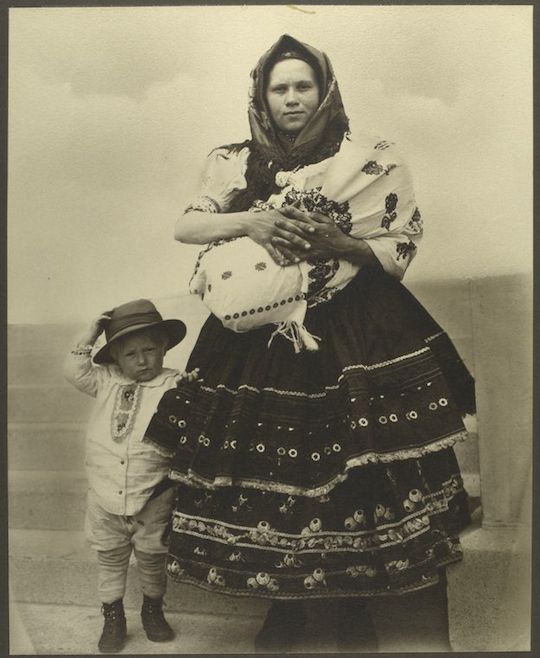
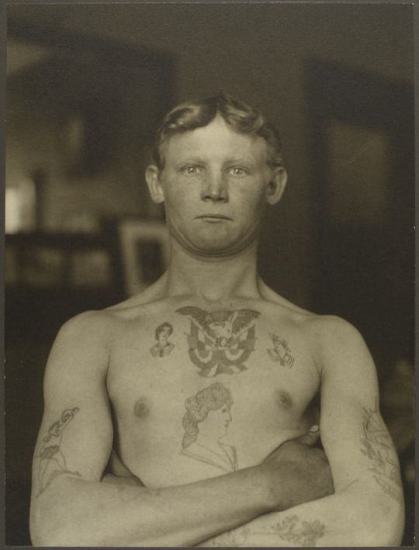
A while back we showed some photos from the wonderful Washington Post feature “What America’s immigrants looked like when they arrived on Ellis Island”. It’s a collection of  photos taken by Augustus herman at Ellis from 1892-1925. Sherman was the chief registry clerk at the immigration station.

Here’s what we said at the time:

His photos are wonderful because most of them show people dressed in their very best clothing, usually traditional clothes. While immigrants at that time traveled in their regular clothes because they knew the trip in steerage was dirty, they brought their best clothes to put on once they arrived at Ellis Island so that they would seem like presentable people who were a) not poor and b) good citizen material. They dressed to impress, and they had plenty of time to change during the long waiting periods between landing at the dock and being processed.

Adults and children alike were decked out in elaborate clothes. Women must have been sewing for months to create these wonderful ensembles. As the site points out, seeing these people reminds us that America has long been a place where a multitude of cultures mix on the streets, in schools, at work and at play. While immigrants did not wear these magnificent dress pieces every day, they did leave Ellis and make their way in America with them on, and brought them out on special occasions, making America a bottomless reservoir of cultural identity and expression.

It would be great if someone would create a similar archive of 21st-century immigrants.

And then we showed some of the photos. At the time, we were just enjoying the window onto the past they provided. But with all the (usual) scaremongering talk about immigrants that was generated by the Syrian refugees, we suddenly thought of them in a new way.

Look at this woman from “Ruthenia” (today’s Belarus and Ukraine):

Ruthenian-woman

Would this woman pass the very, very difficult screening process we have in place for refugees and be allowed into the U.S. today? It doesn’t seem likely. Headscarf, ethnic clothing… looks like a terrorist.

In fact, all the women wore headscarves:

Slovak-woman-and-child


Three-Dutch-women

If headscarves are a red flag, these Slovakian and Dutch women would be held up for quite a while if they were screened today.

And what about these women?

They wear headscarves and have strange looks in their eyes; the one on the left seems pretty angry. Both of them were likely deeply committed to a religion that most native-born white Americans rejected as foreign and dangerous to the U.S. government and American Way. Yes, they were Italian Catholics who whisked into this country without anyone checking to see if they were terrorists. This at a time when the U.S. government was actually suspicious of Catholics as agents of the Pope. Yes, the Immigration Act of 1924 would limit the number of southeast European Catholics (and Jews) who could enter the country, but they were never banned altogether.

This Algerian man would likely not get into the U.S. today dressed like this. Yet he successfully entered the country a century ago, and likely lived a quiet life. His descendants are probably living quietly in the U.S. today.

Algerian-man

What about this guy?

A-German-stowaway

No way, right? But this German man successfully entered the country, likely with no more screening than the usual six-second physical at Ellis Island.

This Russian soldier seems fairly menacing:

Cossack-man-from-the-steppes-of-Russia

Are those bullets of some kind on his jacket? That seems like a knife in his belt. Whatever he’s holding—club, sword—is also pretty violent-looking. This man came to America loaded for bear. But he got in, and you know that he got his picture taken because of his “colorful outfit”.

We just weren’t scared of people like this a century ago because we assumed that anyone who came to America would see that it was the greatest society on Earth and toe the line. We believed that our society was strong enough to take in disparate peoples and turn them into Americans. We believed our society was appealing enough to win over our immigrants and make them real Americans who would live and die for their new country.

When did we lose that faith in ourselves? When did we decide that every single immigrant, man, woman or child, was a threat powerful enough to bring down our whole system and way of life? Why did we decide it? There have been acts of terrorism in this country before 2001, and they were usually (and usually wrongly) blamed on immigrants (think Haymarket). And we’ve passed stupid laws banning certain “undesirable” immigrants: the Chinese, the Japanese, southeastern Europeans (read Jews and Catholics). But the panicky idea that all immigration is a threat, that no one should be allowed into the country unless they’re white people from Europe, that every immigrant and even every refugee must go through the most rigorous, nay impossible screening process imaginable, is recent.

Here’s a rundown of what war refugees must do if they want to enter the U.S. today, courtesy of John Oliver:

Look, it is difficult to vet people coming out of a war zone, but it’s not like we’re letting just anyone in. We are the United States of America, not Arizona State. Because just for the record here, let me just walk you through what our screening process actually is.

If you’re a refugee, first, you apply through the United Nations’ High Commissioner for Refugees, which collects documents and performs interviews. Incidentally, less than one percent of refugees worldwide end up being recommended for resettlement.

But if you’re one of them, you may then be referred to the State Department to begin the vetting process. At this point, more information is collected, you’ll be put through security screenings by the National Counterterrorism Center, the FBI, and the Department of Homeland Security. And if you’re a Syrian refugee, you’ll get an additional layer of screening called the “Syria enhanced review,” which may include a further check by a special part of Homeland Security, the USCIS Fraud Detection and National Security Directorates.

And don’t relax yet, because we’ve barely even started. Then, you finally get an interview with USCIS officers, and you’ll also be fingerprinted so your prints can be run through the biometric databases of the FBI, the Department of Homeland Security, and the Department of Defense.

And if you make it through all that, you’ll then have health screenings which, let’s face it, may not go too well for you, because you may have given yourself a stroke getting through this process so far. But if everything comes back clear, you’ll be enrolled in cultural orientation classes, all while your information continues to be checked recurrently against terrorist databases to make sure that no new information comes in that wasn’t caught before.

All of that has to happen before you get near a plane.

This process typically takes 18 to 24 months once you’ve been referred by the U.N. to the United States.

This is the most rigorous vetting anyone has to face before entering this country. No terrorist in their right mind would choose this path when the visa process requires far less efforts. But nevertheless, the House still voted on Thursday to add a few more steps.

It doesn’t seem likely that anyone in the photos above would have entered the U.S. under those conditions. And that would have been a terrible injustice. Not every immigrant is an angel. That German guy probably got into a lot of fights. But we can’t be scared of immigration. We can’t put ourselves in a lock box and say “no more immigrants”. We have to believe, as we once did, that America makes Americans, that Americans can be made, not born, and that that is a source of our greatest triumphs as a nation.

Civil War 1860–and 2016?

It’s the last post in our series examining the serious and striking comparisons between the U.S. in the months (and years) before the 1860 presidential campaign and the 2016 presidential campaign, in which we leave the campaign and think ahead to its logical and inevitable conclusion—the election of a president.

Again, our point of comparison between the 1860 and the 2016 presidential campaigns is sectionalism. In 1860, slavery drove sectional division north and south. In 2016, as we say in our first post,

Today’s sectionalism, then, represents a divide between liberals and conservatives that seems as strong as the divide between North and South ever did. Liberals and conservatives are found in every geographic region of the country, which means there is no region that serves as a safe haven for either…

Sub out “slavery” for “gun control”, “immigration”, or “religious freedom”, and you find that the language used in the 1860 campaign is strangely similar to the language used so far in the 2016 campaign.

We don’t know who will win the 2016 presidential election, but it seems fair to say that the reporting of Election Day in 2016 will be much like the reporting from the New York Times on Election Day 1860:

…The return of Napoleon from Elba did not a greater excitement than the returns of the present election. All day yesterday the inquiry was in everybody’s mouth, “What’s the latest news?” Newspapers were in demand… Every bus that carried its dozens of citizens businessward in the morning was a reading-room, a political meeting-house and a pseudo stock board, all in one. Some read the papers, some fought the bloodless battle over again, bringing their batteries of profound argument to bear upon the proposition that “they knew Lincoln would be elected”… In the streets, in the restaurants, in offices and counting-houses such was the tenor of the talk, and the character of the occupations of all to whom a leisure moment came.

Change out “newspaper” for “Internet” or “TV” and it fits pretty well. Change out “Lincoln” for “Clinton” or “Trump” and again it seems likely. One hopes that the battles after the 2016 election results are in will be bloodless; as we know, the returns in 1860 heralded the shedding of more American blood than anyone could have imagined even on November 7, 1860, when it was obvious to most Americans that sectionalism, created and exacerbated by the enslavement of black Americans, had driven a wedge so deep into the country that nothing short of a war seemed powerful enough to dissolve the sectionalism and mend the breach.

Today, Trump denies that he was inciting people to murder when he said on August 9 that the “Second Amendment people” might find a way to stop Clinton from naming Supreme Court justices if she is elected president, but this was just the most egregious of many calls to violence and bloodshed that we’ve heard in this country over the past year of campaigning, all, so far as we have seen, coming from the conservative side of the liberal-conservative sectional divide that is currently rending our country in two.

It’s hard to imagine another Civil War being fought today over liberal-conservative sectional issues. But as we said back in 2008 in Union or Slavery?:

Think of it this way: what if right now, as you sit reading this, the United States was in danger of civil war. Some group of states had actually written up papers outlining how they would secede, and they had the power and the foreign backing to do it. Imagine that every week you read about how these states—let’s say 15 western states—were ready to actually sever their ties to the U.S., and leave the nation with 35 states and a big hole.

It’s impossible for us to really imagine this. We are faced daily with serious threats to our economic, intellectual, and political unity—there’s constant talk about red and blue states and how the coasts hate the  middle and vice-versa, etc.—but we cannot imagine this translates into a threat to our actual political unity. We can’t picture facing the possibility that civil war would break out over these issues and that the United States as we know it would cease to exist.

And all over one political and social issue. An important issue, to be sure, but not one that you thought could destroy the United States. Say it was illegal immigration. It’s been simmering for decades, but it’s begun to boil in the past 10 years, and people’s emotions are getting stronger about it. What do you think will happen in this situation?

Well, you expect it to keep dragging along as a divisive issue that will someday get enough minor legislation to die down, and be replaced by something else. Inertia or a solution, those are the options.

You never expect it to cause an actual civil war, with people in your state fighting people from another state. You don’t expect to see armies formed in the western U.S. states to fight the U.S. amed forces. You don’t expect to have your home destroyed by battle next year.

And that’s the way Americans viewed slavery in the antebellum years. It was a divisive issue, and was getting hotter after 1848, but civil war? Really?

The current election is causing great anxiety for many Americans on both sides of the sectional divide, but no doubt few are ready to believe that it could spark another Civil War. As we’ve seen in the Times‘ coverage of 1860, they were loathe to believe it, too; to the very end they kept reflecting the belief that somehow the proslaveryites would gradually back down and accept the fact that they no longer controlled political power in Washington. They were wrong. And those who believe today that one side or the other will back down from civil war may also be wrong. We devoutly hope they are not. But our trip back in time to the 1860 election has, sadly, inspired more fear than hope on that issue.

What is conservative and what is radical? 1860 and 2016

Hello and welcome to post seven in  our series examining the serious and striking comparisons between the U.S. in the months (and years) before the 1860 presidential campaign and the 2016 presidential campaign. Today we extrapolate a parallel between Trump and Abraham Lincoln.

Again, our point of comparison between the 1860 and the 2016 presidential campaigns is sectionalism. In 1860, slavery drove sectional division north and south. In 2016, as we say in our first post,

Today’s sectionalism, then, represents a divide between liberals and conservatives that seems as strong as the divide between North and South ever did. Liberals and conservatives are found in every geographic region of the country, which means there is no region that serves as a safe haven for either…

Sub out “slavery” for “gun control”, “immigration”, or “religious freedom”, and you find that the language used in the 1860 campaign is strangely similar to the language used so far in the 2016 campaign.

Speaking of slavery, a New York Times editorial from October 1861 focuses on whether or not newly nominated Republican presidential candidate Abraham Lincoln really intends to end slavery as southerners insist. Despite the fact that Lincoln represented a party founded in large part to stop the spread of slavery, and that Lincoln had, over the previous four years (since his debates with Stephen Douglas) been more and more clear that he found slavery morally wrong and dangerous to the political Union and American democracy, and that most Republican voters expected Lincoln to “teach the South a lesson” after having its way in Washington for four score and seven years, the author of the editorial is sure that Lincoln will do nothing to stop slavery:

After Mr. Lincoln shall be elected we think he will very promptly take steps to dispel the fogs that have been thrown around his political position – and that he will present himself to the country as a Conservative, devoted to the Union, considerate equally of every section and of every State, and resolved faithfully and with firmness to maintain the Constitution in all its parts. We have no doubt that he will proclaim himself opposed to the extension or increase of Slavery, and equally opposed to any interference of Congress, or of the North, with Slavery in the Southern States. He has repeatedly declared himself in favor of an efficient Fugitive Slave Law, and opposed to negro suffrage and the political equality of the negro race. We regard these as eminently conservative views, and if his Administration adheres to them with firmness and fidelity, we believe it will contribute largely to the restoration of the public peace, and fortify the Constitution and the Union still more thoroughly in the affection and confidence of the American people…

In this short paragraph we have a wealth of contradictions:

—The idea that Lincoln’s plans as a Republican president were unclear, shrouded in “fog” by outsiders, is an amazing example of wishful thinking. Very few people in the U.S. in the election year of 1860 felt unclear about what Lincoln would do regarding slavery. Northerners assumed he would stop it from spreading and eventually end it in the South; Southerners assumed he would immediately abolish it throughout the Union. This is because of Lincoln’s many statements about hating slavery and wishing to help it along to oblivion, and because of his party’s antislavery basis.

—The statement about a conservative being equally devoted to every section and state is also pretty astounding. The 1860 election was the first in which no presidential candidate represented the entire country. The Republicans were Northern, the Southern Democrats were Southern, the Democrats were primarily Southern, and the Constitutional Union party was created to attract loners who did not take a side—of whom there were vanishingly few. That was the whole point of the 1860 election: the country had irretrievably divided over slavery. There was no going back, and certainly not with a candidate like Lincoln who was antislavery. He did not represent the South.

—The characteristics of “eminently conservative views” given here are shocking, as they are three examples of radical race hatred against black Americans and, in the case of the FSL, a violation of the Constitution (state antislavery laws were overruled by federal law insisting that slavery must be acknowledged in those states while slave states were not forced to acknowledge abolition). This is what passes for normal in a country driven to extremes of sectionalism: maintaining the horrible, anti-democratic status quo is “conservative” while attempting to restore democracy is “radical”.

—How is it possible to confidently claim that if Lincoln does continue to maintain the proslavery status quo it will restore the Union and public peace, and fortify the Constitution? The Constitution is already violated, and it’s the status quo of appeasing slaveholders itself that has led the Union to the brink of rupture and destroyed the public peace.

If we look to the present 2016 presidential race, we see unsettling similarities between this article and how Trump is often described by his admirers. He may seem like a dangerous radical, but that’s just a “fog” of misinformation spread by his detractors, all of whom are themselves dangerously biased. Trump is devoted to the United States and its Constitution, and will treat all Americans with the same love and respect, no matter how much he targets certain populations for his hatred. His deeply racist, sexist, and anti-democratic views are actually “eminently conservative”, representative of the established status quo and traditional American values.

At the same time, the editorial writer’s willful blindness to the reality that the nation has changed and is on a very dangerous course toward civil war is seen today in writers and speakers and average Americans on both the Democratic and Republican sides. Pretending that the 2016 election is business as usual is as crazy as pretending that the 1860 election was. Sometimes you have to acknowledge that you live in dangerous times, and that the status quo is being fundamentally challenged. Presenting radical hate as common sense, threats of nuclear war as protecting national security, and an unstable character as “honest” is as much an attempt to say that nothing is changed when everything has changed as anything written in 1860.

Next time: the end of our journey

Delegates forced to vote for Trump, not forced to vote for Douglas

Entry six in our series examining the serious and striking comparisons between the U.S. in the months (and years) before the 1860 presidential campaign and the 2016 presidential campaign focuses on a detail of the second 1860 Democratic convention in Baltimore that hews closely to a detail of the 2016 Republican convention in Cleveland.

Again, our point of comparison between the 1860 and the 2016 presidential campaigns is sectionalism. In 1860, slavery drove sectional division north and south. In 2016, as we say in our first post,

Today’s sectionalism, then, represents a divide between liberals and conservatives that seems as strong as the divide between North and South ever did. Liberals and conservatives are found in every geographic region of the country, which means there is no region that serves as a safe haven for either…

Sub out “slavery” for “gun control”, “immigration”, or “religious freedom”, and you find that the language used in the 1860 campaign is strangely similar to the language used so far in the 2016 campaign.

You’ll remember that in post five on the 2016 Republican national convention, we described how the 1860 Democratic national convention fell apart after proslavery fire-eaters walked out rather than support slavery moderate Stephen Douglas as their candidate. The Democrats decided to try again six weeks later in Baltimore. When we wrote post five, we noted that it was uncertain whether the 2016 Republican national convention would suffer the same division as moderate delegates tried to rescind their promised votes for Trump. The answer is yes and no.

In Baltimore in 1860, the Democrats had to decide whether to let the southern proslavery delegates who had walked out of the Charleston convention six weeks earlier to participate in the new convention. Eventually the committee charged with the decision said the party should re-admit all of the renegade delegates except those from Louisiana and Alabama. Those states would have to provide new delegates. They did so, and the new delegates joined the convention, but as they did almost all of the other southern delegates walked out again, and this time they took some northern and western delegates with them.

When Douglas was nominated by well over a 2/3 margin of the remaining delegates, the official Democratic party had its presidential candidate. But the delegates who walked out regrouped in another location in Baltimore and elected their own candidate, John C. Breckinridge of Kentucky, in the name of their new party, the Southern Democratic party.

The Democrats were officially split, and this helped guarantee a win for the Republican candidate, Abraham Lincoln, in the presidential election.

In the New York Times‘ initial coverage of the reconvening of the Democratic convention, before the walkout, there is an interesting note:

The most significant step taken was the action upon a resolution offered …that all the delegates admitted to seats in the Convention should be deemed bound in honor to support its nominees. Nothing could be intrinsically more just than such a rule. Conventions become a mere farce when they cease to carry any obligation—and if one portion of their members are held bound by their action, while another portion is entirely free, they become insurgents of oppression. But the Southern Delegates refused utterly to assent to any such restriction of their liberty. They declared their determination to secede en masse in advance of any action, if such a rule should be adopted.

This is almost identical to what happened in Cleveland this year: the Republican convention began with some delegates attempting to force through a resolution to change the rules of the convention to allow them to rescind their promised votes for Trump. They were not successful, and basically the above argument was made against them that “Conventions become a mere farce when they cease to carry any obligation—and if one portion of their members are held bound by their action, while another portion is entirely free, they become insurgents of oppression.”

The present-day Republican delegates did not “utterly refuse to assent to this restriction of their liberty”, they did not walk out, and the convention did not split. But the eerie similarities between 1860 and 2016 continue in this moment from both conventions.

Next time: political spin, 1860 and 2016