We can’t help liking this ad with Paul Revere.
If only he had told them “by sea”. Maybe they called him back.
Our past matters today
We can’t help liking this ad with Paul Revere.
If only he had told them “by sea”. Maybe they called him back.
Hello and welcome to the last post in our unexpectedly long series on Oliver Stone’s new TV series, The Untold History of the United States, currently airing on Showtime. We are analyzing and judging Episode 1 – World War II on its historical accuracy, as Stone asks us to do in the intro.
We left off with 15 minutes to go, and the Allies yet to open a second front in western Europe to relieve the pressure on the Soviet Union, which was fighting off the Nazi invasion launched in 1941. At 51.00 Stone, narrating, shows a propaganda movie clip of Russian people of all ages swearing to fight the Nazis to the death, and describes the superhuman effort of the Russian people to push back the Germans. While their sacrifice was astounding, the lionization of the people ends up subbing in for a frank assessment of Stalin, whose incompetent leadership repeatedly betrayed his people. At last at 55.40 Stone does mention that Stalin decreed that anyone caught retreating or surrendering was to be treated as a traitor, and his family imprisoned. Over 135,000 Russian soldiers were executed during the course of the war for this “treason”; Stone also mentions the over 400,000 prisoners still held in Soviet gulags during the war. He does not say who they were, eliding the fact that many thousands were Polish citizens removed from their homes during the Soviet occupation of Poland. Instead, Stone turns away from a close inspection of Soviet policy under Stalin to focus once more on the heroism of Soviet soldiers.
At 57.52 the episode wraps up by saying: “Though the myth lives on that the U.S. won World War II, serious historians agree that it was the Soviet Union and its entire society, including its brutal dictator Joseph Stalin,who, through sheer desperation and incredibly stoic heroism forged the great narrative of World War II: the defeat of the monster German war machine.”
Again, as we mentioned in our first post, one immediately wonders who the “serious historians” consulting on this project were, but an examination of the credits brings up only three “Researchers” who are not listed as having advanced degrees or belonging to any university or institution. Dr. Peter Kuznick has a bio on the website; he specializes in atomic- and nuclear-era U.S. history. Clearly Dr. Kuznick’s expertise will be critical in later episodes that focus on the Cold War, but in this WWII overview episode, it can have been put to minimal use at best. Who else informed this episode?
We ask because the closing statement is full of holes. No reputable historian of WWII says that the U.S. won it; it is always acknowledged as the joint effort of Britain, the USSR, the U.S., forces from the British Commonwealth, and resistance movements, like the Polish Home Army, in occupied Europe. The Soviets holding on and keeping the Nazis from the Baku oil fields was critical in the Allied victory, but the Soviets alone did not win the war, either. Even if they had been able to force the Nazis out of their country, that would not have stopped fighting on other fronts, like Italy and North Africa, which Stone dismisses as small potatoes because Allied forces there generally “only faced about 10 German battalions.”
More crucially, had the Soviets won the war on their own, they would not have had to negotiate with Roosevelt and Churchill, and would simply have taken over as much of Europe as they possibly could have, fulfilling the same purpose Hitler had had in invading eastern Europe and the Soviet Union itself. Winning the war is not winning the peace, and in this case, the peace was as hard-fought for by the Allied leaders as the war had been, as Churchill and Roosevelt tried to keep Stalin from seizing 3/4 of Europe and starting a war with Britain and the U.S. for the rest of it.
We have documented the extremely rose-colored view of Stalin and the Soviet Union throughout this first episode in our earlier posts. Stone says that the major goal of the series is to find unsung American heroes and to “explore the demonization of the Soviets.” So we know up-front that the USSR is going to be presented in a better light than usual, and that makes the “serious historian” uneasy. Whenever you have a goal of undermining the popular view of a person, group, or issue, you have to make your goal clear throughout your work. You can’t just present a radically different view without comment, and you have to back up your new theory with plenty of research. You have to say, for example, “Most people say the Soviets would only have started another war to take Europe if Churchill and Roosevelt hadn’t been firm with him, but I can prove that’s not true.” Then you make your contrary case and prove it with primary documents. Stone does not do this. He leaves out information that contradicts his theory, and that means he is not a serious historian, and cannot ask us to accept his series as serious history.
We can’t say for sure what the point of glorifying the Soviets is in this series; perhaps it will become clear in later episodes, or maybe it will just be put out there over and over with no explanation. It’s likely that for each glorification of the Soviets there will be a denigration of the U.S., since Stone wants to flip the US-good/Soviet Union-bad paradigm. But we are unlikely ever to know, since we won’t be watching any more movie-making masquerading as historical documentary, and will stick with serious history, radical and persuasive as it is.
Part 3 of our series on Stone’s “Untold History of the United States”, currently running in 10 one-hour episodes on Showtime. So far in our review of Episode 1—World War II, we have not encountered a lot of U.S. history; it has mostly been a retelling of world events with a loving focus on Stalin and the Soviet Union as lone crusaders against Hitler. More, unfortunately, on that below.
But at about 19.00 Stone introduces Henry Wallace, FDR’s Secretary of Agriculture, as our first unsung hero of U.S. history. Wallace directed the soil conservation program that helped reverse the Dust Bowl, and was an outspoken opponent of racism against black Americans and Jewish people worldwide. When FDR chose Wallace as his running mate in 1940, the Democratic party protested, leading the president to write a letter to the delegates at the Democratic National Convention saying he would not accept their nomination if they did not accept Wallace’s. Stone edits the letter, of course, to make a sound bite; there’s nothing wrong with that. But oddly, he changes the end of the letter fairly substantially. The actual text is:
“The party must go wholly one way or wholly the other. It cannot face in both directions at the same time. By declining the honor of the nomination for the presidency, I can restore that opportunity to the convention. I so do.”
Stone gives it as:
“The party cannot face in both directions at the same time. Therefore I decline the honor of the nomination for the presidency.”
The meaning is changed, from “I will refuse to run unless you let me unify the party on morally right terms” to “I’m not running.” This level of editing makes one wonder about the accuracy of all the other quotes given in the episode, and whether the goal of making a more dramatic soundbite led Stone and the editors to substantially change the content of other quotes.
Another basic law of documentary film-making is broken here, as Stone uses footage of Roosevelt delivering a radio address as a voiceover artist reads the letter text, seemingly saying to viewers that this is footage of Roosevelt actually reading from the letter. The lips don’t match the words well until the very end, where whatever Roosevelt was actually saying matches “the presidency” very closely. You don’t pretend to have footage of something you don’t have footage of.
FDR’s tough stance paid off, and Wallace was accepted as the vice-presidential nominee. So far in the episode, FDR is coming off pretty well, as someone who would have liked to aid the Spanish Republic, and forced his party into braving conservative pressure. The only real negative so far is the U.S.’s perversely small quota allowed for Jewish immigration from 1933-1945, for which FDR must take some blame.
At 27.40, Stone at last acknowledges Stalin’s paranoia by saying it would not allow him to believe that Germany would attack its new Soviet ally in 1941. But we veer back into Stalin-boosting at 29.28, when Stone says that after the Nazi invasion of the Soviet Union was launched, “Stalin begged Britain for military material and to land immediately in Europe and engage Hitler on a second front. And for the west, it was now crucial to keep the Soviet Union in the war to absorb the main thrust of the Nazi war machine.” To say that the Allies wanted the Soviet Union in the war simply to let someone else be destroyed in their place is inaccurate, to put it mildly, and Stone himself contradicts this cynical view immediately before this clip, at 29.15, when he says the west feared that the Soviets would fall to the Nazis, and conclude a separate peace. The prospect of the Nazis controlling the Soviet Union and its massive resources of farmland and oil was so dire that Churchill, an entrenched anti-communist, “pledged support for the Soviet Union.” So the real reason it was crucial to keep the Soviet Union in the war was not so it could be destroyed by the Nazis while the west looked on laughing, but to keep it in the war so that its crucial resources would not be used to fuel the Nazi war effort. If the Soviet Union fell, the odds of defeating the Nazis shrank considerably.
But Stone continues to present the west as anxious to support a Nazi victory over the Soviet Union, explaining the reluctance of U.S. military leaders to send war materiel to the USSR, and the reluctance of the British to divert that war materiel from their own war effort to the eastern front, this way: “There were still many in the west who frankly were glad to see the Soviet Union finally on her knees.” It’s true that many American leaders would have been glad to see the Soviet Union fall. It’s not true to say that that is the reason why they did not want to provide war supplies to Stalin. American leaders hesitated to get involved in a war the U.S. was not part of—in the summer of 1941 the U.S. was officially neutral, and getting involved in the war might invite an attack on the U.S. British leaders hesitated to redirect war supplies from Britain to the Soviet Union because Britain was still fighting for its life at that point. They did not know, as we do now, that Germany would not attempt another invasion of Great Britain. Britain was the only western European nation still fighting the Nazis, and it’s reasonable that its leaders would not want their only outside supply line from the U.S. sent to the eastern front. Stone has just said Churchill pledged to support the Soviet Union because he needed them in the war. So how can he then say Britain was “frankly” glad to see the Soviet Union fall?
The real issue in 1941 was one that would persist for three more years: the Allies wanted to open up a western front but were unable to get the foothold in Europe to do so, and needed considerable firepower in the west to create that opportunity. There was no conspiracy to let the Nazis destroy the Soviet Union. If the USSR fell, then the Nazis could return their full focus to the west, and then the odds of carrying out the D-Day invasion would have shrunk dramatically.
Stone then moves on to FDR’s secret meeting with Churchill in Newfoundland in August 1941, and notes that FDR was reluctant to help Churchill protect and extend its empire; the Atlantic Charter that came out of the meeting that set the Allied goals for a post-war world specifically ruled out “territorial aggrandizement” as a goal. Stone then has audio of FDR explaining the “Four Freedoms” (freedom of speech and worship, freedom from want and fear), and ends it by saying “These were big words, but the Atlantic Charter was a truly visionary document.” (34.03) The Four Freedoms, however, were not in the Atlantic Charter; they were introduced in a speech by FDR 7 months earlier, in January 1941. Yes, the principles of the Freedoms are upheld by the Atlantic Charter, but the articulation of the Freedoms is not in the Charter, and it’s sloppy history to say they were. And just another red flag about the accuracy of the series as a whole…
…as we see when we move on to the origins of the Manhattan Project. Stone describes how it was turned over to the U.S. military and the oversight of Major General Leslie Groves. He says that Vice President Wallace “had a low opinion of Groves, believing him ‘a slightly pathological, anti-semitic Roosevelt-hater, and outright fascist.'” (42.54) Then Stone moves on to the team Groves created. Wallace may well have believed Groves was all those things, but the responsible historian cannot simply present Wallace’s opinion as the objective truth about Groves, as Stone does here. What if a history of the U.S. 50 years from now introduces President Obama by quoting a neo-conservative politician claiming that Obama was a Kenyan citizen posing illegally as a U.S. citizen, and then just moved on, letting that stand as the only description of the president, tacitly saying it is true? What if a history of the U.S. 50 years from now introduced President George W. Bush by quoting an activist claiming that Bush was in on the September 11th attacks and then moved on, letting it stand as true? If you present incendiary charges in what is supposed to be a documentary, you have to prove them. Stone does not.
On to another go-around at 44.22 about Stalin “pleading” for a second front, and here at least gives a few accurate reasons why this didn’t happen, from Eisenhower’s estimation that it would take much longer than the U.S. had thought to create the opportunity for a landing in western Europe to Churchill’s concerns about holding North Africa, in part hoping that the second front could be opened up in southern Europe from British North Africa.
We are almost done; next time will be the last time, but it will be an enormous dose of truth v. myth, so be ready.
On we go in part 2 of our review of director Oliver Stone’s TV series “Untold History of the United States”, now airing on Showtime. We’re analyzing it for its historical accuracy and reliability. Why do this? Because Stone asks us to, in the intro to episode 1, “World War II”, in which he says rather than make another narrative movie, he thought the important topic of “real” U.S. history deserved something more—a documentary series informed by real historians. So we are taking him at his word and watching the show as historians, and as we made clear in our first post, finding it lacking. No one is more dedicated to Truth v. Myth than the HP, so it’s not that we don’t like myth-busting, one of the promised activities of Stone’s series. It’s just that myth must be busted by truth, and not the other way around, and in Episode 1, at least, there’s a lot of myth posing as truth.
So we left off last time about 12 minutes into “World War II” and now we pick up at 12.35, where Stone, narrating, says that western non-intervention in the Spanish Civil War convinced Stalin by 1939 that “the western powers had no real interest in a collective action to slow the Nazi advance. For years, the Soviet dictator had implored the west to unite against Hitler and Mussolini, even joining the League of Nations in 1934. But Soviet pleas were repeatedly ignored. And then in 1937, full-scale war erupted in China as the powerful Japanese army captured city after city.”
Like a good dissertation advisor, let’s mark this up: First we are in 1939, with Stalin trying in vain to get the west to fight the Nazis. Coming where this claim does, after a wrap-up of the U.S.’s refusal to intervene in the Spanish Civil War and FDR’s statement that the refusal would come back to haunt the nation, one has to assume that Stone means Stalin was the only major leader who fought the Nazis in Spain and the only leader who was willing to keep fighting them afterward. Stone gets this, apparently, from the fact that the Soviet Union provided war materiel to the Republicans in Spain. But cursory study of the Soviet role in the SCW shows that Stalin intervened only in an attempt to convert the civil war into a communist revolution that would create a Soviet satellite nation in Spain. Stalin’s man in Spain, Alexander Orlov, had the socialist prime minister deposed and installed a communist who could be a puppet leader, and carried out arrests and execution of Republican leaders who did not sympathize with communism. In exchange for military support, Stalin demanded that the Republic pay in gold; about $500 million in gold left Spain for the Soviet Union during the war.
To say that Stalin was “fighting the Nazis” in Spain is disingenuous: he was in a fight to control Spain and had no interest in the stated goals of the Spanish Republicans. He supplied arms to the communist revolutionaries in Spain and directed most of his efforts to using those weapons to rid the revolution of its non-communist participants. Stemming the Nazi menace was fairly far from his mind. Stalin did hate European fascism, because it was not Communist, but his heart did not bleed for Hitler’s victims in Europe. Stalin was only ever concerned with his own security. Spain served his purposes only for as long as he thought he might control it, and begin to build his own empire in Europe.
Next, we have the statement that Stalin had been “imploring” the west “for years” to fight Hitler, and even had the USSR join the League of Nations to get his urgent message heard. First, Stalin never implored the west to fight Hitler, as we have seen. Second, the Soviet Union joined the League of Nations after Germany and Japan withdrew their memberships; Stalin hoped to develop some tactical alliances with western nations alarmed by Hitler’s actions so that if Hitler supported a Japanese attack on the Soviet Union in the east, or Germany attacked in the west, the Soviet Union would be able to call on its new allies to come to its aid. Stalin also wanted to give temporary support to anti-fascist movements in Europe, again to protect his own territory from invasion. No one can argue with the necessity of protecting one’s country from invasion. But to say that the Soviet Union joined the League of Nations primarily as a gesture of goodwill to try to get fighting the Nazis on the agenda is plainly wrong.
Finally, we jump backward in time from 1939 to 1937 to the Japanese invasion of China, which, presented in this way, is seen as an inevitable consequence of the west’s refusal to help Stalin fight Hitler. In reality, Hitler was not interested in really allying with Japan, a racially inferior nation in his view, and there was no cooperation between Germany and Japan before the invasion. So these are unrelated.
We recall at this point that the website for the series claims that we will discover unsung heroes of U.S. history and “explore the demonization of the Soviets”. This agenda is never actually stated in the episode. That is a red flag for the historian, who knows that you must always make your biases and agenda clear in anything you write or produce. When we practice Truth v. Myth here at the HP, it is clearly tagged as such and identified as such within the post. The second problem is that, while revisionist history is valuable, you have to do good history. You can’t take facts (the Soviet Union sending aid to the Republicans, the Soviet Union joining the League of Nations) and simply make up fictional narratives about why they happened. You have to stick to the real facts throughout, and suffer the times when they don’t support your thesis just as you celebrate the times that they do.
That’s a lot of ink to spill on 10 seconds of video. But those 10 seconds are so misleading, they have to be fully unpacked.
We move on, but only to another Stalin example: at 14.45, Stone says that after Hitler invaded Czechoslovakia “Stalin recognized the truth: his country was facing its most deadly enemy alone. He needed to buy time, and fearing a German-Polish alliance to attack the USSR, he shocked the west when he signed a non-aggression pact with Germany.”
The Soviet Union had made an alliance with Czechoslovakia in 1935 as a by-product of its new alliance with France (which was a Czech ally itself). These alliances were the fruits of and the reason for the Soviets’ joining the League of Nations. When Hitler took the Sudetenland nothing happened. When he took the rest of Czechoslovakia, France signed the Munich Agreement, accepting the new status quo and abandoning the Czechs. Churchill looked to Stalin to stand by his alliance; Churchill saw early on both the threat Hitler posed and the necessity of involving the Soviet Union in a war against Hitler. Churchill pushed incessantly for a British alliance with the Soviet Union, but British Prime Minister Neville Chamberlain was not interested in an alliance that he believed Hitler would find aggressive. When Stalin terminated its alliance with Czechoslovakia, Churchill was shaken, but continued to believe that the virulently anti-fascist Stalin would come around. When Stalin signed the Non-Aggression Pact with Germany in August 1939, just five months after the invasion of Czechoslovakia, Churchill was stunned.
After Hitler invaded Czechoslovakia, the USSR immediately dropped its alliance with that nation and then did absolutely nothing to stop Hitler. And when Stalin was approached by Joachim von Ribbentrop for an alliance with Germany, he accepted with alacrity, not because he feared a Polish-German alliance but for two reasons: first, he saw the Munich Agreement as evidence that France and Britain would not stop a German invasion of the Soviet Union, and second because Ribbentrop agreed to Stalin’s demand for half of Poland in return for an alliance. The Molotov-Ribbentrop Pact was perfect for Stalin because it protected him, he thought, from a western invasion. Germany would not invade, and occupying eastern Poland and part of the Balkans would give the Soviets a buffer zone against any British-French invasion. The Soviet Union also agreed not to get involved in any European war—that is, when Germany launched World War II, the Soviets would not interfere or intervene to protect France, Britain, or any other nation from German invasion.
The idea that Stalin feared a German-Polish alliance strains credulity to the breaking point. Poland had its own non-aggression pacts with Germany and the Soviet Union, but these seemed so flimsy to the Poles that they gratefully accepted British and French guarantees of military protection at the end of March 1939 in case of an attack by Hitler or Stalin. Only the paranoid mind of Stalin could have conjured up the threat of a joint German-Polish invasion of the Soviet Union; for Stone to accept it is baffling.
Stone says that Stalin had proposed to join the Franco-British alliance to protect Poland, but “neither [France nor Britain] would accept Soviet troops on Polish soil as a way of blocking the Germans.” This is astounding. France and Britain knew, as most European nations knew, that Stalin had been angling for years to find a way to annex Poland. That’s why they did not accept Stalin’s offer to occupy Poland “to block the Germans”—they knew it had nothing to do with Germany and everything to do with annexing Poland. Once Soviet troops entered that nation, they would never leave.
We have only covered about 5 minutes of film here. That’s the danger of it. A full hour episode presents stretches of conventional history that lull you into confidence and then slips in 5 minutes here and there of complete malarkey that you might be fooled into accepting.
We hope to make better time in part 3, where we move on to the actual war and more Stalin-burnishing.
Next time: finally a bit of the U.S. in this secret U.S. history
Director Oliver Stone claims that “there is a classified America we were never meant to see”, comprised of “events that at the time went under reported but crucially shaped America’s unique and complex history.” Rather than write off this effort as part of Stone’s work in conspiracy-theory proliferation without investigating, we took a look at episode 1, “World War II”, watching it on the series’ website. The copy on the episode home page says, in part, “Through examination of key decisions during World War II, discover unsung heroes such as American Henry Wallace and explore the demonization of the Soviets.”
The odd thing about this premiere episode of a series on secret U.S. history is that about 70% of it was not about the U.S., but a pretty standard overview of the run-up to the war and how it was fought. With some odd exceptions.
The lead-in shows Stone telling us that as a boy he thought he knew America—he learned in his “extensive” studies of history at school that “we were the good guys.” But as he traveled the world and served in Vietnam and made movies, “some of them about history,” he has learned otherwise. Seeing his children learn the same dishonest history provoked him to create something that “looks beyond what I call the tyranny of now” to the “really important subconscious stuff” that is going on under the surface. He wanted “to tell the American story in a way that it has never been told before”, mostly by debunking accepted heroes and presenting those who were unsung heroes. We will learn about “the meaning of this country, and what so radically changed after World War II.”
Somehow it’s not surprising that he starts mid-20th century; so few people are interested in our earlier history, with the exception of the Civil War.
The episode then begins with footage from a government documentary (after the fact) about the Manhattan Project, and uses celebratory classical music over scenes of an atomic explosion—a bit of sarcasm that is not only cruelly overused but immediately makes one wonder if the episode as a whole will take the easy way out of showing something negative in cartoon form rather than forcing the viewer to take in its full context. As the film rolls, Stone, who narrates throughout, says that the bomb “turned the refuge of the Founding Fathers into a militarized state.”
Stone makes the first of his debunking claims [at 6.22]: “Generations of Americans have been taught that the United States reluctantly dropped atomic bombs at the end of World War II to save the lives of hundreds of thousands of young men poised to die in an invasion of Japan. But the story is really more complicated, more interesting, and much more disturbing.”
The problem with both the claim about a militarized state and the “real” story of the bomb here is that neither is addressed in this episode. Granted this is the first in a long series, but if you raise dramatically striking issues at the beginning of an episode, you have to at least touch on them at some point in that episode. But it seems one will have to watch episode 2 (at least) to get any more data on these claims. For now, we are dealing strictly with the rollout of WWII.
Americans remember WWII as a good war but, Stone says, the rest of the world, “not so blessed,” remembers it as the bloodiest war in human history. This is specious in a few ways. First, Americans remember it as a “good war”, in quotes, because it was fought for a good cause (stopping fascism), not because it was a good time. Second, Americans certainly honor the bloodshed of the war. Third, Stone never describes what makes the U.S. “so blessed”; one has to assume it’s the fact that no battles were fought on U.S. soil (aside from the Pearl Harbor attack) and that war production built our economy. But to imply that because we fought the war in other lands, Americans love WWII and tacitly wish it would happen again while all other nations somberly recognize it for what it was is beyond ridiculous.
In his chronology of what is usually seen as the run-up to the war (Stone says the war began in 1931; that unlike other wars, it began “slowly and incrementally” with the Japanese invasion of Manchuria), Stone devotes time to the Spanish Civil War. He claims that the Second Spanish Republic had made enemies of big business in the U.S. because of its “progressive policies and tight regulation of business.” This led Firestone, Ford, GM, and “others” to provide Franco’s fascists with “trucks, tires, and machine tools”, and Texaco, headed by pro-fascist Torkild Rieber, promised Franco unlimited oil on credit.
There are two problems here: first, it’s true that Rieber was pro-fascist. But you can’t fall back on the catch-all “others” in this way.If you name four companies, you have to name them all—why should the four be called out publicly while the “others” get to remain anonymous? If it’s important to name some, why isn’t it important to name all? One gets the feeling that Stone wants to call out the biggest companies because they are the ones we know, and will be shocked at, while the others are less well-known and won’t be as effective. That is something historians do not do because it’s misleading and unprofessional; the other names would at least appear in a footnote.
Second, Stone clearly means to shame the U.S. government and people with this information, although FDR (as Stone mentions) was furious and the American people likely knew little about it.
It’s true that the Republican government of Spain was not popular with U.S. big business, in large part because it promoted socialism and nationalized the railways and banking, anathema to American free enterprise. But to equate nationalization with regulation is inaccurate, since they are two very different things; so is describing socialism as “progressive policies,” especially in the context of U.S. history in the early 20th century, when the Progressive movement was still an active if waning force in our country and was decidedly not socialist. This insidious favoring of the Spanish Republican government, presenting it as all good when the reality was complex, is disingenuous at best. This kind of twisting of the facts will recur in descriptions of Stalin and the Soviet Union later in the episode.
At this point, one has to start wondering which historians advised the series. Only one is named: Peter Kuznick, who specializes in atomic- and nuclear-era U.S. history. Clearly Dr. Kuznick’s expertise will be critical in later episodes that focus on the Cold War, but in this WWII overview episode, it can have been put to minimal use at best. Who else informed this episode? The closing credits list three “researchers” without Ph.D.s (at least they are not credited as such) or affiliation. When you are hired by a company called “Secret History LLC”, how much autonomy can you expect to have as you research? The sinking feeling that we will not quite be getting fully accurate history in this series setsin at this point and does not go away. As you’ll see in our own multi-episode “series” on this single episode and the ax it grinds, this episode likes to use real history to tell lies, mostly by taking quotes out of context, using leading language to color events, and drawing conclusions unsupported by facts.
To return to the Spanish Civil war segment, documentary footage is suddenly dropped, at 11.20, to use footage from a Hollywood movie to describe the heroic actions of Americans fighting in Spain against Franco. The movie—“For Whom the Bell Tolls”—was made in 1943, during WWII, and puts a strong spin on the motives of Americans fighting in the Spanish Civil War to make them jibe with the motives of Americans fighting in World War II. Gary Cooper plays the American hero who says he must fight in Spain to keep the war from coming to his own country: “It’s not only Spain fighting here, is it? …The Nazis are using your country as a proving ground for their new war machine, their tanks and dive bombers, and stuff like that, so they can get the jump on the democracies and knock off England and France and my country before we get armed and ready to fight.” These are clearly the sentiments of an American in 1943, not 1936; precious few Americans went to Spain in the 30s to fight the Nazis, with a prescient eye to what Germany was planning in the future—maybe none did. The episode, to its credit, uses a large lower-third to identify the switch to a Hollywood movie; it doesn’t try to pass Cooper off as a real volunteer. But to its discredit, the episode does present the 1943 spin as representative of 1936, a violation of basic history-writing. If Stone wants to be taken seriously by historians and the public, he can’t blur that line.
We’ll continue on in our own episode two where we get our first oddly revisionist presentation of Stalin.
Yes, it’s the seventh appearance of this post, which we run each time the issue of gay marriage comes up in high court in the U.S. The first time was back on May 21, 2008, when California’s Supreme Court decided that banning gay marriage was unconstitutional. The original point was that whenever a court overturns a law, there are always those who squawk—incorrectly—that it has overstepped its authority. The judiciary in the U.S. is meant to overturn laws, even laws with great popular support, that are unconstitutional because they restrict peoples’ liberty for no good reason.
Overturning bans on gay marriage started out as an example of thwarting this “tyranny of the majority”, as de Tocqueville called it, but now that the majority of Americans support or do not care to ban gay marriage, this type of legislation is becoming a rebuke to tyranny of the minority. That’s heartening.
Here is the original post, resurfacing now as we circle back to California. The U.S. Supreme Court is hearing a challenge to that original California ruling that made banning gay marriage illegal in the state:
The California Supreme Court’s decision that banning gay marriage is unconstitutional has been met with the by-now common complaint that the Court overstepped its bounds, trampled the wishes of the voters, and got into the legislation business without a permit.
A review of the constitutionally described role of the judiciary is in order.
The famous commentator on American democracy, Alexis de Tocqueville, talked a great deal in his books Democracy in America about the tyranny of the majority. This is when majority rule—the basis of democracy—ends up perverting democracy by forcing injustice on the minority of the public.
For example, slavery was an example of the tyranny of the majority. Most Americans in the slave era were white and free. White and free people were the majority, and they used their majority power to keep slavery from being abolished by the minority of Americans who wanted to abolish it. The rights of black Americans were trampled by the tyranny of the majority.
Before Brown v. Board of Education in 1954, the majority of Americans were fine with segregated schools. They used their majority power to oppress the minority of Americans who were black, or who were white and wanted desegregation.
In each example, the majority is imposing and enforcing injustice which is incompatible with democracy. They are tyrannizing rather than governing.
The judiciary was created to break this grip of majority tyranny. The legislature—Congress—cannot usually break majority tyranny because it is made up of people popularly elected by the majority. But the appointed judiciary can break majority tyranny because its sole job is not to reflect the wishes of the people but to interpret the Constitution.
If the judiciary finds that a law made by the legislature perverts democracy and imposes the tyranny of the majority, it can and must strike that law down. This is what happened in California. The court found that although the majority of Californians (as evidenced by a previous referendum) had voted to ban gay marriage, that majority was enforcing and imposing injustice on the minority. So the court found the ban unconstitutional.
This is not beyond the scope of the judiciary, it’s exactly what it is meant to do.
I heard a commentator yesterday saying the California court should have left the issue to “the prerogative of the voters”. But if the voters’ prerogative is to oppress someone else, then the court does not simply step aside and let this happen.
The same people who rage against the partial and biased justices who lifted this ban are generally the same people who would celebrate justices who imposed a ban on abortion. People who cry out for impartiality are generally only applying it to cases they oppose.
So that’s what the judiciary does: it prevents the tyranny of the majority from enforcing injustice in a democracy. Like it or not, the “will of the people” is not always sacred, and sometimes must be opposed in the name of equality.
It shouldn’t be necessary to parse such a short text to fully comprehend its meaning; it shouldn’t even really be possible. But the Gettysburg Address, delivered on November 19, 1863 at the dedication of the Soldiers’ National Cemetery in Gettysburg, Pennsylvania, by President Abraham Lincoln, packs a great deal of meaning into a very few words, and the fact that some of its phrases have become iconic, used liberally in everyday society, has actually blurred some of their meaning. Let’s go through it, attempting to be as concise as the author was, but knowing we will fail [this article is many times longer than his speech]:
“Fourscore and seven years ago our fathers brought forth on this continent a new nation, conceived in liberty and dedicated to the proposition that all men are created equal.”
—Yes, the first five words may be the most well-known; there’s probably no American alive today over the age of 5 who hasn’t heard those words, usually used in jest, or presented as impenetrable. It’s the one archaic rhetorical flourish Lincoln included. “Score” means 20, so the number is four times 20 plus seven, or 87 years ago. In 1863, that was, of course, 1776, the year the Declaration of Independence was written and signed.
The important thing about that number and that date is how recent it was; just 87 years ago there had been no United States. Adults in the crowd at Gettysburg had heard their parents’ stories about colonial days, and the Revolutionary War. Their grandparents might never have known independence. So the nation brought forth so recently, conceived in liberty and dedicated to the proposition that all men are created equal, possessed all the vulnerability of youth. It was not a powerful entity that could be counted on to withstand a civil war, particularly one that amassed casualties such as those at the Battle of Gettysburg.
“Now we are engaged in a great civil war, testing whether that nation or any nation so conceived and so dedicated can long endure.”
—The point is reiterated: can the U.S. survive the war? But Lincoln’s real question is about the precarious state of world affairs that the U.S. Civil War represented. The U.S. was founded as a nation dedicated to liberty for all. The Confederacy that fought the war was fighting for slavery, the opposite of liberty, and there seemed to be a real possibility that other nations, primarily England and France, would join the war on the Confederate side. If the Union lost the war, the only attempt at real democracy, personal liberty, and equality on Earth would be no more, and there might never be another. The U.S. had the best chance at making it work; if the U.S. failed, who could succeed? The worst fears of the Founders and of all patriotic Americans were realized in this war, and in losses like the ones at Gettysburg.
“We are met on a great battlefield of that war. We have come to dedicate a portion of that field as a final resting-place for those who here gave their lives that that nation might live. It is altogether fitting and proper that we should do this.”
—This was a recent battlefield. The bodies were cleared away, but the landscape was devastated by three days of cannon and gunfire. This drawing purports to show the start of the battle:
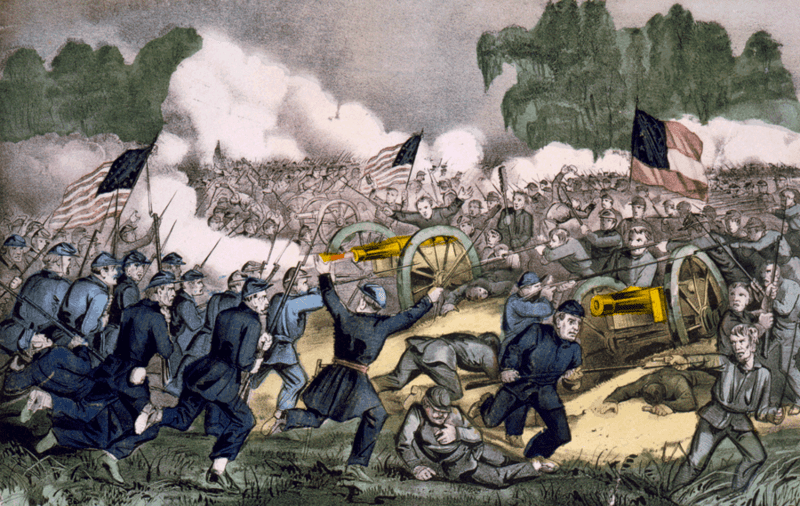
The soldiers are in a field surrounded by trees. Here is a photo from the day of the Address:

Yes, it’s now November instead of July, but the ground being completely stripped of vegetation is not the result of the onset of winter, and the lack of a single tree speaks volumes about the ferocity of the battle. There is a tree stump taken from the battlefield at Spotsylvania on display at the Smithsonian Museum in Washington, DC that is all that’s left of a tall tree that was shot away to nothing by rifle fire during the fighting.

Gettysburg’s trees must have suffered the same fate. Under that stripped-bare ground many men from both sides were already hastily buried. There was a strong need on the part of the families of the dead, who could not travel to Pennsylvania to find and retrieve their bodies, to find some way to set this battlefield aside as sacred ground.
“But in a larger sense, we cannot dedicate, we cannot consecrate, we cannot hallow this ground. The brave men, living and dead who struggled here have consecrated it far above our poor power to add or detract. The world will little note nor long remember what we say here, but it can never forget what they did here.”
—You can make the battlefield into a cemetery, but that action is not what makes the field sacred. It is the unselfish sacrifice of the dead, who fought to keep democracy and liberty alive in the world, that makes the land sacred—not just the land of the cemetery, but all lands of the United States. They are buried now in the cemetery, but they will live forever in the memory of the nation.
“It is for us the living rather to be dedicated here to the unfinished work which they who fought here have thus far so nobly advanced.”
—The “unfinished work” the soldiers were doing is the work of keeping democracy alive as well as the nation.
“It is rather for us to be here dedicated to the great task remaining before us—that from these honored dead we take increased devotion to that cause for which they gave the last full measure of devotion—”
—“The last full measure of devotion” must be one of the most powerful ways to say “they gave their lives” ever conceived of. The men buried here did not just die for a cause, they died because their faith in liberty was so devout that they put the life of their nation above their own lives.
“—that we here highly resolve that these dead shall not have died in vain, that this nation under God shall have a new birth of freedom, and that government of the people, by the people, for the people shall not perish from the earth.”
—We tend to think that the last phrase, “government of the people, by the people, for the people”, must have appeared somewhere before this, in the Constitution or some Revolutionary War speech. It’s surprising that it had not. This was Lincoln’s own description, and it is simple and powerful. This final statement in the Address is far from a gentle benediction. It is a steely resolve to continue the fighting, continue the bloodshed, allow more men to die, and to dedicate more cemeteries to the war dead in order to guarantee that the United States will not perish and take freedom along with it. We “highly resolve” to continue the work of this war, knowing that it will not be easy and success is not assured.
Delivering this final line, the president sat down. People in the audience were surprised. They had expected a longer speech—something more along the lines of the “translation” we’ve just provided, something more didactic that pounded points home over and over, and expressed its patriotism in more familiar, jingoistic language. Some felt insulted, and the press reviews were mixed: The Chicago Times said “The cheek of every American must tingle with shame as he reads the silly flat and dishwattery [sic] remarks of the man who has to be pointed out as the President of the United States.” The local Harrisburg Patriot and Union said “…we pass over the silly remarks of the President: for the credit of the nation we are willing that the veil of oblivion shall be dropped over them and that they shall no more be repeated or thought of.”
Part of the problem was that the elder statesman of Massachusetts politics, Edward Everett, had spoken for over two hours in a much more conventional way before Lincoln. Technically, Everett was right to speak longer, as he was on the program to deliver an “oration” while the president was listed as giving only “dedicatory remarks”. It was an age of very long speeches, and the longer the speech, the more seriously the speaker was taken.
But there were many people who realized they had just heard an historic speech. We’ll close with the opinion of the reporter from the Providence Daily Journal who felt the same way we do today after he heard Lincoln speak: “We know not where to look for a more admirable speech than the brief one which the President made…. It is often said that the hardest thing in the world is to make a five minute speech. But could the most elaborate and splendid oration be more beautiful, more touching, more inspiring than those few words of the President?”
The Supreme Court is currently hearing arguments to strike down sections of the Voting Rights Act of 1965. This has been a top news story, particularly after Justice Antonin Scalia called the VRA itself (not just the sections in question) a “racial entitlement”. Let’s look at the VRA of 1965 and the debate over it in the Court.
The VRA was passed in 1965 as part of President Johnson’s civil rights legislation. The U.S. Department of Justice website describes it this way: “Pursuant to the Act, the Voting Section undertakes investigations and litigation throughout the United States and its territories, conducts administrative review of changes in voting practices and procedures in certain jurisdictions, and monitors elections in various parts of the country.” This means that voting procedures anywhere in the U.S. can be reviewed, especially when those procedures are changed, and that elections can be monitored to make sure they are fair. Notice the language goes from the entire U.S. and its territories to “certain jurisdictions”—this was originally directed at the southern states, where repression of black voters was well-documented. The Act does not say “southern states” because its authors knew that while it was the south that had a demonstrable problem with fair elections in 1965, the problem could crop up anywhere else at any time. So wherever unfair elections were discovered, those “certain jurisdictions” would come under scrutiny.
Sections 2, 4 and 5 of the Act are the most critical. Section 2 forbids race discrimination in poll worker hiring, voter registration, and redistricting plans. Section 4 sets out the criteria for determining when a jurisdiction is violating fair elections and voting. And Section 5 states that once your state or territory has been designated as problematic and unfair in its voting and election process, any change with respect to voting there can’t be legally enforced until it’s been reviewed by the U.S. District Court or Attorney General. Any jurisdiction with a proven history of voting discrimination had to prove that the change being proposed is not discriminatory—not just another attempt to prevent minorities from voting freely. The jurisdiction has to prove the absence of racial discrimination, and if it can’t, the proposed change cannot be made law. If the suspect jurisdiction can prove that it has gone 10 years without any voter discrimination, it is no longer subject to Section 5.
The key word in all this, of course, is proof. The suspect locale has to prove it is not discriminatory. This represents a rejection of the federal government’s traditional tactic, post-Reconstruction, of listening to southern political leaders say everything was just fine and there was no threatening or lynching of black voters and saying, Great—that’s good news.
The VRA as a whole has been re-approved by Congress several times, most recently in 2006, when it passed by a vote of 98-0 in the Senate and 390-33 in the House. At that time, House Speaker John Boehner (R-Ohio) said the VRA was “an effective tool in protecting a right that is fundamental to our democracy.”
But in the summer of 2012, Shelby County, Georgia, challenged the 2006 reauthorization, saying that Congress had exceeded its authority under the Fourteenth and Fifteenth Amendments and violated the Tenth Amendment and Article IV of the United States Constitution. To quote from SCOTUS Blog:
“…lawyer Bert Rein, representing Shelby County in its challenge to the statute… began by reminding the Court of its 2009 decision in Northwest Austin Municipal Utilities District No. 1 v. Holder, in which it acknowledged that “the South had changed” and “questioned whether current remedial needs justified” the costs – both financial and to the jurisdictions’ autonomy – of the pre-clearance requirement. But Justice Sonia Sotomayor quickly jumped in, observing that even if the South as a whole has changed, Shelby County itself has not. Because Shelby County’s track record of discrimination at the polls remains poor, she suggested, it ‘may be the wrong party bringing this’ case.”
In short, Shelby County said the VRA was outdated and permanently labeled the south as racist, violating the south’s right to equal protection and due process under the law. Justice Sotomayor said this was not about the past but about the present, as Shelby County could not prove it was not discriminatory at the moment, in 2012. Between 1984 and 2010, Shelby County underwent a shift from majority Democratic to Republican, and in 2010 100% of all elected county officials were Republican. The county has not proved that this is the result of the free will of all voters, regardless of race, and not election fraud or voter intimidation, and so it must remain subject to Section 5 of the VRA.
The Court began hearing arguments in the case on February 27, 2013. This was the day Justice Scalia made his controversial claim that Section 5 was a “racial entitlement”, but his 2006 run-up to that statement is even more illustrative of how he sees the VRA:
“The comment came as part of a larger riff on a comment Scalia made the last time the landmark voting law was before the justices. Noting the fact that the Voting Rights Act reauthorization passed 98-0 when it was before the Senate in 2006, Scalia claimed four years ago that this unopposed vote actually undermines the law: ‘The Israeli supreme court, the Sanhedrin, used to have a rule that if the death penalty was pronounced unanimously, it was invalid, because there must be something wrong there.’
“That was an unusual comment when it was made, but Scalia’s expansion on it today raises concerns that his suspicion of the Act is rooted much more in racial resentment than in a general distrust of unanimous votes. Scalia noted when the Voting Rights Act was first enacted in 1965, it passed over 19 dissenters. In subsequent reauthorizations, the number of dissenters diminished, until it passed the Senate without dissent seven years ago. Scalia’s comments suggested that this occurred, not because of a growing national consensus that racial disenfranchisement is unacceptable, but because lawmakers are too afraid to be tarred as racists. His inflammatory claim that the Voting Rights Act is a ‘perpetuation of racial entitlement’ came close to the end of a long statement on why he found a landmark law preventing race discrimination in voting to be suspicious.” [our italics]
Here is Scalia’s 2013 statement: “[The VRA was] reenacted 5 years later, again for a 5-year term. Double-digits against it in the Senate. Then it was reenacted for 7 years. Single digits against it. Then enacted for 25 years, 8 Senate votes against it. And this last enactment, not a single vote in the Senate against it. And the House is pretty much the same. Now, I don’t think that’s attributable to the fact that it is so much clearer now that we need this. I think it is attributable, very likely attributable, to a phenomenon that is called perpetuation of racial entitlement. It’s been written about. Whenever a society adopts racial entitlements, it is very difficult to get out of them through the normal political processes.”
Scalia’s point, and that of most of the VRA’s opponents, is that the Act is no longer necessary, for two main reasons: a) the south isn’t racist anymore; b) other regions are racist but not being subjected to the Act. As we’ve seen, the Act is not written specifically for the south, but for any jurisdiction, state, or region that has provable voter repression and unfair elections. Yes, repressive new voting laws in northern and western states, usually strict voter ID laws, should be investigated as well… yet how can they be if the VRA is revoked? If the complaint is that all other regions of the nation should be equally suspect of racial discrimination in elections and should be punished for that, how can they be punished if the Act making that illegal is taken away?
What the push to revoke Section 5 and, one can’t help believing, the VRA as a whole, reveals is not a rejection of Civil War-era prejudice against the south but the very modern push to get rid of “big government”. Anti-VRA activists don’t want the DoJ involved in regulating and investigating state voting procedures. They want voting procedures to be regulated by the states, with no federal oversight, which is exactly the situation that made the VRA so necessary, when states violating fair elections were allowed to do that because there was no federal law to stop them. States with a history of racial discrimination in voting—whether it goes back to 1865 or started in 2012—have to be subject to federal oversight because they will not change their own laws.
We’re not sure if members of Congress voted to re-authorize the VRA in 2006 because they were afraid to be labeled as racist if they didn’t; we’re not sure that’s a bad thing. One would hope that being racist would always be a red flag in the United States, and something politicians would want to avoid. But we do know that there is a new trend in play, in which laws that have outlawed discrimination against minority populations have been called reverse discrimination, or revoked because they were successful. The latter is like saying, “Why do you take pills for your high blood pressure? You haven’t had high blood pressure in years. Why are you wasting all that money taking medicine for something you don’t have?” And if one replies, Well, if I didn’t take the pills my high blood pressure would come back, so the pills are preventive, the other party would say “So you’re paying good money not to fix a real problem, but to make sure a problem doesn’t happen? What evidence do you have that the problem might ever happen?” And one might say, My history of high blood pressure. And the arguer would say, dismissively, “History! You’ve got to respond to conditions as they are today, not spend money based on what happened in the past.”
But we would hold that a history—no matter how long or how short—of racial discrimination is a red flag, and needs to subjected to federal investigation in the present, to ensure the future. The fact that states all over the nation are regularly introducing discriminatory voting laws proves that we need the VRA, and need it to be more stringently enforced than ever, not that it’s time to realize that the south isn’t racist and the government’s too big and everything is just fine with voting in the U.S., and all the other claims being made in the Court and the nation as we follow this case.
John Winthrop, governor of the Massachusetts Bay Colony in its earliest years (most of the time between 1630 and 1649), kept up a correspondence with many people left behind in England. One of the more interesting of these correspondents was his sister Lucy Winthrop Downing. Lucy was married to Emmanuel Downing, a London lawyer, and she was a lively and intelligent woman whose repeated promises to join her brother in New England were unfulfilled until 1638, when she and her husband made the journey, only to return home when the English Civil War began in 1642. (Oddly, they lived in Salem rather than with John Winthrop in Boston.)
Lucy’s son George Downing is worth mentioning here. His mother wrote to her brother Governor Winthrop in 1636 to say the family was keen to move to New England but she worried that with no college there, her ambitious son George would have to stop his education: “and it would, I think, as we say, grieve me in my grave to know that his mind should be withdrawn from his book… for that were but the way to make him good at nothing.” In a great coincidence, in October 1636 the Massachusetts Bay Colony founded Harvard College, and this may have had something to do with the Downings’ decision to go to America at last in 1638. George was one of the nine graduates of Harvard College’s second class in October 1642, and returned to England with his parents to serve the Parliamentary government under Cromwell, but after the Restoration he neatly changed sides and served as Secretary of the Treasury under Charles II. George Downing was accused of betraying several of his former revolutionary colleagues, one of whom was executed. The jury is still out on Downing’s guilt there. He served both Cromwell and Charles II as Ambassador to the States General, and was recommended for the job by John Milton. He was the author of the Navigation Act of 1660, and served as an untiring diplomat. Downing Street in London, the street where the Prime Minister’s official residence is located, is named after him.
Sir George Downing may have inherited his intelligence from his mother. Lucy Downing’s letters are at once thoughtful, loving, and full of slang (such as “grieve me in my grave”) that reverberates down the centuries to this day with life and humor. She is much more earthy and matter-of-fact than her elder brother John, and one gets the feeling (unverifiable by historical research) that he must have enjoyed her letters a great deal.
We will look here at Lucy’s letter of March 4, 1636, which has several interesting features. It is the letter referenced above, where she expressed her concern for young George having no college if they moved to New England. All spellings and usages are modernized.
“MY DEAR BROTHER I received your most kind Letter dated in October and your dainty fruits which indeed were as good as Old England itself affords in their kind, but coming from New England and from your self they were rarities indeed, and we then being at Graces I sent for them thither and Sir Harry and my Lady were much taken with them. Sir Harry professed it did much satisfy him that things did prosper so well with you.”
—What it is John sent her is unknown; it may have been actual fruit or it may have been some American commodity, but Lucy appreciates them mostly because they came from her brother. Her love for John comes through like this in all her letters. It becomes clear that Lucy lives in the world; she is in London with Sir Harry and my Lady and in most of her letters she makes mention of the passing things of this world that Puritans rejected in a very matter-of-fact way, with little or no judgment. But her love of God and her religion also shine through when she mentions the trials of plague and persecution visiting England, and it becomes clear that Lucy Downing’s faith in God and commitment to her religion never wavered, even as she lived the life of a London lady for the most part.
“Now to give you account of our proceedings since my last [letter] to you. We were in progress from after midsummer till part of January, half of which time we wear at Graces and in the other half at Groton… all well in health …except James [had] a few ague fits. Since my coming home myself and maids have had agues but I bless God for it it hath left me again and God hath hitherto most graciously preserved our family from the arrow of pestilence or any other such sad disasters as for our sins might most deservedly have have embittered our lives or deprived us of life and all comfort ere this and on the contrary hath He blest us with many contents.”
—The family has spent part of its time at their house in Groton (in the summer and fall) and part in London (Graces) over the winter. Her son James had an ague, or fever, and so did Lucy and her maids. How different a world is described here than her brother John was living in New England! Traveling from the summer house to the house in London, having maids, and living the life of a wealthy woman, Lucy is worlds away from life in Boston, which was only six years old when this letter was written and was a warren of mud alleys and 100 square foot wooden houses. But just when it seems that brother and sister have nothing in common, their shared piety is expressed by Lucy saying it is only through God’s grace that her family was not struck with the plague then terrorizing England, which would be what they all deserved for their sins, but God has been merciful to them.
“Now I know you wish us no less good than that these cords of love may unite us to the fountain of love in the firmest bands, but for the great cause most sudden and sad is the change in so short a time. I confess a heart very dead might have been much rapt with the gracious light in those parts all that time and in a way of admiration. God grant that it may prove a gleam before a storm rather than a lightening before the night of death. In this relation might I spend more time and spirits than my condition will now permit but I may spare. Ill news seldom wants messengers (in our climate) and what was then put in execution in those parts is at this instant called upon in Essex and but a month limited for answer which answer is feared will prove a very fearful silence these are days of trial. Pray that our faith fail not.”
—We’ll be honest; this passage is hard to understand. Lucy, like many other correspondents in England, is writing in code about political trouble in case her letter is intercepted by the government. Our interpretation is that she is saying that after a brief flowering of the true faith, persecution has cracked down on Puritans in England. She shouldn’t dwell on bad news, for two reasons: first, her condition (she is pregnant, as we will hear more about later) and she should not work herself into grief for the sake of her health; and second she is sure John is getting more than enough bad news from home (“ill news seldom wants messengers”). Persecution elsewhere is now happening in Essex, and Lucy begs John to pray that the English Puritans will hold firm.
“Now I confess could a wish transport me to you, I think as big as I am I should rather wish to bring an Indian than a Cockney into the world. But I cannot see that God hath yet freed us for that journey, yet I doubt not but if He call us to it we shall discern Providence clearly therein, and I see more probability of the concurrence of things that way now than formerly I ever did, both for generals and particulars, if God please to spare our lives…”
—If she had her way, Lucy would fly to New England this moment, heavily pregnant, and bring an “Indian” into the world rather than a London Cockney. This lighthearted and fairly sassy statement is typical of Lucy, yet so untypical of her brother. For a lady in high circles, Lucy has a pretty relaxed attitude. Yet when it comes to religion, again, she is more serious, and says that God has not yet freed her family to make the journey in reality. When she says “if He call us to it” Lucy reveals a deeply felt worry: that God has not made a way for them to go to New England because God does not (yet) see them as worthy of the journey, worthy to join the saints in America. This is the typical Puritan sense of anxiety about one’s state of grace. Lucy is hopeful, however, that they will be called, for she “sees more probability” of it than before, in the big picture and in the details (details following below in the PS).
“…but may it not be more seasonable for one in my condition to breathe my gratefulness to so faithful a brother as yourself for all your surpassing affections both to me and mine, and to desire the continuance of your brotherly care of their best education, which is a very importunate suit of mine to you, whether I live or die, but especially if God should prevent my endeavors therein.”
—Lucy’s many references to dying are not just about God suddenly swooping in to deliver his judgment on sinners. She is in the last stages of pregnancy at age 35, and in the back of her mind she knows she may not survive this delivery. So she changes tack here, to thank John for his past goodness to her and her children, and to ask him to continue to help them in their education if she dies. Clearly John Winthrop had done something to aid in the education of the Downing children, whether it was giving money or books or using his influence to get the older ones into good schools, perhaps before he left England.
“George and his father comply most cordially for New England, but poor boy, I fear the journey would not be so prosperous for him as I could wish, in respect [that] you have yet no societies [in New England], nor means in that kind for the education of youths in learning, …and it would, I think, as we say, grieve me in my grave to know that his mind should be withdrawn from his book by other sports or employments, for that were but the way to make him good at nothing. It’s true the colleges here are much corrupted, yet not so [much] I hope but good friends may yet find a fitting tutor for him, and if it may be with any hopes of his well doing here.”
—Lucy’s husband and her eldest son George are eager to go to America when it becomes possible, but she worries that if they go to New England, which has no colleges or societies, George’s education will come to an abrupt end. It is odd that Lucy fears George might waste his time in sports if that happens (the Puritans having banned all sports); that is referenced again below. Staying in corrupt England isn’t great, but her Puritan friends could find George a reliably religious and learned tutor, both of which she fears are lacking in New England.
“Knowing your prevalence with my husband and the hazard the boy is in by reason both of his father’s and his own strong inclination to the plantation sports, I am bold to present this solicitous suit of mine with all earnestness to you and my nephew Winthrop that you will not condescend to his going over till he hath either attained to perfection in the arts here or that there be sufficient means for to perfect him therein with you, which I should be most glad to hear of. It would make me go far nimbler to New England if God should call me to it than otherwise I should, and I believe a college would put no small life into the plantation.”
—Lucy asks that her brother and her nephew, John Winthrop, Jr., already a leader in New England and governor of the Saybrook settlement in Connecticut, use their influence (“prevalence”) with her husband to persuade him that the Downings should not go to America until such time as George Downing has finished his education in England or a college has been founded in New England. She would be much more willing (“far nimbler”) to go if she knew George could get an education there. And she reveals that her husband has a fatal weakness that he has passed on to George: “plantation sports”. Again, we’re not sure exactly what this is referring to, but it could simply mean the distractions of the frontier. Whatever it is, it must be countered by devoting one’s time to school. Plus, a college would “put life” into the colony. We have a sneaking suspicion that by this Mrs. Downing means not only intellectual debate and the life of young minds but the pranks and mischief traditionally associated to college students, another unorthodox affection of this Puritan lady.
“[Were] my [letter-writing] answerable to my desires of discourse with you, I should be as tedious to you as I am to myself. But in good manners I forbear your further trouble at present, and desiring your prosperity and prayers for me and mine and a happy meeting either in this or a better life, [I am]
Your sister to command,
L DOWNING”
—If writing to her brother satisfied her desire to see him and be with him, Lucy would write so often and so long that she would drive him crazy. She would be “as tedious to you as I am to myself”, a nice piece of self-deprecation and humor. She signs off for now, and her wish for a happy meeting with her brother “either in this or a better life” is, once again, not just a pious catchphrase but indicative of deep affection and some anxiety about her approaching childbearing.
“I forget to tell you how forward we are for New England; George his jointure and mine is sold and but 320 pounds would it afford us and 2 years delay for payment but the truth is I saw them so unwilling to do me right in the assurance that I feared payment would be more hardly drawn from them and something may be better than nothing.”
—Their desire to go to New England is so strong that Lucy sold her jointure, the estate settled on her to provide her an income if she is widowed, and which her eldest son will inherit on her death. This estate was likely provided for her by her father at the time of her marriage. She sold it at a loss (for just £320) to be paid after two years, which is fishy, but whoever “they” are whom she sold it to were so unwilling to give her a better deal that she just took it, hoping to get at least some part of that money to help them pay for the journey to America, as “something may be better than nothing.” This is indeed a sacrifice of her own and her son’s financial security in the name of joining the saints in America. it’s also one of a few examples of phrases we use today appearing in a 17th-century letter (in another she uses the phrase “what can I say?”).
Lucy Downing leaps off the pages of her letters; her vitality shines through and is unexpectedly affecting centuries later. You will be glad to know she survived this pregnancy and lived to an old age. We’ll be hearing more from her in the future, and, like John Winthrop, we will await her letters with great impatience.
James Wagner, President of Emory University, made a startling claim in his President’s Letter in this month’s edition of Emory Magazine: that the Three-Fifths Compromise is a model of putting aside petty differences to work for the common good.
As you recall, the 3/5 compromise made at the 1787 Constitutional Convention counted an enslaved person in the southern states as 60% of a person. The compromise came about when southern delegates to the convention wanted their enslaved population counted in the general population so that their states could have more representatives in the House. Northern delegates said this was ridiculous: enslaved black people could not vote, so how could they be counted amongst the population sending representatives to the House? Enslaved people had no rights, so how could someone serve in the House claiming to represent their wishes and rights as citizens? The debate was one during which southern delegates threatened to pull out of the convention and the Union if they were thwarted, and the result was a compromise: each enslaved person would be counted as 3/5 of a person, allowing the south to benefit from a large portion of its enslaved population but not the entire population.
President Wagner described the 3/5 this way in his letter: “”Some might suggest that the constitutional compromise reached for the lowest common denominator — for the barest minimum value on which both sides could agree. I rather think something different happened. Both sides found a way to temper ideology and continue working toward the highest aspiration they both shared — the aspiration to form a more perfect union. They set their sights higher, not lower, in order to identify their common goal and keep moving toward it.”
Wagner was using the compromise as part of his discussion about the tension between those at the university who want to push ever higher in their service to students and the ideal of the liberal arts university and those who point out the dwindling funds available to do so, and want to reign in or cut some programs. If only these two sides could put the common good of Emory ahead of their own desires and work for the common good, said Wagner, like the delegates who came up with the 3/5 by putting aside “ideology”—ideology being, in this case, having an opinion about enslaving people.
After the uproar over his letter, Wagner issued an “apology” in which he said slavery was repugnant and that the ends don’t justify the means, but, as observers have pointed out, his original letter did very much suggest that the ends do justify the means, and that he never expressed any horror or regret over the 3/5 compromise and what it meant for enslaved people in the United States in his original letter.
It’s embarrassing for the president of a university to be so historically uninformed; it’s particularly surprising at Emory, which has been very upfront about admitting its ties to slavery in the antebellum period, has faced up to its involvement in and benefit from slavery, and even hosted a conference in 2011 on “Slavery and the University”. Seeing the 3/5 only in terms of an example of willingness to compromise and reach across the aisle in Washington is symptomatic of what happens when people know a little history—just enough to draw exactly the wrong conclusions from our past.
 The Historic Present