Paul Revere’s time capsule opened to reveal… a pine tree

The Old State House in Boston has been undergoing renovations, and two time capsules have been found in it. The first, laid away in 1901, was found inside the head of the gold-plated lion atop the building and was opened in October 2014 to reveal letters and business cards from Massachusetts politicians, and multiple newspapers from that great age of newsprint. The contents of the second capsule, which was found under a foundation stone, were just revealed to the public.

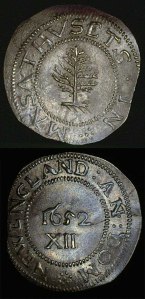
This second capsule is by far the more exciting. It was placed under the State House on July 4, 1795 by Governor Samuel Adams and Paul Revere, among others, to commemorate the impressive 20th anniversary of American independence. A rundown of the capsule and all of its contents is here, but we want to focus on one particular item in it: a “1652” pine tree shilling.

1652-massachusetts-pine-tree-shilling-large-planchet

This humble coin was one of the first revolutionary acts to take place in English America, but merely one in a string of stands for independence made by the Puritans of the Massachusetts Bay Colony.

In colonial America—from its beginnings in 1607 right up to independence—actual money was scarce. There were no mints in North America to mint coins. (Paper money as we know it did not exist.) In most colonies, there was either no metal to coin, or, as in Virginia, metal was available but the colonists did not have the wherewithal to mine it. Colonists had to rely on coins coming from England, usually via the Caribbean, where trade was strongest. Items called “Spanish dollars” were used most often as currency. These were not real coins produced in a mint. They were round slugs of silver with no markings that were quickly cut in New Spain so they could be sent to Spain and melted down for different purposes, from silverware to coins. But since these “cobs”, as they were called, were made of silver, they were hijacked in the Americas to be used as currency. As with all coins through human history, they were clipped: someone would trim the edges of the coins to make them slightly smaller, save the trimmings, and melt them down to make more coins for themselves. This meant that the value of the Spanish dollar was unreliable—one might weigh 3 ounces while another weighed 5. On top of that, counterfeiters would reproduce Spanish dollars by mixing silver and alloy. No one could be sure if their Spanish dollars were really worth what they were supposed to be worth. In New England, it was far more reliable to use wampum, which American Indians manufactured to strict standards of quality. Wampum was the most valuable currency in colonial America for many decades in the 1600s.

But Europeans still valued silver, too, and all that suspect Spanish silver coming into North America was causing enormous economic problems, so the MBC came up with a solution. In 1652, the General Court (Massachusetts’ elected legislature) ordered that the colony would begin producing its own silver coins. Here is part of that order:

…all persons what
soever have liberty to bring in unto the mint house at Boston all 
bullion plate or Spanish Coin there to be melted & brought to the
 allay of sterling Silver by John Hull master of the said mint and his sworn officers, & by him to be Coined into 12d : 6d : & 3d pieces which 
shall be for form flat & square on the sides & stamped on the one
side with N E & on the other side wth the figure XIId VId & IIId—
according to the value of each piece, together with a privy mark—which shall be Appointed every three months by the Governor & known 
only to him & the sworn officers of the mint.

The denominations represented in Roman numerals in the order are threepeence, sixpence, and one shilling. The coins are known as “pine tree shillings”  because they had an image of a pine tree on one side. Trees were a major export from the MBC, as the huge trees of North America made perfect masts for ships. All coins read 1652, to mark the year of the mint’s founding, which is why they are referred to today as “1652” shillings even if they were minted in 1662, 1673, etc.

The people of Massachusetts were willing to bring in their shifty Spanish dollars and bullion that had no practical use value to be melted down into MBC coins at the new mint. Indeed, they brought in silver bars, candlesticks, jewelry, and other items that were of no use to them and had likely been brought over with the emigrants from England for fear they might be stolen or lost track of by their agents and/or relatives.

The Boston shilling, as the coins came to be known, was enormously and immediately popular, and began circulating throughout North America, much to the chagrin of the Massachusetts government. The whole point of minting its own coins had been to keep silver money in Massachusetts to steady the economy. But the coins were flowing out of the MBC to other colonies, which meant that Massachusetts wealth (its people’s silver) was accruing in and enriching Virginia, New Amsterdam, and New France.

Its mint caused political problems for the MBC as well. Minting coins was something only a royal government had the authority to do. Colonists in America had absolutely no authority to mint coins—only the king of England could grant that. In 1652, of course, England had no king: Charles I had been executed in 1649 during the English Civil War, and the country was being governed by Oliver Cromwell, the Puritan Lord Protector. Remember how the pine tree shillings had an image of a pine tree on them? This was in place of an image of a king, which had always been on English coins. The establishment of a Puritan government in England led the Puritans in Massachusetts to believe that they had a good chance of getting away with establishing their own mint, and for eight years, they did. But when Charles II came to the throne in the 1660 Restoration of the monarchy (after Cromwell’s death and his son’s short stint in office) the renegade mint eventually came under attack from London. Charles II had no love for the Puritans who had executed his father, and he lent a friendly ear to those in his government who hated the Massachusetts Bay Colony in particular as a hotbed of treason and independence. These royal agents visited Boston in 1665 to “review” its laws and statutes, and demanded that the General Court of the colony change 26 of them to fall in line with British law. One of the demands was to immediately stop production at the mint.

The MBC resisted, sending two “very large masts” to the royal navy as a gift in 1666 and another shipload of masts two years later. (Charles II’s government was of course very wrapped up in government at home after 11 years of the Protectorate and the religious upheaval the Restoration caused, so the efforts to bring Massachusetts to heel took a back seat to more pressing matters during this time.) More masts were delivered over the years and this sufficed to keep the mint running while colonial agents tried to win permanent and official royal approval, pleading the colony’s loyalty to the king. They argued that the coins only grew the colonial economy, which could only mean more goods and profits flooding into England at a time when the country’s finances were precarious. But that argument was used by the crown against the colonists: to recover from its depression, the English economy needed to control its coinage, and issue and enforce the use of one English currency throughout its dominions.

Boston kept its mint open despite the mounting problems it was facing. In 1675-6, the devastating civil war known as King Phillip’s War weakened the economy and destroyed political unity in New England. Bickering between New England colonies after the war, which included appeals to London for mediation, contributed to the crown’s decision to revoke Massachusetts’ charter in 1684. The colony was no longer politically independent. It had to accept a governor appointed by the king rather than voted by representatives of the people. The mint was closed. Massachusetts would continue to struggle for independence, and one of the ways it did so was to begin printing paper money in 1690. It was the first government known to have established a paper currency in the history of western civilization.

But that’s another story. We keep our eyes on the pine tree shilling. It’s clear why one was saved, and placed with great pomp and ceremony into the time capsule in 1795. The pine tree shilling represented an early strike for American independence. It represented the Puritan commitment to independent government, and the role of Massachusetts in opposing royal political interference and control. Pine tree shillings were prized by Americans who knew them. With the pine tree shilling found in the time capsule now on temporary display, more Americans can learn about them.

The plan is to return the capsule to the State House foundation with its original contents, and items from 2015. The pine tree shilling that is now seeing the light of day for the first time in 220 years will return to the darkness of history. But one day it will be unearthed again, and it seems that nothing we could add to that time capsule today will outweigh the importance of that small coin, and when it is unearthed again it will steal the show once more.

Christmas in Colonial New England, or not

Re-running our Christmas Classic this year. Enjoy the holiday break!

In December we think of Christmas and the ever-evolving forms of celebration of that holiday in America. And being the HP, we think of the very long period over which Christmas was not celebrated in New England.

The Separatist Pilgrims and the Puritans, the two English groups who settled what is now New England, did not celebrate Christmas because they did not celebrate any holidays, because they believed that every day was given by God, and so every day was holy. It was humans who picked and chose certain days to be better than the rest, thus impugning God’s holy creation by identifying some days as unimportant and boring. Holidays were the creation of humans, not God, and an insult to God in more ways than one: not only was the creation of holidays a disparagement of other days, but the usual form of celebrating holidays in England involved raucous immorality. There were few silent nights during religious holidays in Europe. They were times of drunkenness, gaming, gambling, dancing, and licentiousness, and as a major Christian holiday, Christmas involved high levels of all these things—let’s just say there were a lot of babies born the next September. “Men dishonor Christ more in the 12 days of Christmas,” wrote the reformist Bishop of Worcester Hugh Latimer in the mid-1500s, “than in all the 12 months besides.”

While they lived in England, the Pilgrims and the Puritans withdrew from Christmas celebrations, conspicuous by their absence from the debauched partying in the streets. When they removed to America, both groups took great pleasure in putting an end to the observance of holidays, Christmas in particular. Both groups observed many special days, either of thanksgiving or fasting. When something particularly good happened, a thanksgiving was held. This involved a church service and then gatherings at home or in groups (see Truth v. Myth: The First Thanksgiving for more). When danger threatened, or something bad happened, a fast was held. This involved a day of church services preceded by fasting, which meant not eating and even refraining from sex the night before. (Puritans knew that nothing humbled people like hunger and celibacy.) No other special days were observed.

So December 25 was just like any other day for the Pilgrims and Puritans. If it was a Sunday, you’d go to church and perhaps hear a sermon that referenced Jesus’ birth. If it was a Tuesday, you got up and went to work as usual. In Plimoth, where the Separatist Pilgrims were outnumbered by unreformed Anglicans, Governor Bradford had a hard time stopping the Anglicans from celebrating Christmas. The Anglicans would not learn from the example of the Separatists, who were hard at work on Christmas day 1621. Here is Bradford’s good-humored account of a run-in he had with unreformed celebrants that day (he refers to himself in the third person here as “the Governor”):

“And herewith I shall end this year. Only I shall remember one passage more, rather of mirth than of weight. One the day called Christmas day, the Governor called them out to work, as was used. But the most of this new company excused themselves and said it went against their consciences to work on that day. So the Governor told them that if they made it matter of conscience, he would spare them till they were better informed; so he led away the rest and left them. But when they came home at noon from their work, he found them in the street at play, openly; some pitching the bar and some at stool-ball, and such like sports. So he went to them, and took away their implements, and told them that was against his conscience, that they should play and others work. If they made the keeping of [Christmas a] matter of devotion, let them keep [to] their houses, but there should be no gaming or revelling in the streets. Since which time nothing hath been attempted that way, at least openly.” [Of Plymouth Plantation, 107]

When the Puritan Massachusetts Bay Colony absorbed the Pilgrim Plimoth Colony into itself, and Massachusetts came under direct royal control in 1681 (losing its political independence), the Anglican governor assigned to the colony brought back Christmas celebrations. In 1686, when King James II created the Dominion of New England, composed of Massachusetts, Vermont, New Hampshire, Connecticut, Rhode Island, New York, and East and West Jersey, and designed specifically to destroy Puritan political independence and religious identity, the royal governor James chose, Edmund Andros, was bitterly resented by all his new subjects. When Andros went to church to celebrate Christmas in Boston in 1686 he needed an armed escort to protect him.

Now Christmas was associated with royal dictatorship and all the grief of the Dominion, and the people of New England and especially Massachusetts continued to boycott the holiday well into the 18th century. When the Revolutionary War began, Christmas boycotts rose in popularity as the day was again tied to royal control and tyranny. After the war, Congress met on Christmas Day, businesses were open, and while private celebrations were not uncommon, there was no official recognition of Christmas in New England. In fact, no state recognized Christmas as an official holiday until Alabama took the plunge in 1836. President Grant made it a federal holiday in 1870, and that was about the time that New England at last gave up the remnants of its ancient resistance. (Readers of Little Women, which Louisa May Alcott began to write in Concord, MA in 1868, will remember that while the Marches celebrate Christmas with gusto as well as reverence, Amy March is able to go to a store first thing Christmas morning to exchange a gift, revealing that Christmas was still a day of business in Massachusetts at that late date.)

It’s ironic, given this history, that the winter scenes created by Massachusetts-based lithographers Currier and Ives became the template for “a traditional New England Christmas” in the 1870s, complete with one-horse open sleighs and jingle bells. Sleigh rides, roasting chestnuts, spiced apple cider—all these Christmas traditions originated in New England, but they were not specific to Christmas when New Englanders enjoyed them in the 18th century. They were just part of winter. Even the “traditional” white Christmas relies on a cold northern winter, a defining characteristic of the region that no one in colonial times associated with the holiday.

Today, there are still branches of Protestantism that look down on “the observance of days”, and urge that all days be seen as equally holy and important. But Christmas is here to stay… for the foreseeable future, anyway.

Lynching in the 21st-century: or, black lives matter

One of the cornerstones of a history education is civics. If we don’t understand how our government is supposed to work, and why it is structured the way it is, we cannot participate properly in our own government, and we can’t hold the people in positions of political authority accountable for their actions. We can’t define what justice is. We have no recourse when confronted with a crime against our proper form of government but to run into the streets as mobs, in brief and ultimately futile demonstrations that accomplish no long-term reform. So here’s our civics lesson for 2014 and beyond.

In the United States, the police are bound by the same laws they enforce. They are not above the law. They don’t have a separate code of law from non-police officers. They are government employees (at the federal, state, or local level) bound to obey the law just like other government employees. A police officer has no special waiver to break the law in dangerous circumstances; the police can use their judgment to decide whether force is needed to prevent a criminal from killing someone, but they are bound to use only so much force as is necessary to defuse the danger and take the suspect into custody alive.

Clearly, we haven’t been seeing this in the U.S. over the past few years. At the same time, it’s not a new problem. The police generally uphold the values of the majority in any country. In the U.S., the police have traditionally been white men (and this still holds true today), and they have generally upheld racial and sexual discrimination. They’re not the only ones, of course; the same can be said of Congress and most state and local governments. When we look back at U.S. history, we see that government officials and the police have often worked together to thwart the principles of our nation’s founding, and to pervert our democratic government. But one would have thought that since 1970, say, and a full century of civil rights progress and seemingly increasing enlightenment about race, sex, and sexuality, this would not be happening so openly and baldly today, in 2014. A leader of the New York police department on the radio this morning promised in-depth training and education for officers, basically to help them not respond to every encounter with a black man with deadly force. This made us wonder why, at this late date, and after so many decades upon decades of civil rights activism and education in this country, this “training” begins only now.

You have to take the long view on any current problem. When we do that here, we see that the police assaults on black men are just part of a larger problem that is not fully encompassed even by race. The real problem being expressed in these incidents is the militarization of our police and our culture. Somehow, in the last 30 years, guns have been made the hallmark of American freedom. Everyone must have one everywhere, despite their criminal record or mental stability. One of the outcomes of this is the regular school shootings we endure each year. Another is attacks on the police. For years now, we’ve heard about police being called to a domestic dispute and being shot instantly, either as part of a general shootout or as the end result of a deliberate trap. Police have been shot by people they pull over for speeding. In many states, people can carry guns around everywhere, at all times; this makes any interaction with them by the police potentially fatal for the officer.

The logical reaction to this by the police has been to up the ante: when you expect to be shot, the only way to defend yourself is to make sure you shoot first. It’s not surprising that police officers have begun to expect that every encounter they have could be fatal. And it doesn’t seem likely that any “training and education” will prevent further deaths when Americans continue to carry guns at all times—the police will still believe that the only outcome of every encounter is gunfire, from both sides. Add race to this, in the form of a black suspect, and death is almost a given. Even when it is clear the black suspect does not have a gun, extreme force is used to subdue him before he somehow injures the officer. Eric Garner was not shot like Michael Brown, but he was immediately put into a choke hold—an extreme action.

Darren Wilson’s perception of Brown as looking like “a demon” was not only an admission of his fear of being killed by a suspect, it was a shocking admission of racism that was so very like descriptions of black men during and after slavery in this country that we were left aghast. Describing black men as big, hulking, animal-like, amoral, dumb, demonic, and savage was boilerplate for two centuries in this country. Black men had to be “demonized” to justify slavery and then post-slavery oppression and… lynching.

Lynching has to come to mind here. We seem to have entered a new age of lynching in this country. Lynching is characterized not just by a violent death (by hanging, mutilation, torture, burning, etc.), but by one or two men making a lightning-fast decision about someone’s guilt and immediately acting on that decision to kill them. Originally, lynching in the West was done by whites to whites. No one described lynching more decisively and unflinchingly than Ida B. Wells, so let’s let her describe it here (from Lynch Law in America, published in 1900):

Our country’s national crime is lynching. It is not the creature of an hour, the sudden outburst of uncontrolled fury, or the unspeakable brutality of an insane mob. It represents the cool, calculating deliberation of intelligent people who openly avow that there is an “unwritten law” that justifies them in putting human beings to death without trial by jury, without opportunity to make defense, and without right of appeal. The “unwritten law” first found excuse with the rough, rugged, and determined men who left the civilized centers of eastern States to seek for quick returns in the gold-fields of the far West. Following in uncertain pursuit of continually eluding fortune, they dared the savagery of the Indians, the hardships of mountain travel, and the constant terror of border State outlaws. Naturally, they felt slight toleration for traitors in their own ranks. It was enough to fight the enemies from without; woe to the foe within! Far removed from and entirely without protection of the courts of civilized life, these fortune-seekers made laws to meet their varying emergencies. The thief who stole a horse, the bully who “jumped” a claim, was a common enemy. If caught he was promptly tried, and if found guilty was hanged to the tree under which the court convened.

The key here is the speed of the judgment. If someone was caught committing a crime, large or small, or even suspected of it, he was immediately found guilty and killed. It could be done in 10 minutes. There’s no trial (later there would be nauseating show trials with a pre-determined guilty verdict), no testimony beyond “He stole that from me”, no chance for the accused to protest or prove himself innocent. Lynching is about pre-determined guilt, but it’s also about leaping over the lengthy process of criminal justice and fair trials to the instant gratification of death to the criminal.

That’s what is shocking about every instance of police brutality or deadly force. Instead of doing all he can to bring a suspect into custody where he can be tried, the officer makes a split-second decision about how much danger he himself is in from the suspect, and acts on it immediately. Afterward, this decision is validated by a claim that the suspect was resisting arrest. This is a claim so old and so reeking of our nation’s long history of injustice to minorities of all kinds that it’s difficult to hear it spoken today. Police officers are trained to overcome suspects resisting arrest in many ways; deadly force is supposed to be a last resort. But in our militarized and violent culture, it is the first and only resort for too many police officers.

We had already thought about this as a new kind of lynching when we realized that the head of the NYC police union is named Patrick Lynch. Here is his commentary on the Garner death as reported by NBC News:

“We feel badly that there was a loss of life,” said Patrick Lynch, president of the Patrolmen’s Benevolent Association. “But unfortunately Mr. Garner made a choice that day to resist arrest.”

—Don’t most suspects “make a choice” to resist arrest? Does anyone go quietly? We would wager that most suspects resist arrest, but only the large, black ones are put in choke holds. Does any police officer expect that no one he confronts will ever resist arrest? Aren’t the police trained in how to deal with someone resisting arrest without killing them?

He praised the officer, Daniel Pantaleo, as a good man, a mature policeman and an Eagle Scout who “went out and did a difficult job, a job where there’s no script, and sometimes with that there’s tragedy that comes.”

—But there is a script: it’s called police procedure. It’s police training. Is Lynch really saying that police officers have no idea what to do when someone resists arrest other than to use deadly force? The Eagle Scout reference we will pass by in disbelief.

“It’s also a tragedy for this police officer who has to live with that death,” Lynch said.

—It doesn’t seem like it should be a tragedy if, as Lynch maintains, no real harm was done. Someone resisting arrest got what they deserved. The warped idea that it is really the police officer, not Garner’s family, who suffers most is all too common in these statements.

He also praised New York police for their handling of protests on Wednesday night, when thousands who objected to the decision took to the streets. Lynch lashed out at Mayor Bill de Blasio, who said on Wednesday that the grand jury’s decision not to bring charges was “one that many in our city did not want.”

He suggested that the mayor was teaching children to fear police officers, and he said the lesson instead should be to comply with police officers, even if they feel an arrest is unjust.

—It is only possible to comply with police officers if their treatment of you as a suspect is constitutional and legal. If not, you are under no such obligation.

“You cannot resist arrest,” Lynch said. “Because resisting arrest leads to confrontation. Confrontation leads to tragedy.”

—Americans have the right to resist arrest. The police are obligated to take people who resist arrest into custody without killing them. Resisting arrest does lead to confrontation—but the idea that confrontation must lead to tragedy is so outrageous. Are we really to accept that if we resist arrest we will be killed? Shot, choked, tased, however it happens? Any act of defiance will be met with death? This sounds more like the totalitarian states the U.S. is constantly battling around the world than our own country.

We cannot allow our police force to become perverted. We cannot become a police state, where police officers have the right to kill if, in their own, split-second judgment, they are personally endangered. The first duty of a police officer cannot be to protect himself. We can’t have local city police suddenly driving around in armored vehicles, basically tanks, because they fear for their lives. We can’t accept this as the new normal. It takes bravery and a strong commitment to justice to be a good police officer. We need more people with those qualities to take on that job.

We also need to reform our society and put an end to our obsession with “protecting ourselves” with guns. For as long as a police officer has good reason to suspect that the people he encounters are armed, we will have nothing but escalating police violence.

And finally, we cannot opt out of our government system. We can’t eviscerate our government as unjust and wash our hands of it, deciding to riot or protest and then do nothing. We can’t change anything unless the people who are outraged by injustice do the long, hard work of changing the system. We can’t have people making the split-second decision that the police are corrupt, there’s nothing we can do about it, and we are thus free to hate and defy the police. That will not change anything. Everyone has to participate in our democracy to keep it working. Anger and outrage should fuel hard work, not self-righteous inactivity. It’s hard work to be free.

We’ve said many times here at the HP that every generation has to accept and commit to our nation’s founding principles of justice. Learn what those principles are, commit to them, and uphold them in your daily life to the greatest extent that you can, and never back down from them. It’s the only way to prevent lynching.

The First Thanksgiving was not a scam!

In honor of the season, we’re re-posting our classic Truth v. Myth post on Thanksgiving. This is the time of year when people take a moment to wonder about the Pilgrims: why were they so cruel to the Indians? The Thanksgiving celebration is marred by this concern. There are many reasons why it shouldn’t be. First, Thanksgiving has only been a holiday since 1863. It’s fitting that President Lincoln instituted this holiday during the Civil War to unite the U.S. in thanks for its blessings even in the midst of that terrible war. Here’s how he put it:

In the midst of a civil war of unequaled magnitude and severity, which has sometimes seemed to foreign States to invite and to provoke their aggression, peace has been preserved with all nations, order has been maintained, the laws have been respected and obeyed, and harmony has prevailed everywhere except in the theatre of military conflict; while that theatre has been greatly contracted by the advancing armies and navies of the Union.

—Britain and France have refused, in the end, to support the Confederacy, the U.S. itself is still intact and strong, and the U.S. Army and Navy are driving back the enemy.

Needful diversions of wealth and of strength from the fields of peaceful industry to the national defence, have not arrested the plough, the shuttle or the ship; the axe has enlarged the borders of our settlements, and the mines, as well of iron and coal as of the precious metals, have yielded even more abundantly than heretofore. Population has steadily increased, notwithstanding the waste that has been made in the camp, the siege and the battle-field; and the country, rejoicing in the consiousness of augmented strength and vigor, is permitted to expect continuance of years with large increase of freedom.

—The U.S. economy has not fallen apart for lack of slave-produced cotton, as the South had always predicted it would. Industry and agriculture are stronger than ever and the U.S. continues to expand.

No human counsel hath devised nor hath any mortal hand worked out these great things. They are the gracious gifts of the Most High God, who, while dealing with us in anger for our sins, hath nevertheless remembered mercy. It has seemed to me fit and proper that they should be solemnly, reverently and gratefully acknowledged as with one heart and one voice by the whole American People. I do therefore invite my fellow citizens in every part of the United States, and also those who are at sea and those who are sojourning in foreign lands, to set apart and observe the last Thursday of November next, as a day of Thanksgiving and Praise to our beneficent Father who dwelleth in the Heavens.

—God has punished the U.S. with this war for the sin of slavery, but is showing encouraging signs of his support for the U.S. war effort.

And I recommend to them that while offering up the ascriptions justly due to Him for such singular deliverances and blessings, they do also, with humble penitence for our national perverseness and disobedience, commend to His tender care all those who have become widows, orphans, mourners or sufferers in the lamentable civil strife in which we are unavoidably engaged, and fervently implore the interposition of the Almighty Hand to heal the wounds of the nation and to restore it as soon as may be consistent with the Divine purposes to the full enjoyment of peace, harmony, tranquillity and Union.

—While thanking God for his mercies to the U.S. so far, Americans should also offer up prayers asking for his care for all those who have lost someone in the war, and asking for his help in ending the war as quickly as possible.

So the First Thanksgiving was in November 1863 and inaugurated for a good cause. The first thanksgiving in what would become the U.S. was held in November 1621 and was merely the first of many, many days of thanksgiving observed by the Pilgrims and was not celebrated as an annual holiday at all. Let’s go back to the original article to learn the real story:

____

The first Thanksgiving: it’s a hallowed phrase that, like “Washington crossing the Delaware“, “Don’t fire until you see the whites of their eyes”, or “Damn the torpedoes!”, does not bring up many solid facts. Unfortunately, “the first Thanksgiving” is usually either completely debunked, with people saying no such thing ever happened, or used as a weapon against the Pilgrims—i.e., they had a lovely Thanksgiving with the Indians and then killed them all.

The truth about the first thanksgiving is that it did happen, in the fall of 1621. The Pilgrims had landed in what is now Massachusetts the previous November—a terrible time to begin a colony. Their provisions were low, and it was too late to plant anything. It is another myth that they landed so late because they got lost. They had intended to land south of Long Island, New York and settle in what is now New Jersey, where it was warmer, but their ship was almost destroyed in a dangerous area just south of Cape Cod, and the captain turned back. They then had to crawl the ship down the Cape, looking for a suitable place to land. Long story short, they ended up in what is now Plymouth.

Most Americans know how so many of those first settlers died from starvation and disease over the winter, and how it was only by raiding Wampanoag food caches that the colony survived at all. By the spring, there were not many colonists left to plant food, but they dragged themselves out to do so. They had good luck, and help from the Wampanoags, who showed them planting techniques—potentially just to keep the Pilgrims from raiding their winter stores again. By November 1621, a very good harvest was in, and Governor William Bradford called for a day of thanksgiving.

The Pilgrims often had days of thanksgiving. In times of trouble, they had fasts, which were sacrifices given for God’s help. In celebration times, they had thanksgivings to thank God for helping them. So thanksgivings were a common part of Pilgrim life, and calling  for a thanksgiving to praise God for the harvest would not have been unusual, and would have been a day spent largely in church and at prayer.

So the men went out to shoot some “fowls” for the dinner, and perhaps they ran into some Wampanoags, or maybe a few Wampanoags were visting Plymouth, as they often did, and heard about the day of celebration. At any rate, here is the only—yes, the one and only—eyewitness description of what happened next:

“Our harvest being gotten in, our governor sent four men on fowling, that so we might after a special manner rejoice together after we had gathered the fruit of our labors.  They four in one day killed as much fowl as, with a little help beside, served the company almost a week.  At which time, amongst other recreations, we exercised our arms, many of the Indians coming amongst us, and among the rest their greatest king Massasoit, with some ninety men, whom for three days we entertained and feasted, and they went out and killed five deer, which they brought to the plantation and bestowed on our governor, and upon the captain and others.  And although it be not always so plentiful as it was at this time with us, yet by the goodness of God, we are so far from want that we often wish you partakers of our plenty.”

That’s Edward Winslow, writing about the thanksgiving in his journal of Pilgrim life called “Mourt’s Relation”, published in London in 1622. We see that Massasoit and 90 of his men arrived at some point, having heard about the feast, and the Pilgrims hosted them for three days, and had some rather Anglican sport firing their guns. Certainly the Wampanoags had a right to feel they should join in, since it was their help that had led to the good harvest. A one-day thanksgiving turned into three days of feasting and games.

And that was it. People often wonder why there wasn’t another thanksgiving the next year, but the idea of celebrating the harvest every year didn’t make sense to the Pilgrims. They had only held a thanksgiving for the first good harvest because it was a life-saving change from the previous fall. Once they were on their feet, they expected good harvests, and didn’t have to celebrate them. It was also against their Separatist beliefs to celebrate annual holidays—like the Puritans, they did not celebrate any holidays, not even Christmas. Holidays were a human invention that made some days better than others when God had made all days equally holy. So to hold a regular, annual harvest thanksgiving was not their way. When things were going well, Separatists and Puritans had days of thanksgiving. When things were going badly, they had days of fasting. None of them were annual holidays or cause for feasting (of course fast days weren’t, but even thanksgivings were mostly spent in church, with no special meal).

That one-time harvest thanksgiving was indeed a happy event, shared in equally by Pilgrim and Wampanoag. If only that first thanksgiving–an impromptu, bi-cultural celebration–had set the tone for the rest of the interactions between the English colonizers and the Indigenous peoples of North America. Since it did not, we can only think happily of the Thanksgiving called for by President Lincoln, who made an annual Thanksgiving a holiday in 1863.

The hype around the Pilgrims’ first thanksgiving only began after 1863, when historians noted the tradition of impromptu thanksgivings in the 1600s and made an unwarranted and improper connection to the new holiday to make it seem less new and more traditionally American. Before then, their many days of thanksgiving and fasting were completely forgotten. The Pilgrims certainly weren’t the inspiration for the holiday we celebrate today—they were retroactively brought into that in the worst, most ironic way: after the Civil War, southerners resented Thanksgiving as a “Union” holiday celebrating U.S. victories in the war and so the focus was changed from fighting slavery to the Pilgrims… who supported slavery.

This year, spend Thanksgiving however you like, and share the truth about where the holiday really comes from—the depths of a terrible war fought for the greatest of causes. Let Thanksgiving inspire you to stand up for the founding principles of this nation and re-commit to upholding them in your own daily life of good times and bad.

Finding Your Roots—sort of

We watched the latest episode of the PBS series Finding Your Roots with Henry Louis Gates, Jr., last night, which featured Sting, Deepak Chopra, and Sally Field. It was going along dependably well when the awful specter of ignorance about the Puritans invaded the last segment on Sally Field’s family tree.

Gates revealed that Field is directly descended from William Bradford, the governor of Plimoth Colony and the man who led the Separatists across the Atlantic to America on the Mayflower in 1620. The narration (done by Gates) described Bradford as a Puritan who was imprisoned in 1607 for non-conformity. We shifted a little uncomfortably, since the Pilgrims led by Bradford were not Puritans (who wanted to reform the Church of England) but Separatists (who abandoned the Church of England as a lost cause), and there was a great deal of tension between the two groups in England and outright hostility in New England once the Puritans arrived in 1630. But in 1607 Bradford had not yet separated, so we accepted it.

Field was told that Bradford sailed with other “Puritans” on the Mayflower and still did not recognize Bradford’s name as that of the governor of the colony, the famous Pilgrim who wrote Of Plimoth Plantation, the history of the colony and a crucially important record of early settlement in New England. We held our breaths as Gates’ narration described the voyage over, hoping against hope that he would not repeat the tired error that the Pilgrims intended to settle in Virginia but were blown off course by storms to Massachusetts, but that hope was lost. The myth was repeated (what really happened was that the ship almost capsized crossing a soon-to-be notoriously dangerous stretch of water south of Long Island and turned back, leaving the settlers on what is now Cape Cod).

Even after Gates told Field that her ancestor Bradford was elected governor, she did not make any connection. She had clearly never heard of him and had no idea that he is a famous figure. All of this was disappointing, but the worst finally came here:

GATES VO: UNDER THE GUIDANCE OF SALLY’S ANCESTOR, AND THE WAMPANOAG, THEIR NATIVE AMERICAN NEIGHBORS, THE PILGRIMS FINALLY GAINED A FOOTHOLD IN THEIR NEW HOME.

AND, INCREDIBLY, WE UNEARTHED THE LETTER DESCRIBING A NOW FAMILIAR EVENT THAT TOOK PLACE IN PLYMOUTH IN THE FALL OF 1621.

FIELD: Many of the Indians coming amongst us whom for three days we entertained and feasted. And although it be not always so plentiful as it was at this time with us yet by the goodness of god we are so far from want.

GATES: And you know what they were describing?

FIELD: Thanksgiving.

GATES: The very first Thanksgiving.

FIELD: Well there you go. I’ve always loved Thanksgiving. It’s always been a big deal.

GATES: Could you please turn the page? Look at that painting.

FIELD: Oh, yeah.

GATES: Now –

FIELD: Okay are you going to tell me one of those is…

GATES: Historians guess that is William Bradford sitting at the head of the table.

FIELD: He hasn’t changed a bit. (Laughs) You’re telling me he presided over the first Thanksgiving?

GATES: Right.

The errors in this exchange are glaring. First, the account of what we call the “first Thanksgiving” was not in a letter but in the journal of Edward Winslow, which he published in 1622 as Mourt’s Relation. Winslow wrote what became known as Mourt’s Relation (because it was published in London by a man named Mourt) with Bradford, who seems to have written many of the early entries. But the account of the thanksgiving is not in the first half of the book (it’s about 3/4 of the way through), and seems to be Winslow’s work. Second, it is hardly “incredible” that the researchers for the show “unearthed a copy of the letter” because Mourt’s Relation has been in print for centuries—every New England scholar and every college library has a copy. What is incredible is that they pan over a photo of a contemporary edition of Mourt’s Relation that has the chapter title “A letter sent from New England to a friend in these parts…”, which was the literary device used to frame the stories from Winslow’s journal. One expects a professional historian like Henry Louis Gates, Jr., to know this—or at least have it fact-checked. Third, this was not the “first Thanksgiving” but the first thanksgiving the Pilgrims had in America. As we explain in our post Truth v. Myth: The First Thanksgiving,

People often wonder why there wasn’t another thanksgiving the next year—we have seen that thanksgivings were not annual events, but came up often, and the idea of celebrating the harvest every year didn’t make sense to the Pilgrims. They had only held a thanksgiving for the first good harvest because it was a life-saving change from the previous fall. Once they were on their feet, they expected good harvests, and didn’t have to celebrate them. It was also against their Separatist beliefs to celebrate annual holidays—like the Puritans, they did not celebrate any holidays, not even Christmas. So to hold a regular, annual harvest thanksgiving was not their way.

Fourth, and most unbelievably, Gates shows Field a 19th-century painting of the First Thanksgiving and treats it like a historical artifact by saying “Historians guess that is William Bradford sitting at the head of the table.” Of course it is, because it was painted by a 19th-century artist who put him there! As if the 90 Indians and roughly as many colonists all sat at one table “presided over” by Bradford. It is the well-known painting of one long table inexplicably placed in the middle of an empty field with 12-20 very white Pilgrims around it, bowing their heads as they hear grace, and a mother rocks an infant in a cradle (inexplicably brought out to the empty field) and holds her toddler by the hand. No Indians are present. This is the item presented by Gates as a historical artifact depicting the first day of thanksgiving celebrated by the Puritans in North America.

That’s a lot to get wrong. Sadly, shows like this only misinform the American people, if the comments one viewer left on the PBS website for the episode are representative:

I had some uncomfortable feelings hearing the excerpt from a letter written by Sally Field’s distant relative, William Bradford in 1621 describing the feast in such a feel-good manner. Yes, the Pilgrims were praising God because they were finally “so far from want,” but in a 1623 sermon delivered by Mather the Elder, they were thanking God for the gift of smallpox that wiped out the majority of Wampanoag Indians, “chiefly young men and children, the very seeds of increase, thus clearing the forests to make way for a better growth.” I know the purpose of this episode wasn’t to uncover the “truth” of Thanksgiving but I believe having this awareness will deepen our understanding of how much we of European descent have benefited at the expense of the indigenous New World inhabitants.

You can’t blame the viewer for having these views when this is the quality of information at hand. First, as we said, the account was not in a letter and was not written by Bradford in 1621. Second, and much worse, is that the “Mather the elder sermon” is a complete hoax. Richard Mather (the “elder”) was the patriarch of the family that gave us his son Increase Mather and his son Cotton Mather. Richard Mather was a Puritan who came to the Massachusetts Bay Colony, not Plimoth, in 1635. He was not there in 1623. No one named Mather was in Plimoth in 1623. An intrepid independent scholar has a long account of the scam here. Long story short, the quote about young men and children is borrowed from Puritan “historian” Edward Johnson’s 1653 book The Wonder-Working Providence of Sion’s Saviour in New England, a subjective and lionizing history of the Massachusetts Bay Colony. Here’s the text from Johnson:

Their Disease being a sore Consumption sweeping away whole Families but chiefly yong Men and Children the very seeds of increase.  …Howling and much lamentation was heard among the living who being possest with great fear oftimes left their dead unburied their manner being such that they remove their habitations at death of any. …by this means Christ whose great and glorious works the Earth throughout are altogether for the benefit of his Churches and chosen not only made room for his people to plant but also tamed the hard and cruel hearts of these barbarous Indians…

Interestingly, Johnson says he will not talk about the Pilgrims’ relationship with the Wampanoags “particularly being prevented by the honoured Mr Winslow who was an eye witness of the work.” Winslow did not want the unreliable Johnson describing Plimoth because he knew Johnson would depict the Pilgrims there as Indian-haters when they weren’t.

The scam aside, yes the Pilgrims saw smallpox as God’s work, but they didn’t really celebrate it. God constantly struck people down—including Pilgrims. Pilgrims died of infectious diseases, their babies, children, and young men died from disease and accident, often in ways that severely tested their parents’ faith in God. Why did God strike down the young? Why did God torment his most faithful followers by striking down their children? The answer was always that it was part of God’s mysterious plan that no one could understand and everyone had to accept as eventually bringing about a greater good. They often used 17th-century English and called God’s will “God’s pleasure”, but this does not mean that it made God happy to kill people, even Indians. It meant that God fulfilled his will (acted at his pleasure). Johnson says the Indians’ deaths were caused by God (Christ) to make the land safe for pure churches. This had to be done, no matter how horrible it might be or how much howling and lamentation it caused. Unlike Johnson, when the Pilgrims or even other Puritans described Indian deaths from smallpox, they usually did not exult about savages dying; they saw God’s mighty will revealed through the deaths and moved on, hoping their own deaths would not eventually be necessary to further God’s plan.

It would have been nearly impossible for anyone in the 17th century—Wampanoag, Englishman, Egyptian, Japanese—to think outside the clannish box of us v. them and feel pity for people so obviously struck down by God. Humans, like all animals, are clannish; our first and strongest identity is being part of one group as opposed to other groups. It has taken centuries since the Enlightenment for humans to at least pay lip-service to the idea that all men are created equal and all are deserving of equal justice, that, as the bumper sticker says, “God bless the whole world—no exceptions”. So if an English settler in 1623 saw God’s providential hand in Indian deaths, that does not reveal and confirm the Pilgrims to be terrible racists. It confirms them as 17th-century human beings along the same lines as Indians, Asians, Africans, and everyone else who celebrated their enemies’ deaths in battle, sacked cities killing women and children, enslaved rival groups, etc. It is taking us a long time to change our ways.

And so we leave Finding Your Roots with heavy hearts and grave concerns about Americans ever learning their real history. Who will kickstart-fund the HP’s own TV series??

Check out the Atlas of the Historical Geography of the United States!

There is an amazing set of maps at the University of Richmond’s Digital Scholarship Lab that show the geographic progression of issues in American/U.S. history. For example, you can track the abolition of slavery from 1800-1865, or the growth of colleges and universities from 1775-1890.

These maps are invaluable for showing the concrete steps different movements, reforms, laws, and more had to take to become reality—steps that are all too often ignored in favor of descriptions like “abolition swept the north” or “the right to vote was granted to some American women before 1920.” If you want to know—to see—how ideas progressed, what we call “historical geography”, check out the Atlas.

Gay marriage in Alaska v. tyranny of the majority

Round 10 for this post, which we run each time the issue of gay marriage is resolved by a state court in its favor. The first time was back on May 21, 2008, when California’s Supreme Court decided that banning gay marriage was unconstitutional. The original point was that whenever a court overturns a law, there are always those who squawk—incorrectly—that it has overstepped its authority. The judiciary in the U.S. is meant to overturn laws, even laws with great popular support, that are unconstitutional because they restrict peoples’ liberty for no good reason.

Overturning bans on gay marriage started out as an example of thwarting this “tyranny of the majority”, as de Tocqueville called it, but now that the majority of Americans support or do not care to ban gay marriage, this type of legislation is becoming a rebuke to tyranny of the minority. That’s heartening.

Here is the original post, resurfacing now as Alaska’s ban on gay marriage is revoked:

The California Supreme Court’s decision that banning gay marriage is unconstitutional has been met with the by-now common complaint that the Court overstepped its bounds, trampled the wishes of the voters, and got into the legislation business without a permit.

A review of the constitutionally described role of the judiciary is in order.

The famous commentator on American democracy, Alexis de Tocqueville, talked a great deal in his books Democracy in America about the tyranny of the majority. This is when majority rule—the basis of democracy—ends up perverting democracy by forcing injustice on the minority of the public.

For example, slavery was an example of the tyranny of the majority. Most Americans in the slave era were white and free. White and free people were the majority, and they used their majority power to keep slavery from being abolished by the minority of Americans who wanted to abolish it. The rights of black Americans were trampled by the tyranny of the majority.

Before Brown v. Board of Education in 1954, the majority of Americans were fine with segregated schools. They used their majority power to oppress the minority of Americans who were black, or who were white and wanted desegregation.

In each example, the majority is imposing and enforcing injustice which is incompatible with democracy. They are tyrannizing rather than governing.

The judiciary was created to break this grip of majority tyranny. The legislature—Congress—cannot usually break majority tyranny because it is made up of people popularly elected by the majority. But the appointed judiciary can break majority tyranny because its sole job is not to reflect the wishes of the people but to interpret the Constitution.

If the judiciary finds that a law made by the legislature perverts democracy and imposes the tyranny of the majority, it can and must strike that law down. This is what happened in California. The court found that although the majority of Californians (as evidenced by a previous referendum) had voted to ban gay marriage, that majority was enforcing and imposing injustice on the minority. So the court found the ban unconstitutional.

This is not beyond the scope of the judiciary, it’s exactly what it is meant to do.

We heard a commentator yesterday saying the California court should have left the issue to “the prerogative of the voters”. But if the voters’ prerogative is to oppress someone else, then the court does not simply step aside and let this happen.

The same people who rage against the partial and biased justices who lifted this ban are generally the same people who would celebrate justices who imposed a ban on abortion. People who cry out for impartiality are generally only applying it to cases they oppose.

So that’s what the judiciary does: it prevents the tyranny of the majority from enforcing injustice in a democracy. Like it or not, the “will of the people” is not always sacred, and sometimes must be opposed in the name of equality.

Watch the United States form out of American Indian lands

There’s a sobering interactive called The Invasion of America: How the United States took over an eighth of the world that shows the steady, seemingly inexorable westward advance of the U.S. border. Click the arrow at bottom left for the overall animation; Highlight by Nation at the top. It’s worth remembering that every step of that advance was complicated, with no clear “whites v. reds” dynamic most of the time. Just as the “ground” beneath modern cities is just the top layer of 50 feet of previous top layers of previous cities, societies, and civilizations that have fallen, so the United States as we know it today is just the top layer of a long history of peoples. It makes you wonder what layers will cover our own in the future.

Why don’t we remember Watergate?

Hello and welcome to the final post in our series on the Watergate Crisis, in which we ask the depressing question, Why have Americans forgotten about Watergate? This series has only given an outline of the terrible challenge to our democracy posed by President Nixon’s actions, and those of his top advisors. Their attempt to put the executive branch above the law and create an imperial presidency, if successful, would have allowed the president, any president, to commit any crime s/he felt was necessary to achieve her/his goals. Whether or not the president’s goals were good ones would be immaterial.

The American public’s response to this attempted hostile takeover was spectacular. They rose up almost as one to protest. Network news, newspapers large and small, and the man on the street all knew that the Constitution was being violated and they all refused to sit back and accept that. Nixon was out of office once his criminal activities and determination were clear. Maybe that’s part of the problem. The reaction was so swift and complete, and Nixon out so quickly (and immediately pardoned by Gerald Ford, so there was no long criminal trial after his resignation), and Americans so eager to leave the sordid episode behind them, that Watergate was collectively buried. More Americans today know about George Washington’s alleged infidelity (a complete lie, by the way) or Lincoln’s alleged homosexuality (don’t know, but it doesn’t seem likely) than the actual, open, undeniable crimes committed by Richard Nixon.

But we think the amnesia surrounding Watergate is caused by something far worse than a quick burial. One of the long-term effects of the crisis was a deep mistrust of the federal government. This is so inexplicable. Representatives of the federal government, notably the Watergate special prosecutor Cox, Attorneys General Richardson and Ruckelshaus, the Supreme Court, and all the members of the Senate Watergate Committee heroically resisted efforts to corrupt them. It was men within the president’s inner circle who committed and/or ordered the crimes, not the machinery of the federal government. The federal government rejected the attempt to transgress the Constitution, and the next two presidents after Nixon, Ford and Carter, made strenuous efforts to restore the dignity and honor of the executive branch. Yet somehow, over the 1980s, the message of Watergate became “You can’t trust the government.”

Perhaps the controversial/criminal actions of the Reagan Administration, coming so soon after Nixon’s, became merged with Nixon in the public mind, and led people to believe that the government had not been trustworthy since Kennedy.

Or maybe the steady decrease in civics education from the 1970s on created new generations of Americans who have no idea why Nixon’s actions were criminal.

Or maybe the imperial actions of President George W. Bush, and over a decade of invasion of privacy and other constitutional violations, notably by the Patriot Act, have made Americans forget that the president is not supposed to govern by executive order.

Whatever the reason, it’s bad news to forget about Watergate—what it threatened, who stood up to it, and how the Constitution and good government triumphed. If we begin to believe as a nation that we have “never” had good government, that “all” presidents are corrupt, or that the president is “supposed to” rule the nation like a king, then Nixon wins, corruption wins, and it’s as if Bill Ruckelshaus never stood up to the power of the president who told him he had “no choice but to obey” and said, “I have a choice—I can resign.” We all have the choice to refuse to obey when our Constitution is threatened, whether it’s by the federal government, or by our own ignorance.

Nixon Resigns… and passes the buck

Second to last post in our series on the Watergate Crisis; here we follow the crisis to its end, in President Nixon’s resignation on August 8, 1974. The Smoking Gun tape released three days earlier evaporated any support Nixon had left in Congress, and the handful of its members who had voted against impeachment in the House Judiciary Committee said they would now vote for it when the full House voted. The night of August 7, two Senators and a Congressman met with Nixon and told him impeachment in the House and Senate was a certainty. Faced with this, Nixon decided to resign before he could be impeached.

It was a move true to his character. In a way, resigning before he could be impeached was just another form of being above the law—no one would impeach Richard Nixon. He would not submit to Congress in that way. He would get out before the law could be exercised on him, before democratic procedure could be completed.

Nixon gave two resignation speeches that were exemplars of his twisted logic. The first was to the nation, on August 8, 1974, where he said, in part,

In all the decisions I have made in my public life, I have always tried to do what was best for the Nation. Throughout the long and difficult period of Watergate, I have felt it was my duty to persevere, to make every possible effort to complete the term of office to which you elected me. In the past few days, however, it has become evident to me that I no longer have a strong enough political base in the Congress to justify continuing that effort. As long as there was such a base, I felt strongly that it was necessary to see the constitutional process through to its conclusion, that to do otherwise would be unfaithful to the spirit of that deliberately difficult process and a dangerously destabilizing precedent for the future….

—That first sentence is breathtakingly deceitful. If Americans had learned anything by August 8, 1974, it was that Nixon was always out to do what was best for Nixon. He goes on to describe Watergate as a cross he has been forced to bear rather than a crime committed in his name that he himself covered up. Nixon then blames Congress for failing to support him, and forcing him to abrogate the “constitutional process” (by which he means serving his full elected term). To hear Nixon lament a breach of the Constitution at this point is, to put it succinctly, pretty rich.

I would have preferred to carry through to the finish whatever the personal agony it would have involved, and my family unanimously urged me to do so. But the interest of the Nation must always come before any personal considerations. From the discussions I have had with Congressional and other leaders, I have concluded that because of the Watergate matter I might not have the support of the Congress that I would consider necessary to back the very difficult decisions and carry out the duties of this office in the way the interests of the Nation would require.

—Again, Congress is the villain here. There is also a veiled threat (something Nixon was good at): there are “very difficult decisions and duties” the president must handle, but now, because of Congress, Nixon has to leave office, and it’s likely that the man to take his place will not be able to do as good a job handling these difficulties as Nixon.

I have never been a quitter. To leave office before my term is completed is abhorrent to every instinct in my body. But as President, I must put the interest of America first. America needs a full-time President and a full-time Congress, particularly at this time with problems we face at home and abroad. To continue to fight through the months ahead for my personal vindication would almost totally absorb the time and attention of both the President and the Congress in a period when our entire focus should be on the great issues of peace abroad and prosperity without inflation at home. Therefore, I shall resign the Presidency effective at noon tomorrow. Vice President Ford will be sworn in as President at that hour in this office.

—Again, no one puts the nation ahead of personal interests like Nixon. Again, Congress is a villain. And again, the nation is in particular peril “with problems we face at home and abroad” and will likely suffer in Nixon’s absence, so in a way we, the American people, are also villains for failing to support Nixon, and we will get our just desserts.

The second speech was given the next day to the White House staff, privately. It was mostly impromptu, and rambling, and in places very weird. Nixon talked about his parents and how saintly his mother was, and he talked about Theodore Roosevelt’s struggle to recover from the death of his first wife. We’ll focus on the parts where he came closest to addressing why he was leaving office:

…I am proud of this Cabinet. I am proud of all the members who have served in our Cabinet. I am proud of our sub-Cabinet. I am proud of our White House Staff. As I pointed out last night, sure, we have done some things wrong in this Administration, and the top man always takes the responsibility, and I have never ducked it. But I want to say one thing: We can be proud of it — five and a half years. No man or no woman came into this Administration and left it with more of this world’s goods than when he came in. No man or no woman ever profited at the public expense or the public till. That tells something about you.

—In defending his staff, Nixon really places blame on them for the first time. No one had thought the Watergate cover-up extended beyond Nixon and his top half-dozen aides. By saying he is proud of them and that “we” have done “some things wrong”, and that as “top man” he has taken responsibility for those wrongful acts, Nixon really seems to be saying he took the fall for his entirely criminal staff. Then he seems to note that none of them ever made any money from their crimes.

Mistakes, yes. But for personal gain, never. You did what you believed in. Sometimes right, sometimes wrong. And I only wish that I were a wealthy man — at the present time, I have got to find a way to pay my taxes — and if I were, I would like to recompense you for the sacrifices that all of you have made to serve in government. We think sometimes when things happen that don’t go the right way; we think that when you don’t pass the bar exam the first time — I happened to, but I was just lucky; I mean, my writing was so poor the bar examiner said, “We have just got to let the guy through.” We think that when someone dear to us dies, we think that when we lose an election, we think that when we suffer a defeat that all is ended. We think, as [Theodore Roosevelt] said, that the light had left his life forever. Not true.

—Again, it’s the staff who committed the crimes—“you” did what “you” believed in, “Sometimes right, sometimes wrong.” And then again the odd swerve into talking about money. And then, after accusing his staff of crimes and of making him take the fall, he comforts them by saying they mustn’t worry about him, that the light has not left their lives forever just because he is leaving office. They will survive their grief at losing him, somehow.

It is only a beginning, always. The young must know it; the old must know it. It must always sustain us, because the greatness comes not when things go always good for you, but the greatness comes and you are really tested, when you take some knocks, some disappointments, when sadness comes, because only if you have been in the deepest valley can you ever know how magnificent it is to be on the highest mountain.

…Always give your best, never get discouraged, never be petty; always remember, others may hate you, but those who hate you don’t win unless you hate them, and then you destroy yourself.

—Nixon’s suffering has made him great; it has purified him to the point where he can end with a parable. To hear Nixon, whom the tapes revealed to be one of the most petty men in public office, constantly pursuing old grudges and trying to harm people for small offenses, loftily telling people not to be petty is remarkable. To hear the man who hated just about everyone he ever met say you should never hate because then “you destroy yourself” is almost funny.

He was right, though; his hatred and pettiness did destroy him, and he lost while most of the people he tried to bring down won. Next time, we’ll go over the legacy of Watergate.

Next time: Why don’t we remember Watergate?