CNN’s 10 “most bizarre” elections in U.S. history

We were looking for the video CNN uses in its ads for its new series Race for the White House, which shows the changing face of the White House from the mid-1800s to the present (very interesting—more and more barriers put between the street and the building). We couldn’t find it, but in the mayhem of features on the site we did find “10 of the most bizarre elections in American history”. The name implies that many more than 10 American presidential elections were bizarre, but likely they just mean 10 were actually bizarre.

At any rate, they do a pretty good job describing the 10 elections/campaigns they list. No glaring errors. They don’t say the 1824 election really was a corrupt bargain, they just note that Jackson claimed it was. They admit that the 1876 election was rigged by racist southerners to give the Republican candidate the presidency if he would end Reconstruction. And they focus on the real issue of the 1964 campaign—Johnson’s commitment to ending institutional racism—instead of talking about the Daisy ad.

This was more than we expected of CNN, so we thought we’d pass it along with our commendation.

Make America great again–by supporting its federal government

We’re re-running this post from a few years ago to counter the constant message of the Republican presidential campaigners and those of their supporters who get on TV and the radio saying that what makes America great is its people, not its government. Marco Rubio just made this statement a few days ago at a rally.

How the Founders would shudder to hear this. If the American people are great, it’s because of their government, which empowers and ennobles them, gives them national, political, and individual freedom, and relies on the people themselves to participate in the government, by voting and/or serving in public office.

When you have a government like that, you are free, even determined to offer free public education for all, to make sure everyone gets enough food, to sit on juries so your fellow Americans can get justice. Our representative democracy—still so very rare in the world, the first of its kind, and in the minority even in the 21st century—is what gives us our national character, our optimism, our passion for justice, our sense of fair play. We infuse our government with these good things.

When we decide the federal government is the root of all ills, that decision is usually led by  selfish people who don’t want to help their fellow Americans eat or get justice or live in decent housing; they are out for themselves and themselves alone. They call themselves libertarians or rugged individuals, and they claim that they are returning to original American values that made the country great.

These people are voted into office and there they pervert the federal and state governments into criminal systems that oppress the poor and non-white and female. It’s vicious circle: People who hate the government go into it to destroy and pervert it, and then the government actually becomes the root of all evils they said it was. It’s a self-fulfilling prophecy. If America is no longer great, it’s because of these people saying they themselves will make it great again by destroying the government.

But we need to cling to our representative democracy, our principles of liberty and justice for all, taxation with representation that helps people get the things they need. We need to let it keep us generous and fair-minded. A woman on the radio this morning said she voted for Trump because “I just want a change. I want a change.”

Change in and of itself is not positive. You can’t just say I’m fed up and I will throw the baby out with the bathwater. You can’t say “change” when you mean “I want to get my own way all the time and not help anyone else.” You will get a change for the worse, and you might find that it’s a change you don’t end up liking.

Here’s the original post. We’re in it for the long haul to November and beyond.


We saw in the last post that Americans live in a unique situation: we enjoy all three types of basic freedom, national, political, and individual. Listing the nations that have offered all three freedoms to all of their citizens is a counting-on-one-hand proposition. Successfully providing and defending all three freedoms is what makes the United States great.

But it also presents some problems. Over the generations, Americans have veered between putting national freedom first and putting individual freedom first. We’re sometimes willing to give up individual freedom to be safe from attack, and sometimes unwilling to perform our duties of national and political freedom in the name of individual freedom. When the U.S. faces attack or threats to its safety, many Americans want to put laws in place curtailing individual freedoms like freedom of speech, religion, and assembly in order to at once weed out troublemakers and create a more homogenous society. Conversely, when the federal government tries to put sweeping legislation into effect, such as government-paid health care or social security or gun control, many Americans loudly protest the move as an infringement of their individual rights.

Individual rights also lead many Americans to neglect their political freedom to participate in government by holding office and/or voting. The feeling that participation in our democracy  is unnecessary, an extra rather than a basic tenet of American citizenship, is pervasive. Resentment of “big government” leads many people not to want to participate in government at all, as if they would be supporting an invasive federal government by voting or running for office, although the way to change the nature of government is to join it or vote in those you wish to have representing your views. The belief that our government is an impediment to individual freedom is sadly prevalent.

Holding all three freedoms in equal esteem is difficult. Many Americans have come to see our individual freedoms as the wellspring from which national freedom is born, and thus individual freedoms are the most important. But these individual freedoms come from our government, from the Constitution, and last only as long as we have our national freedom. Without national freedom, there is no individual freedom, and national freedom only lasts as long as we have political freedom. Giving up our right to vote—for refusing or failing to vote is tantamount to giving up that right—is a dangerous step toward losing national and individual freedom. Once we stop demanding that our government really represent us, our democracy is crippled, and then the nation is open to outside threats. If individual freedoms are seen as separate from or at odds with national and political freedom, then we begin to prioritize our liberty to do whatever we want at the expense of national safety.

Individual freedom is really our freedom to live up to the founding principles of our nation. It’s our freedom to speak and worship and serve our country as we each see fit, and not really the freedom to be lazy and uninvolved and prioritizing our own choices over other people’s choices. It is the freedom to live together as one without having to be the same, not the freedom to push our own ways at the expense of everyone else’s.

Political freedom is our freedom to have a democracy, to be represented accurately in the federal government, and to preserve the individual freedoms we enjoy.

National freedom is the end result of the first two freedoms, because we who value our individual and political freedom will not allow our country to be destroyed by outside forces—or by those Americans who don’t believe in the full triad of freedoms.

Going forward, we’re seeking to bring our three freedoms into balance and remember that each is equally valuable, and each demands our equal time and effort to maintain.

Confusion on the campaign trail in South Carolina

We were listening to NPR yesterday morning and heard yet another story about the upcoming primary in South Carolina, this one focused on the drive to win the votes of military personnel, who make up about 25% of eligible voters in that state. It very quickly changed from just another story to one that brought up several boggling contradictions. For this post, we’re working from the transcript of the story.

Just outside the small town of Walterboro in South Carolina’s low country yesterday, the stage for a big outdoor rally featured giant American flags and camouflage bunting.

—Camouflage bunting? This is very hard to picture. The whole point of bunting is that it is another way to display the colors of the U.S. flag, which is desirable because it shows loyalty to and support for the United States. Using camouflage bunting creates a queasy equivalence of the nation with the armed forces, and we wondered who made it. A quick look online did not uncover U.S. flag-type bunting, though camouflage-pink baby bunting is available… it made us wonder if one of the campaigns created it especially for South Carolina campaigning, which again creates a queasy one-to-one identification of the U.S. with its military (and nothing but its military).

…in the hours before that speech by Donald Trump began, a long line formed on the wooded property, including many voters with military ties, among them 58-year-old Jim Shinta, a veteran of both the Army and the Air Force.

JIM SHINTA: I never registered to vote before until this election.

—If you are eligible to vote and never vote, you are not doing your duty as an American. Participating in our representative democracy is crucial. When people do not vote, the system becomes rigged in favor of those who know they can push through un-American policies and laws simply because no one will turn up to vote against them. Serving in the armed forces can be a way to serve your country, but voting—keeping our democracy alive and in good working order—is far more important. There’s no America to defend if there’s no participatory democracy.

GONYEA: He says Trump is the reason. Shinta likes Trump’s promise to restore U.S. respect around the world.

What do you want to see Trump do in that regard?

SHINTA: Defeat ISIS number one, close the borders – that’s number two.

—We have commented recently on this mindset (at Nation of Refugees and Immigrants have always been scary looking, but that’s never stopped us before); here the desire to defeat ISIS is oddly connected with closing the U.S.-Mexican border, and the message is that all outsiders are evil threats and the U.S. must destroy the worst of them and keep out the rest of them, and live in a splendid isolation of perfection. The day the U.S. closes its borders is the day we should dismantle the Statue of Liberty. But we get the feeling Shinta does not mean all borders—he probably doesn’t mind non-Latin or non-Syrian immigrants coming in. It’s a partial border closing, a racially based border selection, that again sits ill with the concept of liberty and justice for all.

…Nearby is 49-year-old Shawn Sauerbrei, who was in the Marines for 23 years. He has no doubts about Trump, saying it’s great to have a candidate who’s truly committed to helping veterans. He also says people should take some of Trump’s over-the-top rhetoric with a grain of salt.

SHAWN SAUERBREI: You know, if he uses the language, it’s Donald. He makes people cheer. He makes people think that OK, he’s going to do something.

—The conflation here is dangerous: Trump says he’s going to do some crazy things that you can ignore because they’re meaningless… yet these are the things that make people happy—they’re the things people want him to do. So which is it: we can ignore it because no one really means it, or it’s exactly what people want? This question is immediately answered:

GONYEA: But on some of Trump’s very tough talk, Sauerbrei says it’s warranted, like when Trump says he’ll bring back waterboarding and worse.

SAUERBREI: I think we’ve got to do what we’ve got to do for terrorism. If he wants to bring it back – hey, if it works it works. If it doesn’t, I’m sure he’ll try something else.

—This is a prime example of deciding something is okay and then ignoring all evidence it is not. Torturing prisoners has been proved over and over to be worthless, because people will say anything to stop the torture. So it doesn’t work. Sauerbrei himself goes back and forth: at first torture is “what we’ve got to do”, and then “if it works it works”, and finally “if it doesn’t, we’ll try something else”. Deep down he knows torture is pointless and even counter-productive, but like the people he discounts in his previous statement, the talk of torture makes him cheer because it means Trump will do something.

Even if torture did get good, solid results, a nation devoted to justice can never, ever use it. The U.S. led the global campaign against torturing prisoners of war in the 20th century. We can’t let it now lead a global campaign promoting torture. It’s not compatible with our founding principles, and we would think someone who took an oath to protect his nation would be more interested in protecting it from tearing its integrity to shreds.

…Meanwhile, at a Jeb Bush event in North Charleston, 48-year-old Derek Robbins says the military has been neglected under President Obama. Robbins’ son currently serves in the Air Force.

DEREK ROBBINS: We have one in the service. And so we see how important that is. And to see the military, you know, to be downgraded – it’s very important to rebuild that strength.

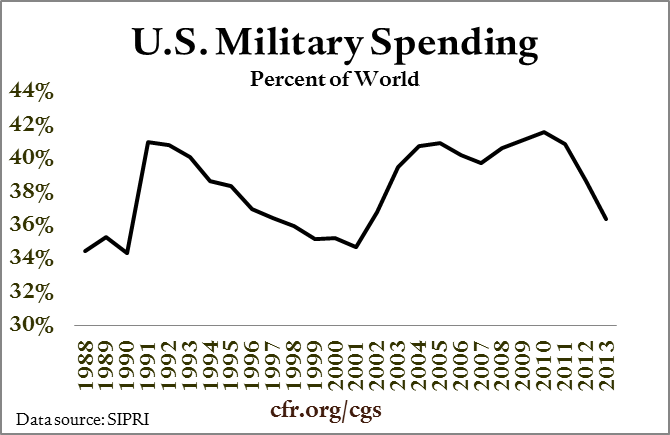
—The idea that the military is being pushed into a dark corner and allowed to rot is just another example of deciding something is true and sticking to it no matter how many proofs to the contrary you see around you every day. Let us offer just two graphics:

001_military_spending_dollars

002_military_spending_percent_of_world

Since September 11th, military spending has skyrocketed, and actually had a strong surge upward during President Obama’s first term (after a slowdown during Bush’s second term). Even the decline in Obama’s second term leaves spending levels far higher than they’ve been for nearly 40 years. So the military  has not been neglected…

…unless you mean spending on people, not equipment. What these veterans in South Carolina are really talking about is support for people in active service and for veterans, especially those with health problems related to their service. The U.S. treats its veterans shamefully for the most part, providing little to no health care, counseling, insurance, or just plain money and time and people and care for the men and women who serve in its ranks. Veterans dying on a wait list for VA hospitals make the news, then fade away. The high suicide and murder rate among veterans is well-known, yet the government does almost nothing about it.

When this is the problem, people should say so plainly instead of making broad statements about the military being downgraded and needing to rebuild its strength. No military is stronger technology and materiel-wise than ours. But our military is weak and tottering when it comes to the mental and physical health, the income, and the security of its members. If Trump torturing POWs and bombing the sh** out of China will fix those things, then we’re all for it. But it won’t.

And so we leave South Carolina with a sense of foreboding. Simply being in the military is not patriotic. You have to support, and vote to support, the founding principles of this nation if you want to protect and defend it. Let’s hope the vote turns out well for the democracy and justice the U.S. is meant to stand for.

A Nation of refugees

The wars in what we grew up calling “the Middle East”, from the Syrian civil war to the battles against the so-called Islamic State, are doing what all wars do: creating millions of refugees. This is not new in human history. Why is the U.S. a nation of immigrants? In large part because millions of people fled war in Europe during the 19th century. From the revolutions of 1848 to the wars that created Germany to the people who fled Europe after WWII, war has always grown our population in the U.S.

But that last one in the list, WWII, is actually an anomaly. It was after WWII that the U.S. began adopting policies that limited immigration, even for people claiming refugee status. There were multiple reasons for this; anti-immigration policies had begun to multiply in the 1920s and 30s, and affected people’s ability to leave Europe for America before the Second World War. These policies led to the refusal of the St. Louis in May 1939,  because it carried 937 Jewish Europeans seeking refugee status in Cuba; Cuba would not take them, and according to the Immigration Act of 1924 that cut immigration from southeastern Europe sharply, neither would the U.S. (The Jewish refugees were sent back to Europe where they fell victim to Nazism.) After WWII, the Cold War encouraged U.S. officials to restrict European and Asian immigration as we became a fortress closed against Communism.

So we actually became less welcoming to Refugees from Foreign Wars, as they used to be called, during WWII. Famously, it took an emotional visit by First Lady Rosalyn Carter to starving and dying Vietnamese and Cambodian refugees from the Vietnam War to change our policy and allow them to enter the U.S.

In the 1920s, the U.S. banned immigration based on religion and race: “undesirable” Catholics, Jews, and people who were not considered white at that time like Italians and Czechs and Russians all had their quotas lowered. Since the 1950s, immigration has been viewed through the lens of politics and religion: Catholic Latinos in the 1970s-90s, and now Muslim Middle-Easterners are the new bogeymen. In the late 19th century and to the 1930s, southeastern European Jews and Catholics were decried  loudly by panicking white Protestants: their mission from the Pope or whoever controlled them was to destroy the U.S. government and our white nation. Today, the nativists panic as they claim… the exact same thing.

Muslims can’t understand democracy. They can’t participate in it. They won’t learn English. They hate our free society. They’ll bring their religious laws here and try to enforce them. They’ll destroy our government. They’ll commit acts of terrorism.

All of these hate-panic claims were once made about Italian, Jewish, Chinese, and Catholic immigrants. Somehow none of them came true.

Yet some of our political leaders are clearly nostalgic for the bad old days. Rick Santorum thinks all Syrian refugees should go back home and fight ISIS. Somehow they will succeed where Russian air strikes have not. Carly Fiorina wants all refugees screened for terrorism before they can come here. Rand Paul has a blanket “no” when it comes to Muslim refugees. Bobby Jindal thinks all refugees should be constantly monitored in the U.S., ankle-bracelet style. And Mike Huckabee thinks it’s “crazy” to take poor people from the “desert”, “who don’t speak our language, who don’t understand our culture, who don’t share a [sic] same worldview, and bring them to Minnesota during the winter”.

Luckily none of these people are running the country. Our president faced this front of ignorance by reminding us of who we are:

When I hear political leaders suggesting that there would be a religious test for which a person who is fleeing from a war-torn country is admitted, when some of those folks themselves come from families who benefited from protection when they were fleeing political persecution, that’s shameful, that’s not American. That’s not who we are. We don’t have religious tests (for) our compassion.

This is a much-needed counter-attack against those who insist that instituting the religious tests that our Constitution absolutely outlaws and deplores as undemocratic will keep our democracy safe. Suspecting people who have fled for their lives in a war of being warmongers whose only goal is to destroy any nation that takes them in and offers them hope is beyond ignorant. And it’s beyond American.

Whenever anti-immigrant, hate laws were passed in our history, there were Americans who stood up against them. There are always Americans who fight for justice for all. That’s our true identity. That’s American. Let’s remember that. Let’s remember who we are and how we got here, always aspiring to greatest-nation-on-Earth status, because the old saw is true: if we destroy everything we stand for in the name of security, the terrorists win.

Jefferson-Jackson Day no more?

The Democratic and Republican Parties each hold annual fundraisers that, while they attract big names—including sitting presidents—go mostly under the public radar. The Republicans have Lincoln Day, and the Democrats have Jefferson-Jackson Day.

Each event is named for founders of each party. Clearly Lincoln was the first Republican president, but it’s harder to claim  that Jefferson was the first Democratic president. His party was called the Democratic-Republican party, but it did not have much in common with the modern Democratic Party, which didn’t really come into being until 1828, when supporters of Andrew Jackson who were enraged over his loss in the 1824 presidential campaign decided to scrap the Democratic-Republican Party and form a new party. It became an increasingly proslavery party during the 1830s and 40s, and was solidly proslavery by 1850.

And that’s the problem with Jefferson-Jackson Day and the J-J dinners held in every state in Spring or Fall: some people (including the NAACP) have begun to question the wisdom of continuing to associate the modern-day Democratic Party with two men who were unapologetic slaveholders, each of whom also did a lot to alienate and destroy American Indian populations. Connecticut, Florida, Iowa and others have already renamed their dinners, and other state Democratic parties are considering it. There has been predictable outrage over this from conservative spokespeople, who see it as political correctness gone wrong, and who urge us to remember that no one is perfect, and that our national history is filled with people who did good things for the nation while holding views that we can no longer accept.

When the “view” you’re holding is proslavery, it’s hard to defend this rationalist point of view. It posits the idea that there was ever a time when people did not know that enslaving human beings was very bad for the enslaved, did not know that it was always done sheerly to make money at any cost, did not understand that it was deliberately designed to destroy the humanity of the enslaved and turn them into animals bred and raised for stock.

There was never a time when slavery was not fully understood as a complete negative. This doesn’t mean there was never a time when people lied to themselves and others by claiming it had its good points, was bad but sadly necessary, was supported by religion, civilization, and tradition, etc. In fact, the present day is one of those times, as slavery is of course still going on unapologetically in many parts of the world and secretly in others.

We think it’s a good idea to rename the Jefferson-Jackson Day and Dinner in every state, and it would be wonderful if each state came up with different people to name them for, people whom we can celebrate without reservation. Each state has them—sometimes people say it’s impossible to find someone from “the past” who was fully honorable, but of course that’s not true. So get busy in your own state and nominate suitable heroes to name the Day and Dinner for!

What does the First Amendment say?

Hello and welcome to part 2 of our series on the Bill of Rights. We’re moving into the First Amendment here. It’s the celebrity Amendment in the Bill of Rights. “First Amendment rights”, “my First Amendment rights”—these phrases are like “Washington crossing the Delaware” or “Don’t fire until you see the whites of their eyes”: famous, oft-repeated, but often difficult for the people saying them to really explain. What are our First Amendment rights?

Let’s read the text of the amendment:

Congress shall make no law respecting an establishment of religion, or prohibiting the free exercise thereof; or abridging the freedom of speech, or of the press; or the right of the people peaceably to assemble, and to petition the Government for a redress of grievances.

What is “an establishment of religion”? A state religion. The FA says that Congress (the legislative branch of the federal government) cannot make any religion the official state religion of the United States. A state religion is supported financially by the federal government of a nation, which also puts barriers in the way of other religions to prevent them from gaining traction. In the 18th century when this amendment was written, every kingdom in Europe had a state religion. Britain’s was Anglicanism. The Anglican church received tax support and if you were a member of another church it was hard to get a job in the government. Go back a century to the 1600s and it would be illegal to be a member of any other church. “State” religion is endorsed by the government, and so the head of the government—the monarch—is the head of the church. Henry VIII created the Anglican church when he made himself, not the Pope, the head of the Catholic church in England. An English person who rejected Anglicanism was rejecting the authority of the monarch, which is treason, which is a capital offense. The Puritans and Pilgrims left England because they could not accept the Anglican church without major reforms, and refused to worship in it as they were told to. This was political treason and made them criminals.

By rejecting the concept of a state religion, the concept of the head of state (our president) being the head of a church, and the concept of forcing people to either belong to the state-approved religion or stand trial for treason, the Framers were making a bold and revolutionary stand that went directly against everything the great European powers had fought for during the Thirty Years’ War. We tend to think of a state religion as obviously contrary to democracy, but European powers would not reach this conclusion for over a century, and in Europe the old state religions are still powerful. In France, non-Catholics are rare. In Britain, Anglicanism is the norm. Even people who don’t practice their religion are born into its culture, which by now is indistinguishable from the socio-political culture to them.

Finally, this statement is saying the U.S. government will be completely civil. There is complete separation of church and state. The federal government will play no role in the religious life of the country, and no religious beliefs can shape our laws.

Why is “or prohibiting the free exercise thereof” tacked on to the first statement? Of course this is all one sentence, and makes more sense as one sentence, but we had to pull it apart to discuss state religion. This phrase is important on its own, though: it doesn’t just reiterate the main message that there is no state church, but also forbids the federal government to outlaw any religion. Again, this was radical for the time. In Europe practicing any religion other than the state religion was heresy and treason. The U.S. is not only saying it won’t impose religious uniformity by adopting a state religion, it’s saying it will not just allow but protect by law the proliferation of religious practices.

This was a big deal in a country that mostly hated and feared Catholics. If Congress had decided to outlaw Catholicism in 1787, most Americans would have been very supportive. But the Framers are making an enormous commitment to true democracy by saying no religion will be outlawed in the U.S.

What does it mean to say Congress will not abridge the freedom of speech, or of the press? This is the most famous part of the celebrity Amendment. Freedom of speech—if you asked Americans to name one phrase that sums up all our freedoms, this might be it. It’s so important that the concept and definition of “speech” has been expanded over the centuries to include clothes, tattoos, parades, art, and other non-mouth-moving activities. In 1919 the Supreme Court decided that some kinds of speech are indeed illegal; any speech that endangers other people is not protected (this was the case that gave us the famous example of shouting Fire! in a crowded theater when there is no fire; someone who does that will be arrested). But that decision was overturned 50 years later because Americans have identified themselves so completely with freedom of speech that we found a way around the problem of endangerment (that ruling said that only speech that creates a dangerous situation faster than the police can arrive to mediate it is illegal).

Again, this amendment is radical. No kingdom in Europe allowed its citizens to criticize the monarch, the government, or the state religion, without punishment. After nearly two centuries of religious war and civil war, Europe cracked down hard on anyone who tried to stir up trouble. But the Framers believed Americans could have freedom of speech without abusing it. Libel laws were maintained, of course; we never said you could lie about someone and not be punished if they choose to prosecute. But expressing an opinion would never be illegal in this country.

Isn’t “the press” synonymous with speech? It’s just speech that is printed rather than spoken aloud. But the Framers specifically included the press so they could protect actual printers. Again, the way to start trouble in Europe for nearly 200 years had been to print pamphlets and broadsides criticizing the government and/or church. And for nearly 200 years European powers had punished rebellion by punishing not just the authors of these documents but their printers—men hired to put paper through a printing press who had nothing to do with what was written. The Framers were protecting printing presses, publishers of books, pamphlets, and broadsides as well as newspapers, as well as the authors of all these items. In an age where a book that displeased the government could get not just its author but its printer arrested, this was an important addition to the amendment.

Why protect the right of the people peaceably to assemble? Once more we think of the time the Constitution was born in. In pre-modern Europe, people did not gather in large groups. It just didn’t happen in the course of normal human events. The vast majority of people lived in small villages, where there weren’t enough people to make up large crowds. The only way a large crowd could gather was if there was trouble: someone stirring up the people and urging them to leave their villages and meet in one place, usually to protest the government. These gatherings quickly turned into mobs, and were usually violent. In the cities, people could gather in large crowds but were prevented by the watchful eye of royal authorities from doing so, for the same reason. There was just no acceptable reason why any large crowd would gather in that period. The Reformation period was characterized by mob after mob after mob being put down violently by government forces, causing almost incalculable losses of human life and capital.

So when the Framers said Americans had the right to gather in large groups, they looked like they were inviting trouble. That’s why this part of the amendment is the only one with a caveat: the people must assemble peaceably. Colonial America had a terrible record of mob violence, often sparked for no good reason (see our post The Boston Tea Party and a tradition of violence for more on this). It seemed like the last place where you would be safe allowing people to gather in large groups. But part of freedom of speech is freedom of assembly—people have to be allowed to talk together. Knowing the fondness for mob violence that Americans had, the Framers offer the one condition in the amendment by saying Americans can gather together but only if they are not violent. They didn’t say speech was free as long as it didn’t criticize; they didn’t say printers could print anything as long as it didn’t call for violence. But they did restrict public gatherings to peaceful purposes.

What is petitioning the Government for a redress of grievances? This means that Americans can criticize the government, and as you understand by now, this was not on the table in Europe. At a time when Europe was trying to end its centuries of strife by cracking down hard on any public expression, America was inviting its citizens to talk to their government and even make complaints. A redress of grievances is making something wrong right. If someone has injured (grieved) you, they must make it right somehow (redress it). If the government does something wrong, if it violates the Constitution, Americans have the right to demand that the government stop that violation and then make up for the damage it has done. This is two rights in one: the right to demand that the government obey the Constitution, and the right to demand repayment for any violations of the Constitution. This keeps the government honest, and sharpens people’s love for and commitment to the Constitution.

That’s a lot! But then this is the star amendment that, for most Americans, completely sums up who we are and how things here should be. You wouldn’t think another amendment could rival the First in importance, and for about two centuries none did. But in the late 20th century, the Second Amendment was wrested out of obscurity and thrust into the spotlight, and we’ll go over that amendment next time.

Next time: the very clearly military Second Amendment

What’s in the Bill of Rights?

It’s time for another series! We’ve decided to take up the Bill of Rights and give it a good going-over, since it seems that when people argue about preserving “the Constitution” they are only ever talking about the Bill of Rights section—the first set of amendments to the Constitution.

So let’s get right into it. For curiosity’s sake, and to give a sense of what was originally proposed, we’re going to start with the first two of the 12 amendments presented to the state legislatures for ratification; the only two that were not ratified.

THE Conventions of a number of the States, having at the time of their adopting the Constitution, expressed a desire, in order to prevent misconstruction or abuse of its powers, that further declaratory and restrictive clauses should be added: And as extending the ground of public confidence in the Government, will best ensure the beneficent ends of its institution.

Article the first… After the first enumeration required by the first article of the Constitution, there shall be one Representative for every thirty thousand, until the number shall amount to one hundred, after which the proportion shall be so regulated by Congress, that there shall be not less than one hundred Representatives, nor less than one Representative for every forty thousand persons, until the number of Representatives shall amount to two hundred; after which the proportion shall be so regulated by Congress, that there shall not be less than two hundred Representatives, nor more than one Representative for every fifty thousand persons.

—The closing phrase of the first paragraph (from the short preamble) is interesting: these amendments are meant to “extend the ground of public confidence in the Government, to best ensure the beneficent ends of its institution.” In other words, the amendments we know as the Bill of Rights are meant to make Americans more confident in the federal government because they prevent the federal government from ever overstepping its powers and becoming tyrannical. Yet today, most Americans seem to see the Bill of Rights as a weapon to use against a federal government that can only ever be tyrannical: instead of assuring us that our government will never be unfair, the Bill of Rights panics us that our government will always be unfair. The Bill was meant to put fears of tyranny to rest, but now it only ever stirs them up.

On to the first article, which was not ratified. It deals with representatives to Congress, and tries to anticipate the problems that population growth might provoke as the nation grows. The men drafting our Constitution and its amendments had this problem on their minds at all times. It was clear the nation would only experience exponential growth as it took over the continent from sea to sea. They tried to set up frameworks that would work in 1787, when the population was already a little unmanageably large, and work in 1887 or 1987, when they imagined the population to have soared far beyond their imagining.

The public imagination at the time, however, rejected this proposed amendment as impossible. One representative for 50,000 people? That wasn’t right: how could one person fairly and effectively represent so many? The other problem was this: if this amendment had been ratified, today we would have over 6,000 Representatives in the House. As it is, we have 435, and each House member represents over half a million people (about 650,000). When your population grows to hundreds of millions, it’s impossible to give them anything close to effectively individual representation.

When you think about it, that’s why political parties really took off. Parties allow thousands or millions of people to become one person, adopting one set of beliefs. If you represent 650,000 people and 500,000 of them are Republicans, if you just follow the party platform you will be accurately representing most of your district. You don’t have to try to get to know 500,000 personal beliefs. Early on in our history representatives and the represented figured this out.

Article the second… No law, varying the compensation for the services of the Senators and Representatives, shall take effect, until an election of Representatives shall have intervened.

—This failed amendment says that Congress can’t vote to change its pay during a term. Members can propose a pay change for the next term. To make sense of this, first we have to note that they only change in pay likely to be proposed is a raise. So this amendment says that Congress can’t give itself a pay raise without allowing the people to vote on it. What Congress can do is propose a pay raise for the next session, which allows people to vote on that pay raise: if they approve it, they re-elect the members who voted for it; if they don’t approve it, they elect new members. James Madison was behind this amendment because he didn’t think Congress should be allowed to pay itself arbitrarily without giving the people a chance to approve or reject the changes.

The interesting thing about this amendment is that it was not ratified in 1787—but it was ratified 202 years later, in 1992, as the Twenty-Seventh Amendment.

Next time: the amendment we know best

Wrapping up Reagan’s farewell speech

So what is the takeaway from our excruciatingly long and terribly close reading of Reagan’s 1989 farewell address?  It’s one that isn’t unique to Reagan, certainly; it’s a conclusion Americans have drawn almost for as long as there has been an America: mandating an ill-defined patriotism as the measure of our national good is un-American.

Many presidents have urged Americans to support “my country right or wrong”. Reagan was not the only one. Many presidents have urged Americans to define patriotism as never questioning or criticizing national policy. And many presidents have urged Americans to see every war the U.S. fights as just, and never to question our military actions overseas (and to see military service as the highest or only form of patriotism).

But those presidents were usually countered immediately and publicly by Americans who realized and pointed out that this is not the American Way. High-profile Americans were willing to demand real patriotism, which means putting our founding principles of liberty and justice for all first above all other goals and desires, and taking personal responsibility for the preservation and exercise of those principles

Since Reagan, however, there has been an increasing trend away from real patriotism. So much has changed, even since 1989. The Internet has created a wide avenue for shaming and attack that deters many people from even getting involved in debates because those “debates” are actually uninformed dogfights focused on personal attack. Cuts to education funding have dumped civics education onto the scrap heap, so that most Americans have no idea what our founding principles are, and have to rely on the warped interpretations they get from political campaigns run by people as uninformed as themselves. History education has been hit hard, too, so that many Americans do not know their own history and have few examples of real patriotism to summon up for inspiration. Terrorist acts, beginning with September 11th, have been made an excuse to hail military action and military service as the only real patriotism, which is an astounding turnaround from the national opinion when Reagan took office, when the long ordeal of the Vietnam War had made U.S. military action unpalatable for most adults.

Since Reagan economic growth has been prized above all else, and is so important that corporations have been given rights of personhood, corporate money openly controls elections from the state to the presidential level, the federal government failed to take any substantial or lasting legal action to prevent another financial collapse like the 2008 Recession because big business is so much more powerful than the federal government, and Congress is working hard to remove any taxation of estates valued at over $5 million. The shining corporation on a hill is king.

In his speech, while reflecting on the “trickle-down economics” that he introduced, Reagan said this about the critics who pointed out that it would begin a terrible wealth gap: “What they called “radical” was really “right.” What they called “dangerous” was just “desperately needed.”

Sometimes it seems that we live in an America where radical and dangerous stances (anti-gay, anti-immigrant, anti-woman, anti-separation of church and state, anti-environmental health) are considered right and desperately needed to return America to a mythological perfect past where everyone was white, straight, either born here or a “good” (read white) immigrant, and Christian. That is a depressing legacy of Reagan.

But we must not give in to despair. The pendulum always swings, and it will swing back away from this radicalism because there will always be Americans who fight for our founding principles. Our job is to be those Americans.

Reagan’s farewell address: a warning (and how!)

Hello and welcome to part 4 of our series on Reagan’s farewell address of January 1989. In this section, the final one, Reagan shares his final thoughts on our nation’s history and identity, and gives his parting presidential warning.

I’ve been asked if I have any regrets. Well, I do. The deficit is one. I’ve been talking a great deal about that lately, but tonight isn’t for arguments, and I’m going to hold my tongue. But an observation: I’ve had my share of victories in the Congress, but what few people noticed is that I never won anything you didn’t win for me. They never saw my troops, they never saw Reagan’s regiments, the American people. You won every battle with every call you made and letter you wrote demanding action. Well, action is still needed. If we’re to finish the job, Reagan’s regiments will have to become the Bush brigades. Soon he’ll be the chief, and he’ll need you every bit as much as I did.

—This is oddly phrased in the fifth sentence, but Reagan is thanking a new category of political activist, one that was indeed born during his presidency and has ballooned to gargantuan proportions today: “grassroots” attack activism. The elder statesmen here at the HP remember modest kitchen tables in the 1980s covered in urgent, nay hysterical letters from many different political groups, mostly Christian-affilitated, demanding that the housewife recipients immediately write letters of protest to Congress about pending legislation or just general wrong-headed and dangerous political and social trends. The price of inaction was the fiery destruction of the U.S. in a communist, atheist lake of fire. Such were the beginnings of “Reagan’s regiments”, brought fully to flower by the Tea Party activists, PACs, and paid political ads of today.

Finally, there is a great tradition of warnings in Presidential farewells, and I’ve got one that’s been on my mind for some time. But oddly enough it starts with one of the things I’m proudest of in the past 8 years: the resurgence of national pride that I called the new patriotism. This national feeling is good, but it won’t count for much, and it won’t last unless it’s grounded in thoughtfulness and knowledge.

An informed patriotism is what we want. And are we doing a good enough job teaching our children what America is and what she represents in the long history of the world? Those of us who are over 35 or so years of age grew up in a different America. We were taught, very directly, what it means to be an American. And we absorbed, almost in the air, a love of country and an appreciation of its institutions. If you didn’t get these things from your family you got them from the neighborhood, from the father down the street who fought in Korea or the family who lost someone at Anzio. Or you could get a sense of patriotism from school. And if all else failed you could get a sense of patriotism from the popular culture. The movies celebrated democratic values and implicitly reinforced the idea that America was special. TV was like that, too, through the mid-sixties.

—The most glaring omission from this section is a definition of “what America is and what she represents”. Older Americans know what “it” means, they absorbed “it” through their pores in that better, more wholesome and true America that existed before the evil 1960s (“35 or so years of age” in 1989 translates to people born by 1954). It is in the mid-60s that good in America came to a screeching halt.

It is funny to note that earlier in this speech Reagan spoke of celebrating the anniversaries of his 39th birthday, and when he gave this speech in January 1989 he was almost 78, but now suddenly he is 35 or so. Clearly he does not want the values he is celebrating to come off as ancient and inapplicable to all but the elderly.

The only clue we have about what “it” is is war: “the father down the street who fought in Korea or the family who lost someone at Anzio”. Patriotism comes up after that sentence, and one feels that it is actually patriotism that is “what America is”—America is patriotism, America is love of America. Let’s go all the way with our syllogism: love of America is love of America. But no—at the very end “democratic values” are at last brought forward. But that throwaway mention at the very end of a stirring paragraph about war and patriotism, in which fighting in a war is the only way to honor your country and patriotism itself is a virtue, is not very convincing.

But now, we’re about to enter the nineties, and some things have changed. Younger parents aren’t sure that an unambivalent appreciation of America is the right thing to teach modern children. And as for those who create the popular culture, well-grounded patriotism is no longer the style. Our spirit is back, but we haven’t reinstitutionalized it. We’ve got to do a better job of getting across that America is freedom-freedom of speech, freedom of religion, freedom of enterprise. And freedom is special and rare. It’s fragile; it needs production [protection].

—Ah, the 60s have done a number on Americans. Young parents and young people in the media think “an unambivalent appreciation of America” and “well-grounded patriotism” are passé. Where to begin?

First, what does “appreciation of America” even mean in that sentence? An “appreciation of America” seems different in kind from a respect for America’s First Amendment rights. You don’t appreciate rights, you exercise and uphold them. You protect them from attack. You may appreciate the Constitution for enshrining those rights, but again the word itself summons up an inescapable image of people being grateful for something they may or may not deserve to have. “I would appreciate it if you’d get that book for me”—you don’t have to, and that’s why I appreciate you doing it. “I expect to be allowed full exercise of my rights” is different from “I appreciate being able to exercise my rights.” The former establishes that no one has to earn rights; the latter insinuates that we are lucky to be granted rights and could lose them if we’re not grateful enough.

Next, what is “our spirit”? And what, more ominously, is “reinstitutionalizing” it? “Spirit” must be taught in schools and churches and the media so that Americans understand that their freedom is equal parts vital and fragile. Again, it seems like a spirit of appreciation/groveling: teach Americans to be grateful that they are granted the favor of having freedom and rights for some unknown reason or for no good reason. That’s not what our Constitution says: it says we have unalienable rights from God, natural rights that no human can grant or take away. To be human is to have these rights to liberty. Our government in the U.S. lives up to and honors that state of being, it doesn’t create it.

Last, since when is “freedom of enterprise” in the Constitution? Usually presidents and Americans talk about life, liberty, and the pursuit of happiness. Reagan’s triad is freedom of speech, religion, and “enterprise”, and they all work together: churches and corporations should have the freedom to “reinstitutionalize” their agendas by getting religion back into schools and allowing corporations to rewrite the law, and the federal government would be trampling freedom if it regulated business or separated church from state.

So, we’ve got to teach history based not on what’s in fashion but what’s important—why the Pilgrims came here, who Jimmy Doolittle was, and what those 30 seconds over Tokyo meant. You know, 4 years ago on the 40th anniversary of D-day, I read a letter from a young woman writing to her late father, who’d fought on Omaha Beach. Her name was Lisa Zanatta Henn, and she said, “we will always remember, we will never forget what the boys of Normandy did.” Well, let’s help her keep her word. If we forget what we did, we won’t know who we are. I’m warning of an eradication of the American memory that could result, ultimately, in an erosion of the American spirit. Let’s start with some basics: more attention to American history and a greater emphasis on civic ritual.

And let me offer lesson number one about America: All great change in America begins at the dinner table. So, tomorrow night in the kitchen I hope the talking begins. And children, if your parents haven’t been teaching you what it means to be an American, let ’em know and nail ’em on it. That would be a very American thing to do.

—American history has two poles: its European founders the Pilgrims, and WWII. Specifically, our bombing of Tokyo and our invasion of Nazi-controlled Europe are singled out—two times when the U.S. was on the attack. If we forget what we did (military attack) we won’t know who we are.

Look, no one is more on board with the idea that WWII was a just war than the HP. The U.S. had to be on the attack in that war, and its victory over imperial Japan and the Nazis was crucial to the existence of justice and liberty on our planet. But there is more to defending liberty than shooting bullets in a war. Americans can and must defend liberty every day at home, by respecting others’ rights and exercising their own. If we don’t do that, if we don’t uphold democracy here, then how and why should we go to war to preserve democracy elsewhere? If we allow money to corrupt our politics and religion to control our government, and if the only entities in this nation who have true liberty are corporations, then, and only then “we won’t know who we are.”

This is more than “civic ritual”. This is the “it”, this is what America is and what she stands for, and what it means to be an American. “Nailing” people is not. What is that dinner table conversation supposed to be? So far, it would be a list of battles and bombings and wars and would not include one word about how we preserve freedom at home.

And that’s about all I have to say tonight, except for one thing. The past few days when I’ve been at that window upstairs, I’ve thought a bit of the “shining city upon a hill.” The phrase comes from John Winthrop, who wrote it to describe the America he imagined. What he imagined was important because he was an early Pilgrim, an early freedom man. He journeyed here on what today we’d call a little wooden boat; and like the other Pilgrims, he was looking for a home that would be free.

I’ve spoken of the shining city all my political life, but I don’t know if I ever quite communicated what I saw when I said it. But in my mind it was a tall, proud city built on rocks stronger than oceans, windswept, God-blessed, and teeming with people of all kinds living in harmony and peace; a city with free ports that hummed with commerce and creativity. And if there had to be city walls, the walls had doors and the doors were open to anyone with the will and the heart to get here. That’s how I saw it, and see it still.

And how stands the city on this winter night? More prosperous, more secure, and happier than it was 8 years ago. But more than that: After 200 years, two centuries, she still stands strong and true on the granite ridge, and her glow has held steady no matter what storm. And she’s still a beacon, still a magnet for all who must have freedom, for all the pilgrims from all the lost places who are hurtling through the darkness, toward home.

—John Winthrop a) did not consider himself as living in America, b) was not a Pilgrim, c) was not looking to establish freedom of religion as we know it, and d) did not call it a “shining” city on a hill. The “shining” part is pure Camelot nostalgia demanding that we believe that the earliest white settlers in America were heroes dedicated to freedom and democracy. Winthrop was a Puritan creating an outpost of the kingdom of England where reformed Anglicanism could be practiced and brought to a state of perfection. And when he said “we must consider that we shall be as a city upon a hill,” he meant that all of the failures of his settlement would be visible to the world; it was about the pressure of doing well when everyone is watching.

But Winthrop was a “freedom man” [sic] who was heavily involved in the first codification of law written in what would become the United States, the 1641 Body of Liberties that promoted freedoms Reagan would have “nailed” him for in a minute. Like making it illegal to abandon the poor to poverty, and making it illegal to use legal tricks and jargon to win a court case, and making it illegal for business owners to cheat their customers.

Again with big business in Reagan’s corporation on a hill, “humming with commerce”. And his city is not quite open to “all” the pilgrims from lost places hurtling toward darkness, as the U.S. fought a prolonged battle against refugee immigration from Asia and Latin America during his administrations.

We’ve done our part. And as I walk off into the city streets, a final word to the men and women of the Reagan revolution, the men and women across America who for 8 years did the work that brought America back. My friends: We did it. We weren’t just marking time. We made a difference. We made the city stronger, we made the city freer, and we left her in good hands. All in all, not bad, not bad at all.

And so, goodbye, God bless you, and God bless the United States of America.

—Oh yes, they made a difference. The deregulation, corporate personhood, resentment of taxation, religious affiliations with politics, and indignant refusal to help the less fortunate through federal programs begun by Reagan’s men and women, the Reagan revolution, still goes strong today.

Enough–next time the wrap-up.

Reagan’s Farewell, 1989: We the People need no government

As we move along through Reagan’s final speech from the Oval Office in January 1989 in our series on his farewell address, we come to his reinterpretation of the Constitution and the purpose of the American people.

When you’ve got to the point when you can celebrate the anniversaries of your 39th birthday, you can sit back sometimes, review your life, and see it flowing before you. For me there was a fork in the river, and it was right in the middle of my life. I never meant to go into politics. It wasn’t my intention when I was young. But I was raised to believe you had to pay your way for the blessings bestowed on you. I was happy with my career in the entertainment world, but I ultimately went into politics because I wanted to protect something precious.

—The bit of folksy humor that begins this paragraph quickly transitions into something far darker. Reagan is a happy entertainer who is forced by a great danger to change careers and enter politics. What danger? Well, it is set up by this seemingly innocuous description of himself: “I never meant to go into politics. It wasn’t my intention when I was young. I was raised to believe you had to pay your way for the blessings bestowed on you.”

What does this mean? It’s a bold non-sequitor: why would going into politics contradict a belief in “paying your way”? Why is an intention to go into politics the opposite of pulling your own weight? For Reagan, and for the American people who had listened to him and lived with his economic and political policies for eight years, however, the meaning is very clear. Politics is government, and government is bad. The president who introduced the concept of the evil “welfare mother” (or “welfare queen”), who decimated unions and worked hard to convince the nation that anyone on unemployment or welfare or Medicaid (but not Medicare) was a dishonest, un-American liar and cheater would of course see those people as not “paying their way”, as asking for blessings to be bestowed upon them from the government for no good reason. And the government who bestows those undeserved blessings is bad; it is a threat to democracy itself. So entering that government was a tough move for Reagan that he only took out of dire necessity.

Ours was the first revolution in the history of mankind that truly reversed the course of government, and with three little words: “We the People.” “We the People” tell the government what to do; it doesn’t tell us. “We the People” are the driver; the government is the car, and we decide where it should go, and by what route, and how fast. Almost all the world’s constitutions are documents in which governments tell the people what their privileges are. Our Constitution is a document in which “We the People” tell the government what it is allowed to do. “We the People” are free. This belief has been the underlying basis for everything I’ve tried to do these past 8 years.

But back in the 1960’s, when I began, it seemed to me that we’d begun reversing the order of things — that through more and more rules and regulations and confiscatory taxes, the government was taking more of our money, more of our options, and more of our freedom. I went into politics in part to put up my hand and say, “Stop.” I was a citizen politician, and it seemed the right thing for a citizen to do.

I think we have stopped a lot of what needed stopping. And I hope we have once again reminded people that man is not free unless government is limited. There’s a clear cause and effect here that is as neat and predictable as a law of physics: “As government expands, liberty contracts.”

—First paragraph? Fine. The comment about all the other constitutions in the world is incorrect, but we can go with the general flow of this statement about our own form of government. (Although the original wording was “We the States”, which kind of ruins it for Reagan, because originally the framers wanted a political unit, the governments of the states, to dictate terms. “The People” is more folksy for Reagan but was actually a very hard sell at the Constitutional Convention in 1787, where most framers were intent on building up the power of state governments.)

Now for the second paragraph. What can those “rules and regulations” in the 1960s that were so threatening to our democracy be? Yes, it was the Great Society legislation of the Johnson presidency, including civil rights legislation. Reagan was closer to those 1787 delegates who wanted to speak in the name of the state governments than he was to “the People” in that he was not a fan of the federal government telling states what to do. He was not a fan of affirmative action or the Equal Rights Amendment or any of the social legislation passed by Congress under Johnson to guarantee equal protection under the law because that legislation was federal. Reagan found unlikely bedfellows in the South on this topic. Reagan believed that the federal government—and the state governments, too—should not pass any social legislation to help groups that faced entrenched racial, sexual, or ethnic discrimination. Those people needed to get with the American way and help themselves—to pay their own way, like white people did. Like he did.

The dangerous social legislation quickly morphs into dangerous taxation, because many of the social programs Johnson started (like Head Start) were federally funded. Taking money from some Americans to help other Americans was “taking more of our money, more of our options, more of our freedom.” Who “our” or “we” is is unspoken, but it’s clearly referring to hardworking white America.

Reagan is not kidding when he says “I stopped a lot of what needed stopping.” Taxes were cut (and then raised, but only to pay for defense spending), welfare was crucified in an intense attack campaign, Medicaid spending, education spending were all cut in an attempt to give hardworking white America back its money. Then Reagan says “man is not free unless government is limited… as government expands, liberty contracts.”

This is an echo of his First Inaugural speech in 1981, in which he said:

The economic ills we suffer have come upon us over several decades. They will not go away in days, weeks, or months, but they will go away. They will go away because we, as Americans, have the capacity now, as we have had in the past, to do whatever needs to be done to preserve this last and greatest bastion of freedom.

In this present crisis, government is not the solution to our problem; government is the problem.

From time to time, we have been tempted to believe that society has become too complex to be managed by self-rule, that government by an elite group is superior to government for, by, and of the people. But if no one among us is capable of governing himself, then who among us has the capacity to govern someone else? All of us together, in and out of government, must bear the burden. The solutions we seek must be equitable, with no one group singled out to pay a higher price.

We hear much of special interest groups. Our concern must be for a special interest group that has been too long neglected. It knows no sectional boundaries or ethnic and racial divisions, and it crosses political party lines. It is made up of men and women who raise our food, patrol our streets, man our mines and our factories, teach our children, keep our homes, and heal us when we are sick—professionals, industrialists, shopkeepers, clerks, cabbies, and truckdrivers. They are, in short, “We the people,” this breed called Americans.

The “economic ills” are social programs to help the poor and discriminated against, and “they will go away” because we must do “whatever needs to be done to preserve this last and greatest bastion of freedom”. Like our ancestors, we will fight tyranny; the tyranny of democracy, apparently. The “elite” government that created social programs that take money from good hardworking white people and give them to “special interest groups” will be destroyed, and balance and democracy will be restored when the neglected, oppressed white American is safe from having to help those insidious special interest groups. By 1989, Reagan was satisfied that our democracy was safe from helping people.

It’s ironic that later in this speech Reagan will reference John Winthrop’s City on a Hill address. He clearly did not read the part where Winthrop said

…we must be knit together in this work as one man, we must entertain each other in brotherly affection, we must be willing to abridge our selves of our superfluities, for the supply of others’ necessities, we must uphold a familiar commerce together in all meekness, gentleness, patience and liberallity, we must delight in each other, make other’s conditions our own—rejoice together, mourn together, labor, and suffer together, always having before our eyes our Commission and Community in the work, our Community as members of the same body, so shall we keep the unity of the spirit in the bond of peace, the Lord will be our God and delight to dwell among us, as his own people and will command a blessing upon us in all our ways, so that we shall see much more of his wisdom, power, goodness and truth than formerly we have been acquainted with…

—“We must be willing to abridge ourselves of our superfluities, for the supply of others’ necessities”: in other words, people who have money must give some of it to those who don’t. That’s the democratic ideal our nation would be founded on 157 years later. Reagan claims that the “breed” he is describing has no ethnic or racial divisions, but his eight years of demonizing black and Latino Americans as “welfare queens” and criminals proved that to be untrue.

Nothing is less free than pure communism—and yet we have, the past few years, forged a satisfying new closeness with the Soviet Union. I’ve been asked if this isn’t a gamble, and my answer is no because we’re basing our actions not on words but deeds. The detente of this 1970’s was based not on actions but promises. They’d promise to treat their own people and the people of the world better. But the gulag was still the gulag, and the state was still expansionist, and they still waged proxy wars in Africa, Asia, and Latin America. Well, this time, so far, it’s different. President Gorbachev has brought about some internal democratic reforms and begun the withdrawal from Afghanistan. He has also freed prisoners whose names I’ve given him every time we’ve met.

—We segue with Reagan to the outside world again, and to the Soviet Union, the epitome of the unfree state that America will become if we don’t stop giving money to the poor. We will pass over the fact that the U.S. was also fighting proxy wars in Africa, Asia, and Latin America to say that this first mention of Gorbachev is very interesting in hindsight, as this speech was given in January 1989; by that time, Moscow had already begun to lose control of some of its republics, and in just a few months the Soviet people would vote for delegates to the new Congress of the People’s Deputies. The Soviet Union was on the brink of collapse. The Revolutions of 1989 that would dissolve the Eastern bloc were just months away. Gorbachev would allow all of this to happen, and would facilitate the dissolution of the Soviet Union and the creation of a democratic Russia.

Yet to hear Reagan tell it, it is Reagan alone who is pushing democracy, lecturing Gorbachev on what freedom is, and giving him the names of political prisoners to release. “President Gorbachev has brought about some internal democratic reforms” is the understatement of the century.

But life has a way of reminding you of big things through small incidents. Once, during the heady days of the Moscow summit, Nancy and I decided to break off from the entourage one afternoon to visit the shops on Arbat Street — that’s a little street just off Moscow’s main shopping area. Even though our visit was a surprise, every Russian there immediately recognized us and called out our names and reached for our hands. We were just about swept away by the warmth. You could almost feel the possibilities in all that joy. But within seconds, a KGB detail pushed their way toward us and began pushing and shoving the people in the crowd. It was an interesting moment. It reminded me that while the man on the street in the Soviet Union yearns for peace, the government is Communist. And those who run it are Communists, and that means we and they view such issues as freedom and human rights very differently.

We must keep up our guard, but we must also continue to work together to lessen and eliminate tension and mistrust. My view is that President Gorbachev is different from previous Soviet leaders. I think he knows some of the things wrong with his society and is trying to fix them. We wish him well. And we’ll continue to work to make sure that the Soviet Union that eventually emerges from this process is a less threatening one. What it all boils down to is this: I want the new closeness to continue. And it will, as long as we make it clear that we will continue to act in a certain way as long as they continue to act in a helpful manner. If and when they don’t, at first pull your punches. If they persist, pull the plug. It’s still trust but verify. It’s still play, but cut the cards. It’s still watch closely. And don’t be afraid to see what you see.

—For Reagan, the KGB still run the Soviet Union and “while the man on the street years for peace, the government is Communist”, and will never allow freedom and human rights. One gets the feeling that Reagan would be genuinely astounded by what happened in the Soviet government just a few months after this speech. Yes, Gorbachev was very “different from previous Soviet leaders”. The folksily boxing and poker metaphors at the end would all be made obsolete by the open and unimpeded dismantling of the Soviet government led by Gorbachev.

Next time: Closing thoughts on what it means to be an American in the looming 1990s