Democracy on the brink

Back on January 8 of this year, we posted “Truth or Myth: the president can break the law”, focusing on the main argument that was so often obscured:

Unfortunately at this critical moment, Americans have sidetracked into discussions about whether U.S. legal precedent supports or conflicts with the claim that a U.S. president is immune from criminal prosecution instead of focusing on the actual threat: Trump doesn’t want his illegal actions to be protected based on his role as president. He wants them protected based on the new idea that the president is allowed to commit crimes. A president (and by extension, anyone who works for him, or in the federal government, or state government, or local government) can do whatever they want because committing crimes is no longer illegal for them.

At that time, we were awaiting Spring decisions from the Supreme Court that included a ruling on this question. Worriedly we asked,

The question is always, will these rulings [denying that the president is above the law] be upheld by the current Supreme Court, packed as it is with members who have already made it clear that they have an agenda to overturn every ruling that supports civil rights in this country?

Very gravely, but not unexpectedly, we got our answer on July 1 in Trump v. United States, perhaps the most aptly named case ever to appear before that court. As the PBS Newshour sums it up,

In a landmark ruling with potentially major impact on the 2024 presidential campaign, a U.S. Supreme Court majority ruled that presidents — including former President Donald Trump — have immunity from prosecution when carrying out “official acts.”

“Under our constitutional structure of separated powers, the nature of Presidential power entitles a former President to absolute immunity from criminal prosecution for actions within his conclusive and preclusive constitutional authority,” the court wrote. “And he is entitled to at least presumptive immunity from prosecution for all his official acts. There is no immunity for unofficial acts.”

We spent a lot of time in January making the deviousness of the language clear: “[the lawyers for Trump] are not claiming that Trump did nothing illegal. They are claiming that it’s okay that he did.They are claiming that the president can commit crimes–acts that are clearly illegal for everyone else–without consequence.”

How can this be? Because Trump’s legal team changed the definition of “private actions”:

“…precedents [afford] the President immunity from suit for his official conduct – primarily on the basis that he should be enabled to perform his duties effectively without fear that a particular decision might give rise to personal liability… the separation-of-powers doctrine did not require a stay of all private actions against the President. Separation of powers is preserved by guarding against the encroachment or aggrandizement of one of the coequal branches of the government at the expense of another. However, a federal trial court tending to a civil suit in which the President is a party performs only its judicial function, not a function of another branch. No decision by a trial court could curtail the scope of the President’s powers.

What Trump’s lawyers did was broaden the definition of “private actions” to claim that EVERY action a president takes is formal–that is, presidential, part of carrying out the duties of the office.

And the Justices appointed by Trump agreed, saying that “presidents are completely immune from prosecution for things they did through core constitutional powers of the presidency [and] are at least presumed to be immune–and potentially are always immune–for all official acts of their presidency.”

But wait, you might say; they’re still saying official acts only, aren’t they? That’s where the true democracy-killing intent comes in, for the ruling says that what constitutes a core power and an official act is open to interpretation.

That is, the president can decide what is an official act and what is not, and will likely decide that all their acts are official, and the increasingly anti-democratic, Trump-appointed court judges will agree.

As Justice Sonia Sotomayor said in her dissent, this ruling “expands the concept of core powers beyond any recognizable bounds… [this] expansive view of core power will effectively insulate all sorts of noncore conduct from criminal prosecution…” Justice Ketanji Brown Jackson also dissented, writing that “it appears that the first decision point is whether the alleged criminal conduct involves one of the President’s ‘core’ powers. If so (and apparently regardless of the degree to which the conduct [calls on] that core power, the President is absolutely immune from criminal liability for engaging in that criminal conduct.”

Again, Trump and his team don’t attempt to hide the fascist intent of their argument. Infamously, during arguments before the Court, Justice Sotomayor asked Trump attorney D. John Sauer this:

Sotomayor: If the president decides that his rival is a corrupt person, and he orders the military or orders someone to assassinate him, is that within his official acts that, for which, he can get immunity?

Sauer: It would depend on the hypothetical, but we can see that could well be an official act.

It’s mind-numbing. The U.S. Supreme Court has granted any president immunity from legal prosecution for any action he takes. Anything. Any action. This is the definition of a dictatorship.

Under the guise of protecting separation of powers, the Court has agreed to give the executive branch dictatorship powers.

It no longer matters that our judicial system is steadily filling with appointees dedicated to ending democracy in this country. None of their courts will ever hear a case against a president ever again.

It’s hard to take in this moment fully. Life has gone on seemingly as usual since July 1. We’re about to have a presidential election as if nothing has changed. Some people seem to believe that if Trump loses, the threat of this ruling is removed. They are wrong. The president now has dictatorial powers in this country. Anyone who takes office can use them, and when someone in power can do something, they do it.

We have taken a step that we can’t return from any time soon. It would require dedicated, years-long work by a coalition of American politicians, judges, lawyers, and citizens to change the composition of our now anti-democratic, Trump courts and get this ruling reversed. It’s very, very hard to believe that this will happen without first descending into dictatorship. And that’s if Trump is not elected this November, the odds of which are vanishingly small. Republican election officials in many states are already prepared to throw the election, and again make no secret of this:

report by Citizens for Responsibility and Ethics in Washington (CREW) found “[a]t least 35 current county election officials” that have voted against certifying an election in the past. Public Wise, Informing Democracy, and the Center for Media and Democracy identified dozens of additional election officials that have “promot[ed] election denialism or amplif[ied] unsubstantiated claims of voter fraud or irregularities.” The amount of election deniers acting as election officials “presents a challenge for monitoring certification,” specifically in swing states and remote areas. 

…The Brookings Institution found that in 2020, “at least 17 county election officials across six swing states attempted to prevent certification of county vote totals.” In 2022, it grew to “at least 22 county election officials” who voted to delay certification in swing states. This year, there have been “at least eight county officials” that have already voted against certifying election results for primary or special elections.

So we hang by our fingernails from a precipice. Again, it’s just so hard to believe this is really happening. It’s not time to give up. But it is time to prepare for a very different future, in which fighting for justice and democracy through our established channels will be much harder, and often impossible, depending on the state or county you live in. It will likely get much darker before we do fight our way back to the light. But we will continue to use those channels, to force them back into existence where they’ve been choked out, and to stand up for our democratic systems, flawed as they are. That’s what we’re fighting for, after all–the chance to continue the work America has been struggling to do, with success and failure, anger and division, celebration and humility, since 1787–form a more perfect union.

March On, America! – American “history” from 1942

The Republican party’s war on history, which includes book banning, outlawing DEI instruction, and legislation policing what teachers say to students in a top-down effort to ensure that only inaccurate, harmful history “eduction” is offered in K-12 schools erases the racism, slavery, sexism, classism, xenophobia, and other problems of human nature contrary to the work of democratic rule that all nations have experienced in their past and struggle with today. That’s what this attack on history education in this country is intended to do. It’s part of the “magical past” dogma that locates the best of America in its past. Whether this is offered to us in 2024, 1990, 1940, or 1840, as it has been, the message is always the same: until very recently, America was “great”, but now, in the past 20-30 years, that greatness has been impaired by minorities, foreigners, and women who want to destroy all that was good in America by demanding equal rights and changing the status quo.

We hear about this anti-educational goal a lot, and there are myriad examples of it that we can find in the news today. But to show that it’s not just a 21st century effort, let’s examine the 1942 Warner Brothers release March On, America! – a short movie meant to inspire Americans as the nation finally entered World War II. Because there was still plenty of sentiment against entering the war, as we discussed in our recent short series called “WWII and wishful thinking”, Hollywood mobilized to help turn that ship around and galvanize pro-war energy.

It’s worth noting that today, the America of WWII is often held up as the time America was not just great but at its greatest, that this was the “greatest” generation in largest part because it fought the war against fascism. Yet if we travel back to 1942, we find a great deal of foot-dragging, which proves only that the mirage of the “magical past” so near, just a generation away but so dangerously out of reach, is just that–a mirage.

March On! is just 21 minutes long, but in that short time it tells the history of America from Pilgrim to Pearl Harbor. We saw it on Turner Classic Movies a while back, and recorded it so we could pull exact quotes to show that this is the kind of “history” anti-Americans are enforcing right now–a “history” that talks about the Civil War without ever mentioning slavery or showing a black American, a “history” that claims that eastern European immigrants arrived with the Puritans in the 1620s, and a “history” that promotes the myth of the “disappearing Indian” with seeming compassion that is more toxic than open hate could ever be.

By 1630 nearly a thousand immigrants had landed on the shores of Boston Harbor in Massachusetts Bay. The Joneses, and Smiths, and Browns, yes, and the Kellys and the Moskowitzes and the Pulaskis.

Where to begin? The easiest spot is the date and location: the Pilgrims arrived in North America in 1620, not 1630, and colonized the Wampanoag place called Patuxet, which they called Plimoth, not Boston Harbor–that was the Puritans, a different group arriving in the Massachusetts place called Shawmut and renaming it Boston in 1630.

Equally easy but much more alarming is the bald statement that Irish and Catholic or even Jewish eastern European emigrants were right there alongside the Pilgrims and Puritans. It’s so obviously not just untrue but ridiculous that its purpose is made neon-clear: since young men of every background were being drafted into the armed forces after a lifetime of segregation and fear-mongering, an attempt had to be made to suddenly create a sense of unity amongst them, so after three centuries of prejudice and institutional discrimination against eastern European Jewish and Catholic immigrants, this “history” suddenly includes them at the very start. The movie does, of course, show stately and self-controlled English people quietly disembarking from the Mayflower while the “Kellys and the Moskowitzes and the Pulaskis” are shorter, poorer, and goggle-eyed with their primitive excitement.

These immigrants cleared the land, because “it needed to be cleared”, and then we get this remarkable passage:

At first with stoic patience the Indians watched the white men inhabit their hunting grounds, then with distrust and alarm [showing them setting fire to gathered wheat]. “Indians on the warpath!” When that cry rang out, colonists gathered up their families and all else they could take with them and hurried off to a stockade. But all this was part of the work that had to be done in this land that had to be settled so a nation could be born. And after a while, the Indians knew the white man would always be here, even after the last Indian was gone.

It’s remarkable because it begins with a surprisingly frank acknowledgement of white colonizing destruction. Indigenous people were indeed patient and slow to anger as lands they belonged to were made off-limits to them by colonizers exploiting it for personal gain. We don’t expect this to be acknowledged. That’s what makes it even more painful when we zag from justifiable anger to “Indians on the warpath!”–suddenly, Indians are war-mongers, and colonizers innocents who just have to endure until they were free to do their good work of founding a nation. The implicit message is that these colonizers wanted to found a democracy–the U.S. that was drafted into existence in 1787–and this high-minded goal justified and ennobled their colonization. This of course is untrue. The proto-democracy of puritan New England, while leading to the government created by the Constitutional Convention, was in large part created to and by the right to personal profit that drives all colonization, then and now.

The shock of the last sentence–after a while, the Indians knew the white man would always be here, even after the last Indian was gone–lies again in its zag from accuracy to inaccuracy. Indigenous people did realize that there could be no turning back to their real, not at all magical pre-colonizing past, but there will never be a time when “the last Indian is gone”. Colonization insists on erasing indigenous people, and claims that “the last Indian is dead” began in the 1700s in the United States in order to wish away and remove legal personhood from Indigenous people who were and are very much alive.

The story moves along to the Civil War:

But once again storm clouds were gathering over our republic, as the Northern and Southern states of our own union took issue.

[Southern politician in a legislature] “Secession, gentlemen! the people of my state are in favor of it!” And again the truth was self-evident [newspaper headline “Southern States Withdraw from Union”]: the United States of America were no longer united, but a nation divided.

“Took issue”… over? We never find that out. Why did the southern states secede? We just don’t know. …This dangerous nonsense is again very clearly the result of the shamefully successful efforts of southern states to insist that American children be taught that the Civil War was fought strictly over the south’s loyalty to states’ rights to self-government: the north insisted on giving the federal government too much power, and the south stayed true to the Constitution. It’s so maddening that this poison is still being fed to American students to this day. The question of who really won the Civil War is still a live one.

We continue:

[after Fort Sumter is attacked President Lincoln is informed and prays with his son Tad]  “That we may act calmly and justly in this time of great stress, and lastly, that we be given strength to hold one people in one union under one flag. Amen.”

[fade to a Southern general with his men] “…but deliver us from evil… Amen.”

This was no war of foreign aggression, but people against people, brother against brother. Both the North and the South believed their cause to be just. Final victory fell to the North. But the people at home had little heart for jubilation. They were only thankful that the weary struggle was at an end.

Lincoln, whose election sparked the war because southern enslavers knew he would move to make slavery unconstitutional, prays only that the U.S. act with “justice” (i.e., not anger or vengeance or revulsion) against the traitorous Confederacy. A Confederate general also prays, so people who breed human beings for profit are just as nobly Christian as those who fight to end slavery. Finally, both sides believe their cause–whatever that is??!!–to be just. By sheer chance, “final” victory “falls” to the North; the strong suggestion is that the Confederacy deserved to win but at the very end through no fault of its own or virtue of the U.S. Army, it lost. But no one–not even the Americans who won a war to end slavery–was happy. No one celebrated. Everyone just wanted the war to end because it was unjust and unnecessary and best forgotten as quickly as possible.

Normally we would say that it’s bizarre that the movie shows Lincoln giving the 1863 Gettysburg Address after the war is over in 1865, as a benediction on U.S. and Confederate deaths, but that’s par for the course when you’re doing fake “history”.

We move rapidly from this point, into the Manifest Destiny period:

Now began the great era of Reconstruction and development. Lumbering prairie schooners rolled westward over plains, through rivers… To the Indians, watching from hidden places, the spinning wagon wheels recalled the old story: the white man will build a campfire on your hunting ground. Then he’ll build a house. Then a fence—to keep you out. The Indian massacres wrote chapters of horror into the story of the west. But the lusty bustling western town springing up in a hundred places confirmed the end of the Indian wars.

Again, the whiplash of hearing real history–the “old story” of colonization beginning with a campfire and ending with massacres–is unexpected, and of course painful when the massacres are identified as being committed by Indigenous people rather than white colonizers. Again, Indigenous people are described as being cheated and harmed, and having a just cause for anger, but then as immediately leaping to all-out massacre and war, which simply is not true. And again, the inevitability of “Indian disappearance” is referenced. When the “Indian wars” end, we understand the “Indian” to end as well. This clip actually ends with a re-enactment of a railroad connection being finished as a crowd watches in the late 1800s; as the final spike is driven, two Plains Indigenous men in full feather regalia grab their heads in dismay and run off screen. It’s as plain a signaling of “past” making way for “future” as one could ever ask for.

We speed through Teddy Roosevelt and his cousin FDR right up to Pearl Harbor, and the movie concludes with a good deal of footage of draftees training and planes flying and ships sailing. We, the eternal audience of “modern” Americans, are asked to call upon our proud history as a nation in order to find the desire to fight this war. Our history of welcoming immigrants of all races and religions, of working toward democracy from day one in 1620, of rejecting war with “our brothers” as ridiculous and sad, of lusty economic development that banished the darkness of the primitive past with the light of the just and equal future… this is what we were meant to think of then, and are instructed to think of now.

There are many problems with fake history. First, it’s not convincing. Americans know from their own experience what this nation is like in their own time, and how previous times got them there. Second, and perhaps worse, that very unconvincing nature makes it believable–it’s the fantasy many people want to believe, because it makes discrimination in the present the fault of the victims: America has always been fair to everyone, so if you aren’t succeeding it’s your own fault. If I’m succeeding, it’s because I earned it. it’s history as wish fulfillment. Finally, for now, it makes history unnecessary and boring because it only retells the truth we already believe and want to believe. Maybe once in a while you need to relate parts of it, in order to shut people up who are complaining, but thinking that history matters is the same as thinking that we need to be taught what America is and what it’s meant to be. If you think real history is important, it’s because you think we still have something to learn or improve on, that the past wasn’t perfect, and that we need to do better. And that means you’ll question or challenge injustice today, which is not what the people leading the war on history want, in any time period. Not in 1942, and not today.

Any democracy that isn’t strong enough to learn about and from its mistakes will never stand. A war on history is a war on democracy. Let that be the moral you take away from any motivational short, and every attack on teaching real history in our schools.

Project 2025 and “neutral” history

Since we last posted, the Supreme Court has created a Supreme Leader out of what we once called the president. The damage done to our democracy by four years’ worth of the Trump administration appointing puppet judges dedicated to dismantling democracy to courts high and low across this country is now made dramatically clear by those appointees in our highest court.

This transformation of the judiciary is the necessary precursor to implementing Project 2025 in a second Trump presidency. You’ve likely heard a lot about this by now; an even-handed description at Snopes, a non-partisan news source and investigatory journalism outlet, details it without being exhausting…. as much as that’s possible, since Project 2025 is the roadmap to a police state and a dictator in the U.S. With the judiciary firmly packed with kangaroo court anti-democratic worker bees, carrying out Project 2025 will be very easy, as any challenges to it in court will be overruled or dismissed (like the Trump classified documents case was dismissed by U.S. District Court Judge Aileen Cannon earlier this month).

When this end goal is made as unapologetically clear as Republicans have made it, it’s astounding to us that many people still call on historians to remain “neutral”. We’ve addressed this in the past–the hesitation, the worried caution around drawing parallels between what’s happening now (with roots in the Reagan Administration) in the U.S. and what happened in Germany in the 1930s or any other democracy that was forced into authoritarianism. Somehow that’s irresponsible, and alarmist. “Just keep on doing what you’re supposed to do,” historians are told, which usually means “just talk about the past as past.”

People posing as historians, of course, do just the opposite, but we’ll get to that next time.

For now, we think of our March 2021 post “Neutrality isn’t justice, silence = death”, which was part of our posting on the efforts of the Iowa state legislature to incorporate the anti-justice language and intent of the Trump Executive Order 13950 of September 22, 2020 (Combating Race and Sex Stereotyping), which we wrote about in-depth in late 2020. All of the universities whose Republican presidents have initiated or are currently initiating these “anti-diversity” regulations provide helpful test-runs for Project 2025’s universal rollout.

As we said back in March 2021, one quote in particular from the story on Iowa by Inside Higher Ed sticks with us:

Representative Sandy Salmon, a Republican, argued that there still “needs to be a paragraph in there about requiring a public institution of higher education to attempt to remain neutral on current public policy controversies.”

Neutrality. We understand the disequilibrium our nation is going through as it attempts its boldest reckoning with racism since the 1950s and 60s. We know how painful it is to everyone to disturb the equilibrium of an entire nation, to call a halt to business as usual, including all the coping mechanisms people have relied on for centuries to deal with and survive racism and sexism. That coping state is identified as neutrality, and it can seem like neutrality, a grey area between violence and safety, but it isn’t neutral. It’s charged with fear and hate. It’s the medium in which cells of injustice grow and multiply.

So there is nothing noble or helpful about calling for neutrality on “controversies” that are tearing our nation apart, and that we are finally stopping all the machinery to address and redress. It doesn’t “calm things down”. It only perpetuates the medium for injustice by refusing to call it out and destroy it.

First they force universities to go along, then K-12 schools, then businesses, then everything else. Neutrality isn’t justice, in Iowa or anywhere else. All of us have to stick with the exhaustingly difficulty work of derailing what is corrupt in our society and nation, and then, when all injustice is indeed safely “in the past,” we can figure out how to keep it that way.

There was a slogan back in the 90s amongst gay Americans fighting the unwillingness of the U.S. government–and most of society–to do anything to stop the AIDS epidemic.

Silence=Death was a quick, efficient way to get the message across that not talking about AIDS, or “gays”, was a way to guarantee that the death rate just kept rising. Gay Americans who had adopted the coping mechanism of silence about their sexuality, concealing it in some way, to some extent, in order to survive had to be mobilized for public protest, public political action. It was not easy. But momentum grew with the death rate, and heroic gay Americans put their lives on the line to stand up and demand equal medical treatment and attention. It was dangerous, it was hard, it put all of American society into disequilibrium as “mainstream” America was forced to acknowledge gay people as human beings with equal rights (and as people–regular people who had jobs and pets and went on vacation and hated broccoli, etc.).

Neutrality in that situation was not the answer. It’s never the answer when justice is at stake. We all need to revive this slogan for today. Find a new shape to replace the pink triangle that represented homosexuality and get those t-shirts and buttons out there on every American who knows that “neutrality and silence for all” is not our national slogan.

This is even more true today in 2024, as pretend history is manufactured by Americans who don’t want liberty and justice for all and see their best chance since the Civil War to restrict those freedoms to themselves alone. All of us have a job to do speaking out against home-grown fascism, campaigning against candidates who want authoritarianism and for democratic candidates, running for office, protesting publicly, and of course voting democratically.

We’re in a hole now, as the Supreme Court rulings prove. Dictatorship in America is like climate change–no longer something possible, on the horizon, that we can avoid, but something already here. The Court has already made the president above the law. That’s done. We will be living with the unfolding and ever-increasing horrors of that decision well into the latter half of this century. If Trump becomes president again, the horrors will only come sooner and become more permanent.

In this situation it’s easy to feel helpless, and that’s a justifiable first reaction. But if “traditional” American history has told us anything over the past 200 years, it’s that Americans rise to any challenge and vanquish it. Let’s borrow a little of that spirit from the unhinged false histories that trumpet American exceptionalism in all the worst, most ahistorical ways to promote real history, the kind that draws parallels to fascism when necessary and obvious, refuses to go along, and offers later generations evidence they can use to carry on the fight.

A “no-win proposition”: WWII and wishful thinking, part 3

Hello and welcome to part the last of our short series on Radio and the Great Debate over U.S. Involvement in World War II, by Mark S. Byrnes. As we said in part 1, Mark painstakingly documents the many Americans who made their cases for the intervention and anti-intervention sides of the argument between September 1939 and December 6, 1941, when the Japanese attack on the U.S. Navy at Pearl Harbor, Hawaii settled the question.

His main focus is disproving the established anti-interventionist (“isolationist”) claim that the interventionists got special treatment–more time on the air, and support from a Democratic-controlled Congress that did whatever the popular and clearly interventionist Democratic president, Franklin Roosevelt, said to do. Both sides got equal time, and both sides made points that resonated with Americans.

In part 1 we covered the first argument in the anti-interventionist side of the debate: the wishful thinking Americans engaged in that the war could be won without them. In part 2, we looked at the second, even more alarming argument against going to war: that the U.S. could get along just fine–even thrive–in a world where fascism had conquered Europe and Asia.

Now we conclude with the final, fainter argument made most explicitly by the American Socialists who entered the debate. Not faint because it was presented timidly, but because it was a more complex argument than the overall “it is our business–no it’s none of our business” debate generally encouraged.

In April 1941, author Stanley High, of the FFF (a recently formed pro-intervention organization), debated Norman Thomas, chair of the Socialist Party. Stanley presented the stark choice: “Either Hitler’s defeat is of desperate, deadly importance to us or it’s of no importance whatsoever.” He believed it was of desperate importance, and that America should enter the war as a belligerent, not just send aid to allies. He concluded his opening statement by saying “We can either beat Hitler now–or we can deliver into his hands the power to fashion our future.” (273)

Norman Thomas didn’t disagree on the main point–he agreed that Hitler and fascism were a threat. Where he took issue was on that last idea that fighting and defeating Hitler would make sure fascism did not dictate America’s future.

Norman said that entering the war with the honest intention of defeating fascism would, in fact, dictate that fascism rose to power in America: “I believe that we should go not so far as to insure the triumphs of an American Hitlerism, and that would be the probably consequence of our entry into total war.” (273)

His point was that fighting fascism on three continents would require a mobilization of people, industry, government, and society unparalleled in U.S.–or perhaps even human–history. The U.S. would have to fundamentally change all four to make the turn on a dime that would be entering a war that was already in full swing. Government would have to be given new powers to take over industry, which would mean mobilizing people as workers, turning over food production to the war effort, food rationing, and a complete halt to the manufacture of cars and appliances for private use. Trains, the main means of long-distance transportation in the country, would be reserved for transporting soldiers, other war personnel, raw materials, and finished war goods. Government spending would skyrocket while wages dropped.

To do all of this, the federal government would expand almost beyond reckoning, and that’s what Norman and the Socialists feared. As Mark puts it, Norman “feared that the result of a total war effort would be an irreversible centralization of power that would threaten American liberty. Total war, [Norman] argued, ‘will require us to lose our internal democracy for the duration.'”

He was likely remembering WWI, when freedom of speech was basically thrown out the window by the federal Espionage Act of 1917 and the Sedition Act of 1918. These Acts basically made it illegal to criticize the U.S. government or the war effort by giving a wide, ever-changeable definition of espionage and sedition. The “Red Scare” immediately after the war was used as a reason to prosecute American citizens charged with being Communists. The Sedition Act was repealed in 1920, but the Espionage Act was still in force. The scaffolding was already in place on which fascism could be erected in the U.S.

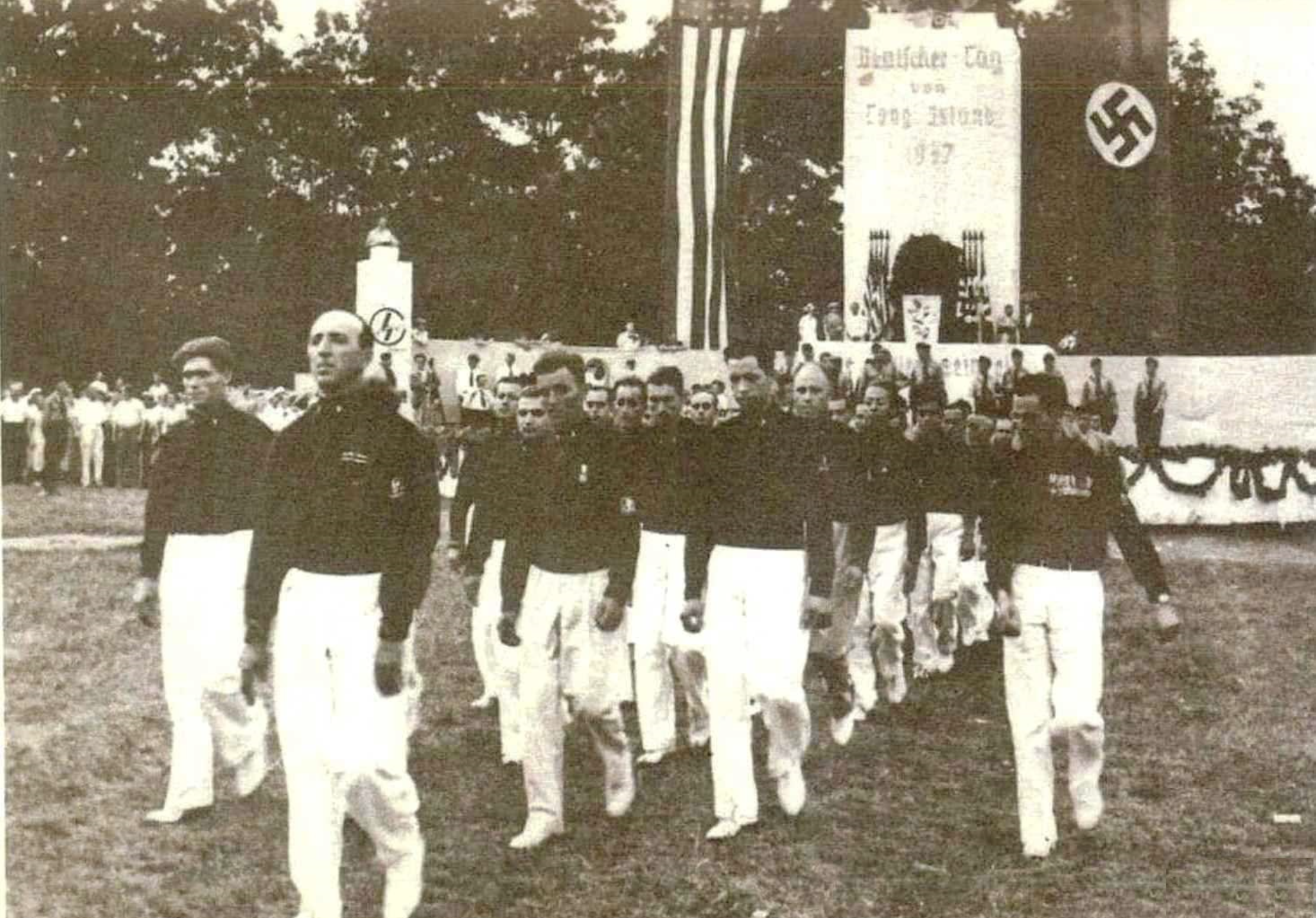
American Nazis existed, and they had grown louder and more unashamed as the crimes of the Nazis in Europe unfolded in the late 1930s. You can see a good documentary of the American Nazis (the “German American Bund” as they called themselves) of that time at PBS: Nazi Town, USA. The town of Yaphank, New York, on Long Island, was one of their strongholds, and Nazi youth camps, called “Camp Siegfried”, operated in five states. This is a photo from the Camp Siegfried in Yaphank:

American Nazis were a minority of the population. But German Nazis were, too, yet they were able to take over their government and country. If the U.S. expanded the federal government and stripped state and local governments of some of their power in order to mobilize for the war, and passed acts to eviscerate freedom of speech, this would open the door to American Nazis. Even if the U.S. won the war against fascism abroad, it would lose the war to fascism at home.

And if the U.S. won the war at a moment when it had its troops all over the globe, would it be willing to withdraw those troops? or would it seize the opportunity to expand its own empire?

And if the U.S. won the war, would it really return industry back to private, commercial manufacture? Or would the federal government continue to massively fund the military, in the name of preventing another war, but in reality to protect the new lands it now controlled?

And if the U.S. won the war, would it really restore full civil rights to its citizens? or would it continue to curb them in order to squash protest against the imperial expansion and the military spending?

“The primary consequence [of a U.S. victory] would be ‘an American… imperialism which would perpetuate armaments, and for which Fascism at home in this generation must be the inevitable accompaniment,” Norman warned. As Mark sums it up, for Norman Thomas and the Socialists, “War was, in every possible scenario, a no-win proposition.” (273-4)

Their argument was overshadowed at the time, and easy to dismiss in the years immediately after the war, when the U.S. seemed to indeed reverse all its wartime emergencies and return to normal. But the key word there is seemed. The American Nazis officially disbanded, and the Nazi youth camps shut down. Industry returned to commercial production and spawned the boom of consumerism that made the 1950s and 60s a high-water mark of personal and household purchasing. The Civil Rights movement was revived in the 1950s and won huge gains in the 1960s, including desegregation and voting rights.

But this is not the whole story. Those American Nazis closed their camps, but they didn’t go away. They lived on to pass down their hatred to their next generation, to wave Confederate flags at lynchings, and threaten, torture, and kill Civil Rights activists. Industry created out-of-control consumerism but not at the expense of military production. Military production continued apace with the excuse of the Cold War. The U.S. went into permanent wartime military spending, and military spending is still by far the largest slice of the federal budget pie to this day.

In 1961, outgoing president Dwight Eisenhower warned Americans that all was not well. In his farewell address he coined the phrase “the military-industrial complex”:

A vital element in keeping the peace is our military establishment. Our arms must be might, ready for instant action, so that no potential aggressor may be tempted to risk his own destruction. . . . American makers of plowshares could, with time and as required, make swords as well. But now we can no longer risk emergency improvisation of national defense; we have been compelled to create a permanent armaments industry of vast proportions. . . . This conjunction of an immense military establishment and a large arms industry is new in the American experience. . . .Yet we must not fail to comprehend its grave implications. . . . In the councils of government, we must guard against the acquisition of unwarranted influence, whether sought or unsought, by the military-industrial complex. The potential for the disastrous rise of misplaced power exists and will persist.

Dwight Eisenhower was proven to be as prescient in 1961 as Norman Thomas had been twenty years earlier in 1941. The U.S. government and military have been involved in other nations’ governments since the war, carrying out crimes and terrorism when needed to meet U.S. interests. Our military power was impossible to walk away from, especially with the Cold War providing a constant justification for imperialism in the name of promoting democracy. The influence of unchecked military and industrial spending is seen in the very innovation that drove consumerism from the start–constant new inventions, new technology, from microwave ovens to computers to the Internet to cell phones. Many commercial products have their origin in military experimentation. More dangerously, the invisibility of the people who control our destiny that began with the top-secret Manhattan Project that created atomic bombs continues, as a small group of people, mostly white men, develop AI without any guardrails or intervention, oversight, or control from outside.

Finally, all the money that the military-industrial complex generates has corrupted our government at every level, as lobbyists, kickbacks, and insider trading demonstrate over and over.

America still struggles to achieve full democracy, but it is, in the end, an always-difficult fight that has indeed been made much more difficult by our victory in World War II. This is not to say we should not have entered the war. Of course we had to, and should have done it sooner.

What it is to say is that American democracy would be in much better shape if Americans had cared to intervene in European and Asian politics in the 1920s, after the first world war had enriched America and devastated many European nations as well as Japan. Rather than accept that wealth as deserved, the U.S. could have used it to level the playing field, support democracy at home and abroad, and used the Paris Peace Conference to really change the status quo, rather than consolidate its own gains. Then there may not have been a WWII to consider entering into.

Such “what if” history is usually frowned upon, but it’s worth considering. It’s no more wishful thinking than the idea that America really did emerge from the total war effort unscathed.

Let us stay home: WWII and wishful thinking, part 2

Hello and welcome to part 2 of our short series on Radio and the Great Debate over U.S. Involvement in World War II, by Mark S. Byrnes. As we said in part 1, Mark painstakingly documents the many Americans who made their cases for the intervention and anti-intervention sides of the argument between September 1939 and December 6, 1941, when the Japanese attack on the U.S. Navy at Pearl Harbor, Hawaii settled the question.

His main focus is disproving the established anti-interventionist (“isolationist”) claim that the interventionists got special treatment–more time on the air, and support from a Democratic-controlled Congress that did whatever the popular and clearly interventionist Democratic president, Franklin Roosevelt, said to do. Both sides got equal time, and both sides made points that resonated with Americans.

In part 1 we covered the first argument in the anti-interventionist side of the debate: the wishful thinking Americans engaged in that the war could be won without them. Now in part 2, we look at the second, even more alarming argument against going to war: that the U.S. could manage living in a world where fascism had conquered Europe and Asia.

We should make up our minds that we probably have to live in a world with Stalin, Mussolini, and Hitler… Let us not undertake to police the world. Let us come home and stay home.

–Senator Arthur Capper (R-KS), “Let Us Keep Out of Foreign Wars,” February 7, 1941 radio address

By February 1941, the U.S. was sending weapons and ships to Great Britain under the Lend-Lease Act. As Mark says, “the logic of the argument behind Lend-Lease was that a German victory was unacceptable and that the U.S. should act to prevent that outcome.” And, as we said in part 1, most Americans agreed that the U.S. must act, and approved Lend-Lease. But the anti-interventionist side knew well that many of those Americans only wanted to act short of sending soldiers and nurses and other personnel to the battlefields in Europe, Asia, and Africa. “Acting” could not extend that far–to declaring war. The U.S. should fund Great Britain’s soldiers, not send its own.

All the same, even those Americans felt less and less sure that this was really possible. With the fascists advancing on every front, it seemed like they might well win the war. Then how could the U.S. be safe?

The anti-interventionsts attacked this in two ways: first, they pressed the idea that the U.S. couldn’t begin to fight for democracy and justice abroad until it had completely offered it at home. Tell “the sharecroppers, the Oakies, the Negroes, the slumdwellers, downtrodden and oppressed for gain” that America had the right to send soldiers to fight abroad for democracy, said Robert Hutchins, president of the University of Chicago, in a radio address on January 23, 1941. “If we would change the face of the earth, we must first change our own hearts.” [133]

True enough… sort of… but what’s the timeframe on that? How long would changing Americans’ own hearts take? And couldn’t a powerful nation like the U.S. do both at once? Perhaps fighting overseas for democracy would have an important impact on American domestic policy. Waiting until you are perfect to act in the name of justice is a formula–or, to be more blunt, an excuse–for never acting, at home OR abroad. It’s a recipe for maintaining the status quo.

Former president Theodore Roosevelt’s son Theodore made a variation on this theme in a speech on February 16, 1941, saying that Americans “can serve our people and the world best by keeping alive in this country free democracy…” [137] Those are the key words: alive in this country. As long as America is free and democratic, the idea goes, we’re safe and will never change, so really, what do we have to worry about? Europe is a permanent mess, the argument went–they just had one devastating war and now they’re in another. No one can help them until they help themselves. And Asia was never democratic, and never will be, they continued. Needless to say, most American commentators never even mentioned Africa. The only place where the U.S. can assure democracy is the U.S., the anti-interventionists began to say. And that’s all we really need. We don’t need the rest of the world to be democratic.

As Mark puts it, “Well-meaning Americans, understandably fearful of fighting yet another world war, were being lulled into a false sense of security by demagogues who assured them that America and its democratic values could somehow not only survive but even prosper in an Axis-controlled world.” [187]

On January 9, 1941, the radio debate “Is a Hitler Defeat Essential to the United States?” was held between Dean Acheson (interventionist) and Verne Marshall (anti-interventionist). Yes, you saw that title correctly.

“The time has come to decide once and for all if it is essential to us that Hitler be defeated” was the statement of the Problem. Here are the Three Questions to be debated:

  1. Could we cooperate peacefully with a victorious Hitler?
  2. Would there be immediate danger of Hitler successfully attacking us?
  3. Would his victory give so much encouragement to totalitarian forces abroad and at home as to make them dangerous? [244]

The debate was hardly carried out, as Verne was immediately and consistently booed and shouted over by the live studio audience. But we don’t really need to hear the debate to choke over the Problem and the Questions, which basically have the premise that as long as the U.S. is not invaded, and can still make money through global trade, what does it matter who runs what other nation? As long as we’re okay politically and economically, let the chips fall. Hitler, after all, would probably be open to trade with the U.S. to recover from the war; why alienate a potential market?

It’s shocking to know this argument was presented by Americans to Americans. This argument was not about justice or weighing the value of lives lost. It was about making money at all costs, and claiming that democracy would be unharmed in a nation that made friends with fascism. Notice the language in Question 3–that a Hitler victory would encourage totalitarians at home as well as abroad. Those Americans who supported Hitler, or disliked even the half-way democracy in America that allowed black people to vote and ended slavery, would naturally strengthen and grow if the U.S. partnered with fascists. There is no democracy at home for a nation that won’t fight for democracy abroad. Refusing to fight to support democracy abroad means you don’t really care about fighting for democracy at home.

Next time: the final argument against intervention

WWII and wishful thinking, part 1

We’ve just finished reading a very interesting book: Radio and the Great Debate over U.S. Involvement in World War II, by Mark S. Byrnes. He painstakingly documents the many speakers who made their cases for the intervention and anti-intervention sides of the argument between September 1939 and December 6, 1941, when the Japanese attack on the U.S. Navy at Pearl Harbor, Hawaii settled the question.

His main focus is disproving the established anti-interventionist (“isolationist”) claim that the interventionists got special treatment–more time on the air, support from a Democratic-controlled Congress that did whatever the popular and clearly interventionist Democratic president, Franklin Roosevelt, said to do. Both sides got equal time, and both sides made points that resonated with Americans.

What’s fascinating to us is a twofold undercurrent Mark presents, at first almost as a footnote, but with growing emphasis as the book goes on:

  • The wishful thinking Americans engaged in that the war could be won without them–or, much more alarmingly, the message they were sent by the anti-interventionists that America could manage living in a world where fascism had conquered Europe and Asia
  • The prescient warning some anti-interventionists gave that even a U.S.-aided victory over fascism could lead to unintended, irreversible degradation of democracy here at home.

We’ll cover the first in parts 1 and 2, and the second in part 3.

The majority of Americans supported sending arms and planes to Great Britain to help it in their fight against Nazi invasion. They were repulsed by fascism and knew it posed a threat not just to Britain, or Europe, but to America and the whole world. And yet… in polls, many Americans consistently said things like this:

“I detest Hitler and everything he stands for, as I’m sure the vast majority of Americans must do. My sympathies are all with England in this struggle. But that doesn’t mean for one moment that I think we should involve ourselves in a war to destroy Nazism.” [p. 115]

As Mark summarizes the argument, “The evil nature of the Nazis did not mean it was America’s responsibility to right that wrong.” A year before America entered the war, in December 1940, 88% of Americans wanted to stay out of the war, and that number most likely included many or most the 60% of Americans who wanted to send arms and materiél–everything short of U.S. soldiers–to Britain. Even most of the Americans who said Britain’s survival was essential to America did not want to join the fighting. [p. 131] In May 1941, Alan Barth, assistant to Treasury Secretary Henry Morgenthau, said the nation was suffering “a form of schizophrenia”; as Mark puts it, “Even if most Americans believed Hitler must be defeated and that he almost certainly would not be without an American declaration of war, they would not support one until it was absolutely clear it was necessary.” [p. 256]

So American entry into the war was necessary to defeating Hitler, but Americans wouldn’t support entering the war until it was necessary. This reminds us of the Dred Scott Supreme Court decision that said slavery might well be unconstitutional, and the Court had the power to overrule slavery on that basis, but as we say in our post, it refused to do so because “the Constitution can be changed, but until it is changed, it must be obeyed (‘it must be construed now as it was at the time of its adoption’). So yes, you can change the Constitution if you deem it unjust, but until you change it you can’t change it. And they’re not going to change it… because it hasn’t been changed yet.”

Wishful thinking at this moment, and this scale, is at once astonishing and frightening. By 1939 Americans had watched fascism engulf most of two continents and begin on a third. Yet so many of them willed themselves to believe that somehow that would all change without a major U.S. commitment. It’s easy to try to defend this by focusing on the understandable fear of sending young people to war and losing them. But it’s important to be honest and say that Americans were at least equally afraid, and perhaps even more afraid, of the economic disruption of war. The Great Depression seemed to be in the rear view as recovery continued. Things were getting back to normal. Why throw that all away by going to war? War meant shortages at home, high prices, and rationing. And, as we’ll discuss in part 2, there were many voices telling Americans that a Nazi victory wouldn’t be a bad thing for the U.S. economically.

We tend to learn about anti-interventionists as “isolationists” who knew about the Holocaust and still didn’t want to fight Hitler. This is not accurate. The main anti-interventionist argument was empahtically not “who cares about human rights? who cares about the Holocaust?” It was “we will fight when we know it’s the absolute last resort to save democracy in the world.” The message was “it’s not America’s job to fight for democracy anywhere but here at home.” Therefore, Americans could and should root for democracy in Europe from the sidelines.

This wasn’t just foolish, it was selfish. People committed to democracy and liberty and justice for all cannot ever sit back and hope someone else will do the fighting that’s always required to maintain those principles, practices, and governments in the world. If you really value them, you will always fight for them, in whatever way is necessary.

Next time: the shocking “would a fascist victory really be so bad?” message

Truth v. Myth: the U.S. president can break the law

Myth: the president has immunity from criminal or civil lawsuits for actions he carried out while he is in office

Truth: the president has immunity from criminal or civil lawsuits for actions he took to ensure the enforcement of recognized laws

Let’s nutshell this: former U.S. president Donald Trump is the focus of many different lawsuits. Some accuse him of financial fraud, some of sexual assault, falsifying records to cover up bribery, removing official documents from the White House to his private home in Florida and concealing that fact, election subversion and racketeering, and for provoking a mob of criminals to attack the U.S. Capitol building, where the U.S. Congress meets, on January 6, 2021, with the purpose of using violence against members of Congress to stop the certification of the 2020 presidential election that removed Trump from office–in other words, treason and insurrection.

All of the suits are grave. The suits about trying to overturn legal election results, by provoking an insurrection and by demanding that the Secretary of State for the state of Georgia demanding that he lie about the results and say Trump won, are the most serious. (“All I want to do is this: I just want to find 11,780 votes, which is one more than we have… Fellas, I need 11,000 votes, give me a break.”)

Trump and his lawyers have claimed that as president, he has “absolute immunity” from any and all criminal prosecution, both in and out of office: “Trump’s lawyers contended earlier this month that he simply can’t be prosecuted for efforts to overturn that election because they related to his official responsibility as president to safeguard federal elections.”

Unfortunately at this critical moment, Americans have sidetracked into discussions about whether U.S. legal precedent supports or conflicts with the claim that a U.S. president is immune from criminal prosecution instead of focusing on the actual threat: Trump doesn’t want his illegal actions to be protected based on his role as president. He wants them protected based on the new idea that the president is allowed to commit crimes. A president (and by extension, anyone who works for him, or in the federal government, or state government, or local government) can do whatever they want because committing crimes is no longer illegal for them.

This isn’t immediately apparent, perhaps, but if we look at the legal precedent people are distracting themselves with we see it emerge very clearly.

Legitimate sources that try to answer the question “does the president have immunity from criminal and civil lawsuits?” usually begin with the 1867 case Mississippi v. Johnson. This case involved the state of Mississippi suing President Johnson in an attempt to forbid him from enforcing the Reconstruction Acts that were meant to protect the newly granted civil rights of black Americans who had been enslaved. The Supreme Court refused to allow this, not because its members supported civil rights–the complete opposite is true–but because it upheld the immunity of a president from “judicial process” related to carrying out the law of the land: “Very different is the duty of the President in the exercise of the power to see that the laws are faithfully executed, and among these laws the acts named in the bill…”

Notice that important language: the president cannot be prevented from ensuring that “laws are faithfully executed.” If you have a problem with the law of the land, you have to challenge the constitutionality of that law in court. You can’t challenge the power of the president to enforce the law. Those are two very different things: laws can be challenge; the role of the president cannot. Americans who challenged slavery before the Civil War didn’t sue the men who were president to get them to stop upholding laws that permitted slavery. They challenged those laws in the courts.

Most sources also mention United States v Burr, an 1807 case where the Court ruled that President Jefferson could be required to testify in the treason trial of Aaron Burr, who was his vice-president from 1801-1805. As Constitution Annotated puts it, “Chief Justice Marshall recognized that while the President could be subject to a criminal subpoena, the President could still withhold information from disclosure based on executive privilege. In the two centuries since the Burr trial, the Executive Branch’s practices and Supreme Court rulings unequivocally and emphatically endorsed Chief Justice Marshall’s position that the President was subject to federal criminal process.”

Next, United States v. Nixon, the 1974 case where the Court similarly ruled that President Nixon could be required to testify if subpoenaed in the criminal case against him and members of his staff. “The President’s counsel had argued the President was immune to judicial process, claiming “that the independence of the Executive Branch within its own sphere… insulates a President from a judicial subpoena in an ongoing criminal prosecution, and thereby protects confidential Presidential communications.” However, the Court held, “neither the doctrine of separation of powers, nor the need for confidentiality of high-level communications, without more, can sustain an absolute, unqualified Presidential privilege of immunity from judicial process under all circumstances.” The primary constitutional duty of the courts to do justice in criminal prosecutions was a critical counterbalance to the claim of presidential immunity, and to accept the President’s argument would disturb the separation-of-powers function of achieving “a workable government” as well as “gravely impair the role of the courts under Art. III.”

Finally, the Court upheld that ruling in the 1997 case Clinton v. Jones when it denied President Clinton’s motion to dismiss the sexual harassment charges filed against him by Paula Jones on the grounds of presidential immunity. As FindLaw puts it: “The Court held that its precedents affording the President immunity from suit for his official conduct – primarily on the basis that he should be enabled to perform his duties effectively without fear that a particular decision might give rise to personal liability—were inapplicable in this kind of case. Moreover, the separation-of-powers doctrine did not require a stay of all private actions against the President. Separation of powers is preserved by guarding against the encroachment or aggrandizement of one of the coequal branches of the government at the expense of another. However, a federal trial court tending to a civil suit in which the President is a party performs only its judicial function, not a function of another branch. No decision by a trial court could curtail the scope of the President’s powers.

Again, the key here is that a president must be allowed to “perform their duties”–that is, ensuring that laws are enforced. That’s what the president has the power to do. No president can be punished for performing their duty of ensuring that existing laws are carried out. But any and every president can and must be punished for breaking the law.

These Supreme Court rulings and the precedent they set are being examined and argued by legal experts and pundits and just about everyone else. The question is always, will these rulings be upheld by the current Supreme Court, packed as it is with members who have already made it clear that they have an agenda to overturn every ruling that supports civil rights in this country?

But that isn’t the right question, because again, that’s not the claim Trump and team are making. They are not claiming that Trump did nothing illegal. They are claiming that it’s okay that he did. They are claiming that the president can commit crimes–acts that are clearly illegal for everyone else–without consequence. Most recently, Trump lawyer John Sauer told the D.C. Circuit Court of Appeals that “a president directing SEAL Team Six to kill a political opponent would be an action barred from prosecution given a former executive’s broad immunity to criminal prosecution”. 

Former president Donald Trump’s lawyer argued that presidential immunity would cover the U.S. president ordering political rivals to be assassinated by SEAL Team Six.

During a hearing at a federal appeals court on Tuesday, Trump’s lead lawyer John Sauer made a sweeping argument for executive immunity, essentially saying that only a president who has been impeached and removed from office by Congress could be criminally prosecuted. Therefore, Sauer argued, the former president should be shielded from criminal prosecution.

One of the judges asked Sauer: “Could a president who ordered SEAL Team 6 to assassinate a political rival, and is not impeached, would he be subject to criminal prosecution?”

Sauer responded: “If he were impeached and convicted first… there is a political process that would have to occur.”

The argument here is: if the president breaks the law, he can’t be prosecuted for it because the president is allowed to commit crimes.

Crucially, the argument is not if the president is ensuring that laws are enforced, he can’t be prevented from doing so.

That’s what’s at stake here. That’s what is really being argued, somehow, in this country. It’s no surprise. Almost exactly 8 years ago, when he was a presidential candidate, Trump said “I could stand in the middle of Fifth Avenue and shoot somebody, and I wouldn’t lose any voters, OK?” And somehow this did not immediately disqualify him in the eyes of his supporters and people who were undecided. Somehow this didn’t end his campaign. He became president, broke the law repeatedly, tried to overthrow the government when he lost the election… and still we actually sit and debate whether he should be tried for breaking the law. For treason. For insurrection. For election subversion.

In these dark times, there is little hope that Trump will not prevail. And it’s not just about him–so many, many people seem so very eager to follow in his footsteps and go even farther into dictatorship. But that doesn’t mean we shouldn’t do all we can, wherever we are, to fight for the rule of law, the legal process, and the president being subject to the law. It’s a fight that is only going to require more and more of our energy going forward. American democracy has always been deeply flawed and incomplete, but its trajectory has always been toward the expansion of civil rights despite the dogged, unrelenting, hate-filled attempts of the undemocratic to stop it. The forces for that reversal are enjoying a heyday right now, but the fight is not over. Myth can’t be allowed to become truth–not on our collective watch.

Housekeeping: The City Upon a Hill by John Winthrop

Happy New Year 2024! let’s hope.

Now you know that we’re serious here at the HP about updating old posts with new information. As we noted when we updated The First Thanksgiving, we’re always learning and growing right along with you:

Yes, we strive to be accurate in our posts, but they only reflect the extent of our knowledge at the time of posting. We realize now, many years in, that some of our content is now badly outdated and even inaccurate–and, importantly, that it was inaccurate at the time of writing, because our own knowledge was incomplete.

So in short, we have to myth-bust ourselves as well as everyone else, and today we’re looking at our much-traveled post on “The City Upon a Hill”, which you’ll find at the top of the site as its own page, such is its popularity with people searching for information on this by-now familiar phrase. Now that we’ve posted this update on the main page, we’ll correct the dedicated page as well.

Again, we’ll do as we always do when close-reading a text: our comments follow the original text, indented and set off by a long dash.


The “City upon a Hill” section of the sermon called “A Model of Christian Charity” was written in 1630 by the Puritan leader John Winthrop while the first group of Puritan emigrants was still onboard their ship, the Arbella, waiting to disembark and create their first settlement in what would become New England. The “City” section of this sermon was pulled out by later readers as a crystallization of the Puritan mission in the New World.

–Oh it’s very embarrassing to find such an error right at the start. The “Model” was not a sermon. Because Winthrop was not a minister. It was what he would have called a “lay sermon” or “lay exhortation”: a religious meditation written by a layperson (not clergy) and shared with others informally. The Puritans encouraged each other to share their spiritual seeking and reflections for their mutual benefit. They did this with friends, their families, small groups gathered to discuss a recent sermon and, sometimes, during worship services. If there was no minister to tend a congregation, respected laymen might speak informally to the people who gathered on the sabbath. This was not a sermon, because the laymen could not take the place of a minister ordained by God. Only an ordained minister could administer communion and baptize people (the only two sacraments the Puritans observed). But a layman (yes, always a man) could get up in front of a group of people gathered to worship and speak to them until the were able to hire a minister. This was what they called “exhorting” or “exhortation”.

So the “Model” was a lay exhortation written by John Winthrop. Which makes sense–he was deeply respected for his spirituality. But everything else we are taught about the “Model” and its “City” section is very wrong.

Cut to Daniel T. Rodgers’ amazing book: As a City on a Hill: The Story of America’s Most Famous Lay Sermon”, which we read avidly here at the HP. He tells the story better than we can here, but let’s hit the main points (all on page 4):

  • “None of those who voyaged with John Winthrop to the Puritan settlement in New England left any record that they heard Winthrop’s words…”
  • “Most likely ‘A Model of Christian Charity’ was never delivered as a sermon at all.”
  • “Although copies… circulated in England during his lifetime, by the end of the 17th century they had all literally vanished from memory.”

One copy was found in 1809, but not printed until 1838. It promptly disappeared again, and it wasn’t until the 1980s that it fell into the spotlight, through the efforts of two very different people: politician Ronald Reagan (but really his speechwriters) and the literary scholar Sacvan Bercovitch. Each side resuscitated the lay sermon with very different purposes. If you want to know why Reagan’s side won out with its COMPLETELY mythical reading of John Winthrop’s work… get Rodgers’ amazing book.

For now, we move on to the rest of our post, which thankfully requires no further heavy-lifting. You can scroll down to the very last paragraph for our final change.

Of course, as with any topic touching on the Puritans, there’s some myth-busting to be done. By now, the “City upon a Hill” excerpt has come to represent irritating Puritan pridefulness—they thought they were perfect, a city on a hill that everyone else would admire and want to emulate. In reality, the excerpt is far from a back-patting exercise. It is a gauntlet laid down to the already weary would-be settlers. Let’s go through it:

Now the only way to avoid this shipwreck and to provide for our posterity is to follow the Counsel of Micah, to do Justly, to love mercy, to walk humbly with our God:

The “shipwreck” Winthrop refers to is the wrath of God that falls on peoples or nations who fail to do God’s will. Earlier in the sermon, Winthrop has been at once warning the people that they must not fail in their efforts to set up a godly state in the new World and reassuring them that this does not mean they can never make a mistake. God is with them, and will suffer small failings. But if, like the government and church of England, the Puritans forsake their mission to create a truly godly society, they will suffer the wrath of God. This is the shipwreck to be avoided.

…for this end, we must be knit together in this work as one man, we must entertain each other in brotherly Affection, we must be willing to abridge our selves of our superfluities, for the supply of others necessities, we must uphold a familiar Commerce together in all meekness, gentleness, patience and liberality, we must delight in eache other, make others Conditions our own, rejoice together, mourn together, labour, and suffer together, always having before our eyes our Commission and Community in the work, our Community as members of the same body, so shall we keep the unity of the spirit in the bond of peace, the Lord will be our God and delight to dwell among us, as his own people and will command a blessing upon us in all our ways…

This is a beautiful passage, reminiscent of the Sermon on the Mount in its focus on mercy, kindness, sharing, and other selfless qualities. The Puritans will not succeed by harrying out the sinner or otherwise smiting evil, but by loving each other, caring for each other, and “abridging our selves of our superfluities, for the supply of others necessities” (that is, there will be equality of wealth, with no one living in luxury while others starve). They will delight in each other,  making others’ conditions their own, and they will do all this to create a natural community of faith. The point here is that religious faith will not be mandated or policed or forced on anyone. It will be generated naturally by the hope and love and faith of the people themselves. It will be an effect, not a cause. The Quakers would try to live out this same philosophy decades later.

…so that we shall see much more of his wisdom power goodness and truth than formerly we have been acquainted with:

And how. That’s an understatement. The projected society would be almost unequalled anywhere in the known world.

…we shall find that the God of Israel is among us, when ten of us shall be able to resist a thousand of our enemies, when he shall make us a praise and glory, that men shall say of succeeding plantations: the lord make it like that of New England:

Here comes the crux of the excerpt. Why will later settlers hope their societies will be like New England? Because of the love and comradeship, care and goodwill in New England. Notice that so far Winthrop has been urging his people to be caring and loving and selfless. He isn’t saying they already are all those things. He isn’t boasting about a pre-existing condition. He is urging them to become caring and loving and selfless, in the name of their godly mission, so that they will truly succeed. If—and it’s a big if—they succeed in becoming all those good things, their society will be admired. It’s not really that the Puritans will be admired so much as their society will be admired. There’s no self in this for Winthrop; it’s all about serving God as a society, and not about individuals becoming famous for their virtue. To him, there’s a difference. Fame may come as a result of serving God, but it’s the serving of God that matters.

…for we must Consider that we shall be as a City upon a Hill, the eyes of all people are upon us; so that if we shall deal falsely with our God in this work we have undertaken and so cause him to withdraw his present help from us, we shall be made a story and a byword through the world, we shall open the mouths of enemies to speak evil of the way of God and all professors for God’s sake; we shall shame the faces of many of God’s worthy servants, and cause their prayers to be turned into Curses upon us till we be consumed out of the good land whether wee are going:

First, we see what “city on a hill” really means: it doesn’t mean perfect, it means visible. They will be under a microscope, unable to hide their failures from all the eyes trained on them. No one wants to live in a city on a hill, because all of your faults and failings are in plain view.

Second, Winthrop wasn’t just speculating. This fate of becoming a byword for failure had already befallen every English colony in North America by 1630. Roanoake had disappeared, and Jamestown was so well-known in England for the horrors its unprepared settlers suffered that by the time the Puritans sailed their main goal was to avoid Jamestown’s very well-publicized failures. Among the many reasons the Puritans did not want to settle in Virginia was to avoid contamination with Jamestown’s perpetual bad luck (which the Puritans put down in large part to the colony’s lack of a commission from God). Even Plimoth Plantation, founded by Separatists just 10 years earlier, wasn’t exactly thriving. The Puritans settled far from the Pilgrims. So there was evidence, to Winthrop, that God had already withdrawn his support from all previous English settlements. The stakes were high.

…And to shut up this discourse with that exhortation of Moses, that faithful servant of the Lord in his last farewell to Israel [in] Deut. 30. Beloved there is now set before us life, and good, death and evil in that we are Commanded this day to love the Lord our God, and to love one another, to walk in his ways and to keep his Commandements and his Ordinance, and his laws, and the Articles of our Covenant with him that we may live and be multiplied, and that the Lord our God may bless us in the land whither we go to possess it:

In closing (“to shut up this discourse”), Winthrop dramatically positions his group on the very edge of life and death, good and evil; they have never been more free to choose which way they will go. It’s all up for grabs. If Winthrop was sure that it would be easy for the Puritan to make the right choice, because they were so much better than everyone else in the world, he wouldn’t have hammered this point home. He wouldn’t have had to show them how high the stakes were, and he wouldn’t have supposed there was even a choice to be made. Since he was a realist, albeit a compassionate one, Winthrop reiterated the fact that the Puritans too, like everyone else, had to choose good over evil.

… But if our hearts shall turn away so that we will not obey, but shall be seduced and worship other Gods, our pleasures, and profits, and serve them, it is propounded unto us this day, we shall surely perish out of the good Land whither we pass over this vast Sea to possess it:

Again, high stakes. The important thing to note here is what Winthrop considers to be the threat: “our pleasures and profits”. Colonies were founded to make money. Everyone knew that. And even the Puritans would have to repay their investors. They were business people, many of them London merchants, and they would set about creating industry in New England. They were also normal people who loved dancing, music, alcohol, sex, and love, and they would enjoy all those things in their new land. Being a Puritan was not about denial. It was about balance. Enjoy without attachment, enjoy without letting pleasure become your master—this was the Puritan ideal (it’s also very Buddhist—see The Bhagavad Gita).

Therefore let us choose life, that we, and our Seed, may live; by obeying his voice, and cleaving to him, for he is our life, and our prosperity:

Let us choose life: it’s a very positive, very idealistic, beatific closing to the excerpt and the sermon. Winthrop even wrote it out in verse (I didn’t do that here for space reasons). Choose life that we may live, choose God for God is life. This sermon must have truly inspired the Puritans who heard it, in part because it did not confirm their virtue but challenged it. It is an exhortation to do better than they normally would, to try harder, to aim higher. It is not a smug confirmation that they are the best people in the world and that whatever they do will be better than what anyone else does. It is a call to virtue and effort, love and compassion, sharing and helping that does Winthrop and his group credit. In that sense, it is the first of many other great American calls to idealism and justice, including the Declaration of Independence, the Constitution, and the Emancipation Proclamation.

–As we said above, there were likely no “Puritans who heard it” since we have no evidence that John ever delivered this lay sermon/exhortation to anyone. There were 11 ships in what we now call “the Winthrop fleet” that brought Puritans from England in 1630, so there was no way that everyone could have heard it even if John had delivered it during the voyage. It seems clear he wrote it to be published in England, then distributed there and in what he called New England. This was the standard practice for publications by Puritans in New England until a printing press was established in the colonies.

But knowing John, we feel pretty confident in saying that the message to be better people was one he likely delivered many, many times over, to groups large and small, as a matter of course rather than one emotional, dramatic set-piece speech. If only they–and he, for that matter–could have lived up to the call to put personal financial gain aside for the commonwealth. We’d be living in a very different, and much better, world today. As usual, it’s up to us to do what they did not, and take our future into our own hands.

Christmas in colonial New England–or not

Re-running our Christmas Classic this year. Enjoy the holiday break!


In December we think of Christmas and the ever-evolving forms of celebration of that holiday in America. And being the HP, we think of the very long period over which Christmas was not celebrated in Woodland New England.

The Separatist Pilgrims and the Puritans, the two English groups who settled what is now New England, did not celebrate Christmas because they did not celebrate any holidays, because they believed that every day was given by God, and so every day was holy. It was humans who picked and chose certain days to be better than the rest, thus impugning God’s holy creation by identifying some days as unimportant and boring. Holidays were the creation of humans, not God, and an insult to God in more ways than one: not only was the creation of holidays a disparagement of other days, but the usual form of celebrating holidays in England involved raucous immorality. There were few silent nights during religious holidays in Europe. They were times of drunkenness, gaming, gambling, dancing, and licentiousness, and as a major Christian holiday, Christmas involved high levels of all these things—let’s just say there were a lot of babies born the next September. “Men dishonor Christ more in the 12 days of Christmas,” wrote the reformist Bishop of Worcester Hugh Latimer in the mid-1500s, “than in all the 12 months besides.”

While they lived in England, the Pilgrims and the Puritans withdrew from Christmas celebrations, conspicuous by their absence from the debauched partying in the streets. When they removed to America, both groups took great pleasure in putting an end to the observance of holidays, Christmas in particular. Both groups observed many special days, either of thanksgiving or fasting. When something particularly good happened, a thanksgiving was held. This involved a church service and then gatherings at home or in groups (see Truth v. Myth: The First Thanksgiving for more). When danger threatened, or something bad happened, a fast was held. This involved a day of church services preceded by fasting, which meant not eating and even refraining from sex the night before. (Puritans knew that nothing humbled people like hunger and celibacy.) No other special days were observed.

So December 25 was just like any other day for the Pilgrims and Puritans. If it was a Sunday, you’d go to church and perhaps hear a sermon that referenced Jesus’ birth. If it was a Tuesday, you got up and went to work as usual. In Plimoth, where the Separatist Pilgrims were outnumbered by unreformed Anglicans, Governor Bradford had a hard time stopping the Anglicans from celebrating Christmas. The Anglicans would not learn from the example of the Separatists, who were hard at work on Christmas day 1621. Here is Bradford’s good-humored account of a run-in he had with unreformed celebrants that day (he refers to himself in the third person here as “the Governor”):

“And herewith I shall end this year. Only I shall remember one passage more, rather of mirth than of weight. One the day called Christmas day, the Governor called them out to work, as was used. But the most of this new company excused themselves and said it went against their consciences to work on that day. So the Governor told them that if they made it matter of conscience, he would spare them till they were better informed; so he led away the rest and left them. But when they came home at noon from their work, he found them in the street at play, openly; some pitching the bar and some at stool-ball, and such like sports. So he went to them, and took away their implements, and told them that was against his conscience, that they should play and others work. If they made the keeping of [Christmas a] matter of devotion, let them keep [to] their houses, but there should be no gaming or revelling in the streets. Since which time nothing hath been attempted that way, at least openly.” [Of Plymouth Plantation, 107]

When the Puritan Massachusetts Bay Colony absorbed the Pilgrim Plimoth Colony into itself, and Massachusetts came under direct royal control in 1681 (losing its political independence), the Anglican governor assigned to the colony brought back Christmas celebrations. In 1686, when King James II created the Dominion of New England, composed of Massachusetts, Vermont, New Hampshire, Connecticut, Rhode Island, New York, and East and West Jersey, and designed specifically to destroy Puritan political independence and religious identity, the royal governor James chose, Edmund Andros, was bitterly resented by all his new subjects. When Andros went to church to celebrate Christmas in Boston in 1686 he needed an armed escort to protect him.

Now Christmas was associated with royal dictatorship and all the grief of the Dominion, and the people of New England and especially Massachusetts continued to boycott the holiday well into the 18th century. When the Revolutionary War began, Christmas boycotts rose in popularity as the day was again tied to royal control and tyranny. After the war, Congress met on Christmas Day, businesses were open, and while private celebrations were not uncommon, there was no official recognition of Christmas in New England. In fact, no state recognized Christmas as an official holiday until Alabama took the plunge in 1836. President Grant made it a federal holiday in 1870, and that was about the time that New England at last gave up the remnants of its ancient resistance. (Readers of Little Women, which Louisa May Alcott began to write in Concord, MA in 1868, will remember that while the Marches celebrate Christmas with gusto as well as reverence, Amy March is able to go to a store first thing Christmas morning to exchange a gift, revealing that Christmas was still a day of business in Massachusetts at that late date.)

It’s ironic, given this history, that the winter scenes created by Massachusetts-based lithographers Currier and Ives became the template for “a traditional New England Christmas” in the 1870s, complete with one-horse open sleighs and jingle bells. Sleigh rides, roasting chestnuts, spiced apple cider—all these Christmas traditions originated in New England, but they were not specific to Christmas when New Englanders enjoyed them in the 18th century. They were just part of winter. Even the “traditional” white Christmas relies on a cold northern winter, a defining characteristic of the region that no one in colonial times associated with the holiday.

Today, there are still branches of Protestantism that look down on “the observance of days”, and urge that all days be seen as equally holy and important. But Christmas is here to stay… for the foreseeable future, anyway.

Housekeeping: The First Thanksgiving

We’re introducing a new series here at the HP, this one devoted to correcting our own previous errors.

Yes, we strive to be accurate in our posts, but they only reflect the extent of our knowledge at the time of posting. We realize now, many years in, that some of our content is now badly outdated and even inaccurate–and, importantly, that it was inaccurate at the time of writing, because our own knowledge was incomplete.

Do we ignore this? Never! We fix it, and we’re starting with our very auncient post on “the first Thanksgiving”, which seriously needs revision. Our knowledge and appreciation of Indigenous history has grown by leaps and bounds in the past few years, and needs to inform this post.

We’re going to subject it to the same merciless close-reading we subject others to, with the original writing first, and our response after in bold.

And so, enjoy anew, or perhaps for the first time, our post on Truth and Myth and the First Thanksgiving


This is the time of year when people take a moment to wonder about the Pilgrims: why were they so cruel to the Indians? The Thanksgiving celebration is marred by this concern. There are many reasons why it shouldn’t be. First, Thanksgiving has only been a holiday since 1863. Second, it had nothing to do with the Pilgrims whatsoever.

–Wow, we can’t believe we wrote this. It’s technically correct, but so very technically that its correctness not only has no meaning but is actually harmful. Yes, Thanksgiving didn’t become an official holiday in the U.S. until 1863, and the Pilgrims did not celebrate it. But it is now so inextricably and obviously tied to the endless destruction of colonization that the Separatists we call Pilgrims were early agents of that it is a very appropriate, symbolic time to protest that destruction.

President Lincoln instituted this holiday during the Civil War to unite the U.S. in thanks for its blessings even in the midst of that terrible war. Here’s how he put it:

In the midst of a civil war of unequaled magnitude and severity, which has sometimes seemed to foreign States to invite and to provoke their aggression, peace has been preserved with all nations, order has been maintained, the laws have been respected and obeyed, and harmony has prevailed everywhere except in the theatre of military conflict; while that theatre has been greatly contracted by the advancing armies and navies of the Union.

—Britain and France have refused, in the end, to support the Confederacy, the U.S. itself is still intact and strong, and the U.S. Army and Navy are driving back the enemy.

Needful diversions of wealth and of strength from the fields of peaceful industry to the national defence, have not arrested the plough, the shuttle or the ship; the axe has enlarged the borders of our settlements, and the mines, as well of iron and coal as of the precious metals, have yielded even more abundantly than heretofore. Population has steadily increased, notwithstanding the waste that has been made in the camp, the siege and the battle-field; and the country, rejoicing in the consiousness of augmented strength and vigor, is permitted to expect continuance of years with large increase of freedom.

—The U.S. economy has not fallen apart for lack of slave-produced cotton, as the South had always predicted it would. Industry and agriculture are stronger than ever and the U.S. continues to expand.

–“Slave-produced”?? Again this is painful to see. We mean “cotton produced by the forced labor of enslaved people.”

No human counsel hath devised nor hath any mortal hand worked out these great things. They are the gracious gifts of the Most High God, who, while dealing with us in anger for our sins, hath nevertheless remembered mercy. It has seemed to me fit and proper that they should be solemnly, reverently and gratefully acknowledged as with one heart and one voice by the whole American People. I do therefore invite my fellow citizens in every part of the United States, and also those who are at sea and those who are sojourning in foreign lands, to set apart and observe the last Thursday of November next, as a day of Thanksgiving and Praise to our beneficent Father who dwelleth in the Heavens.

—God has punished the U.S. with this war for the sin of slavery, but is showing encouraging signs of his support for the U.S. war effort.

And I recommend to them that while offering up the ascriptions justly due to Him for such singular deliverances and blessings, they do also, with humble penitence for our national perverseness and disobedience, commend to His tender care all those who have become widows, orphans, mourners or sufferers in the lamentable civil strife in which we are unavoidably engaged, and fervently implore the interposition of the Almighty Hand to heal the wounds of the nation and to restore it as soon as may be consistent with the Divine purposes to the full enjoyment of peace, harmony, tranquillity and Union.

—While thanking God for his mercies to the U.S. so far, Americans should also offer up prayers asking for his care for all those who have lost someone in the war, and asking for his help in ending the war as quickly as possible.

So the First Thanksgiving in the U.S. was held in November 1863 and inaugurated for a good cause.

–Yes, but it very quickly lost all connection to ending slavery and became a celebration of the Pilgrims, so let’s deal with that real history.

The first lower-case “t” thanksgiving in what would become the U.S. was held in November 1621 and was merely the first of many, many days of thanksgiving observed by the Pilgrims and was not celebrated as an annual holiday at all. Let’s go back to the original article to learn the real story:

____

The First Thanksgiving: it’s a hallowed phrase that, like “Washington crossing the Delaware“, “Don’t fire until you see the whites of their eyes” or “Damn the torpedoes!”, does not bring up many solid facts. Unfortunately, “the first Thanksgiving” is usually either completely debunked, with people saying no such thing ever happened, or used as a weapon against the Pilgrims—i.e., they had a lovely Thanksgiving with the Indians and then killed them all.

The truth about the first Thanksgiving is that it did happen, in the fall of 1621. The Pilgrims had landed in what is now Massachusetts the previous November—a terrible time to begin a colony. Their provisions were low, and it was too late to plant anything. It is another myth that they landed so late because they got lost. They had intended to land south of Long Island, New York and settle in what is now New Jersey, where it was warmer, but their ship was almost destroyed in a dangerous reef area just south of Cape Cod, and the captain turned back. They then had to crawl the ship down the Cape, looking for a suitable place to land. Long story short, they ended up in what is now Plymouth.

Most Americans know how so many of those first settlers died from starvation and disease over the winter, and how it was only by raiding Wampanoag food caches that the colony survived at all. By the spring, there were not many colonists left to plant food, but they dragged themselves out to do so. They had good luck, and help from the Wampanoags, who showed them planting techniques—potentially just to keep the Pilgrims from raiding their winter stores again. By November 1621, a very good harvest was in, and Governor William Bradford called for a day of thanksgiving.

–The morally neutral tone of the two paragraphs above is dishonest. Any discussion of the Separatists has to begin with their decision to colonize, which in itself is morally problematic, to say the least. Feeling compassion for their suffering is natural, but it displaces compassion for the Indigenous people who helped them when they could have destroyed them, and in return were systematically displaced from the land they belonged to and subjected to a determined attempt to eradicate them, by death or being driven away, that continues to this day in the U.S.

The Pilgrims often had days of thanksgiving. In times of trouble, they had fasts, which were sacrifices given for God’s help. In celebration times, they had thanksgivings to thank God for helping them. So thanksgivings were a common part of Pilgrim life, and calling  for a thanksgiving to praise God for the harvest would not have been unusual, and would have been a day spent largely in church and at prayer.

So the men went out to shoot some “fowls” for the dinner, and perhaps they ran into some Wampanoags, or maybe a few Wampanoags were visting Plymouth, as they often did, and heard about the day of celebration. At any rate, here is the only—yes, the one and only—eyewitness description of what happened next:

Our harvest being gotten in, our governor sent four men on fowling, that so we might after a special manner rejoice together after we had gathered the fruit of our labors.  They four in one day killed as much fowl as, with a little help beside, served the company almost a week.  At which time, amongst other recreations, we exercised our arms, many of the Indians coming amongst us, and among the rest their greatest king Massasoit, with some ninety men, whom for three days we entertained and feasted, and they went out and killed five deer, which they brought to the plantation and bestowed on our governor, and upon the captain and others.  And although it be not always so plentiful as it was at this time with us, yet by the goodness of God, we are so far from want that we often wish you partakers of our plenty.

That’s Edward Winslow, writing about the thanksgiving in his journal of Pilgrim life called “Mourt’s Relation”, published in 1622. We see that Massasoit and 90 of his men arrived at some point, having heard about the feast, and the Pilgrims hosted them for three days, and had some rather traditional Anglican sport firing their guns. Certainly the Wampanoags had a right to feel they could join in, since it was their help that had led to the good harvest. A one-day thanksgiving turned into three days of feasting and games.

And that was it. People often wonder why there wasn’t another thanksgiving the next year. We have seen that thanksgivings were not annual events, but came randomly when the people felt they were needed as a response to current events, and the idea of celebrating the harvest every year didn’t make sense to the Pilgrims. They had only held a thanksgiving for the first good harvest because it was a life-saving change from the previous fall. Once they were on their feet, they expected good harvests, and didn’t have to celebrate them. It was also against their Separatist beliefs to celebrate annual holidays—like the Puritans, they did not celebrate any holidays, not even Christmas. Holidays were a human invention that made some days better than others when God had made all days equally holy. So to hold a regular, annual harvest thanksgiving was not their way. When things were going well, Separatists and Puritans had days of thanksgiving. When things were going badly, they had days of fasting. None of them were annual holidays or cause for feasting (of course fast days weren’t, but even thanksgivings were mostly spent in church, with no special meal).

That one-time harvest thanksgiving was indeed a happy event, shared in equally by Pilgrim and Wampanoag. If only that first thanksgiving–an impromptu, bi-cultural celebration–had set the tone for the rest of the interactions between the English colonizers and the Indigenous peoples of North America. Since it did not, we can only think happily of the Thanksgiving called for by President Lincoln, who made an annual Thanksgiving a holiday in 1863.

–A “happy event”? …sort of. “Shared in equally”? Not really. The Wampanoags were already becoming aware, that early on, of the English colonizers’ single-minded self-centeredness. They weren’t invited to this thanksgiving that they made possible. But they came anyway, in one of the many hundreds of thousands of attempts Indigenous people made, and still make, to invite reciprocal relationship and live together in peace and understanding. Just deciding not to think about this, and to focus on 1863, is a cop-out we can’t believe we suggested to you.

The hype around the Pilgrims’ first thanksgiving only began after 1863, when historians noted the tradition of impromptu thanksgivings in the 1600s and made an unwarranted and improper connection to the new holiday to make it seem less new and more traditionally American. Before then, their many days of thanksgiving and fasting were completely forgotten. The Pilgrims certainly weren’t the inspiration for the holiday we celebrate today—they were retroactively brought into that in the worst, most ironic way: after the Civil War, southerners resented Thanksgiving as a “Union” holiday celebrating U.S. victories in the war and so the focus was changed from fighting slavery to the Pilgrims… who supported slavery.

This year, spend Thanksgiving however you like, and share the truth about where the holiday really comes from—the depths of a terrible war fought for the greatest of causes. Let Thanksgiving inspire you to stand up for the founding principles of this nation and re-commit to upholding them in your own daily life of good times and bad.

–You can’t really do what we recommend in this final paragraph without joining in any local protest against colonization and the destruction of people, lands, and living things that takes place in your area on Thanksgiving. Join with Indigenous people if you can to acknowledge that upholding the principles of liberty and justice for all can’t begin without a 180 move away from the values of colonization. Enjoy Thanksgiving as a reminder that a different, constructive way to live together exists—one that prioritizes reciprocal relationship. It’s not too late to honor what the Wampanoags were trying to establish!